What if that persistent, musty smell in your bedroom isn’t just an “old house” odour, but a silent colony of black mould expanding unseen against your wardrobe? It is a common realization for many Sydney residents, especially given our city’s moderate to high mould risk throughout 2026. You likely feel a sense of urgency to act, yet you worry about damaging your expensive timber pieces or accidentally spreading toxic spores throughout your home. We understand that finding dark patches behind a bedhead or bookshelf is stressful and poses a real health concern for your children and pets.
You don’t have to tackle this alone or settle for temporary fixes. This guide provides a clear path for removing mould from behind furniture safely and effectively. We will explain why “dead air” zones create the perfect breeding ground in coastal climates and how professional-grade remediation strategies can restore your indoor air quality. You’ll also discover Sydney-specific prevention tips to ensure those musty smells don’t return when the next winter chill hits.
Key Takeaways
- Identify why Sydney’s unique coastal humidity and “dead air zones” make the space behind your furniture a primary target for hidden fungal growth.
- Discover why removing mould from behind furniture requires professional containment and HEPA air scrubbing to prevent toxic spores from spreading to your living areas.
- Learn the truth about bleach and why traditional scrubbing often leaves the mould’s root system intact while potentially damaging your expensive furniture.
- Explore how the Goldmorr System utilizes non-toxic fogging to reach hidden crevices and neutralize airborne contaminants that cloths cannot touch.
- Master long-term prevention strategies to stop condensation and musty odours from returning to your home during the next Sydney winter.
What Causes Mould to Grow Behind Furniture?
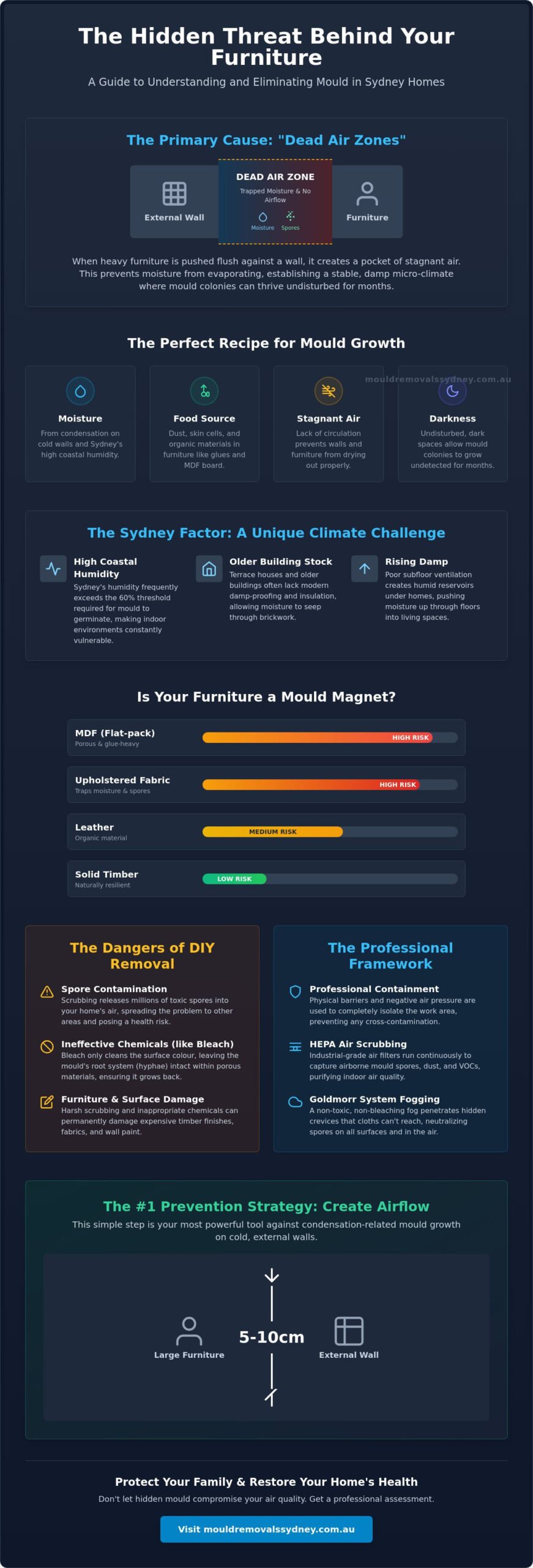
Mould growth isn’t simply a result of poor cleaning; it’s a structural and airflow failure. When you push a heavy wardrobe or bedhead flush against a wall, you inadvertently create a “Dead Air Zone.” A Dead Air Zone is a pocket of stagnant air that traps moisture against porous surfaces. This lack of circulation prevents the wall from drying, creating a stable micro-climate where fungal colonies can expand undisturbed for months. While you might only notice a faint musty smell at first, the colony is often well-established by the time physical staining appears on the wall or the back of your furniture.
Fungi require three things to thrive: moisture, the right temperature, and a food source. Behind your furniture, they find an abundant buffet of organic matter. Dust, shed skin cells, and even the chemical finishes or glues on your furniture provide the necessary nutrients for rapid growth. Because these areas are dark and rarely disturbed, the mould can cycle through its life stages without interruption. Understanding these environmental triggers is the first step toward effectively removing mould from behind furniture and ensuring it doesn’t return.
The Role of Condensation and External Walls
External walls are significantly colder than internal partition walls. During a Sydney winter, the temperature differential between the chilly external brickwork and your heated indoor air creates a “dew point” where moisture in the air condenses into liquid water. If your furniture is pushed too close, it acts as an insulator, preventing room heat from reaching the wall. Professionals recommend maintaining a 5-10cm gap to allow for heat transfer and air movement. Without this buffer, you’re essentially sealing moisture into a dark, cold space, which can lead to the serious health effects of indoor mould. For a deeper dive into how these conditions affect your property, see our What is mould? A complete guide for Australian homeowners.
Surface Material Vulnerability
Different materials offer varying levels of “breathability” and resistance. Solid timber has some natural resilience, but cheap flat-pack furniture made from Medium Density Fibreboard (MDF) is a primary target for toxic species like Stachybotrys. The porous, glue-heavy structure of MDF acts like a sponge, absorbing airborne moisture and providing an ideal substrate for hyphae to take root. Fabric-covered items, such as upholstered bedheads, are equally problematic because they trap spores and moisture deep within their padding. Many homeowners wrongly believe leather is immune; however, the organic nature of leather combined with surface dust can support significant hidden mould growth in high-humidity environments.
The Sydney Factor: Why Hidden Mould Is Common in NSW
Sydney’s climate presents a unique set of challenges for property owners. Our coastal humidity levels frequently exceed the 60% threshold required for mould germination. When ambient moisture stays this high, even a slight drop in temperature behind a heavy dresser can trigger a colony. This is particularly evident in high-density suburbs like Surry Hills or the Inner West. Here, older Sydney terrace houses often lack modern damp-proofing and wall insulation. These structural gaps allow moisture to seep through brickwork, making the task of removing mould from behind furniture a recurring necessity for many residents.
The “La Niña” effect has only intensified these issues across the Greater Sydney region. Recent years of above-average rainfall have saturated the soil, increasing the hydrostatic pressure against foundations. This constant environmental stress means that moisture isn’t just in the air; it’s actively pushing into your living spaces. Following NSW Health advice on mould is critical because hidden colonies can impact respiratory health long before they become visible. If you notice a persistent musty scent, it’s a sign that the environmental balance in your home has shifted.
Subfloor Ventilation and Rising Damp
In many older Sydney homes, the problem starts beneath your feet. Poor subfloor ventilation creates a reservoir of humid air that rises through floorboards. This moisture often settles in the stagnant air zones behind ground-floor wardrobes. If your home has a damp smell that won’t go away, you may need to look beyond surface cleaning. Professional subfloor ventilation systems can provide a long-term cure by addressing the root cause of rising damp and protecting your expensive furniture from future damage.
Sydney Coastal vs. Inland Humidity
Moisture management strategies must change depending on your postcode. Northern Beaches homes face high salt-laden air, which can interact with furniture finishes to attract more moisture through hygroscopic effects. In contrast, Western Suburbs residents often experience extreme temperature swings. Interestingly, winter is the “danger season” for hidden mould in Sydney. As we close windows and turn on heaters, we create warm, moist environments that condense against cold external walls. This hidden condensation is the primary driver for homeowners seeking help with removing mould from behind furniture during the cooler months.
The Hidden Risks of DIY Mould Removal
Many homeowners believe a quick scrub with a household cleaner is the ultimate solution for a musty wardrobe. This is a dangerous misconception. Scrubbing dry mould releases millions of microscopic spores into your breathing zone instantly. Once these spores are airborne, they drift through the house and settle on soft surfaces like carpets, curtains, and bedding. This process of cross-contamination can turn a localized problem into a whole-house issue. Standard household vacuums without HEPA filtration actually exhaust mould spores back into the room air. This ensures that the very act of “cleaning” often makes the indoor air quality worse than before you started.
The use of bleach is another common mistake when removing mould from behind furniture. Bleach is an oxidizer that removes the dark pigment, giving you the illusion of a clean surface. However, it does not kill the “roots” or hyphae embedded deep within porous materials like gyprock or timber. Because bleach is mostly water, it can actually provide a fresh moisture source for the surviving roots once the chlorine evaporates. This leads to a cycle of regrowth where the mould returns faster and more aggressively than before.
Health Implications of Spore Exposure
Hidden mould is a significant health hazard, not just a cosmetic eyesore. Constant exposure often triggers respiratory issues such as asthma, allergic rhinitis, and persistent “mould flu” symptoms. Children and the elderly are more susceptible to hidden mould toxins because their immune and respiratory systems are more vulnerable to environmental stressors. For a deeper understanding of the specific risks associated with toxic strains, consult our What is black mould? A complete guide for Sydney homeowners. Adhering to NSW Health mould guidelines is the best way to protect your family from long-term exposure risks.
When DIY Becomes Dangerous
Professional intervention is mandatory if the affected area exceeds one square metre. Large-scale infestations suggest a structural moisture issue that simple vinegar solutions cannot resolve. Attempting to clean large areas without professional containment risks infecting your entire property. You should also exercise extreme caution with high-value or antique items. Acidic home cleaners can permanently strip delicate finishes or stain expensive fabrics. If your efforts at removing mould from behind furniture keep failing, it is likely because the underlying moisture source remains unaddressed.
Removing Mould From Behind Furniture: A Professional Framework
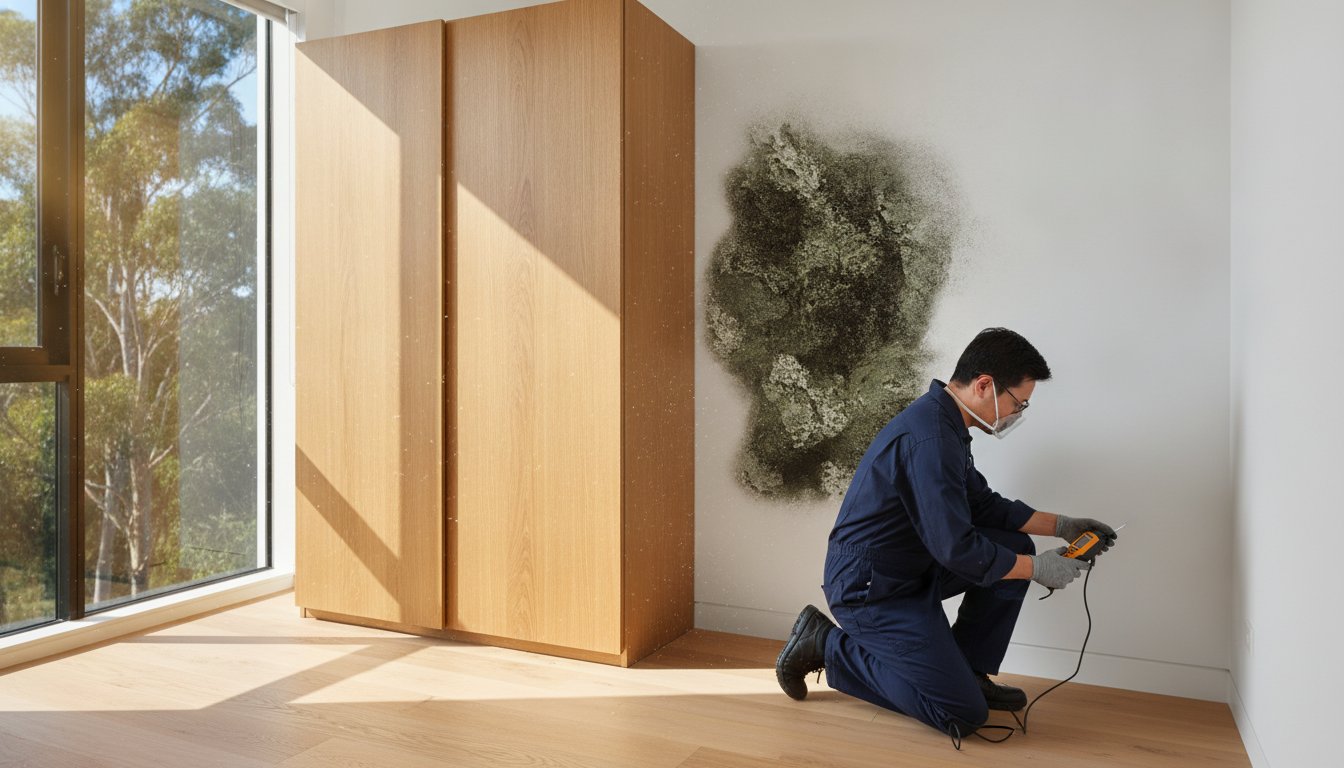
Professional remediation is a systematic process designed to eliminate the colony while protecting the rest of your property. It is not a simple wipe-down; it’s a controlled environmental cleanup. The process begins with establishing strict containment. We seal the affected room using poly-sheeting and tape to ensure that when we begin removing mould from behind furniture, no spores can migrate to other living areas. This containment creates a safe zone where the remediation can take place without risking the health of occupants in adjacent rooms.
Simultaneously, we deploy industrial HEPA air scrubbers. These powerful machines create negative air pressure and capture 99.97% of airborne contaminants as small as 0.3 microns. While you might see the physical growth on the wall, the invisible airborne spores are often the greater health risk. By scrubbing the air throughout the process, we ensure that the indoor air quality is restored to a safe level. This framework ensures that once the visible stains are gone, the hidden threats are also eliminated.
Step 1: Preparation and Safety
Safety is the priority before any furniture is moved. You must equip yourself with a P2 or N95 rated mask and nitrile gloves to prevent inhalation and skin contact. When you are ready to move the item, never pull it away from the wall while it’s dry. We use a misting technique, lightly applying a professional antimicrobial solution to the growth first. This “weighs down” the spores and prevents them from becoming airborne during the move. Don’t use a standard household fan to dry the area; this only serves to broadcast spores across your bedroom or lounge.
Step 2: Effective Surface Eradication
We utilize biodegradable antimicrobial solutions that are designed to kill the colony at the root (the hyphae) without leaving toxic residues. It is vital to treat both the wall surface and the furniture backing simultaneously. If you only clean the wall, the spores remaining on the furniture will quickly reinfect the area. Detailed vacuuming with HEPA-certified equipment follows the treatment to remove dead biological matter. We then ensure the area is 100% dry using commercial dehumidifiers before any furniture is returned to its position.
Step 3: Long-Term Prevention Strategies
The “5cm Rule” is your simplest and most effective long-term defence. By maintaining a minimum 5cm gap between your furniture and external walls, you allow for the thermal regulation and air movement needed to prevent condensation. During Sydney’s humid months, using moisture absorbers or a dedicated dehumidifier can keep your indoor humidity below the critical 60% threshold. If you have recurring issues on the ground floor, it’s time to consider a permanent solution. Our specialists can install a professional subfloor ventilation system to address the root cause of rising damp and protect your home forever.
Professional Remediation: The Goldmorr System and Air Scrubbing
Traditional cleaning methods often fall short because they only address the visible staining. When our specialists handle the task of removing mould from behind furniture, we look beyond the surface. ABC Mould Cleaning Solutions utilizes the Goldmorr System, a world-class methodology that combines precision surface cleaning with advanced air treatment. This approach ensures that we don’t just “wipe away” the problem; we eliminate the biological threat at a microscopic level. It’s the difference between a temporary cosmetic fix and a scientifically verified restoration of your home’s safety.
Air scrubbing is the critical “missing link” in standard remediation services. As we move wardrobes and bookshelves, millions of spores are inevitably disturbed. Without industrial-grade HEPA air scrubbers, these spores remain suspended in your indoor air, ready to settle and regrow elsewhere. Our high-volume scrubbers capture these contaminants in real-time, ensuring that the air you breathe is as clean as the walls we treat. This dual-action approach—treating both the surface and the air—is what makes our professional service superior to any retail alternative.
How the Goldmorr System Works
The core of our methodology is a two-part process designed for maximum efficiency and safety. First, we apply a specialized antimicrobial agent to the physical growth. This is followed by a non-toxic, biodegradable fogging process. This fogging agent is a “dry” mist that penetrates deep into porous materials and fills the entire room volume. It reaches the hidden crevices behind built-in cabinetry and inside furniture joints where cloths and sponges simply cannot reach. The Goldmorr System provides several distinct advantages for Sydney properties:
- Comprehensive Coverage: Eliminates airborne spores throughout the property volume, not just on the wall.
- Safety-First Approach: Uses non-toxic, biodegradable agents safe for residents, pets, and delicate fabrics.
- Non-Destructive: Requires no removal of structural materials or drywall in the majority of cases.
- Rapid Results: Completes most remediation projects, including removing mould from behind furniture, within a single day.
Why Choose ABC Mould Cleaning Solutions?
We understand the specific architectural challenges of Sydney, from the damp-prone terraces of the Inner West to the high-humidity apartments of the Northern Beaches. Our local expertise allows us to identify the exact moisture source, whether it’s a subfloor ventilation issue or a localized condensation problem. We don’t believe in guesswork. Our professional inspection service uses advanced moisture mapping to provide you with a clear, evidence-based plan for remediation. This ensures the problem is solved correctly the first time.
Don’t let hidden mould compromise your family’s health or damage your property. As Sydney’s #1 Mould Removal Service, we provide the authoritative, results-driven solution you need. We are committed to delivering guaranteed results that stand up to the rigours of the NSW climate. Take the first step toward a healthier home environment and Book a Professional Mould Inspection Today. Our team is ready to provide the security and peace of mind you deserve.
Restore Your Sydney Home Today
Leaving hidden fungal growth to thrive behind your wardrobes and beds puts your family’s health and your property’s value at risk. You’ve learned that effective remediation requires more than a surface wipe; it demands the elimination of airborne spores and the correction of “dead air” zones. By avoiding the common pitfalls of DIY scrubbing and bleach, you prevent the dangerous cross-contamination that often follows amateur cleaning attempts. Removing mould from behind furniture is a task that requires specialized containment and industrial-grade air purification to be truly successful.
Our team provides expert Sydney-wide inspections to find the exact source of your dampness. We utilize the Goldmorr System for safe, non-toxic removal, ensuring your living spaces are restored in as little as one day. For those facing urgent situations, we offer a 24/7 emergency response for water damage to stop colonies before they start. Don’t let a musty smell dictate the comfort of your home any longer. Get a Professional Quote for Mould Removal in Sydney and breathe easy knowing your environment is safe, clean, and professionally protected. We are here to help you reclaim your space today.
Frequently Asked Questions
Is it safe to sleep in a room with mould behind the wardrobe?
No, it is not recommended to sleep in a room with an active mould colony. Fungi release spores and microbial volatile organic compounds (mVOCs) directly into your breathing zone throughout the night. This constant exposure can lead to respiratory irritation, headaches, and disrupted sleep. If you detect a musty odour, you should address the growth immediately to protect your long-term health.
Can I use vinegar to remove mould from the back of my sofa?
Vinegar can kill some surface-level mould, but it rarely reaches the hyphae or “roots” embedded deep within upholstery foam and fabric. You also risk spreading spores across your living area if you scrub the sofa while it is dry. For porous materials like sofas, professional fogging is often required to ensure the treatment reaches the internal structure without damaging the fabric or frame.
How much space should I leave between my furniture and the wall?
You should maintain a gap of at least 5cm to 10cm between your furniture and any external walls. This “buffer zone” is essential for thermal regulation and air movement. By allowing room heat to reach the wall surface, you prevent the temperature from dropping to the dew point. This simple adjustment is one of the most effective ways of preventing the need for removing mould from behind furniture in the future.
Does a dehumidifier stop mould from growing behind furniture?
A dehumidifier is an excellent preventative tool, but it is not a complete solution for existing growth. While it lowers the overall humidity in a room, it cannot always penetrate the stagnant “dead air zones” trapped behind heavy wardrobes. You must combine dehumidification with proper furniture spacing and professional remediation if a colony has already established itself on your walls or furniture backing.
Will mould behind my furniture come back after I clean it?
Mould will return if you only treat the visible stains without addressing the underlying moisture source. Simply removing mould from behind furniture with household cleaners doesn’t solve the problem of cold external walls or poor ventilation. To stop the cycle of regrowth, you must improve airflow, manage indoor humidity, and ensure the colony was killed at the root using professional-grade antimicrobials.
What does mould behind furniture smell like?
It typically produces a pungent, earthy, or “damp sock” odour that persists even after you ventilate the room. This scent is a byproduct of the mould’s metabolic process as it consumes organic matter like dust or furniture finishes. Because the smell is often trapped in stagnant air pockets, it may become more noticeable when you open a wardrobe or move a heavy bedhead.
Should I throw away furniture that has mould on the back?
You don’t always need to discard affected items, but the decision depends on the material’s porosity. Solid timber can usually be saved through professional cleaning and HEPA vacuuming. However, if the mould has deeply infested cheap MDF flat-pack backing or internal upholstery foam, replacement is often the safest and most cost-effective option to prevent the spores from reinfecting your home.
How do Sydney professionals treat mould differently than DIY?
Professionals follow a strict remediation framework that prioritizes air safety and root eradication. While DIY methods often aerosolize spores and spread the infection, we use HEPA air scrubbing and physical containment to protect your property. We also utilize the Goldmorr System, which involves non-toxic fogging to reach hidden crevices that standard cloths and vinegar solutions simply cannot treat effectively.