That bottle of bleach in your laundry cupboard might be making your mould problem worse. While a standard spray for mould can hide visible stains, it often fails to address the biological roots embedded in porous materials. It’s exhausting to spend your Saturday scrubbing only to see the same black spots return two weeks later. You deserve to know that your home is truly safe, not just superficially clean.
We understand the anxiety of watching a small patch of dampness turn into a health concern for your family. This guide explores the truth about mould sprays, from $9.19 supermarket staples like RMR-86 to the rigorous ANSI/IICRC S520 Standard used by professionals. You will learn how to select the right product for non-porous surfaces and identify the exact moment a bottle is no longer enough to protect your property.
We will break down the latest EPA recommendations and explain why the industry is shifting away from bleach toward physical remediation. We also examine how new regulations like the 2026 MOLD Act are changing safety expectations. By the end, you will have a clear plan to achieve a mould-free surface and the knowledge to prevent regrowth for good.
Key Takeaways
- Stop treating just the stain. Learn the difference between denaturing proteins and actually removing the physical biomass from your home.
- Avoid the “Spore Explosion” by learning how mechanical scrubbing with a spray for mould can accidentally launch contaminants into the air.
- Compare the efficacy of sodium hypochlorite against natural acetic acid solutions to find the right balance between toxicity and results.
- Master the isolation techniques and PPE requirements needed to prevent cross-contamination between your bathroom and living spaces.
- Discover why the proprietary Goldmorr System and professional fogging provide a level of air purification that standard retail bottles cannot match.
Understanding the Science: How Does a Spray for Mould Actually Work?
A retail spray for mould is essentially a chemical delivery system. Its primary job is to denature the proteins that form the cellular structure of the fungus. Most consumers assume that if the black stain disappears, the problem is solved. This is a dangerous misconception. Visual whitening is often just a cosmetic reaction to bleach, leaving the underlying biological threat intact and ready to regrow.
To be effective, a solution must do more than sit on the surface. Professional-grade formulations include surfactants. These chemicals reduce the surface tension of the liquid, allowing it to “wet” the surface more effectively. Without them, the spray simply beads up on timber or plaster, failing to reach the deeper layers where the mould actually lives. A high-quality spray for mould needs to penetrate the substrate to be truly effective.
Mould Killers vs. Mould Removers
There is a massive technical difference between a biocide that kills an organism and a remediation process that removes it. Many supermarket sprays act as biocides. They neutralize the living part of the fungus but leave the physical structure behind. This is problematic because even dead spores can trigger severe respiratory reactions and allergic symptoms in sensitive individuals. You aren’t just fighting a living plant; you’re fighting a biological contaminant.
To understand the scale of this issue, we must look at the biological makeup of these organisms. What is mould? It is a complex fungal growth that spreads through microscopic spores. Biomass refers to the total physical weight and structure of the mould organism, including the living hyphae and the dormant spores left behind after treatment. If you kill the mould but leave the biomass, the health risk remains in your home.
The Problem with Porous Surfaces
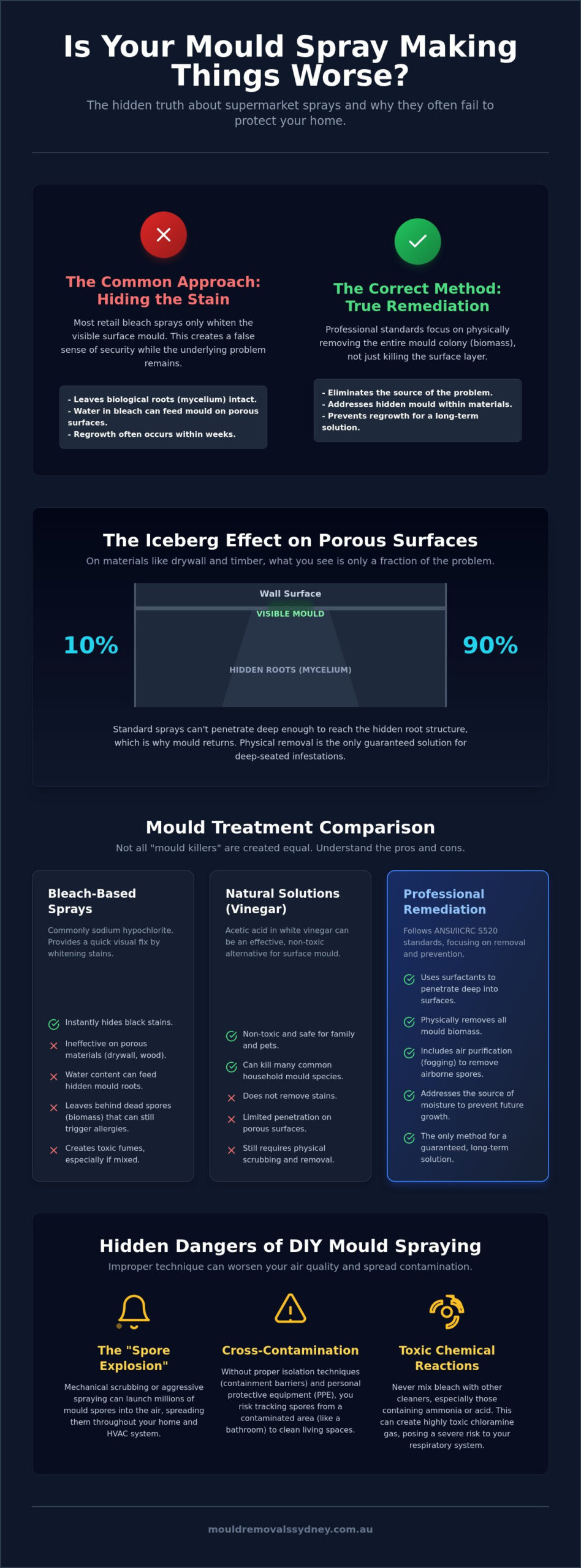
Sprays often fail on materials like gyprock, grout, and unsealed timber because of the “iceberg effect.” What you see on your wall is usually only 10% of the total infestation. The rest is hidden deep within the fibers of the material. Standard household cleaners lack the penetrative power to reach these roots. While the surface looks clean, the fungus continues to feed on the cellulose inside the wall.
Our guide on what is mould explains how these root structures, known as mycelium, weave through building materials. This is why a simple spray for mould is rarely a permanent fix for porous surfaces. Physical removal or professional-grade penetration is the only way to ensure the colony won’t return. If the mould has reached the backing of your drywall, no amount of surface liquid will solve the problem.
Comparing Popular Sprays: Bleach, Natural Remedies, and Professional Grade
Choosing an effective spray for mould involves balancing chemical strength against the safety of your family. Supermarket shelves are dominated by sodium hypochlorite, commonly known as bleach. While these products provide instant visual gratification by turning black spots white, they rarely solve the underlying biological issue. You need a solution that addresses the root of the problem, not just the surface stain.
The Truth About Bleach and Mould
Bleach is mostly water. When you apply it to porous surfaces like drywall, grout, or timber, the chlorine stays on the surface while the water component soaks deep into the material. This provides the exact moisture necessary for the mould roots to thrive. You aren’t killing the colony; you’re hydrating it. This often leads to the mould returning with more vigour just a few weeks later.
Breathing bleach fumes is also a significant health risk. Mixing it with ammonia or other household acids creates toxic gas that can cause immediate respiratory distress. Unlike the targeted, low-toxicity chemicals used in professional mould removal Sydney, household bleach is a blunt instrument. It damages your lungs and your home’s surfaces without offering any long-term protection against regrowth.
Natural Solutions: Vinegar and Clove Oil
Vinegar is a highly effective, non-toxic alternative that many homeowners overlook. The acetic acid in white vinegar can penetrate the membrane of many common household moulds. To create a functional DIY spray for mould, use a concentration of at least 80% white vinegar to 20% water. Do not dilute it further or you will lose its efficacy against tougher fungal strains.
Clove oil is another powerful natural inhibitor. It doesn’t just bleach the mould; it can actually kill the spores. However, it requires careful handling to be safe and effective:
- Correct Dilution: Use 1/4 teaspoon of clove oil per litre of water in a spray bottle.
- Pet Safety: Avoid using essential oils around cats and dogs, as they can be highly toxic to animals.
- Skin Protection: Wear gloves to prevent irritation from the concentrated oil during the mixing process.
While these natural methods are safer for your air quality, they still require you to physically remove the biomass. Following the official mould cleanup guidelines ensures you don’t accidentally spread spores while you work. If the infestation covers a large area, home remedies are rarely sufficient to stop the spread. If you’re unsure if your DIY efforts are working, a professional assessment can provide the clarity you need to protect your property.
The Hidden Danger: Why Spraying Can Sometimes Make Mould Worse
Spraying a liquid directly onto a dry mould colony is a common mistake that can have severe consequences for your indoor air quality. When you trigger a spray for mould, the mechanical force of the liquid hitting the surface causes a “spore explosion.” Thousands of microscopic spores launch into the air, turning a localized surface issue into a property-wide contamination problem. Scrubbing the area with a brush only amplifies this effect, aerosolising the biological payload before the chemicals have a chance to work.
This process leads to rapid cross-contamination. Spores are lighter than air and travel easily through hallways or ventilation systems. A small patch of black mould in your ensuite can quickly establish new colonies on the bedroom curtains or under the bed. Surface sprays are fundamentally unable to catch these airborne particles once they are in motion. You might clean the wall, but the spores are now settling into your carpets, upholstery, and lungs.
Airborne Spores and Indoor Air Quality
Mould is a three-dimensional problem that exists on surfaces, within materials, and in the air you breathe. Professional remediation protocols, such as those detailed in OSHA’s mould safety guide, emphasize that surface cleaning is only one part of the solution. If you don’t address the airborne spores, you are essentially leaving seeds in a garden. This leads to “secondary mould” growth, where new colonies appear in areas that were previously clean. Real safety requires air purification and scrubbing to remove the invisible threat that a bottle simply cannot reach.
The Myth of the Permanent Fix in a Bottle
We often hear property owners claim that spraying once a week is enough to keep the problem at bay. This is a reactive cycle that ignores the underlying cause. Mould is a symptom of a moisture imbalance. Whether it’s a slow pipe leak, poor subfloor ventilation, or high humidity, the mould will return as long as the source exists. Relying on a spray for mould without performing necessary water damage repair is like mopping a floor while the tap is still running. You must fix the moisture source to stop the cycle of regrowth and protect your family’s health long-term.
Safe Application Guide: How to Use a Spray for Mould Correctly
If you find a small patch of surface mould on a non-porous material, you can manage it safely with the right technique. Most homeowners fail because they rush the process or skip essential safety steps. Your health must be the priority before you even pick up a spray for mould. Following a systematic approach ensures you contain the problem rather than spreading it through your home.
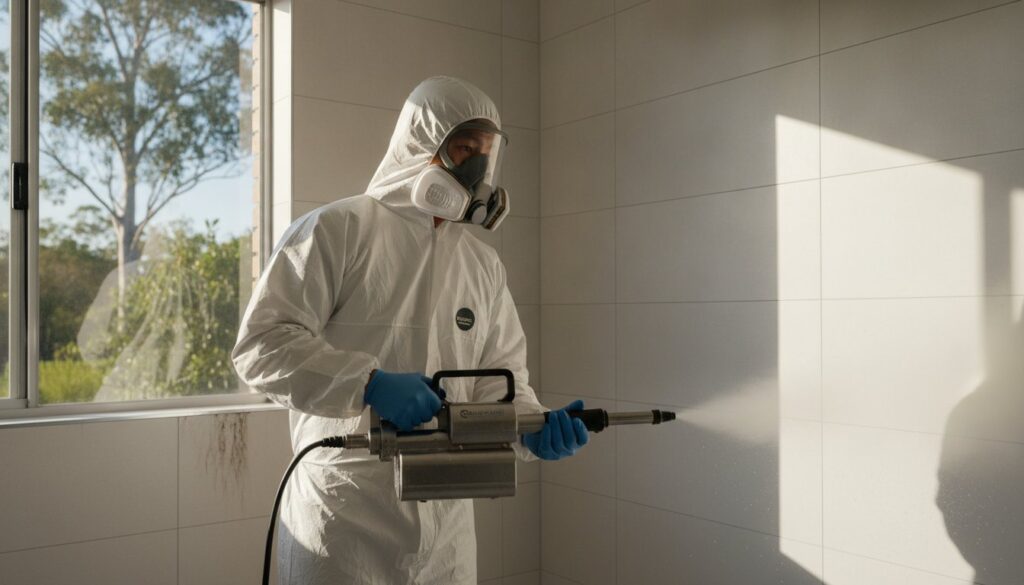
Preparation begins with professional-grade protection. You need a P2 or N95 respirator that fits tightly around your face. Standard dust masks are useless against microscopic spores. Combine this with non-porous gloves and safety goggles to protect your eyes from both chemical splashes and airborne particles. Once you’re protected, isolate the room by closing internal doors. Open external windows to ensure ventilation, but keep the rest of the house sealed off to prevent spore travel.
Use the “Spray, Sit, and Wipe” method to minimize aerosolisation. Apply the liquid gently to avoid the “spore explosion” caused by high-pressure streams. Let the solution sit for at least 10 to 15 minutes. This gives the chemicals time to denature the fungal proteins effectively. Wipe the area with a damp microfibre cloth. Never use a dry brush or a vacuum on dry mould. These actions launch thousands of spores into your breathing zone instantly. Dispose of all contaminated cloths in a sealed plastic bag before taking them to an outdoor bin.
The DIY Safety Checklist
- Use the right mask: Only P2 or N95 respirators offer adequate filtration for fungal spores.
- Wet cleaning only: Never scrub dry mould. Always dampen the surface with your solution first.
- Control the airflow: Keep internal doors shut to protect other rooms while keeping external windows wide open.
- Seal the waste: Double-bag all sponges and cloths used during the process.
Sydney-Specific Tips for Mould Prevention
Sydney’s coastal suburbs face unique challenges due to high salt content and extreme humidity. During our humid summer months, indoor relative humidity often spikes above 60%. This is the threshold where mould begins to thrive. Use a dehumidifier to keep your indoor air between 30% and 50% humidity. This simple step can prevent colonies from establishing in the first place.
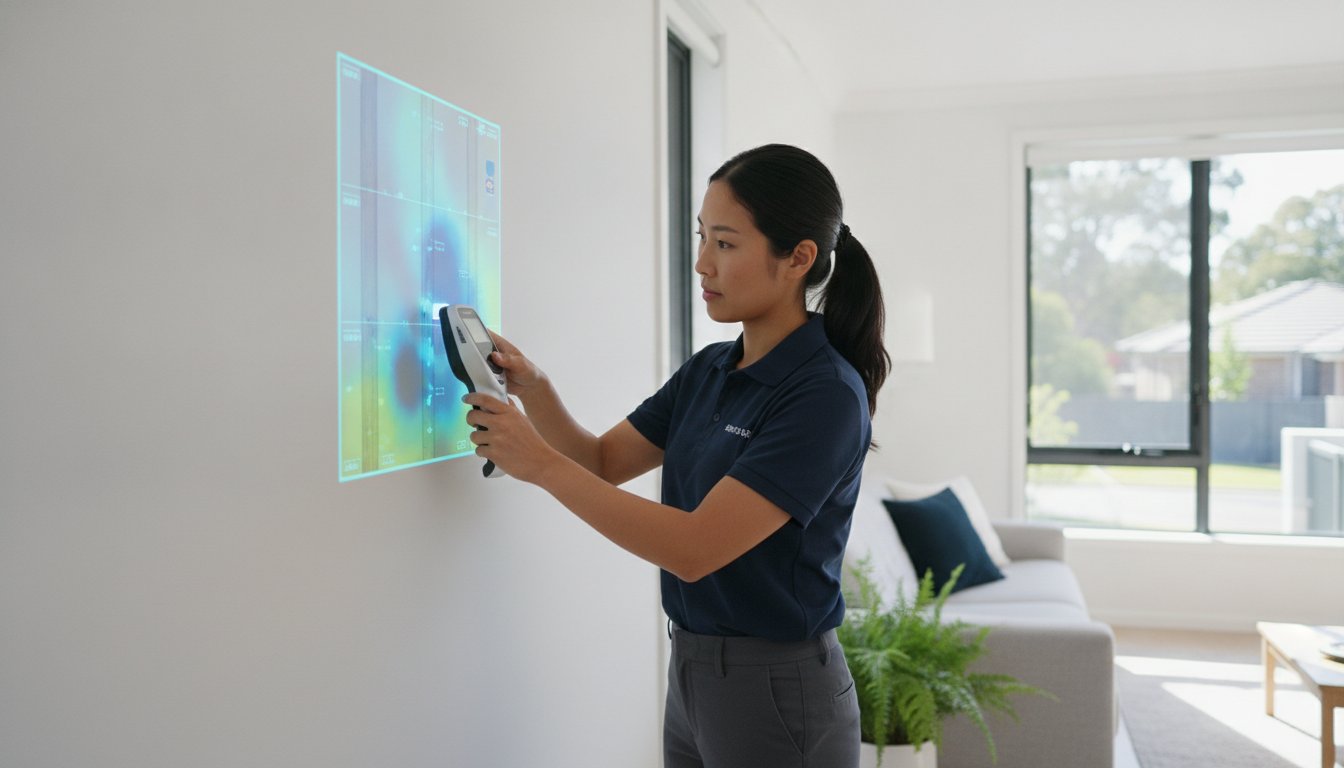
Many older homes in areas like the Inner West or Northern Beaches suffer from inadequate subfloor ventilation. This creates a rising damp effect that feeds mould in floorboards and skirting. If your home has a persistent musty smell despite constant cleaning, a surface spray won’t solve the issue. You likely have a moisture problem under the house. If you see mould covering more than one square metre, stop what you’re doing. This indicates a systemic issue. Contact us for mould inspection services to identify the source and restore your home’s safety.
Beyond the Spray: The Goldmorr System and Total Air Purification
While a retail spray for mould works for minor bathroom maintenance, it isn’t a substitute for professional decontamination. Significant infestations require a solution that addresses the entire environment, including the air you breathe. This is where proprietary technology succeeds where supermarket bottles fail. You need a system that eliminates the biological load permanently rather than just masking the visual evidence of growth.
The Goldmorr System represents a shift in how we approach remediation. Instead of just scrubbing surfaces, this methodology utilizes a two-part process designed to restore your property to a “mould-neutral” state. It focuses on total elimination rather than temporary suppression. Our technicians use biodegradable, non-toxic formulations that are safe for your children and pets. You don’t have to worry about harsh chemical residues or dangerous fumes lingering in your living spaces after we finish our work.
The Goldmorr Difference
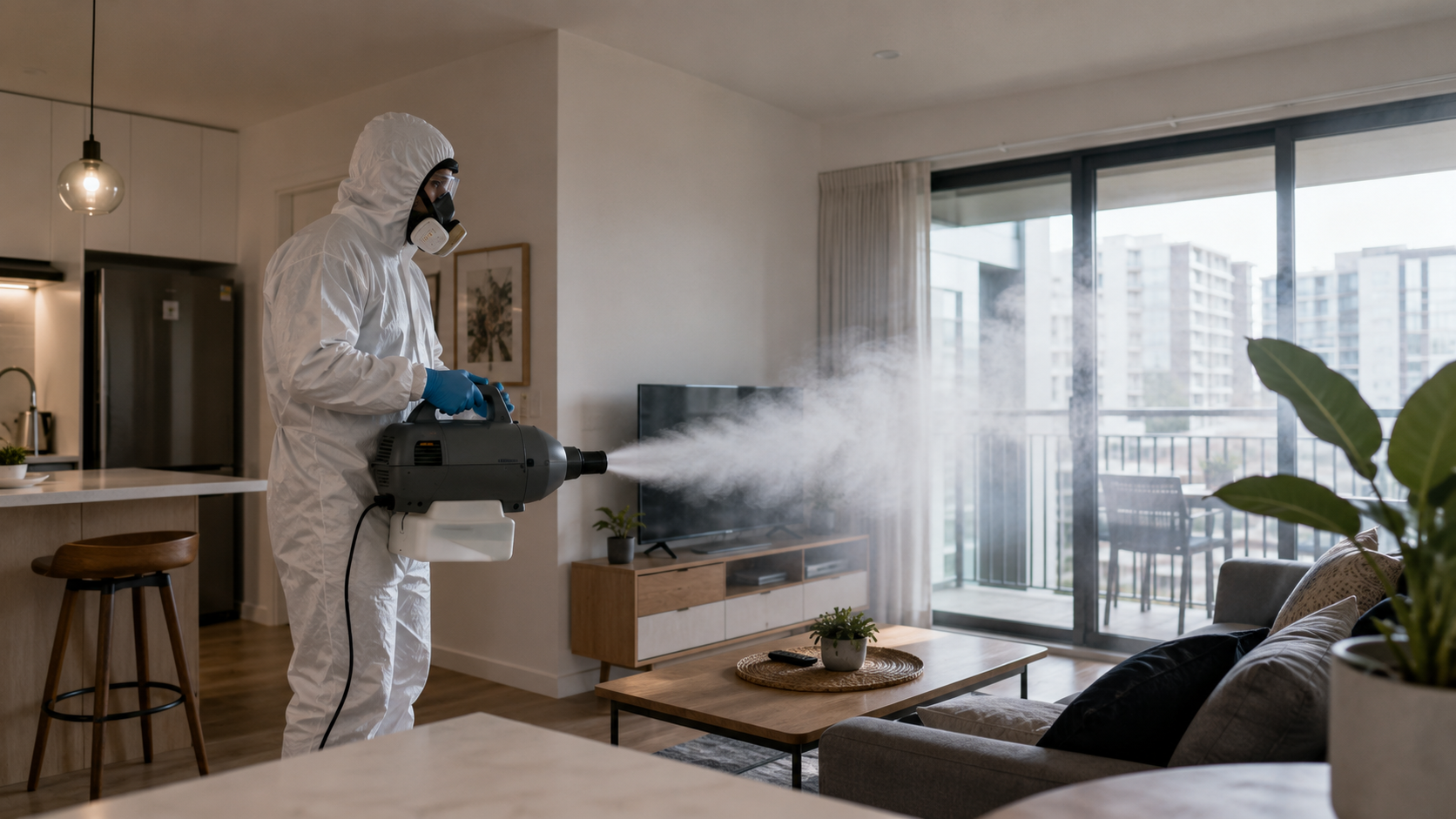
The core of this system is professional fogging. While a standard spray for mould only hits what you can see, fogging creates a fine mist that penetrates every corner of a room. This process targets both visible colonies on the walls and the invisible spores suspended in the air. This methodology is incredibly efficient. We can often achieve total decontamination without the need to tear down walls or remove expensive building materials. This proprietary system targets both visible and invisible contaminants simultaneously to ensure a comprehensive result.
Why Sydney Homeowners Trust ABC Mould Cleaning Solutions
We provide a professional, affordable, and safe path to a healthy home. Our team manages the entire process, from the initial inspection to specialized services like air duct cleaning. We know that mould in your ventilation system can spread contaminants every time the air conditioner turns on. Our specialists ensure every part of your property is addressed, preventing the cycle of regrowth that plagues DIY efforts.
We are committed to providing the best value in New South Wales. We offer an aggressive price-matching guarantee for Sydney residents to ensure you get world-class remediation at a competitive rate. Our process is transparent and results-driven. We use evidence-based techniques to prove that your air is safe. Stop struggling with ineffective sprays that only hide the problem. Get a free professional quote today and take the first step toward a permanently mould-free home. It’s time to breathe easy again.
Take Control of Your Indoor Air Quality Today
A standard spray for mould is a helpful tool for minor surface cleaning on non-porous materials like tile or glass. However, it cannot penetrate the deep structures of your home or eliminate the microscopic airborne spores that cause recurring respiratory issues. True remediation requires more than just a chemical wipe-down; it demands a balance of proper safety equipment, correct application techniques, and a permanent fix for the underlying moisture source.
When an infestation grows beyond a small patch, it’s time to transition from DIY attempts to professional certainty. Our team of Certified Goldmorr System Technicians uses evidence-based methods to restore your property to a safe, neutral state. We offer a Price Match Guarantee to ensure you receive the best value in Sydney, supported by a 24/7 Emergency Water Damage Response for urgent situations. You don’t have to manage this stress alone.
Don’t just hide the mould—eliminate it for good. Book your Sydney inspection today.
Your family deserves to breathe clean, safe air every single day. We’re ready to help you reclaim your home and your peace of mind. Let’s get your property back to its best together.
Frequently Asked Questions
Is it safe to spray mould with bleach?
Bleach is not the safest or most effective option for long-term mould removal. While it whitens surface stains, it cannot penetrate porous materials like drywall or timber. The water content in bleach actually feeds the roots of the fungus once the chlorine evaporates. Additionally, bleach fumes are a significant respiratory irritant. You should avoid mixing it with other household cleaners to prevent the creation of toxic gases.
Does vinegar actually kill mould or just clean it?
White vinegar contains acetic acid, which is capable of killing many common mould species. It is a more effective spray for mould than bleach because it can penetrate deeper into materials to reach the roots. For the best results, use it undiluted and let it sit on the surface for at least an hour. This allows the acid to denature the fungal proteins effectively before you wipe the area clean.
What is the best spray for mould on a ceiling?
Ceilings are often porous, so a specialized antimicrobial spray or a high-concentration vinegar solution is the best choice. Avoid using heavy bleach sprays that can drip and cause chemical burns or damage to your flooring. If the mould covers a large area of the ceiling, it usually indicates a roof leak or a ventilation failure. In these cases, surface sprays will only provide a temporary cosmetic fix until the moisture source is repaired.
Can I use clove oil spray around my pets?
Clove oil is highly toxic to cats and dogs and should never be used in households with pets. Even in diluted spray form, the essential oils can cause severe liver damage or respiratory distress if inhaled or ingested by animals. If you must use it, ensure your pets are completely removed from the area until the surfaces are dry and the room is thoroughly ventilated. Consider safer, non-toxic professional alternatives for pet-friendly environments.
Why does the mould keep coming back even after I use a strong spray?
Mould returns because the environmental conditions that allowed it to grow still exist. A spray for mould only addresses the visible organism, not the high humidity, leaking pipes, or poor subfloor ventilation feeding the colony. If the relative humidity in your home remains above 60%, new spores will settle and grow on the same spot. Permanent removal requires fixing the moisture source and removing the biological biomass entirely.
How long should I leave a mould spray on the surface before wiping?
You should leave most commercial sprays on the surface for at least 10 to 15 minutes. This dwell time is essential for the chemicals to react with the fungal cell walls. If you wipe the solution away too quickly, you won’t achieve a complete kill of the organism. For natural solutions like vinegar, extending this time to 60 minutes provides better penetration into the substrate for a more thorough cleaning.
Should I spray mould before or after scrubbing it?
You must always spray the surface before you begin scrubbing. Scrubbing dry mould launches thousands of microscopic spores into the air, which can lead to cross-contamination and health issues. Wetting the area first traps the spores in the liquid, making them much safer to remove. This wet cleaning method is a standard safety protocol used by professionals to protect the indoor air quality of your property.
What PPE do I need when using a mould spray at home?
Minimal protective equipment includes a P2 or N95 respirator, non-porous gloves, and safety goggles. Standard surgical masks do not filter out fungal spores. You need a tight-sealing respirator to prevent inhaling the spore explosion that occurs during cleaning. Protecting your skin and eyes is equally important to avoid chemical irritation from the spray and contact with the biological contaminants you are removing.