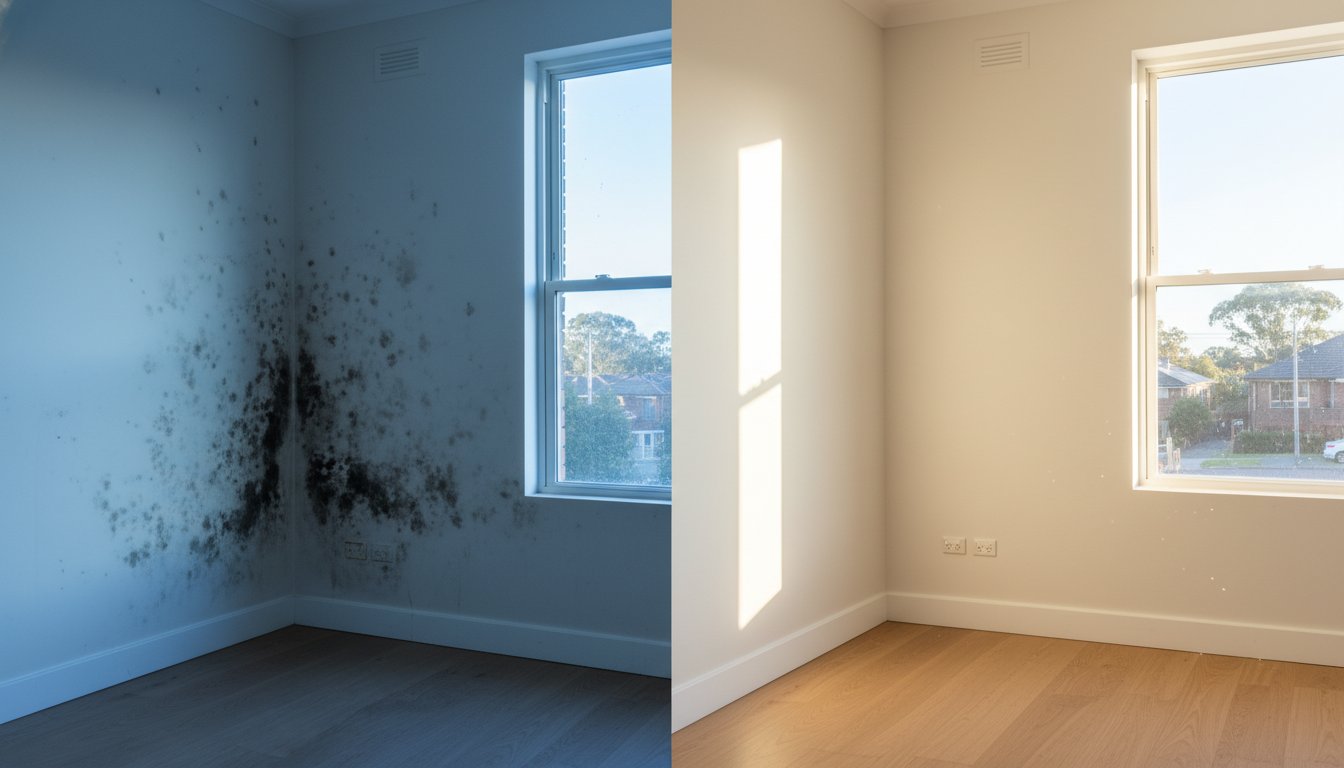

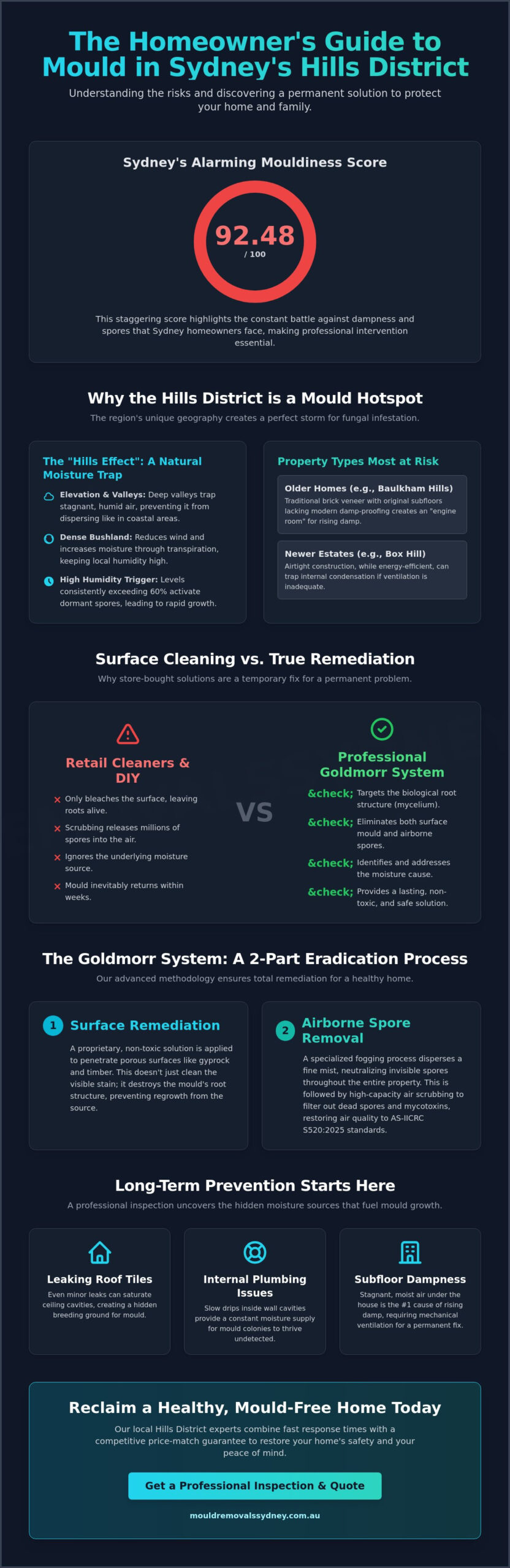
Did you know Sydney carries a staggering mouldiness score of 92.48 out of 100? For local homeowners, this isn’t just a statistic; it’s a daily battle against dampness and invisible spores. If you’re tired of seeing recurring black spots in your bathroom or worrying about respiratory issues in your children, you need a professional approach to mould removal hills district that actually lasts. It’s stressful to feel like your home is under attack, but the right intervention restores your peace of mind and your property’s safety immediately.
We understand the frustration of temporary fixes that fail to address the underlying moisture. You’ll discover how to eliminate toxic mould and airborne spores from your property using the advanced Goldmorr System, a proprietary methodology designed for total remediation. This guide outlines how we identify moisture sources, treat subfloor issues, and use technical air scrubbing to ensure your indoor air quality meets the AS-IICRC S520:2025 standard. Learn how to reclaim a healthy, mould-free home today and protect your family from the risks of structural damage and poor air quality.
Key Takeaways
- Understand how the Hills District’s unique elevation and valley topography create a natural moisture trap that accelerates fungal growth.
- Discover why the Goldmorr System is superior to retail cleaners by targeting the root structure of mould rather than just bleaching the surface.
- Learn why a professional mould removal hills district inspection is vital for uncovering hidden moisture sources like roof tile leaks and internal plumbing issues.
- Identify why your subfloor is the engine room of dampness and how mechanical ventilation can permanently stop stagnant air from fueling mould.
- Get local, expert remediation that combines fast response times with a competitive price-match guarantee to restore your home’s safety quickly.
Why the Hills District is a High-Risk Zone for Mould Growth
Living in the Hills District offers beautiful scenery, but the region’s geography creates a perfect storm for fungal infestation. The unique elevation and deep valleys characteristic of the area act as natural moisture traps. This “Hills effect” means that while coastal Sydney might enjoy a sea breeze, inland valleys often hold stagnant, humid air. When moisture gets trapped against the ridgelines, it settles into residential pockets, creating an environment where fungi thrive. Professional mould removal hills district is often necessary because these geographical factors make the area significantly more prone to dampness than flatter parts of the city.
The Hills District Microclimate and Moisture
The dense bushland surrounding suburbs like Castle Hill, Dural, and Kellyville keeps moisture levels high through transpiration and reduced wind speeds. In 2026, we’ve seen volatile rainfall patterns that push local humidity levels well above the danger zone for extended periods. Scientific data confirms that local humidity levels exceeding 60% trigger dormant mould spores, causing them to germinate and spread rapidly across internal surfaces. For a comprehensive overview of mold and its biological requirements, it’s clear that environmental control is the only way to prevent growth in such a high-risk climate.
Property Types Most at Risk
Property age and construction style play a massive role in how well a home resists the local elements. Older, established homes in Baulkham Hills often feature traditional brick veneer construction with original subfloors that lack modern damp-proofing. These spaces become “engine rooms” for dampness, allowing moisture to rise through the floorboards. Conversely, newer estates in Box Hill might have better insulation, but their airtight construction can trap internal condensation if ventilation isn’t managed correctly. If you’ve noticed dark patches appearing on your walls or ceilings, check our black mould guide to identify the specific species and risks associated with your property type.
Effective mould removal hills district requires more than just a quick scrub with retail products. Surface cleaning fails because it ignores the high ambient humidity and the structural moisture that feeds the colony. Without addressing the root cause, the mould will simply return within weeks. Professional remediation must involve treating the air, the surfaces, and the underlying moisture source to ensure a permanent solution for Hills District homeowners.
Beyond Surface Scrubbing: The Goldmorr System Explained
Most homeowners assume that if they can’t see the black spots, the problem is gone. This misconception is why many attempts at mould removal hills district fail within weeks. True remediation requires a professional-grade, two-part process that addresses both visible contamination and the invisible spores floating in your air. We utilize the Goldmorr System because it doesn’t just “clean” the surface; it targets the biological root structure of the infestation to prevent it from returning.
The difference between amateur scrubbing and professional remediation lies in the treatment of the mycelium. Think of mould like a weed in your garden. If you only snap off the leaves, the roots remain in the soil, ready to sprout at the next sign of moisture. Standard retail products often lack the chemical profile to penetrate porous materials like gyprock or timber. The Goldmorr System uses a proprietary solution that seeks out these roots. It’s a high-efficiency approach that remains entirely safe for your family and pets. Our products are biodegradable and non-toxic, ensuring your home is safe to occupy immediately after treatment.
The Fogging Process: Eliminating Airborne Spores
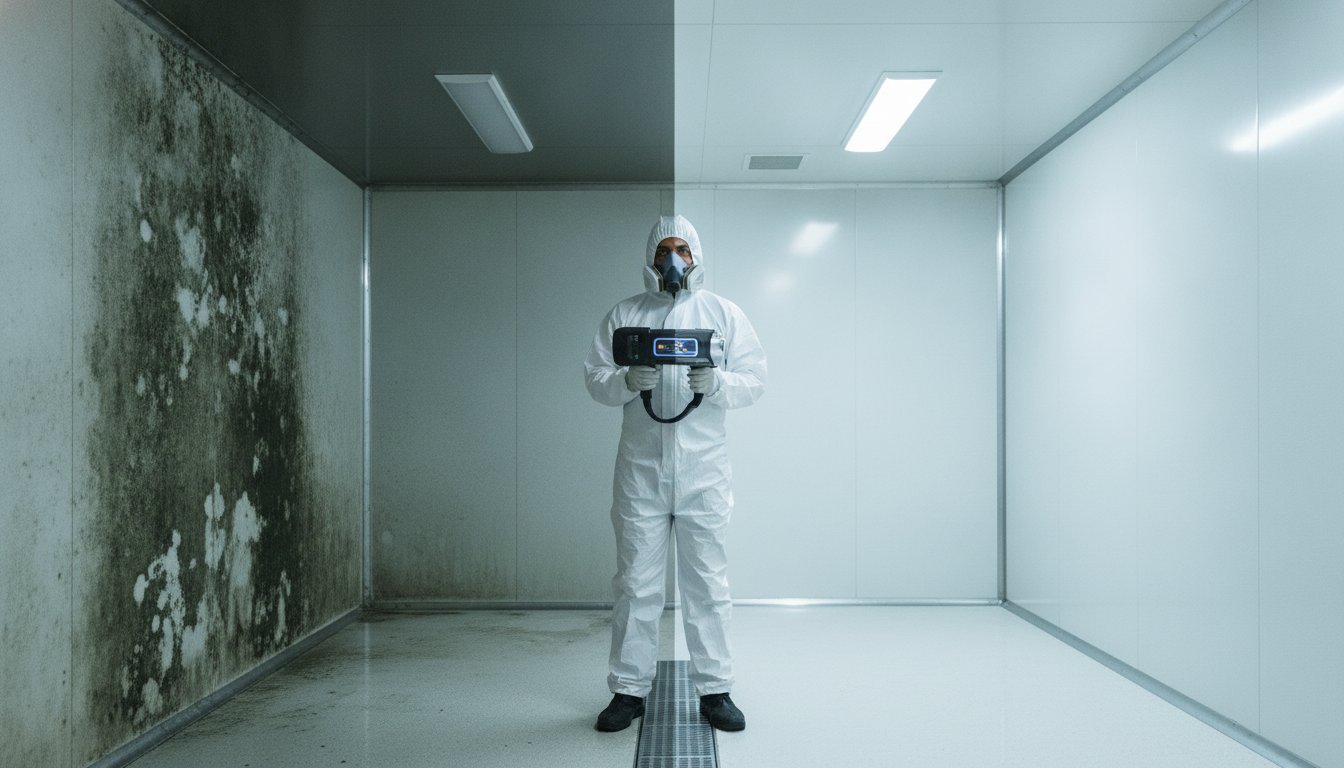
Airborne spores are the primary cause of recurring infestations in the Hills District. When you disturb a mould colony by scrubbing it, millions of microscopic spores are released into the air. These spores settle in crevices, behind wall cavities, and deep within carpets. Removing visible mould is only 50% of the solution; you must also treat the air. We use a specialized fogging process that disperses a fine mist throughout the property. This mist reaches every corner that a cloth cannot touch. Following the fogging, we employ high-capacity air purification and scrubbing. This step filters out dead spores and mycotoxins, restoring your indoor air quality to a healthy state.
Why Bleach is Your Enemy
It is a common myth that bleach kills mould. In reality, bleach is mostly water. While the chlorine component removes the dark pigment, the water content actually feeds the surviving roots deep inside the material. This often leads to a more aggressive regrowth. Worse still, DIY scrubbing without proper containment can spread spores directly into your HVAC system, turning your air conditioning into a delivery mechanism for allergens. If you’re struggling with persistent growth, it’s safer to consult mould removal sydney specialists who understand the science of remediation. Following NSW Health advice on mould is the best way to protect your family’s respiratory health. If you want to ensure your home is truly clear of contaminants, you can request a professional assessment of your property’s air quality today.
Professional Mould Inspection vs. DIY: Identifying Hills District Causation
Relying on the naked eye is the most common mistake in property maintenance. By the time mould is visible on your gyprock or skirting boards, the internal structure of your home may already be compromised. A professional mould removal hills district specialist doesn’t just look for spots; we look for the “why” behind the growth. While a DIY approach usually involves a quick wipe with vinegar, our technicians use advanced thermal imaging cameras and moisture meters to detect temperature differentials and hidden dampness behind walls. This scientific approach finds the hairline roof tile cracks or slow-dripping plumbing joints that you’d otherwise miss.
Professional documentation is also a critical shield for homeowners. If you’re dealing with strata disputes, insurance claims, or a potential property sale, a verbal “it looks fine” isn’t enough. You need a formal Mould Causation & Prevention Report. This document provides the evidence-based proof required to hold parties accountable or to reassure buyers that your home is biologically safe. Without this data, you’re just guessing at the health of your property.
Hidden Moisture Sources in the Hills Shire
The geography of the Hills District presents specific challenges that DIY methods can’t handle. Many local properties sit on sloped blocks where water runoff naturally pools against foundations, leading to rising damp. In newer, high-performance homes in Kellyville, “air-tight” construction often traps internal humidity. This leads to heavy condensation on windows and in wall cavities, creating a breeding ground for spores. It’s also vital to check your split-system air conditioners; these units often harbour internal growth that circulates contaminants through your living spaces. Following an EPA guide to mould and moisture is a great starting point for understanding how these environmental factors interact with your home’s structure.
The Value of a Professional Report
Our comprehensive reports include precise moisture percentage readings, spore count analysis, and a clear list of rectification steps. This isn’t just a summary; it’s a roadmap to a healthy home. If our inspection reveals a major structural issue like a burst pipe or a failed waterproof membrane, you’ll likely require immediate water damage repair to prevent further rot. Having this professional documentation protects your property value and ensures that remediation efforts are targeted and effective. Don’t risk your family’s health on guesswork when a technical assessment can provide total certainty. If you’ve noticed a musty smell or damp patches, contact us for a professional inspection before the damage spreads further.
Long-Term Prevention: Subfloor Ventilation and Air Purification
The subfloor is the engine room of most moisture problems in Sydney. In the Hills District, the clay-heavy soil often retains water long after the rain stops. This moisture evaporates and rises through your foundations, entering your living spaces through floorboards and skirting. Effective mould removal hills district must address this subterranean dampness. If the air under your house remains stagnant, the humidity levels inside your home will stay dangerously high, regardless of how often you clean your walls.
We recommend a pragmatic approach to moisture management. Start by monitoring your indoor climate with a digital hygrometer. If your humidity levels consistently exceed 60%, your home is at risk of a new infestation. Using portable dehumidifiers helps in the short term, but permanent solutions require mechanical intervention to move humid air out of the building structure before it settles.
Subfloor Ventilation Systems
Rising damp from the Hills District soil is a constant threat to older brick homes. Natural vents often fail in our local valleys because there isn’t enough natural wind to create a cross-flow. We install mechanical ventilation systems, using either solar-powered or electric fan-forced units, to actively extract damp air. This process creates a consistent flow of dry air throughout the void. Continuous subfloor airflow prevents floorboard cupping and structural rot by keeping the timber and soil dry year-round.
Air Purification and Duct Cleaning
Once we fix the moisture source, we must address the remaining airborne contaminants. We use industrial-grade air scrubbers to achieve “Clearance” status after major remediation projects. These units utilize HEPA filtration designed to trap 99.97% of particles as small as 0.3 microns, including microscopic spores and mycotoxins. Don’t neglect your split systems during this process. A contaminated unit will simply recirculate spores back into your freshly treated rooms. You should book regular air conditioner cleaning to ensure your HVAC system isn’t undermining your air quality.
Maintaining a healthy home requires a combination of specialist technology and consistent monitoring. If you’ve struggled with recurring dampness, it’s time to stop the cycle at the source. Contact our team to install a permanent ventilation solution and protect your property from future structural damage and health risks.
ABC Mould Cleaning Solutions: Your Hills District Experts
ABC Mould Cleaning Solutions stands as the primary authority for families across the Hills Shire. Our local presence near Castle Hill and Baulkham Hills ensures we arrive at your door faster than city-based contractors. We know the stress a damp home causes. It’s not just about the smell; it’s about the health of your children and the structural integrity of your investment. Our master technicians utilize the Goldmorr System, a proprietary methodology that has set the global standard for effective remediation. This system is the preferred choice for Sydney families because it prioritizes safety without compromising on power.
We don’t expect you to settle for anything less than the best value. That’s why we offer the ABC Guarantee. We’ll match any competitor’s price for professional-grade results. You get the security of a global system delivered by local specialists who care about your property’s long-term health. We’ve built our reputation on being pragmatic and results-driven. We don’t offer vague promises; we provide tangible evidence of a clean, safe environment through technical reporting and clearance testing. If you want a permanent solution for mould removal hills district, you need a team that understands the local landscape.
The ABC Remediation Process
Our systematic approach transforms a contaminated property into a safe sanctuary through four distinct stages. First, we conduct a thorough inspection. We identify the moisture source using thermal imaging and moisture meters, ensuring we aren’t just treating a symptom. Second, we perform surface treatment. We apply non-toxic, food-grade chemicals to kill the visible mould and its root structure. This is far more effective than amateur scrubbing that often leaves the mycelium intact.
Third, we move to fogging. Our technicians use a biodegradable mist to eliminate airborne spores in every crevice and wall cavity. Finally, we focus on prevention. We provide a roadmap for moisture control, including subfloor ventilation if soil dampness is the root cause. Beyond routine cleaning, we provide a 24/7 emergency response for water damage restoration. If a burst pipe or storm event floods your home, immediate action is vital to prevent fungal growth from taking hold. We use industrial air purification and scrubbing to ensure your environment is safe for all occupants, including the most vulnerable.
Get a Quote Today
The path to a mould-free home is simpler than you think. We’ve streamlined our inquiry process to leverage modern technology and save you time. You don’t have to wait days for an initial answer. Simply capture clear photos of the affected areas on your mobile and send them to us. This allows our experts to provide a fast, preliminary digital assessment of the severity and likely cause. It removes the friction from your customer journey and gets you closer to a resolution immediately.
Don’t let a small damp patch turn into a structural nightmare. Every day you wait allows spores to spread deeper into your building’s fabric. Take the first step toward improved indoor air quality and total property security today. Your home should be a place of refuge, not a source of respiratory stress. Book Your Hills District Mould Inspection Now and see why we are the leaders in mould removal hills district. Our team is ready to restore your home’s safety with the speed and professionalism you deserve. Let’s solve your moisture problem for good.
Restore Your Home to a Healthy State Today
Living in the Hills District means acknowledging that the local microclimate often works against your property’s health. You’ve learned how the Goldmorr System provides a scientific advantage by eliminating both visible colonies and invisible airborne spores. By identifying the root cause of moisture through professional inspection and implementing subfloor ventilation, you can finally end the cycle of recurring growth. Professional mould removal hills district is the only way to ensure your indoor air quality meets modern safety standards.
Our certified Goldmorr System technicians are ready to restore your home using non-toxic, food-grade solutions that protect your family. We back our expertise with an aggressive price-matching guarantee and a 24/7 emergency water damage response for your peace of mind. It’s time to transition from temporary fixes to permanent structural security. Take the first step toward a drier, safer environment now.
Get a Free Mould Removal Quote for Your Hills District Home and reclaim your sanctuary. We’re here to help you breathe easier.
Frequently Asked Questions
Is mould removal in the Hills District different from the rest of Sydney?
Yes, the Hills District requires a specialized approach due to its unique elevation and topography. Valleys in the region trap stagnant, humid air, which means we must focus more on air purification and subfloor ventilation compared to coastal suburbs. Our mould removal hills district strategies are specifically calibrated for this high-risk microclimate to ensure long-term success.
How much does professional mould removal cost in the Hills District?
Costs for professional remediation vary based on the severity of the contamination and the underlying moisture issues. Projects are typically categorized from simple surface cleaning to extensive material replacement and structural drying. We recommend a professional inspection to determine the exact scope of work required for your specific property.
Is the Goldmorr fogging process safe for my pets and children?
Absolutely. The Goldmorr System utilizes biodegradable and non-toxic chemicals that are safe for both pets and children. These food-grade solutions provide a powerful kill rate against spores without leaving harmful residues. It’s a pragmatic choice for families who want a safe, healthy home environment immediately after treatment.
Can I stay in the house during the mould remediation process?
You can often stay in the home for localized treatments, but we may recommend vacating for a few hours during whole-home fogging. This allows our air scrubbers to work at maximum efficiency without disturbance. We prioritize your safety and will provide a clear timeline before any work begins.
How long does a professional mould removal treatment last?
A professional treatment provides immediate results, but its longevity depends on moisture control. If the root cause of the dampness is rectified, the treatment can last indefinitely. We provide a Mould Causation & Prevention Report to help you maintain a dry environment and prevent future infestations.
What is the most common cause of mould in Castle Hill and Kellyville homes?
The most common causes are rising damp and poor ventilation in subfloors. In newer Kellyville estates, “air-tight” building designs often trap internal condensation, while older homes in Castle Hill frequently struggle with moisture rising from the clay soil. Identifying these specific local factors is key to effective mould removal hills district.
Does insurance cover mould removal in NSW?
Insurance coverage in NSW generally depends on the cause of the dampness. Most policies cover mould resulting from sudden events like burst pipes or storm damage, but they often exclude issues caused by gradual wear or poor maintenance. We suggest reviewing your Product Disclosure Statement (PDS) or contacting your provider for clarification.
How can I tell if the mould in my bathroom is toxic black mould?
You cannot accurately identify toxic species with the naked eye. While many people associate a slimy, dark appearance with toxicity, only laboratory testing can confirm the specific species. If you notice persistent musty odours or health symptoms, it’s vital to book a professional assessment rather than relying on guesswork.