If you believe a bucket of soapy water and a rag are enough to keep your facility safe, you are leaving your business vulnerable to a health department shutdown. Many managers rely on daily staff to wipe down shelves, but in commercial cool rooms, focus on how standard cleaning isn’t enough is vital to understanding your true risk. Surface-level scrubbing might remove visible grime, but it fails to reach the microscopic spores embedded in your evaporator coils and drainage lines. This oversight often leads to persistent musty smells and rapid re-colonisation that threatens your entire inventory.
We know the stress of an impending health inspection and the heavy cost of food spoilage. It’s exhausting to fight a battle against mould that you seem to lose every week. This guide explains why basic wiping fails your cool room and how professional microbial remediation protects your stock and ensures compliance. You’ll learn how to implement a long-term solution to mould growth that satisfies NSW food safety standards. We provide the path to protecting your staff health and maintaining the total integrity of your stock through expert, evidence-based methods.
Key Takeaways
- Learn why visually clean surfaces can still be biologically contaminated in commercial cool rooms. Focus on how standard cleaning isn’t enough to target embedded spores.
- Discover how fan coil units act as distributors, spreading airborne mould throughout your entire cold storage area.
- Compare manual scrubbing against professional fogging to see which method offers deeper penetration and faster results for your business.
- Identify the specific NSW Food Authority requirements you must meet to avoid failed inspections and protect your stock integrity.
- Explore a professional 4-stage remediation process that addresses air quality and provides long-term protection for your facility.
Why Standard Cleaning Fails Your Commercial Cool Room
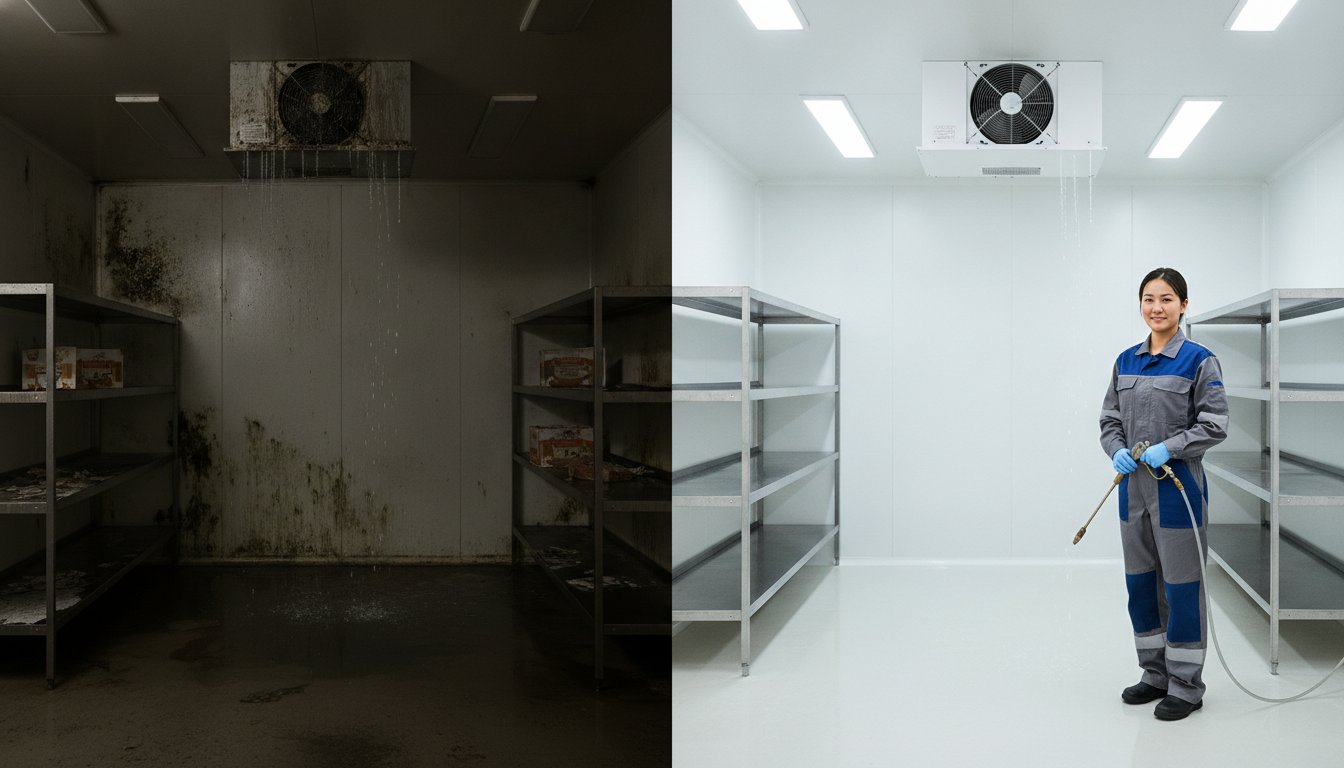
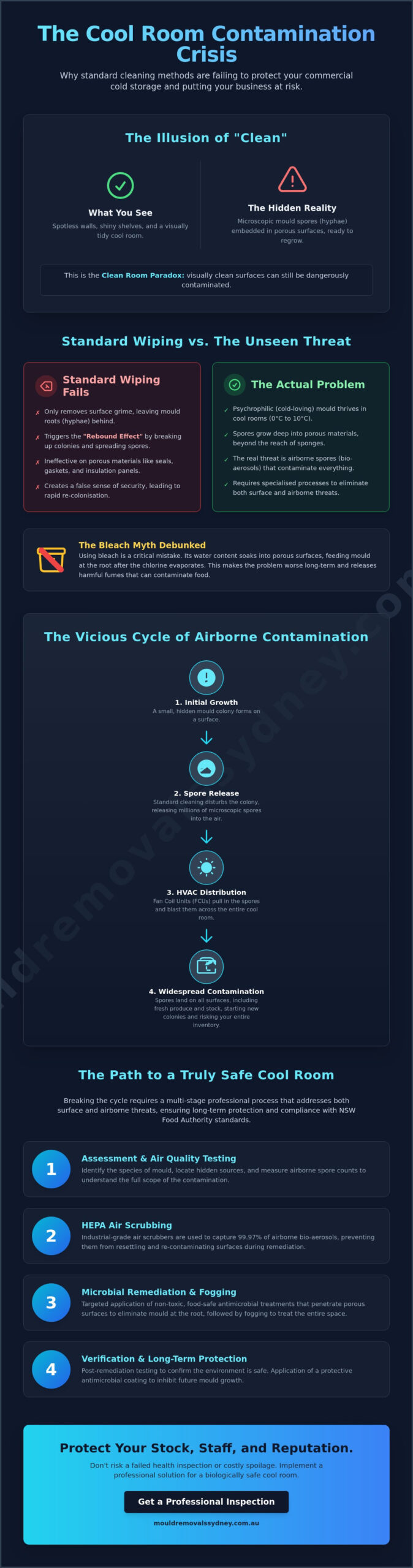
Many business owners believe that if a surface looks shiny, it’s safe. This is the “Clean Room Paradox.” In commercial cool rooms, focus on how standard cleaning isn’t enough to address the biological reality of fungi. You might see a spotless wall, but beneath that surface, microscopic colonies are thriving. Standard detergents are designed to emulsify grease and lift surface dirt. They don’t penetrate the cellular wall of mould spores. While you remove the visible grime, you leave the “roots” or hyphae intact. These roots quickly regrow, often becoming more resilient with every superficial wash.
Cool rooms are filled with porous materials like silicone seals, insulation panels, and rubber gaskets. Mould doesn’t just sit on these surfaces; it grows into them. Standard scrubbing with a brush or cloth often triggers the “Rebound Effect.” This happens when manual agitation breaks apart mould clusters, sending thousands of invisible spores into the air. These spores then travel into the ventilation system, where they’re circulated back onto your fresh produce. You aren’t just cleaning; you’re unintentionally cross-contaminating your entire stock and risking your food safety certification.
The Biology of Cool Room Mould
Psychrophilic (cold-loving) mould is a specialist. While most fungi go dormant in the cold, these species thrive in environments between 0°C and 10°C. Condensation around fan units provides the constant moisture they need to reproduce. When combined with microscopic food particles or organic dust, your cool room becomes a high-efficiency incubator. Understanding the dangers of indoor mould in these specific temperatures is the first step toward effective remediation. Without professional intervention, these colonies will continue to feed on the organic matter present in your storage area.
The Myth of Bleach in Cold Storage
Using bleach is a common mistake that creates a false sense of security. Bleach is mostly water. On non-porous surfaces like stainless steel, it kills some surface bacteria. However, on the porous seals and panels common in commercial cool rooms, focus on how standard cleaning isn’t enough because bleach cannot reach deep enough. The chlorine evaporates quickly, while the water component soaks into the material. This actually feeds the mould roots. Additionally, the harsh fumes from bleach can contaminate food products and irritate your staff. It’s a temporary cosmetic fix that leads to a more aggressive infestation later.
The Hidden Danger: Airborne Mould Spores in Cold Storage
Visible mould is only the tip of the iceberg. In commercial cool rooms, focus on how standard cleaning isn’t enough to manage the millions of invisible spores suspended in the air. These microscopic particles, known as bio-aerosols, are the primary cause of rapid re-infestation after a surface wipe-down. When your staff scrubs a wall, they often release these spores into the air, where they remain buoyant for hours. Your fan coil units (FCUs) then act as high-speed distributors. They pull in contaminated air and blast it across every shelf, crate, and food surface in the room. This mechanical distribution means a small patch of mould behind a cooling unit can compromise your entire inventory in a matter of days.
The risk isn’t just to your stock; it’s to your people. Continuous exposure to high spore counts leads to respiratory distress and symptoms associated with “Sick Building Syndrome” in commercial kitchens. Staff might report persistent coughs, watery eyes, or fatigue that disappears once they leave the workplace. Following EPA guidelines for mould remediation is essential to ensure you aren’t just moving dirt around, but actually creating a safe environment. Professional intervention is the only way to break this cycle of contamination. If you’re noticing these red flags, our specialists can provide a detailed mould inspection to identify the source of the problem.
Air Purification and Scrubbing
Surface cleaning can’t touch what’s floating in the air. We use industrial-grade HEPA air scrubbing to capture 99.97% of particulates down to 0.3 microns. This process strips the “bio-aerosols” from your cold storage environment, preventing them from settling back onto your products. For a truly sterile environment, you should also consider professional air duct cleaning to ensure your ventilation system isn’t a hidden reservoir for spores.
Detecting the Invisible
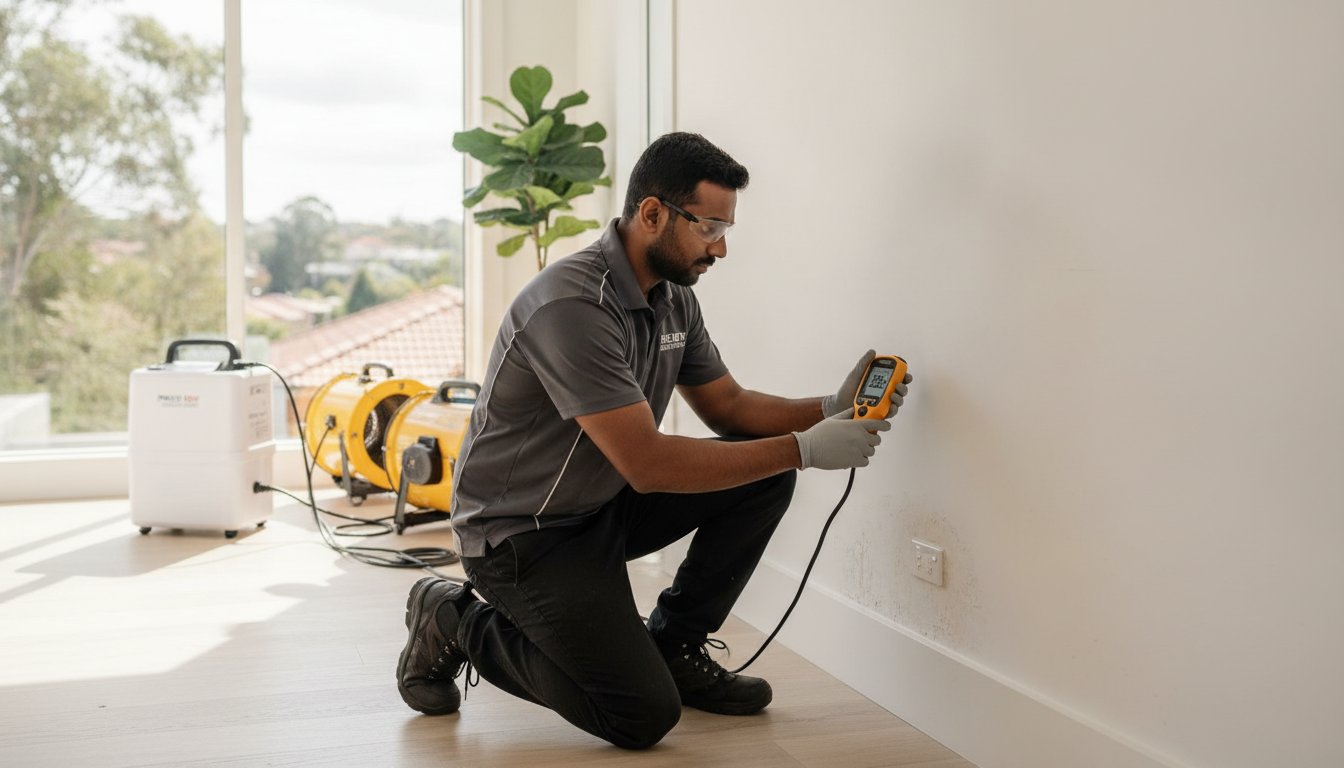
How do you know if your air is contaminated? A persistent musty odour is the most reliable red flag. Even if your surfaces look clean, that smell indicates active microbial growth. High humidity levels above 60% create the perfect conditions for an airborne outbreak. Don’t wait for a failed health inspection. Investing in professional mould testing allows you to quantify the danger and take decisive action before stock loss occurs. We recommend regular monitoring to maintain compliance with NSW food safety standards and protect your investment.
Surface Wiping vs. Professional Remediation: A Critical Comparison
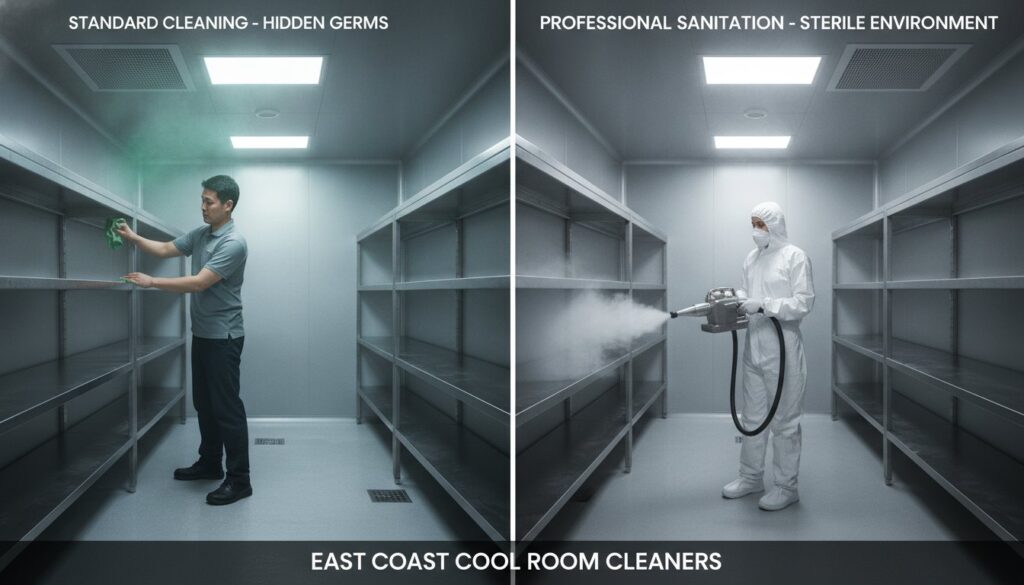
Assigning a staff member to scrub walls might seem like a cost-effective solution, but it is often a waste of valuable labour. In commercial cool rooms, focus on how standard cleaning isn’t enough to reach the structural vulnerabilities where mould actually hides. A cloth only makes contact with high-point surfaces. It cannot reach the deep recesses of fan units, the gaps behind shelving brackets, or the microscopic pores in insulation panels. Professional remediation uses a dual-phase approach that treats the entire volume of the room, not just what a human hand can reach.
Downtime is another critical factor. Manual scrubbing requires hours of intensive labour and often necessitates moving all stock out of the room to avoid chemical splashes. In contrast, professional fogging is significantly faster. Because the process is non-mechanical, it doesn’t rely on abrasive scrubbing that can tear delicate silicone seals or damage expensive cooling fins. You get a deeper level of sanitation with a fraction of the operational disruption. While a standard clean might last a few days before the musty smell returns, professional remediation provides a sterile baseline that lasts for months.
The Goldmorr System Advantage
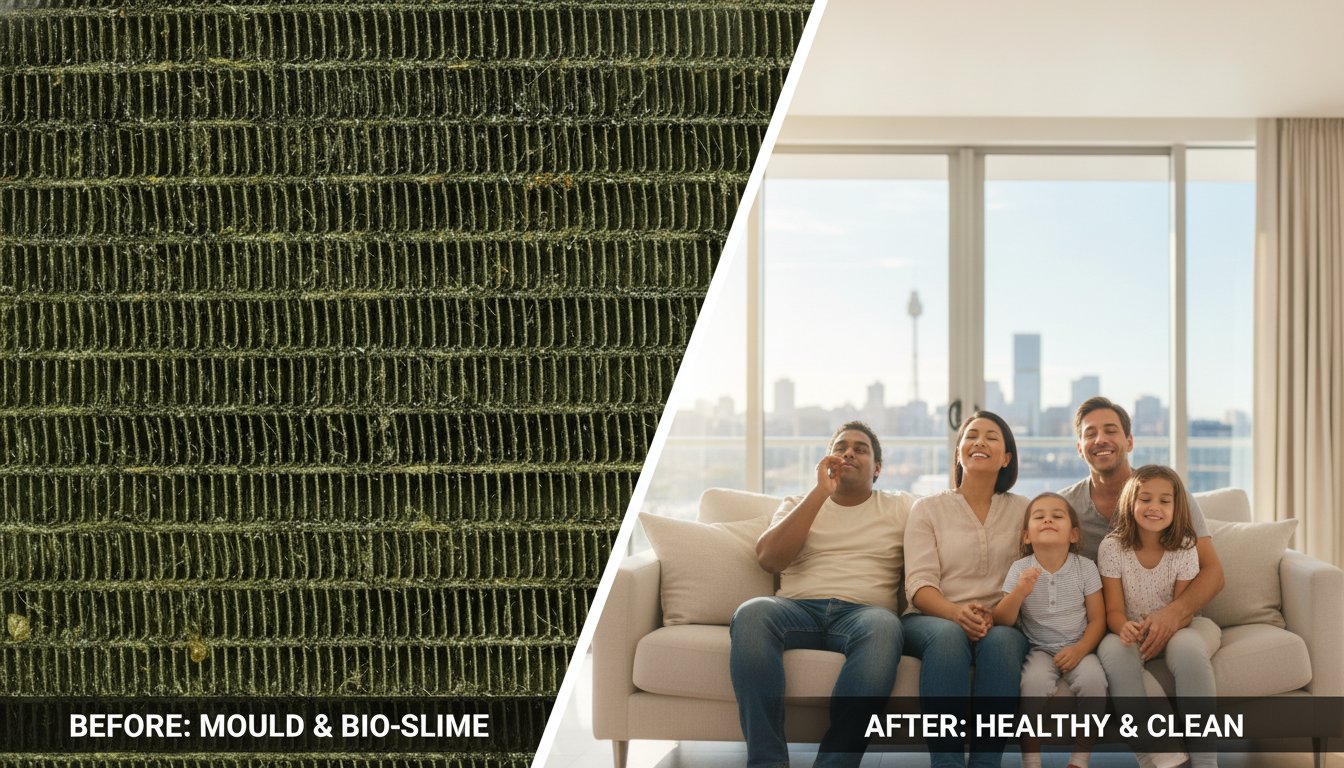
We utilise the Goldmorr System because it is specifically designed for high-stakes environments like cold storage. This proprietary methodology involves a specialised fogging process that fills the entire room with a biodegradable mist. This mist travels exactly where airborne spores do, penetrating insulation gaps and the complex internal components of your evaporator coils. It’s a non-toxic solution that is completely safe for food-handling environments. You don’t have to worry about the sticky, toxic detergent residues that standard cleaning products often leave behind on your surfaces.
Cost-Benefit for Business Owners
Smart managers look at the long-term numbers. If you are paying staff to “deep clean” every week, those labour costs quickly eclipse the price of a professional quarterly treatment. Maintaining a sterile environment also extends the shelf life of your perishables. Mould spores accelerate the decay of fresh produce, leading to preventable stock loss. Beyond the balance sheet, there is the matter of your brand reputation. Meeting Sydney’s Strict Regulations is the only way to avoid the devastating “black mould” headlines that can sink a hospitality business. Investing in commercial cool rooms, focus on how standard cleaning isn’t enough to protect your investment is a pragmatic business decision that ensures compliance and peace of mind. We help you transition from reactive scrubbing to proactive protection.
Compliance and Food Safety: Meeting Sydney’s Strict Regulations
Operating a food business in New South Wales comes with heavy legal responsibilities. In commercial cool rooms, focus on how standard cleaning isn’t enough to satisfy the rigorous audit requirements of the NSW Food Authority. Under the Food Act 2003 (NSW) and Standard 3.2.2 of the Australia New Zealand Food Standards Code, you must maintain your facility in a way that prevents food contamination. A simple spray-and-wipe routine doesn’t constitute a “documented cleaning schedule” that addresses microbial threats. Inspectors look for evidence of deep sanitation, especially in areas where bacteria can double every 20 minutes if temperatures or hygiene levels slip.
Professional remediation is a cornerstone of a robust HACCP safety plan. When you choose a specialist service, you receive a remediation certificate that proves you’ve taken proactive steps to eliminate biological hazards. This documentation is your best defence during an audit. The consequences of non-compliance are severe. Beyond the immediate threat of food spoilage, you face heavy fines, public “naming and shaming” on the NSW Food Authority’s penalty notice register, and potential closure orders. Don’t risk your license on amateur cleaning methods that leave invisible spores behind. If you are concerned about an upcoming audit, request a professional compliance audit today to ensure your facility meets all current safety standards.
Preparing for a Health Inspection
Inspectors are trained to look beyond the obvious. They focus on “red flag” areas like the undersides of fan covers, the tight corners of ceiling panels, and the folds of door gaskets. If they find visible mould or detect a musty odour, it suggests a systemic failure in your hygiene protocols. Since December 2022, federal law requires all food businesses to have a certified Food Safety Supervisor on staff. This supervisor is responsible for identifying these risks before they become a liability. Utilising professional mould inspection services ensures that these hidden hotspots are treated according to industry standards, giving you total confidence before the inspector arrives.
Water Damage and Cool Room Integrity
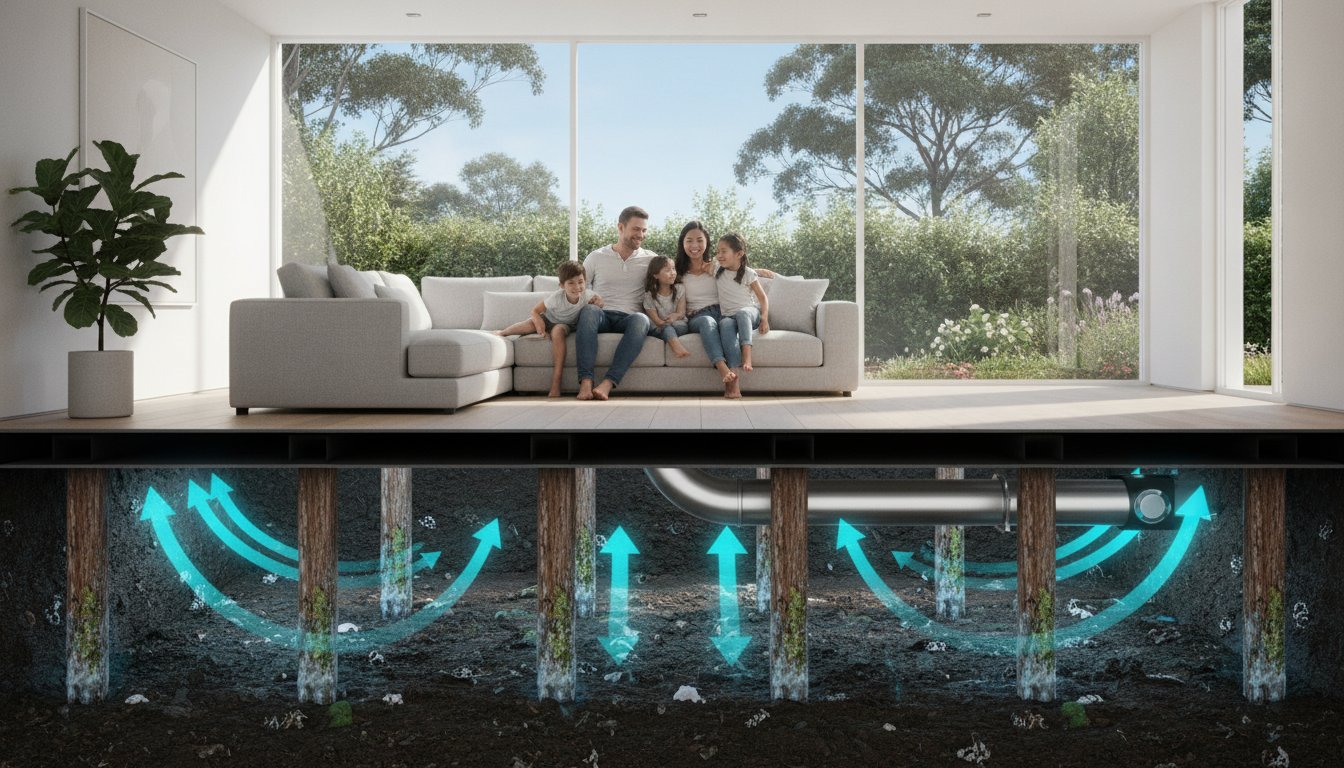
Mould is often a symptom of underlying structural issues. Faulty door seals or damaged insulation panels lead to temperature fluctuations and excessive condensation. This moisture is the primary driver of secondary mould growth. If your cool room is built on a ground slab, you may also need to consider subfloor ventilation system installation to prevent rising damp from compromising the floor integrity. Addressing water damage immediately is vital to preventing structural failure. By fixing the source of the moisture and remediating the air quality, you protect both your stock and your long-term capital investment.
The ABC Solution: Expert Cool Room Remediation in Sydney
ABC Mould Cleaning Solutions provides a systematic, evidence-based approach to restoring your facility. In commercial cool rooms, focus on how standard cleaning isn’t enough to ensure long-term safety; you need a process that targets both surface colonies and airborne spores. Our methodology relies on the Goldmorr System, a proprietary technology that provides a deeper level of sanitation than any retail alternative. We don’t just scrub surfaces; we neutralise the biological threat at its source using a streamlined, four-stage process designed for maximum efficiency.
- Mould Inspection Services: We identify hidden reservoirs and moisture ingress points that staff cleaners often miss.
- Goldmorr Fogging: Our non-mechanical mist reaches behind fan coils and into insulation gaps where mould hides.
- Air Purification & Scrubbing: We deploy industrial HEPA units to strip 99.97% of bio-aerosols from your cold storage environment.
- Prevention: We provide a professional remediation certificate and specific maintenance advice to stop future outbreaks.
Sydney businesses trust us because we prioritise results without compromising on safety. Our staff are highly trained specialists who understand the urgency of commercial operations. We work quickly to restore your environment so you can focus on your customers. By choosing a professional remediation service, you’re investing in the longevity of your equipment and the integrity of your stock. It’s the most pragmatic way to transition from a state of constant concern to a state of total resolution.
Tailored Solutions for Hospitality and Warehousing
Disruption is the enemy of profit. We understand that your kitchen or warehouse cannot stop for days. We recently restored a major Sydney restaurant cool room in just 4 hours, allowing them to resume operations before the dinner rush. We use biodegradable, food-safe technologies that leave no toxic residues. This makes our process ideal for high-volume hospitality environments where chemical contamination is a primary concern. Every treatment is customised to your specific scheduling needs to minimise operational downtime.
Get a Professional Assessment Today
Mould thrives in cold environments, doubling its presence rapidly if left unchecked. Waiting only increases the risk of stock loss and failed health inspections. Book your Sydney cool room inspection now to secure your facility and protect your brand reputation. We offer an aggressive Price Match Guarantee for any comparable professional remediation service. This ensures you receive the highest level of expertise at the best possible value. Don’t let a musty smell become a legal liability. Secure your business with a hassle-free professional assessment today.
Secure Your Food Safety Rating and Inventory Integrity
Maintaining a safe environment requires more than just a bucket and a brush. As we have explored, in commercial cool rooms, focus on how standard cleaning isn’t enough because it fails to eliminate the airborne spores that cause rapid re-colonisation. You now understand that while surfaces might look clean, the internal components of your cooling system can still harbour dangerous biological growth. Professional remediation is the only way to ensure total compliance with NSW food safety standards and protect your business from the high cost of stock loss.
Our certified Sydney-based remediation specialists are ready to help you restore safety to your facility. We utilise the industry-leading Goldmorr System to provide a deep, non-toxic clean that targets every hidden corner of your cold storage. If you are facing an urgent issue, we provide a 24/7 emergency response for water damage and mould. Protect your stock and book a professional cool room assessment today.
Take the first step toward a worry-free health inspection and a healthier workplace for your staff. We are here to help you resolve these issues quickly and permanently.
Frequently Asked Questions
Is the mould removal process safe for food storage areas?
Yes, our remediation process is specifically designed for high-stakes food environments. We use the Goldmorr System, which involves biodegradable and non-toxic agents that neutralise mould without leaving harmful chemical residues behind. This is a critical distinction in commercial cool rooms. Focus on how standard cleaning isn’t enough to keep food safe, as harsh retail detergents can actually taint your stock. Our methodology ensures your facility remains compliant with NSW food safety standards while protecting your inventory.
How long do we need to keep the cool room empty during remediation?
Most cool rooms can be treated and returned to full service within 4 to 6 hours. The exact timeframe depends on the dimensions of the room and the severity of the microbial growth. Because our fogging process is non-mechanical and highly efficient, we minimise operational downtime compared to manual scrubbing. We coordinate with your team to schedule treatments during off-peak hours. This ensures your logistics or kitchen operations face the least possible disruption.
Can we just use vinegar or clove oil to clean our commercial cool room?
Natural alternatives like vinegar or clove oil are insufficient for commercial environments. While they might kill some surface mould, they cannot penetrate porous insulation panels or reach the internal components of fan coil units. These DIY methods fail to address airborne spores, which leads to immediate re-colonisation. In commercial cool rooms. Focus on how standard cleaning isn’t enough to stop the biological cycle. Professional remediation is required to ensure long-term protection and regulatory compliance.
How often should a commercial cool room be professionally remediated?
We recommend a professional assessment every six months for most facilities. High-traffic cool rooms with frequent stock rotation or those storing high-moisture produce may require quarterly treatments. Regular remediation prevents the buildup of invisible bio-aerosols that compromise food safety. By establishing a proactive schedule, you avoid the high costs of emergency shutdowns and stock loss. Our specialists provide a tailored maintenance plan based on your specific operational volume and moisture levels.
What is the difference between a cool room cleaner and a mould remediation specialist?
A general cleaner focuses on visible grime and surface aesthetics using basic detergents. A mould remediation specialist is a trained professional who uses scientific methods to eliminate both surface colonies and airborne spores. Specialists use industrial equipment like HEPA air scrubbers and antimicrobial foggers to achieve a biologically safe environment. While a cleaner might make the room look good, a specialist ensures it is actually safe and compliant with strict NSW health regulations.
Will professional remediation help with the musty smell in our fridge?
Yes, professional remediation is the most effective way to eliminate persistent musty odours. These smells are caused by volatile organic compounds released by active mould and bacteria. Because our process includes HEPA air scrubbing and deep fogging of the ventilation system, we remove the source of the odour rather than just masking it. Once the microbial load is neutralised, your cool room will smell fresh and your food quality will be protected from off-flavours.
Does the Goldmorr System leave any toxic residue on surfaces?
No, the Goldmorr System is formulated to be biodegradable and leaves no toxic residue. This is a primary reason why it is the industry standard for food storage areas and commercial kitchens. Unlike harsh industrial bleaches or retail chemicals, our solutions break down safely after the treatment is complete. You can rest assured that your surfaces remain food-safe and your facility meets the highest hygiene standards without introducing secondary chemical hazards into your storage area.
What happens if we fail a health inspection due to mould?
Failing a health inspection can lead to immediate closure orders and heavy financial penalties. In New South Wales, businesses that fail to meet hygiene standards are often listed on the NSW Food Authority’s public register, which causes permanent brand damage. You may also face legal liability if contaminated stock reaches consumers. Investing in professional remediation is a pragmatic business decision that protects your license, your reputation, and your bottom line from these severe consequences.