
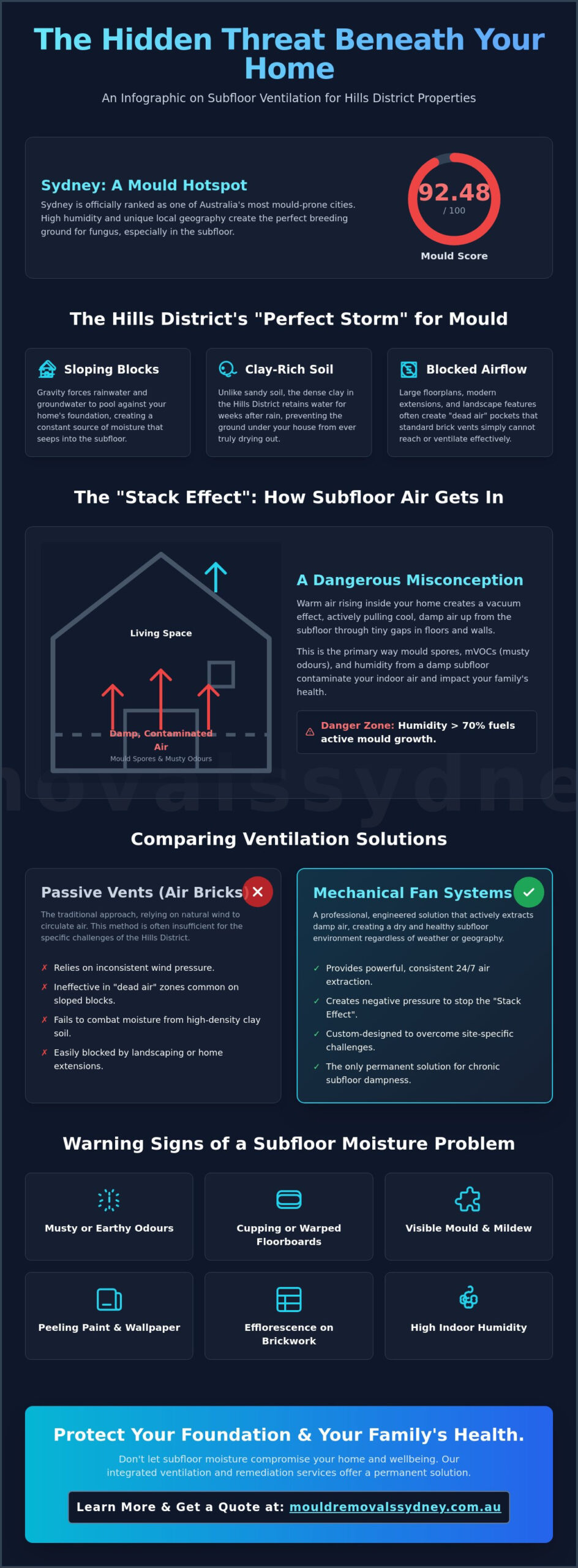
Did you know that Sydney is officially ranked as one of the most mould-prone cities in Australia, carrying a mould score of 92.48 out of 100? For homeowners in the Hills District, this isn’t just a number. The local clay-rich soils and high humidity create a perfect storm for moisture to pool beneath your home. If you’ve noticed a persistent musty smell or cupping floorboards, you’re likely dealing with a buildup of ground dampness. Implementing a professional subfloor ventilation hills district system is the only way to break this cycle and stop structural rot before it compromises your foundation.
It’s exhausting to clean mould off your walls only to have it reappear weeks later. You want a home that feels fresh and safe, not one that triggers respiratory issues for your children or elderly family members. This guide explains how specialized ventilation protects your property from the ground up, eliminating the dampness that fuels fungal growth. We’ll examine why the Hills District’s unique geography requires a technical approach to airflow and how you can achieve a permanently dry, odour-free living space.
Key Takeaways
- Learn why the sloping blocks and clay soil of the region require a tailored approach to subfloor ventilation hills district to prevent water from trapping against your foundation.
- Understand the “Stack Effect” and how damp subfloor air migrates upward, carrying harmful mould spores and musty odours into your primary living areas.
- Compare high-performance mechanical systems against traditional air bricks to determine the most effective moisture control solution for properties with limited natural airflow.
- Discover how to use the “Nose Test” and look for visual cues like efflorescence to identify hidden moisture issues before they cause permanent timber rot.
- Explore why ventilation alone is often insufficient and how our proprietary Goldmorr System purifies your indoor air while addressing existing fungal growth.
Why Hills District Homes Require Specialised Subfloor Ventilation
Subfloor ventilation isn’t just about blowing air under a house. It’s a strategic system designed to control the relative humidity levels within the enclosed space between the ground and your floorboards. In the Sydney region, particularly for those seeking subfloor ventilation hills district solutions, this management is a structural necessity. Without it, the space becomes a reservoir for stagnant, moisture-laden air that inevitably feeds fungal growth and rot. Standard brick vents often fail in this high-humidity climate because they rely on natural wind pressure, which is rarely consistent enough to clear the heavy dampness found in local soils.
The geography of the Hills District presents specific environmental challenges that flat coastal areas don’t face. Most homes here sit on sloping blocks. While this provides great views, it creates a drainage nightmare. Gravity forces surface runoff and groundwater directly toward your foundation walls. When this water meets the clay-heavy soil found in suburbs like Baulkham Hills and Castle Hill, it doesn’t just drain away. High-density clay retains moisture for weeks after a single storm, creating a constant source of evaporation right beneath your feet. This creates a cycle where the soil never fully dries out, even during summer.
The “Hills” Factor: Topography and Drainage
Sloped blocks in Kellyville and Bella Vista often suffer from “perched water tables.” This occurs when water becomes trapped above an impermeable layer of sandstone or clay, saturating the earth directly under the home. Standard brick vents rely on natural breezes to clear this moisture; however, the geography of the Hills often creates “dead air” pockets where wind cannot reach. Local soil density effectively prevents natural evaporation, turning your subfloor into a permanent damp cellar. Understanding The Science of Subfloor Moisture is crucial here; as the ground stays wet, the air above it reaches a dew point that triggers condensation on timber bearers and joists.
Brick Veneer vs. Full Brick: Local Construction Issues
Many older properties in the Hills District were built with minimal original ventilation that doesn’t meet modern standards. Large floorplans, common in the area, create massive internal subfloor zones where air simply stops moving. We frequently see homes where modern renovations or concrete extensions have accidentally blocked the few existing vents. This creates a sealed environment where humidity levels skyrocket. Professional subfloor ventilation hills district specialists must often design custom extraction paths to bypass these structural blockages. Passive vents are rarely enough to combat the sheer volume of moisture generated by the combination of clay soil and restricted airflow.
The Science of Subfloor Moisture: From Damp Soil to Airborne Mould Spores
Many homeowners believe the space beneath their feet is isolated from the air they breathe. This is a dangerous misconception. The “Stack Effect” describes a natural phenomenon where warm air rises through your home, creating a vacuum that pulls cool, damp air from the subfloor through floorboard gaps and wall cavities. This physical process is why a damp subfloor is the absolute primary cause of recurring black mould in Sydney residences. If the ground is wet, the air above it becomes saturated. Once relative humidity exceeds 70%, mould spores don’t just sit dormant; they germinate and colonize every available surface.
This moisture doesn’t just stay hidden. As mould grows, it releases microbial volatile organic compounds (mVOCs) and geosmin. These chemicals produce that unmistakable “musty house” smell that cleaning products can’t mask. According to NSW Health, Identifying the Warning Signs of rising damp early is vital because poor airflow beneath the home is often the silent culprit. Installing a high-performance subfloor ventilation hills district system interrupts this cycle. It ensures that moisture never has the chance to accumulate, keeping the air beneath your home as dry as the air inside it.
Connecting Subfloor Health to Indoor Air Quality
Microscopic spores are light enough to travel through the smallest gaps in your floorboards. Once they enter your living areas, they become part of the air you inhale. This is particularly dangerous for residents with asthma or chronic respiratory conditions. If your subfloor has been damp for a long time, spores may have also settled in your HVAC system. In these cases, professional air duct cleaning is often necessary alongside ventilation to fully restore a healthy environment. Don’t let your home’s foundation compromise your family’s health.
Structural Risks: Termites and Timber Decay
Moisture is a magnet for disaster. Termites are naturally attracted to the high-moisture environment of a poorly ventilated subfloor because they require damp conditions to survive. Beyond pests, excess humidity causes timber floorboards to undergo “cupping” or “crowning,” where the wood warps as it absorbs water. This isn’t just an aesthetic issue. Over time, constant dampness weakens the structural integrity of your brick piers and bearers. If you’ve noticed your floors feeling soft or uneven, it’s time to book a mould inspection to assess the extent of the moisture damage.
Mechanical vs. Passive Ventilation: Comparing Solutions for Sydney Properties
Choosing the right method to dry your home’s foundation is a critical decision. Passive ventilation relies on natural air bricks and wind pressure to move air through the crawl space. While this was the standard for decades, it’s often insufficient for the modern subfloor ventilation hills district requirements. Mechanical, or active, ventilation uses high-performance extraction fans to force a consistent air exchange regardless of the weather outside. For a system to be effective, it must establish “cross-flow” dynamics. This means air is pulled from one side and exhausted out the other, ensuring no stagnant pockets remain to host mould colonies.
Homeowners often worry about energy costs, but modern mechanical systems are remarkably efficient. A high-quality extraction unit typically costs less to run than a single low-wattage light bulb. Understanding The Science of Subfloor Moisture is essential for choosing between these two methods. The National Construction Code (NCC) 2022 requires a minimum of 6,000mm² of unobstructed vent area per lineal metre of wall. On damp sites, this requirement jumps by 50%. Most passive vents simply can’t meet this volume of airflow in the heavy, humid air typical of the Sydney basin.
Why Passive Vents Often Fail in the Hills District
The “dead air” problem is rampant in large, modern Sydney homes. Passive vents require a steady breeze to function, but the sloping topography of the Hills often blocks natural wind paths. When the air outside is as humid as the air inside the subfloor, natural exchange stops completely. Older terra cotta vents are particularly prone to failure. They often become clogged with debris or are blocked by garden beds and landscaping. If your humidity levels stay high despite having open vents, your passive system has reached its limit and requires a mechanical upgrade.
The Benefits of High-Efficiency Mechanical Fans
Modern mechanical systems solve the two biggest homeowner concerns: noise and control. We install ultra-quiet fans that are virtually silent from inside the living area. These aren’t simple “on-off” fans. They utilize smart sensors that monitor ambient humidity. They only activate when moisture levels rise, ensuring you don’t waste energy when the air is already dry. To maintain a truly dry subfloor, a mechanical system should achieve a minimum of five to ten total air exchanges every hour. This high rate of movement prevents spores from settling and keeps your floorboards stable and rot-free. Professional subfloor ventilation system installation is the most reliable way to guarantee these results.
Identifying the Warning Signs: When to Seek Professional Subfloor Remediation
You don’t always need to crawl into a dark space to know your home is at risk. Your senses provide the first line of defense. The “Nose Test” is often the most reliable indicator of a failing subfloor ventilation hills district setup. If you notice a persistent, earthy, or stale scent that lingers despite open windows, you’re likely smelling geosmin and microbial volatile organic compounds (mVOCs). These are gases released by fungi as they colonize damp soil and timber. This isn’t just an “old house” smell; it’s a chemical signal that your subfloor environment is biologically active.
Visual cues are equally telling. Inspect your brick piers and foundation walls for efflorescence. This is a white, powdery mineral deposit left behind as moisture evaporates through masonry. It proves that water is being drawn up through the bricks via capillary action. Additionally, keep an eye on your internal surfaces. If you find mould appearing specifically on the lower half of your walls or witness persistent condensation on windows without a clear cause, the humidity below your floorboards has reached a critical level.
The Checklist for Hills District Homeowners
Walk through your home and pay close attention to the feel of the floor beneath your feet. Does the timber feel “springy” or uneven in certain sections? This often indicates that moisture has caused the wood to swell or lose structural integrity. If you can access the subfloor, look for darkening or staining on the underside of the boards. Inside the living area, check your skirting boards for peeling paint or bubbling plaster. These are classic signs of “rising damp,” where moisture is wicked up from a saturated subfloor into your internal wall linings.
The Professional Inspection Process
Guesswork is dangerous when it comes to structural health. Our specialists use precision moisture meters to quantify exactly how much water is trapped in your building materials. We often identify “bridged” damp proof courses. This is a common issue in Sydney where garden soil or new paving has been built up above the original moisture barrier. We also employ thermal imaging to detect hidden moisture pockets behind walls that the naked eye can’t see. If you’ve spotted any of these red flags, you should book a professional mould inspection immediately to stop the damage before it requires expensive structural repairs.
The ABC Mould Cleaning Solution: Integrated Ventilation and Remediation
Installing a subfloor ventilation hills district system is a vital preventative measure, but it’s only half the battle if fungal colonies have already established themselves. Many companies simply install fans and leave. We don’t. If mould is already present on your bearers, joists, or soil, simply increasing airflow can actually spread dry spores throughout your crawl space and into your living areas. You need an integrated approach that combines mechanical extraction with professional remediation to ensure your home is truly safe.
We utilize the Goldmorr System. This is our specific, trademarked methodology for air purification and surface treatment. It involves a specialized biodegradable fogging process that targets airborne spores that traditional cleaning misses. We don’t just scrub surfaces; we scrub the air. By combining this with our high-performance subfloor ventilation hills district installations, we create a permanent barrier against moisture and microbial growth. This dual-action approach ensures that we aren’t just drying out a problem, but actively removing it.
Our team understands the unique challenges of the Hills region. We know how the local clay soils trap moisture and how the sloping blocks in suburbs like Castle Hill create specific drainage issues. This local expertise allows us to design systems that work with your property’s topography, not against it. We provide a global standard of care delivered by specialists who live and work in your community. Our goal is to restore your home to a state of total environmental safety quickly and efficiently, providing the perfect backdrop for family life; if you are preparing your home for a new arrival, you can check out Moments In Bloom Photography for professional newborn portraits in your safe and healthy environment.
The Goldmorr Advantage for Hills District Families
Your family’s safety is our primary concern. The Goldmorr System uses non-toxic, biodegradable products that are safe for children, pets, and the elderly. Unlike harsh chemical treatments, our fogging process eliminates surface mould and invisible airborne spores simultaneously without leaving dangerous residues. This comprehensive approach provides the peace of mind that comes with a guaranteed mould removal service. We don’t just mask the problem; we eliminate it at the source.
Next Steps: Securing Your Property’s Future
Don’t wait for the musty smell to become a structural failure. Acting fast is the best way to prevent the need for extensive water damage repair. A damp subfloor is a ticking clock for your timber foundations. Contact us today to book a comprehensive inspection of your subfloor and living areas. Our specialists will provide a detailed assessment and a clear path to a dry, healthy home. Protect your home today—contact ABC Mould Cleaning Solutions for an expert Hills District assessment.
Secure Your Home’s Foundation Today
Your home is likely your most significant investment. Don’t let the unique topography of the region compromise its structural integrity or your family’s health. We’ve seen how the combination of sloping blocks and clay soil creates a perfect environment for dampness and fungal growth. By implementing a professional subfloor ventilation hills district system, you interrupt the cycle of moisture and protect your timber from permanent rot.
Our team combines expert Hills District local knowledge with the specialised Goldmorr System to purify your air and dry your foundations. We don’t just guess; we provide comprehensive moisture and air quality reports to quantify the health of your property. Get a Free Subfloor Ventilation Quote in the Hills District. Take the first step toward a dry, odour-free home and enjoy the peace of mind that comes with a professionally managed environment.
Frequently Asked Questions
How much does subfloor ventilation cost in the Hills District?
Pricing for subfloor ventilation hills district projects varies based on the size of your crawl space and the severity of the moisture issue. Every property in the Hills has different drainage challenges and soil types. We avoid one-size-fits-all pricing to ensure you only pay for the specific extraction capacity your home needs to stay dry and mould-free. We recommend a professional on-site assessment to provide an accurate quote.
Will subfloor ventilation stop the musty smell in my house?
Yes, a correctly designed system will eliminate that persistent musty scent. These odours are produced by mould and damp soil beneath your floorboards. By forcing a consistent air exchange, mechanical ventilation removes these odours before they can enter your home. This results in a fresh, neutral-smelling environment for your family while preventing the health risks associated with airborne spores.
How long does it take to install a mechanical ventilation system?
Most professional installations take between four to eight hours to complete. Our technicians arrive with all necessary equipment to install fans, wiring, and ducting in a single visit. We prioritise efficiency so your home’s moisture management is restored as quickly as possible. For expansive properties with complex subfloor layouts, we provide a clear timeline before any work begins.
Are subfloor ventilation fans noisy to run at night?
No, we utilise high-performance fans engineered specifically for quiet residential use. These units are significantly quieter than a standard bathroom exhaust fan. Because they are mounted on the external foundation walls or within the subfloor itself, the sound is muffled by your flooring. You can sleep soundly while the system works to keep your home’s foundation dry.
Can I install subfloor ventilation myself?
Installing these systems yourself is risky and often ineffective. Professionals use airflow modelling to ensure moisture is actually removed rather than just moved around. DIY attempts frequently result in short-circuiting, where air enters and exits the same area without clearing the dampness from the centre of the house. It’s best to rely on experts who understand the “Stack Effect” and cross-flow dynamics.
Does subfloor ventilation help with termites?
Yes, ventilation is a powerful tool in your termite prevention arsenal. Termites thrive in dark, damp, and stagnant conditions. By drying out the soil and timber bearers beneath your home, you create a hostile environment for these pests. While it doesn’t replace regular termite inspections, it significantly reduces the environmental factors that attract them to your property’s foundation in the first place.
What is the difference between rising damp and subfloor condensation?
Rising damp is the physical movement of liquid water up through bricks, whereas condensation is moisture from the air settling on cool surfaces. Both problems stem from excessive subfloor humidity. As noted by humidity treatment specialists like HYPERSEC, a high-quality subfloor ventilation hills district system addresses both by maintaining a low dew point, ensuring that bricks stay dry and air remains too dry for condensation to form on your timber.
How often do ventilation systems need maintenance?
You should have your system professionally serviced every two years. During this visit, we check the fan bearings, clear any external vent obstructions, and test the humidity sensors. Regular maintenance ensures the system operates at maximum efficiency and extends the lifespan of the mechanical components. This small investment prevents moisture from creeping back into your subfloor due to a clogged or failing fan.