
Did you know that nearly one in five maintenance disputes reported to NSW Fair Trading now involve mould? If you’re currently struggling with a damp, smelling apartment while being gaslit by a property manager who claims it’s just “condensation,” you’re part of a growing crisis in the Sydney rental market. It’s incredibly stressful to watch your furniture ruin and your health decline while your urgent requests for help are ignored or dismissed. You shouldn’t have to choose between your well-being and your home. You deserve a space that’s safe and fit for habitation.
This guide shows you exactly how to take control when dealing with a landlord who won’t fix mould by using the 2026 NSW tenancy laws to your advantage. We’ll explain how to exercise your legal rights under the Residential Tenancies Act and provide the evidence needed to force immediate action. You’ll learn the specific steps to secure a rent reduction for the period of disrepair and how to navigate the NCAT process with professional inspection reports. We’re here to help you move from a state of anxiety to a clear resolution. It’s time to ensure your home becomes the safe, mould-free environment you’re paying for.
Key Takeaways
- Understand the 2026 “fit for habitation” standards and why mould qualifies as an urgent repair under the NSW Residential Tenancies Act.
- Learn the exact documentation steps required when dealing with a landlord who won’t fix mould, including why a professional inspection report is your most powerful legal asset.
- Discover the formal escalation process from written notification to NCAT hearings, ensuring you follow the correct legal protocols to secure rent reductions.
- Identify the health risks of DIY cleaning and how to use professional-grade air purification to protect your family while waiting for remediation.
- Understand why surface cleaning fails and how professional remediation using the Goldmorr System provides a permanent, non-toxic solution for your home.
Understanding Your Rights: Mould and the NSW Residential Tenancies Act
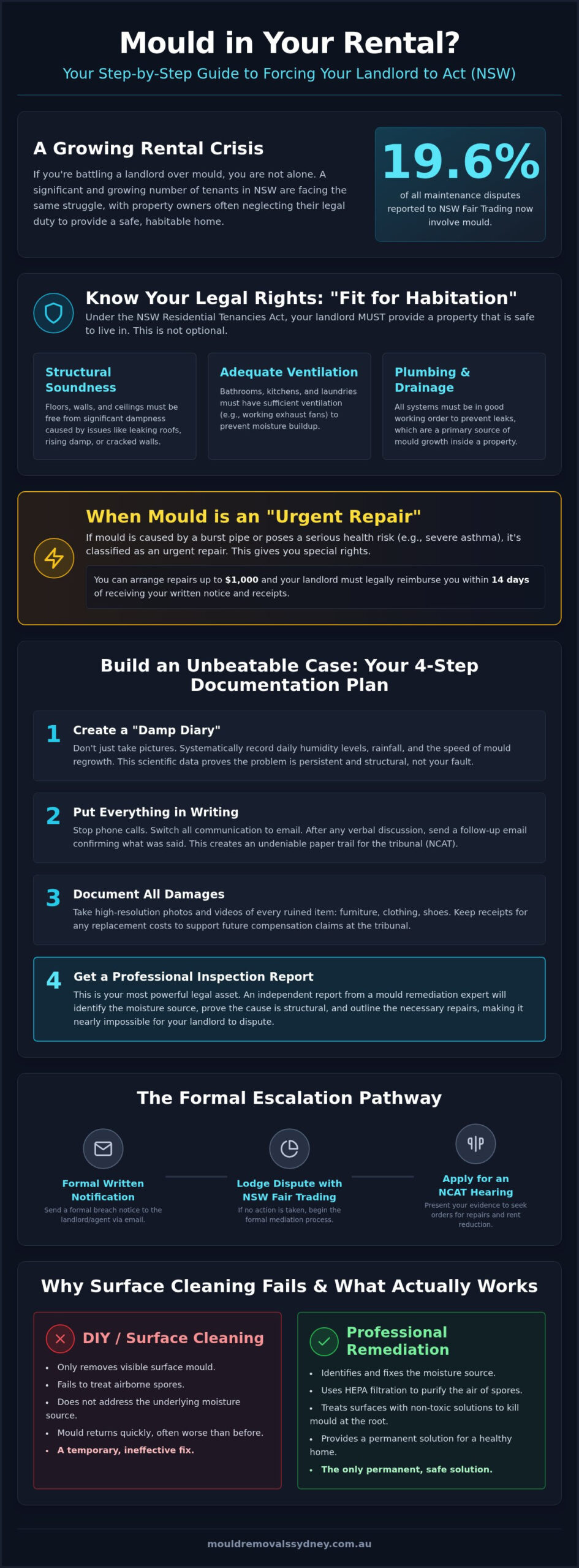
Under the Residential Tenancies Act 2010, updated for the 2026 rental climate, a property must be “fit for habitation.” This isn’t a vague suggestion; it’s a legal requirement. Dealing with a landlord who won’t fix mould often feels like a losing battle, but the law is on your side when the issue stems from structural neglect. If the mould is caused by a leaking roof, cracked walls, or rising damp, the responsibility sits squarely with the property owner. You’re paying for a safe environment, not a health hazard.
Mould is a complex fungal growth that requires specific conditions to thrive. For a comprehensive overview of mould and its biological impact on indoor environments, understanding how spores spread is vital. In Sydney’s humid climate, even minor ventilation failures can lead to massive infestations. Landlords often try to blame “lifestyle factors” like drying clothes indoors, but they’re legally required to maintain the building’s plumbing, drainage, and ventilation systems to prevent moisture buildup in the first place.
The core of most disputes lies in identifying whether the issue is a structural defect or a tenant habit. Landlords frequently use lifestyle claims as a shield to avoid remediation costs. However, if the subfloor ventilation is blocked or the building lacks a proper damp-proof course, no amount of open windows will stop the growth. In the 2024-2025 period, mould accounted for 19.6% of all maintenance disputes reported to NSW Fair Trading. This proves that for many Sydney renters, the problem is systemic building failure rather than personal habits.
The Seven Minimum Standards for Sydney Rentals
Sydney’s high humidity levels make the seven minimum standards for habitation critical for your protection. A property must be structurally sound and have adequate ventilation. In 2026, “adequate” means more than just a window that opens; it requires functioning exhaust fans in bathrooms and laundries. Your original Condition Report is a vital piece of evidence here. If you noted dampness or musty smells when you first moved in, the landlord cannot easily claim your actions caused the current infestation. Key requirements include:
- Structural Soundness: The floors, ceilings, and walls must be free from significant dampness.
- Ventilation: Bathrooms and laundries must have enough airflow to prevent fungal growth.
- Plumbing and Drainage: All systems must be maintained in good working order to prevent internal leaks.
When Mould Becomes an ‘Urgent Repair’
Mould isn’t always a slow-burn issue. It becomes an “urgent repair” if it’s caused by a burst pipe or if it poses an immediate health risk, such as triggering severe asthma or allergies. When these conditions are met, landlords are expected to respond within 24 to 48 hours. Dealing with a landlord who won’t fix mould in these urgent scenarios allows you to take direct action. Under NSW law, tenants can arrange for urgent repairs themselves and seek reimbursement up to $1,000. The landlord is legally required to pay you back within 14 days of receiving your written notice and receipts. Don’t let a property manager tell you that a health-threatening infestation can wait for a routine inspection.
Building Your Case: Documenting Mould Evidence Like a Pro
Photographs of black spots on a wall rarely win a legal dispute. Dealing with a landlord who won’t fix mould requires a scientific baseline that proves the moisture source is structural. Start a “Damp Diary” immediately. Record daily humidity levels, rainfall, and the speed of mould regrowth after cleaning. This data creates a clear timeline that property managers cannot easily dismiss as tenant neglect. Record video footage of moisture dripping from ceilings or windows; digital media is much harder to dispute than static images in a tribunal setting.
Stop using phone calls for maintenance requests. Shift all communication to email or registered post. If a property manager tells you to “just open a window” over the phone, follow up with a written summary. State: “As per our conversation today, you suggested opening windows to resolve the structural dampness.” This archives their attempt to minimize the issue and builds an undeniable paper trail for future NCAT hearings. You must also document every ruined item of clothing or piece of furniture. Take high-resolution photos of the damage and keep receipts for replacement costs to support future compensation claims.
How Professional Inspections Prove Landlord Liability
A professional mould inspection provides the technical evidence required to settle liability once and for all. Specialists use thermal imaging cameras to see moisture behind walls and moisture meters to detect rising damp within the building’s structure. These tools prove if a leak is internal or if the subfloor ventilation is failing. This scientific approach directly counters the common “lifestyle” gaslighting used by agents. Refer to the NSW Health fact sheet to understand how these airborne spores impact your health and why professional detection is necessary for safety.
The Paper Trail: From Email to Breach Notice
If the landlord fails to act within 14 days of your written request, you must issue a formal “Notice of Breach of Agreement.” This is a specific legal document that officially puts the landlord on notice. It signals that you understand your rights and are prepared to escalate the matter to NSW Fair Trading. Set a firm deadline for remediation and clarify that surface-level cleaning is not an acceptable solution for structural defects. Dealing with a landlord who won’t fix mould becomes much easier when you present them with a professional report and a formal breach notice simultaneously. This combination usually forces a transition from avoidance to action.
Escalation Steps: From Fair Trading to NCAT Hearings
If your formal breach notice expires without a satisfactory response, you must move to the next stage of legal escalation. Dealing with a landlord who won’t fix mould requires a systematic approach to ensure you don’t lose your rights. The first step is contacting NSW Fair Trading for their free dispute resolution service. A Fair Trading officer will act as an independent mediator to reach an agreement between you and the property manager. While this process is non-binding, it’s often the catalyst that makes a negligent landlord realize the severity of the situation. In the 2024-2025 period, mould accounted for nearly 20% of all maintenance disputes, so the officers are well-versed in these specific challenges.
If mediation fails, your final and most powerful option is the NSW Civil and Administrative Tribunal (NCAT). For a $53 application fee, you can seek legally binding orders that the landlord cannot ignore. This transitions the dispute from a private argument to a judicial matter where the property owner must answer for the building’s condition. Don’t let the fear of retaliatory eviction stop you from acting. Section 115 of the Residential Tenancies Act 2010 makes it illegal for a landlord to evict you simply because you’ve complained or applied for a tribunal hearing. You’re protected by law when you demand a safe, habitable home.
Navigating the NCAT Process in Sydney
Success at NCAT depends entirely on the quality of your evidence. When filling out the Tenancy Application form, be specific about the orders you want. Don’t just ask for generic “repairs”; request professional remediation by IICRC-trained technicians. Include your expert inspection reports and any data from your “Damp Diary” to prove the timeline of neglect. During the conciliation phase, a Tribunal member will encourage both parties to settle. Stay firm on your requirement for a permanent, scientific solution, such as the Goldmorr System, rather than a temporary “bleach and paint” fix. If you can’t agree, the matter proceeds to a formal hearing where a member will make a final, enforceable decision.
Requesting Rent Reductions and Compensation
You have a right to seek a rent reduction for “loss of amenity” from the date you first notified the landlord of the issue. If a bedroom is unusable due to spores or a bathroom is hazardous, you shouldn’t be paying full price. Calculate a percentage based on the area of the home you can no longer safely inhabit. Additionally, you can claim compensation for personal property damage, such as mould-infested clothes or furniture, and medical expenses related to respiratory issues. The Tribunal can issue an “Order for Repairs,” which legally compels the landlord to fix the issue within a set timeframe. This order ensures that professional standards are met, preventing the common “handyman” approach that typically fails within three months.
Protecting Your Health While the Dispute Continues
Dealing with a landlord who won’t fix mould is an exhausting process, but your respiratory health cannot wait for a tribunal hearing. While you navigate the legal escalation steps discussed previously, you must implement immediate safety measures to reduce spore inhalation. Identifying black mould symptoms early is your first line of defence. If you notice persistent respiratory irritation, chronic fatigue, or sudden allergy flare-ups, the infestation is already impacting your quality of life. These symptoms are clear indicators that the property is no longer “fit for habitation” under the 2026 NSW standards. Don’t ignore these physical warning signs while the legal process grinds on.
Ensuring a healthy environment is a holistic priority for any parent; just as you work to make your home safe, schools like Perth Montessori focus on creating healthy, supportive spaces where students can thrive.
The Myth of Bleach and DIY Removers
Stop using supermarket bleach on porous surfaces. It’s a common mistake that actually feeds the problem. Bleach is mostly water; while the chlorine removes the visible black stain, the water component soaks into the material, providing the moisture the mould needs to grow back stronger. The “roots,” known as hyphae, remain completely intact. You should also avoid using standard domestic vacuum cleaners on any visible growth. Unless your vacuum is equipped with a certified HEPA filter, you are simply aerosolising the spores. This process blasts microscopic particles through the vacuum exhaust and onto your bedding, clothes, and furniture. Natural alternatives like vinegar or tea tree oil are safer for pets but only offer temporary relief. They don’t address the underlying structural moisture that keeps the colony alive. For a scientific evaluation of your indoor air quality, contact our team for a professional mould inspection.
Managing Air Quality in Damp Sydney Rentals
Sydney’s 2026 climate has seen record humidity levels, making moisture management a full-time job for tenants. To protect yourself, invest in a high-quality HEPA air purifier to scrub spores from the air in your sleeping areas. Manage humidity by using a dehumidifier rather than relying on expensive split-system heating, which can sometimes circulate contaminants if the filters are dirty. In fact, air duct cleaning is often necessary if the mould has entered the building’s HVAC system, as this turns the vents into spore delivery units. In high-risk suburbs like the Inner West, keeping indoor humidity below 55% is essential to halt active growth. Be wary of the electricity costs associated with running heavy machinery; a professional subfloor ventilation system is the landlord’s responsibility to install and maintain. If the landlord continues to ignore the structural defects causing this moisture, and your health continues to decline, relocation may be your only safe option. Document any medical advice to move out, as this will strengthen your compensation claim at NCAT later.
Professional Remediation: The Only Permanent Solution
Surface cleaning is a temporary mask, not a cure. Dealing with a landlord who won’t fix mould usually leads to a cycle of “handyman” repairs where visible growth is scrubbed and painted over. This approach is guaranteed to fail within three months because it ignores the biological reality of fungal colonies. Professional remediation requires a systematic, evidence-based approach to eliminate both the visible infestation and the invisible airborne spores that continue to contaminate your home. Anything less is just a cosmetic fix that leaves your health at risk.
The Goldmorr System is our primary methodology for safe, effective removal. This proprietary system uses biodegradable fogging to neutralise spores without leaving toxic residues, making it safe for your family and pets. True resolution also demands addressing the root cause, such as inadequate subfloor ventilation or structural dampness. Once the work is finished, always insist on a “Certificate of Clearance.” This document proves the property has been restored to a sanitary state and provides vital evidence if you ever need to return to NCAT to prove the landlord finally met their obligations.
Why ABC Mould Cleaning Solutions is the Expert Choice
We position ourselves as the primary solution for Sydney tenants facing neglectful property management. Our IICRC-trained technicians use the Goldmorr System to restore safety quickly and efficiently. We provide comprehensive inspection reports that satisfy both NCAT requirements and insurance claims, removing the guesswork from your legal dispute. Our process is fast and professional. It’s designed to provide the emotional relief you need after months of living in a hazardous environment. We don’t just clean; we restore your well-being through scientific methodology.
Preventing Future Growth After Remediation
Stopping the recurrence of mould requires a two-pronged strategy. First, any structural failures must be addressed through professional water damage repair to ensure the building remains dry. Second, follow this final checklist to maintain a mould-free tenancy:
- Verify Ventilation: Ensure all exhaust fans are cleaned and functioning at 100% capacity.
- Report Early: Document any new leaks or damp patches in writing within 24 hours of discovery.
- Control Humidity: Maintain indoor humidity levels below 55% using dehumidifiers during Sydney’s wet periods.
Dealing with a landlord who won’t fix mould is a battle for your health and rights. By insisting on professional remediation rather than amateur cleaning, you ensure that the problem is solved once and for all. Don’t settle for a fresh coat of paint when you deserve a house that’s truly fit for habitation. It’s time to take back your home and breathe easy again.
Take Control of Your Living Environment Today
You now have a clear roadmap to transition from frustration to resolution. Your right to a habitable home is non-negotiable under NSW law. Success depends on moving away from informal complaints and building a scientific trail of evidence. By documenting damage and demanding professional remediation instead of “handyman” patches, you protect your health and your legal standing. You don’t have to navigate this stressful process alone.
Dealing with a landlord who won’t fix mould requires more than just persistence; it requires authoritative verification. ABC Mould Cleaning Solutions provides NCAT-ready expert reports that property managers cannot ignore. With over 15 years of experience servicing Sydney rentals and our Goldmorr System certification, we deliver the evidence needed to force action and restore your home. Take the first step toward a mould-free tenancy.
Book a Professional Mould Inspection for Your Rental Today
Don’t spend another night in a hazardous environment. You have the legal tools, the rights, and the specialist support needed to reclaim your space and breathe easy again.
Frequently Asked Questions
Can I stop paying rent if my landlord won’t fix the mould?
No, you must continue paying your rent in full even when dealing with a landlord who won’t fix mould. Stopping payments is a direct breach of your tenancy agreement and gives the landlord legal grounds to evict you. Instead, you should apply to NCAT for a rent reduction or request that your rent be paid into a special tribunal account until the professional remediation is successfully completed.
How long does a landlord have to fix a mould problem in NSW?
Landlords generally have 14 days to address non-urgent repair requests in New South Wales. If the mould is classified as an urgent repair due to health risks or structural failure, the response time drops to 24 or 48 hours. If these windows pass without action, you should immediately issue a formal Notice of Breach to start the official legal clock for tribunal escalation.
Is mould considered an emergency or urgent repair in Sydney?
Yes, mould is considered an urgent repair if it results from a structural defect like a burst pipe or if it poses an immediate threat to occupant health. Under the 2026 habitation standards, any infestation that triggers respiratory issues or makes a room unusable qualifies as urgent. In these specific scenarios, you can authorise repairs up to $1,000 and legally claim reimbursement within 14 days.
What should I do if the property manager says the mould is my fault?
You must secure an independent professional inspection report to provide scientific proof of the moisture source. Property managers often blame “lifestyle factors” to shield landlords from remediation costs. An expert using thermal imaging and moisture meters can distinguish between surface condensation and structural issues like rising damp. This evidence effectively ends the gaslighting and proves the landlord’s liability in a legal setting.
Can a landlord evict me for complaining about mould?
No, it is illegal for a landlord to evict a tenant for exercising their legal rights. Under Section 115 of the Residential Tenancies Act 2010, this is known as a retaliatory eviction and is strictly prohibited. If you receive a termination notice after filing a formal mould complaint or applying to NCAT, you can challenge the notice at the tribunal and have it overturned as an illegal action.
What is the best way to document mould for an NCAT hearing?
The most powerful evidence for an NCAT hearing is a professional inspection report combined with a detailed “Damp Diary.” Your diary should track daily humidity levels, weather patterns, and the speed of mould regrowth after cleaning. When dealing with a landlord who won’t fix mould, providing high-resolution digital video and a certified technician’s assessment gives the tribunal the authoritative proof needed to issue binding repair orders.
Can I claim compensation for clothes ruined by mould?
Yes, you can claim compensation for personal belongings, including clothes and furniture, if the damage was caused by the landlord’s neglect. To win your claim, you must provide clear photographic evidence of the ruined items and documentation of their value, such as receipts or replacement quotes. Ensure you keep a thorough inventory of all affected property before disposing of anything that has become a health hazard.
Does the landlord have to provide a dehumidifier?
Landlords are not specifically required to provide a dehumidifier, but they are legally mandated to provide adequate ventilation. If the building lacks functioning exhaust fans or has blocked subfloor vents, the landlord is failing the minimum standards for habitation. While you might use a dehumidifier for temporary relief, the owner remains responsible for fixing the structural ventilation failures that are allowing the moisture to accumulate.