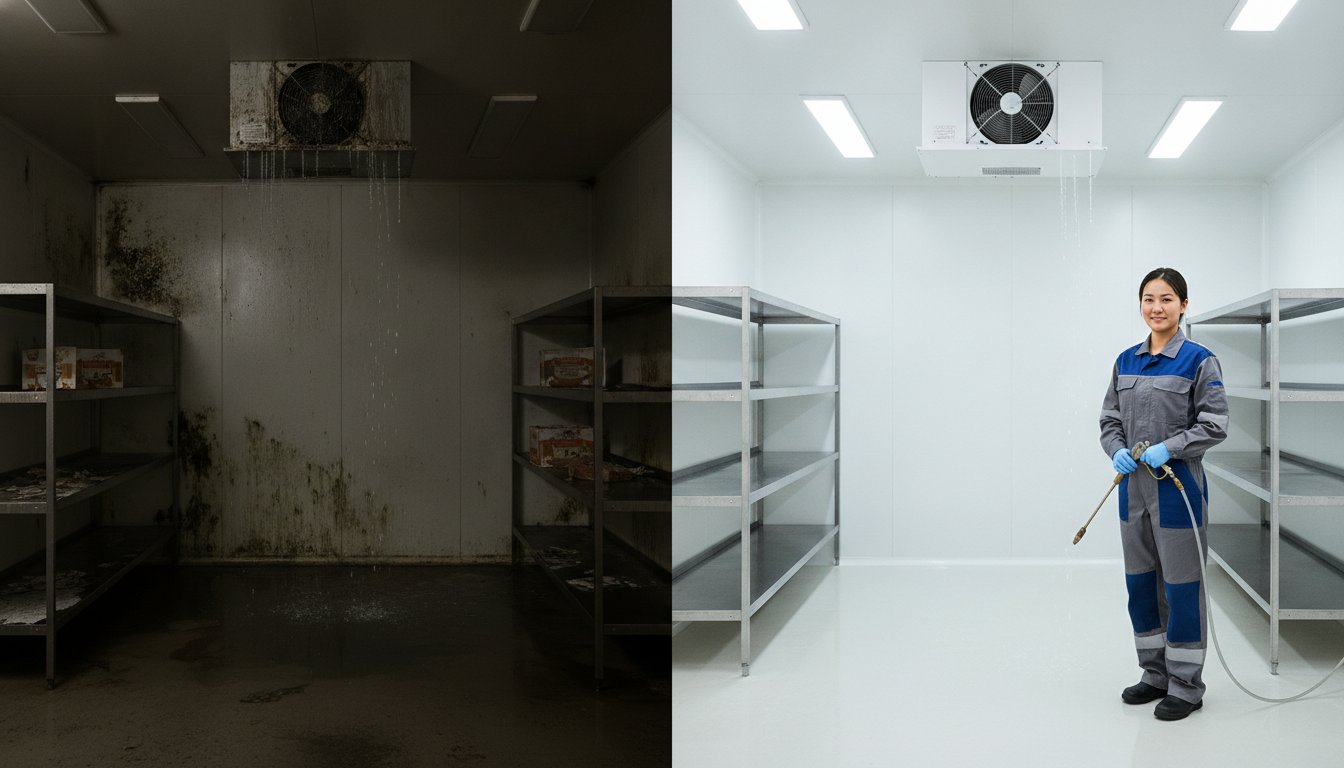
Is your “clean” cool room one health inspection away from a forced closure? Many food business owners find themselves trapped in a frustrating cycle of scrubbing walls only to see grey patches return just weeks later. This isn’t just a maintenance headache. It is a direct threat to your stock and your license. You already understand the constant pressure of maintaining strict hygiene standards while avoiding the risk of contamination and expensive health department fines. Standard cleaning only addresses what you can see. It leaves microscopic spores behind to thrive in the damp environment.
This guide provides the definitive solution to eliminate mould in commercial cool rooms. ‘Food-Safe Anti-Microbial Treatment’ that seals walls and ceilings to prevent regrowth and ensure HACCP compliance is the only way to achieve permanent results. You will learn how to move beyond temporary fixes and implement a professional, non-toxic sealing system that protects your surfaces for the long term. We will explain the systematic process used by specialists to create a microscopic barrier. This ensures your facility remains safe, compliant, and ready for any audit.
Key Takeaways
- Understand why low temperatures don’t stop fungal growth and how to protect your business from legal penalties under FSANZ Standard 3.2.3.
- Discover the long-term benefits of treating mould in commercial cool rooms. ‘Food-Safe Anti-Microbial Treatment’ that seals walls and ceilings to prevent regrowth and ensure HACCP compliance instead of relying on temporary surface cleaning.
- Learn the critical difference between standard maintenance and professional remediation that targets the root system of mould colonies.
- Identify how Sydney’s unique coastal humidity and temperature differentials trigger condensation and accelerate contamination risks.
- Explore how the Goldmorr System provides a biodegradable, non-toxic path to restoring food-safe environments without disrupting your operations.
The Risks of Mould in Commercial Cool Rooms and HACCP Compliance
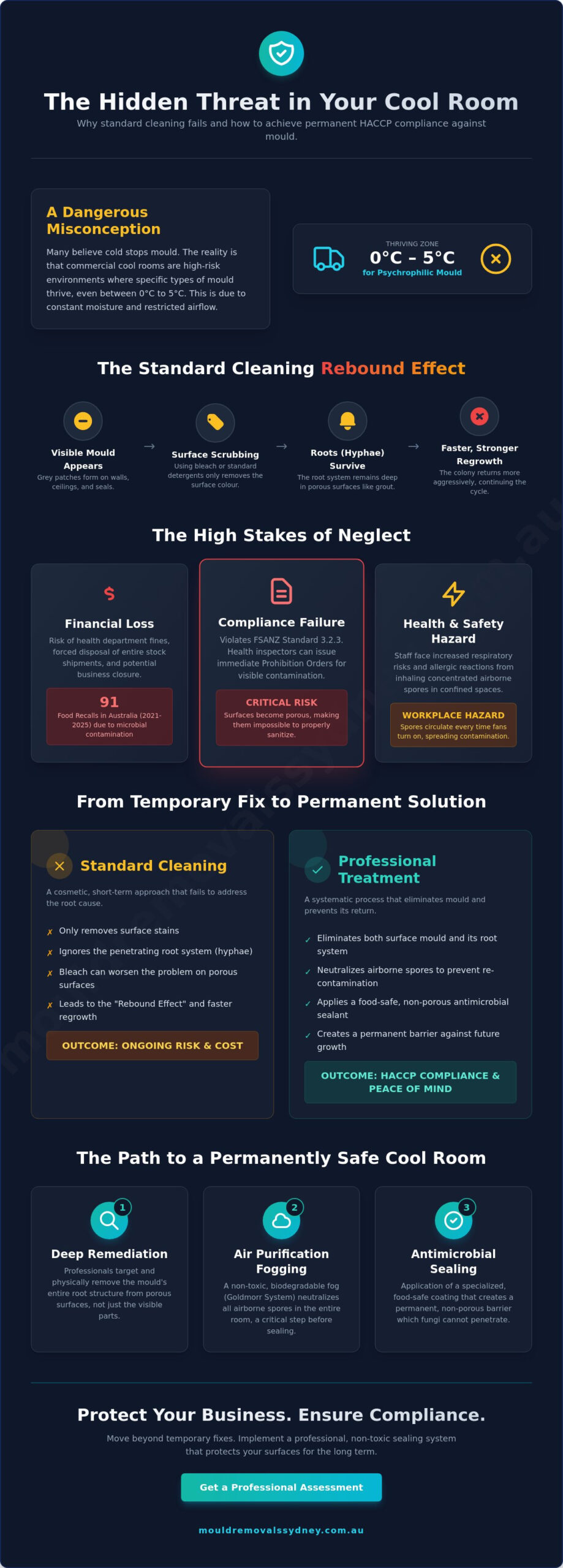
Many restaurant owners and facility managers believe that low temperatures stop fungal growth. This is a dangerous misconception. Cool rooms are actually high-risk environments for Indoor mold because they combine constant moisture with restricted airflow. While the cold slows down some species, others thrive in the 0°C to 5°C range. These psychrophilic organisms find the perfect home on damp ceilings and around door seals. Once a colony establishes itself, it becomes a permanent source of airborne spores that circulate every time the fans turn on.
FSANZ Standard 3.2.3 requires food premises to ensure all surfaces are non-absorbent and easy to clean. Mould growth fundamentally changes the surface of your cool room. It creates microscopic pits in grout and eats into silicone, making surfaces impossible to fully sanitise with standard chemicals. Between 2021 and 2025, Australia recorded 91 food recalls due to microbial contamination. Many of these incidents stem from poor storage hygiene. To stop this cycle, businesses must move beyond basic scrubbing and invest in a specialized solution for mould in commercial cool rooms. ‘Food-Safe Anti-Microbial Treatment’ that seals walls and ceilings to prevent regrowth and ensure HACCP compliance.
Why Standard Cleaning Fails in Cold Storage
Surface wiping is a temporary cosmetic fix, not a permanent solution. Mould grows via a network of roots called hyphae that penetrate deep into porous materials like grout and damaged sandwich panel insulation. Standard detergents or household bleach don’t reach these roots. In fact, using bleach on porous surfaces can actually provide more moisture to the root system while only removing the colour from the surface. This leads to the “rebound effect,” where the colony returns faster and more aggressively than before. You aren’t killing the mould; you’re just pruning it.
Health Risks and Audit Consequences
The presence of fungi isn’t just a food safety issue; it’s a workplace hazard. Staff members working in these confined spaces face increased respiratory risks and allergic reactions from inhaling concentrated spores. Sydney health inspectors from the local council or the NSW Food Authority have the power to issue immediate Improvement Notices or Prohibition Orders if they find visible contamination. A single instance of spore-driven cross-contamination can force the immediate disposal of an entire shipment of stock, resulting in thousands of dollars in unrecoverable losses. Don’t wait for an audit failure to address a problem that’s already visible. Professional remediation is the only way to ensure your facility meets the strict documentation requirements of Standard 3.2.2A.
How Food-Safe Anti-Microbial Treatment Prevents Regrowth
Standard cleaning fails because it ignores the physical structure of the cool room surfaces. While scrubbing removes visible stains, it doesn’t change the fact that grout, silicone, and even some panels are porous. These tiny openings act as safe harbours for moisture and microscopic spores. To break the cycle of contamination, you must implement a solution for mould in commercial cool rooms. ‘Food-Safe Anti-Microbial Treatment’ that seals walls and ceilings to prevent regrowth and ensure HACCP compliance. This specialized treatment creates a permanent, non-porous barrier that fungi simply cannot penetrate. By adhering to the HACCP Principles & Application Guidelines, our process ensures every step supports a total food safety management system.
Our methodology relies on the Goldmorr System to eliminate the threat before sealing begins. We don’t just wipe surfaces; we use a non-toxic fogging process that neutralizes airborne spores throughout the entire room. This step is critical. If you seal a surface without first eliminating the atmospheric spore load, you risk trapping active contaminants behind the barrier. Once the environment is cleared, we apply the antimicrobial coating. This coating is specifically engineered to be non-leaching and non-toxic, making it safe for areas where food is handled and stored. If your facility is currently struggling with persistent growth, our specialists provide professional mould remediation to restore your room to a compliant state quickly.
The Sealing Process Explained
- Preparation: We perform a deep-tissue remediation of all existing growth. This involves using biodegradable agents that kill the mould at the root without damaging your equipment or leaving toxic residues.
- Application: Our technicians apply the specialized antimicrobial seal to every square inch of the walls and ceilings. This creates a smooth, high-performance finish that eliminates the microscopic “pockets” where mould usually takes hold.
- Curing: The treatment is left to bond at a molecular level. Once cured, it forms a durable shield that won’t peel or crack under the extreme temperature fluctuations typical of commercial refrigeration.
Benefits of a Sealed Surface
A sealed surface is a proactive defence against Sydney’s high humidity. Because the treatment removes surface porosity, moisture can no longer soak into the substrate. This makes your routine cleaning protocols significantly more effective; dirt and bacteria sit on top of the seal where they are easily wiped away. These coatings are also designed for industrial environments. They offer high resistance to high-pressure cleaning and the aggressive sanitizers required for food safety audits. You aren’t just cleaning better; you’re making the room physically incapable of supporting fungal life.
Comparing Professional Remediation vs. Standard Maintenance
Relying on your nightly cleaning crew to handle fungal outbreaks is a high-risk strategy. Standard maintenance usually involves surface-level wiping with generic detergents or diluted bleach. While this might make the room look better for a few days, it leaves the biological root system completely intact. Professional remediation is a deep-tissue process that combines chemical neutralisation with structural sealing. To understand the broader implications of fungal exposure and why simple cleaning is insufficient, refer to A Brief Guide to Mold in the Workplace. This guide outlines the necessity of proper remediation to maintain a safe working environment.
The true value of professional intervention becomes clear when you look at a 24-month timeline. A business performing standard maintenance might pay staff for four hours of intensive scrubbing every week. Over two years, this results in hundreds of wasted labour hours and thousands of dollars in chemical costs, yet the mould persists. In contrast, implementing a solution for mould in commercial cool rooms. ‘Food-Safe Anti-Microbial Treatment’ that seals walls and ceilings to prevent regrowth and ensure HACCP compliance provides an immediate return on investment. Once the surface is sealed, the biological cycle is broken. We verify this success through post-remediation air testing, providing scientific proof that your cool room is safe for food storage.
The Hidden Cost of DIY Cleaning
DIY cleaning often does more harm than good. Harsh retail chemicals can strip the protective plastisol coating from your cool room panels. This exposes the metal underneath to moisture, leading to rust and structural degradation. Furthermore, improper agitation of mould colonies with a cloth or brush can release millions of spores into the air. These spores settle on your evaporator coils and stock, spreading the contamination further. You end up spending more on equipment repairs and stock loss than you would have spent on a professional treatment.
Achieving HACCP Certification Post-Treatment
HACCP audits require more than just a clean-looking room. You need to demonstrate that your facility is designed to prevent hazards. Our professional treatment provides the necessary documentation to show auditors that you have taken proactive steps to eliminate biological risks. By creating an impermeable barrier on walls and ceilings, you meet the strict hygiene standards required for food-grade environments. If you are unsure if your current setup will pass an inspection, contact Sydney’s #1 Mould Removal Service for an expert assessment. We ensure your surfaces are not just clean, but technically compliant and ready for certification.
Managing Humidity and Condensation in Sydney Cool Rooms
Sydney’s coastal climate presents a unique challenge for refrigeration management. High ambient humidity means the air outside your cool room is often saturated with moisture. When this warm air enters a cold environment, it immediately reaches its dew point and condenses into liquid water on the nearest cold surface. This is why mould in commercial cool rooms. ‘Food-Safe Anti-Microbial Treatment’ that seals walls and ceilings to prevent regrowth and ensure HACCP compliance is so effective. It addresses the reality that you cannot stop all moisture, so you must make the surfaces physically resistant to it.
The “door opening effect” is the most common trigger for condensation. Every time a staff member leaves the door ajar, a fresh wave of humid air rushes in. This moisture settles on the ceiling and walls, providing the hydration mould needs to thrive. Structural failures like worn door gaskets or gaps in the sandwich panel insulation create localized “cold spots.” These spots act as magnets for condensation. If left unaddressed, this moisture seeps into the structure. Professional water damage repair prevents secondary mould growth from compromising the structural integrity of your cold storage.
Environmental Control Strategies
You must take active steps to reduce the moisture load on your refrigeration system. Install heavy-duty strip curtains to create a secondary thermal barrier. Ensure all doors have functional auto-closers to minimize the time the room is exposed to Sydney’s humid air. Your evaporator cycles should also be optimized. Standing water in the drip tray or on the cooling fins is a major contributor to high internal humidity. Regular maintenance ensures the system effectively removes moisture from the air rather than circulating it. For a permanent solution to environmental moisture, book a professional mould inspection to identify every hidden risk factor.
Monitoring for Early Warning Signs
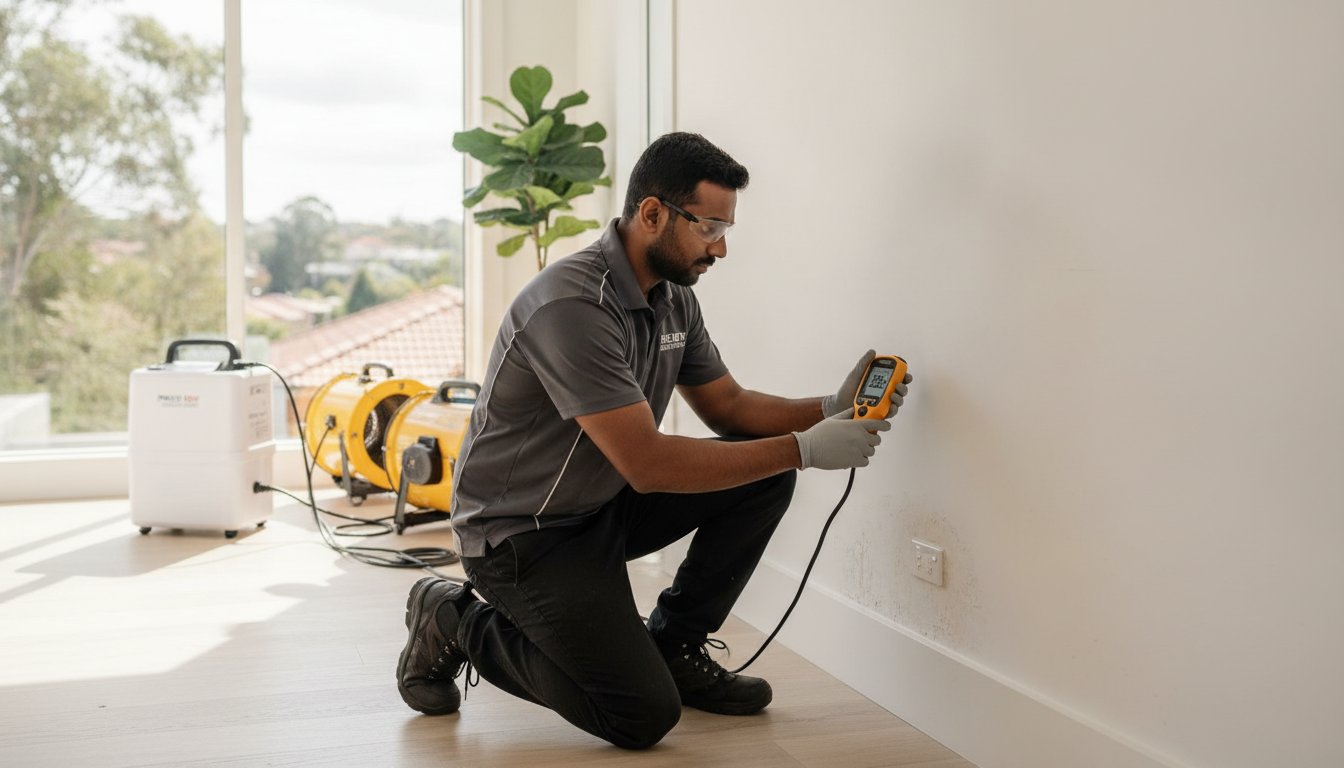
Don’t wait for large black patches to appear before taking action. Fungal colonies often start in hidden areas where airflow is lowest. Regularly check behind pallet racking and in high ceiling corners. Pay close attention to the smell of the room. A persistent musty or earthy scent is a reliable indicator of active growth, even if it isn’t visible yet. These volatile organic compounds (VOCs) are a sign that spores are already in the air. Scheduling a comprehensive mould inspection allows specialists to use moisture meters and thermal imaging to find hidden dampness before it leads to a HACCP failure.
ABC Mould Cleaning Solutions: Sydney’s Cool Room Specialists
ABC Mould Cleaning Solutions provides the specialized expertise required to maintain high-volume refrigeration units. We recognize that a cool room is the heart of your kitchen or warehouse. When contamination strikes, your entire operation is at risk. Our technicians are not general cleaners. They are highly trained remediation specialists who understand the critical intersection of microbiology and food safety standards. We focus on delivering a permanent solution for mould in commercial cool rooms. ‘Food-Safe Anti-Microbial Treatment’ that seals walls and ceilings to prevent regrowth and ensure HACCP compliance. To maintain operational efficiency and streamline our service delivery, we rely on advanced digital infrastructure, often developed by software specialists like AP4 Digital.
Our process utilizes the Goldmorr System. This world-class methodology uses biodegradable, non-toxic agents to eliminate fungal colonies without leaving harmful chemical residues. We prioritize the safety of your staff and your customers. Our antimicrobial seals are specifically formulated for food-handling areas. They provide a durable, non-porous finish that stands up to the most aggressive industrial cleaning schedules. We guarantee results that satisfy even the most stringent health department audits. Stop wasting time on temporary fixes and secure your facility today.
Why Sydney Food Businesses Trust Us
We bring years of experience in black mould identification and removal to every project. Our team knows exactly where fungi hide in complex refrigeration systems. We’ve helped hundreds of Sydney businesses move from “at-risk” to “fully compliant” in record time. Our technicians work around your schedule to minimize downtime. We provide the documentation you need to prove to auditors that your surfaces are impermeable and safe. This evidence-based approach removes the anxiety of health inspections and ensures long-term operational security.
Get Started with a Professional Assessment
Our streamlined digital inquiry process removes all friction from your remediation journey. Simply submit photos or video of your cool room via our mobile-friendly portal. We provide a fast, accurate assessment and a customized treatment plan tailored to your specific facility dimensions. Our pragmatic, results-driven approach ensures your problem is solved quickly and effectively. Don’t wait for a failed inspection to take action. Protect your stock, your reputation, and your bottom line. Contact ABC Mould Cleaning Solutions for an expert cool room treatment today.
Ensure Permanent Food Safety for Your Cool Room
Surface cleaning is no longer enough to meet the rigorous demands of modern food safety audits. You’ve seen how Sydney’s humidity turns every cool room into a potential hazard. Relying on temporary scrubbing only leads to repetitive costs and the constant threat of stock loss. Real protection requires a structural change to your storage environment. Our Goldmorr System certified technicians provide the specialized expertise needed to eliminate biological threats at the source. We focus on restoring your facility to a state of total compliance quickly and effectively.
Stop the cycle of regrowth by implementing a definitive solution for mould in commercial cool rooms. ‘Food-Safe Anti-Microbial Treatment’ that seals walls and ceilings to prevent regrowth and ensure HACCP compliance. This advanced technology creates a safe, non-toxic barrier that protects your stock and your staff. We offer a 24/7 emergency response for Sydney food businesses to ensure you never have to face a health inspection alone. Take control of your facility’s hygiene and eliminate the stress of potential fines or closures.
Secure Your HACCP Compliance with Our Food-Safe Cool Room Treatment today. We are ready to help you create a safer, cleaner, and more efficient storage environment for your business.
Frequently Asked Questions
Is the anti-microbial treatment really safe for food-contact surfaces?
Yes, our antimicrobial treatments are specifically engineered for food-grade environments and are completely non-toxic. They use biodegradable agents that won’t leach into your stock or contaminate food-contact surfaces. This ensures your facility remains safe for both occupants and products. We prioritize products that meet strict safety standards, allowing you to maintain operations without worrying about chemical residues or safety hazards.
How long does the cool room need to be empty during treatment?
Most cool rooms require a window of 4 to 8 hours for the full remediation and sealing process. This timeframe allows our technicians to perform deep cleaning, fogging, and application of the protective seal. We work with your schedule to minimize operational downtime. Once the treatment has cured, you can restock your room and resume normal business activities immediately with full confidence in your facility’s hygiene.
Will this treatment help me pass a HACCP or FSANZ audit?
Yes, this specialized approach is designed to eliminate mould in commercial cool rooms. ‘Food-Safe Anti-Microbial Treatment’ that seals walls and ceilings to prevent regrowth and ensure HACCP compliance. By transforming porous grout and silicone into impermeable surfaces, you satisfy the requirements of FSANZ Standard 3.2.3. Our professional documentation serves as physical evidence for auditors that you’ve implemented proactive, science-based controls to manage biological hazards.
Does the sealing process change the appearance of my cool room walls?
No, the antimicrobial seal is typically clear and won’t negatively impact the aesthetic of your panels. It dries to a smooth, professional finish that often makes surfaces look newer and cleaner. Because it fills in microscopic pits and cracks, the walls become easier to wipe down during your nightly cleaning routine. You get the benefit of high-level protection without needing to repaint or replace expensive sandwich panels.
How long does the antimicrobial seal typically last before needing reapplication?
A professionally applied antimicrobial seal typically provides protection for several years under normal commercial conditions. Its longevity depends on the intensity of your cleaning protocols and the amount of physical traffic in the room. Unlike standard coatings, this treatment bonds at a molecular level to resist peeling and cracking. Regular inspections help ensure the barrier remains intact, providing you with long-term peace of mind and reduced maintenance costs.
Can you treat mould that has grown inside the insulation panels?
If mould has penetrated the internal insulation of a sandwich panel, that specific panel usually requires structural replacement. However, we can effectively treat surface growth and seal the exterior to prevent spores from escaping into the air. Our technicians use thermal imaging during the inspection to determine if the moisture is structural or surface-level. This allows us to provide a pragmatic recommendation that saves you from unnecessary equipment replacements.
What is the difference between this treatment and standard anti-mould paint?
Standard anti-mould paint is often just a cosmetic cover that eventually flakes or traps moisture underneath. Our treatment is a high-performance molecular seal designed specifically for high-moisture refrigeration environments. It is non-porous and technically superior to retail alternatives that aren’t rated for food safety. This specialized system for mould in commercial cool rooms. ‘Food-Safe Anti-Microbial Treatment’ that seals walls and ceilings to prevent regrowth and ensure HACCP compliance creates a permanent barrier.
Do you provide post-treatment reports for my food safety records?
Yes, we provide comprehensive post-remediation reports that are essential for your food safety management records. These documents detail the steps taken, the products used, and the results of our verification testing. Having this professional paperwork ready for your next health department audit demonstrates your commitment to high hygiene standards. It simplifies the audit process by providing clear, authoritative evidence that your cool room meets all regulatory requirements.