The first 24 hours after a Sydney storm aren’t just about mopping up puddles; they’re a high-stakes race against biology. While visible flooding is stressful, the real danger lies in the moisture you can’t see. Professional water damage mould remediation sydney experts know that if structural drying doesn’t begin immediately, your property faces a high risk of toxic black mould and permanent decay. It’s completely normal to feel overwhelmed by the sight of waterlogged carpets and the looming anxiety of hidden rot or difficult insurance claims.
We understand that your primary goal is to return your home to a safe, dry, and healthy state as quickly as possible. This article provides a clear roadmap to protect your investment through advanced extraction and atmospheric management. You’ll learn how to identify the critical window for intervention, why liquid extraction is only half the battle, and how to ensure your property is certified dry. By following these professional restoration strategies, you can stop mould in its tracks and restore your peace of mind.
Key Takeaways
- Act within the critical 48-hour “Golden Window” to prevent mould colonies from establishing themselves in high-humidity environments.
- Understand the difference between water categories, particularly why Category 3 “Black Water” requires immediate professional intervention to handle pathogens safely.
- Learn why industrial-grade extraction and stabilization are far more effective than DIY methods for preventing structural rot and toxic growth.
- Discover how expert water damage mould remediation sydney strategies use truck-mounted vacuums and dehumidification to restore your property’s safety.
- Explore the benefits of the Goldmorr System, using biodegradable fogging to eliminate spores in hidden cavities that standard cleaning cannot reach.
Understanding Storm Water Damage in Sydney Properties
Storm water damage is far more than a simple cleanup task. It’s a complex structural and biological event that begins the moment moisture enters your property. To fully grasp what water damage is, you must view it as a progressive threat. Water doesn’t just sit; it migrates, saturates, and fuels microbial life. In the context of water damage mould remediation sydney, we categorise the intrusion to determine the safety protocols required for your family.
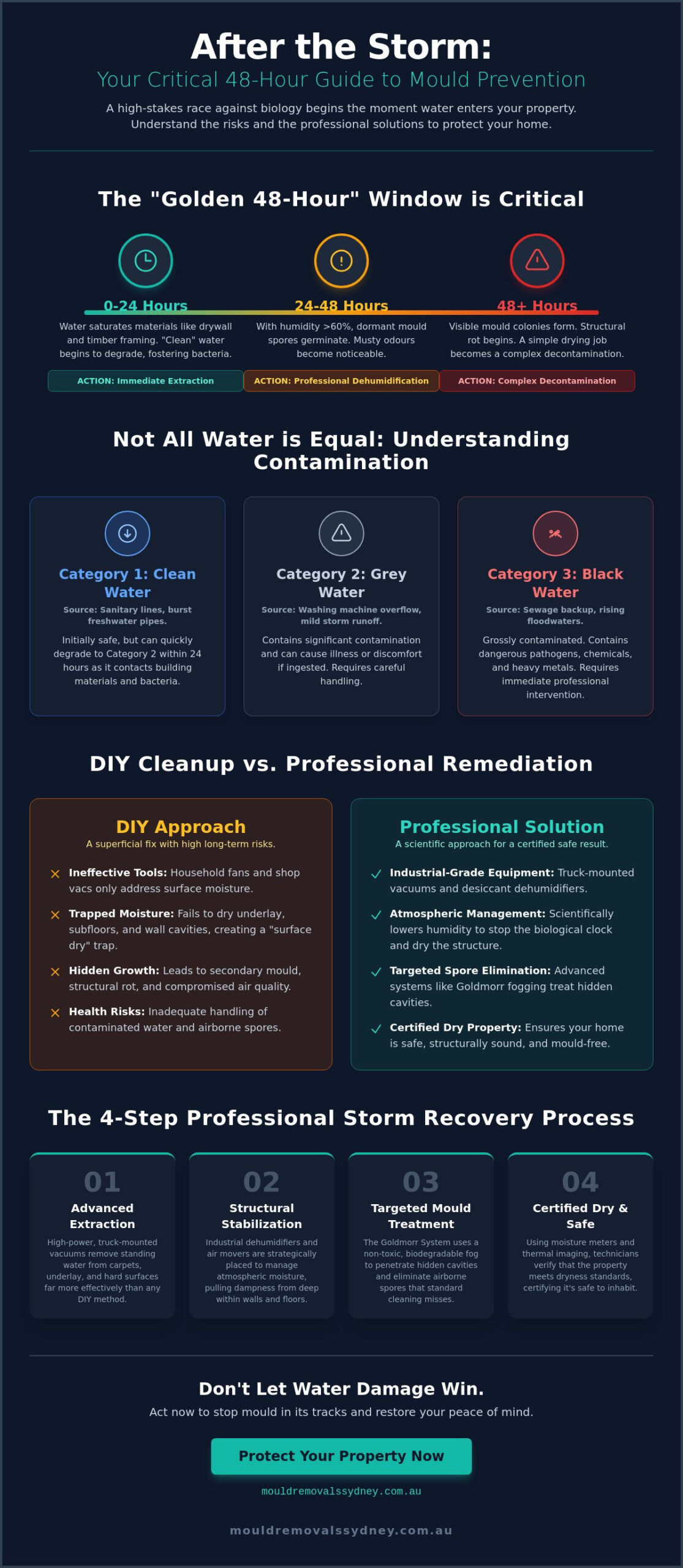
- Category 1 (Clean Water): Originates from a sanitary source, such as a burst freshwater pipe. While initially safe, it can degrade into higher categories within 24 hours.
- Category 2 (Grey Water): Contains significant contamination, such as washing machine overflow or mild storm runoff. It has the potential to cause discomfort or illness if ingested.
- Category 3 (Black Water): Grossly contaminated water from sewage backups or rising floodwaters. This is common during Sydney’s flash flooding and contains dangerous pathogens, chemicals, and heavy metals.
Sydney’s coastal climate creates a unique set of challenges. When East Coast Lows strike, they bring intense rainfall followed by stagnant, humid air. This humidity often exceeds 70%, creating a “pressure cooker” environment that accelerates fungal growth. Beyond the visible puddles, secondary damage quickly sets in. You might notice floorboards beginning to cup, a damp “musty” odour permeating the air, or drywall that feels soft to the touch. These are signs that the water has already begun to compromise the building’s materials.
Common Entry Points During Sydney Storms
Flash flooding often overwhelms local infrastructure, leading to gutter overflows that dump hundreds of litres of water into roof cavities. In low-lying areas like the Sydney basin, rising groundwater can lead to subfloor inundation, trapping moisture beneath your feet. Even the iconic architecture of the city presents risks. Older Sydney terrace houses often suffer from seepage through cracked masonry or failing damp courses, allowing moisture to wick deep into internal walls where it stays hidden from view.
The Immediate Risks to Your Structure
Water is a solvent that aggressively compromises the integrity of Gyprock and timber framing. When water enters wall cavities, it poses a severe risk of electrical shorts and fire hazards. Perhaps the most dangerous misconception for homeowners is the “surface dry” trap. Just because a carpet feels dry to the touch doesn’t mean the underlay or the structural slab beneath it is safe. Without professional water damage mould remediation sydney, trapped moisture will continue to rot timber and feed toxic mould colonies behind your skirting boards.
The 48-Hour Window: Why Fast Remediation is Critical
Biological clocks start ticking the second storm water enters your property. You have a narrow window, often referred to as the “Golden 48 Hours,” before dormant mould spores begin to germinate and form visible colonies. In Sydney’s often humid environment, this process can accelerate. When indoor relative humidity levels climb above 60%, your home effectively becomes an incubator for microbial life. Delaying water damage mould remediation sydney services by even a few days can transform a simple drying job into a complex, expensive decontamination project.
It isn’t just about the building’s structural health. The Australian Government Department of Health and Aged Care highlights the potential health effects of mould, which include respiratory distress, allergic reactions, and asthma triggers. Professional dehumidification is the only reliable method to lower the atmospheric moisture content and stop this biological clock. Household fans simply move damp air around; industrial-grade desiccant dehumidifiers actually pull the water from the air and the building’s fabric to ensure total stabilisation.
The Science of Secondary Mould Growth
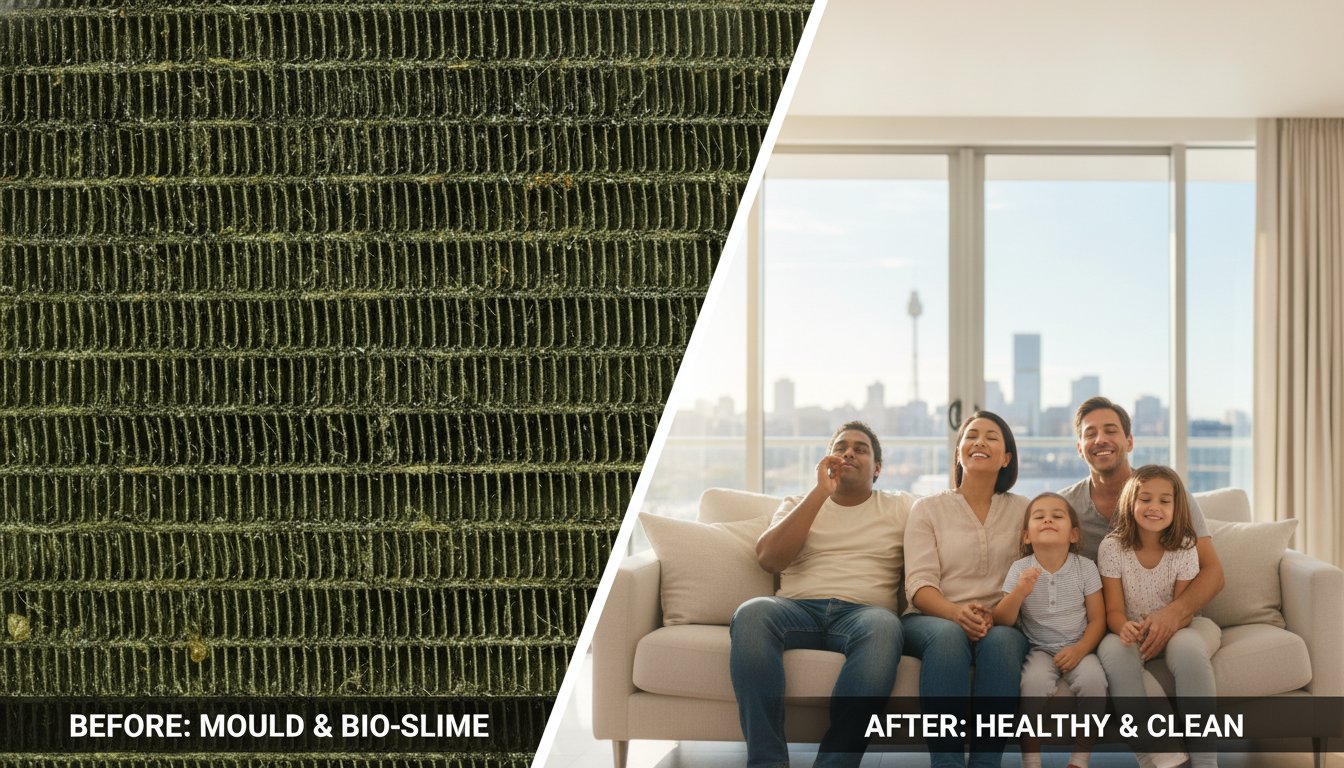
Secondary mould growth occurs when moisture from a flood evaporates and increases the humidity in unaffected rooms. Airborne spores then settle on damp surfaces like drywall, cardboard boxes, or the back of wardrobes. These materials are rich in cellulose, providing the perfect food source. In the aftermath of a storm, black mould is a primary concern because it thrives in saturated, low-light environments. Stagnant air in closed-off, storm-damaged rooms acts as a catalyst, allowing spore counts to reach dangerous levels quickly.
Hidden Moisture: The Silent Threat
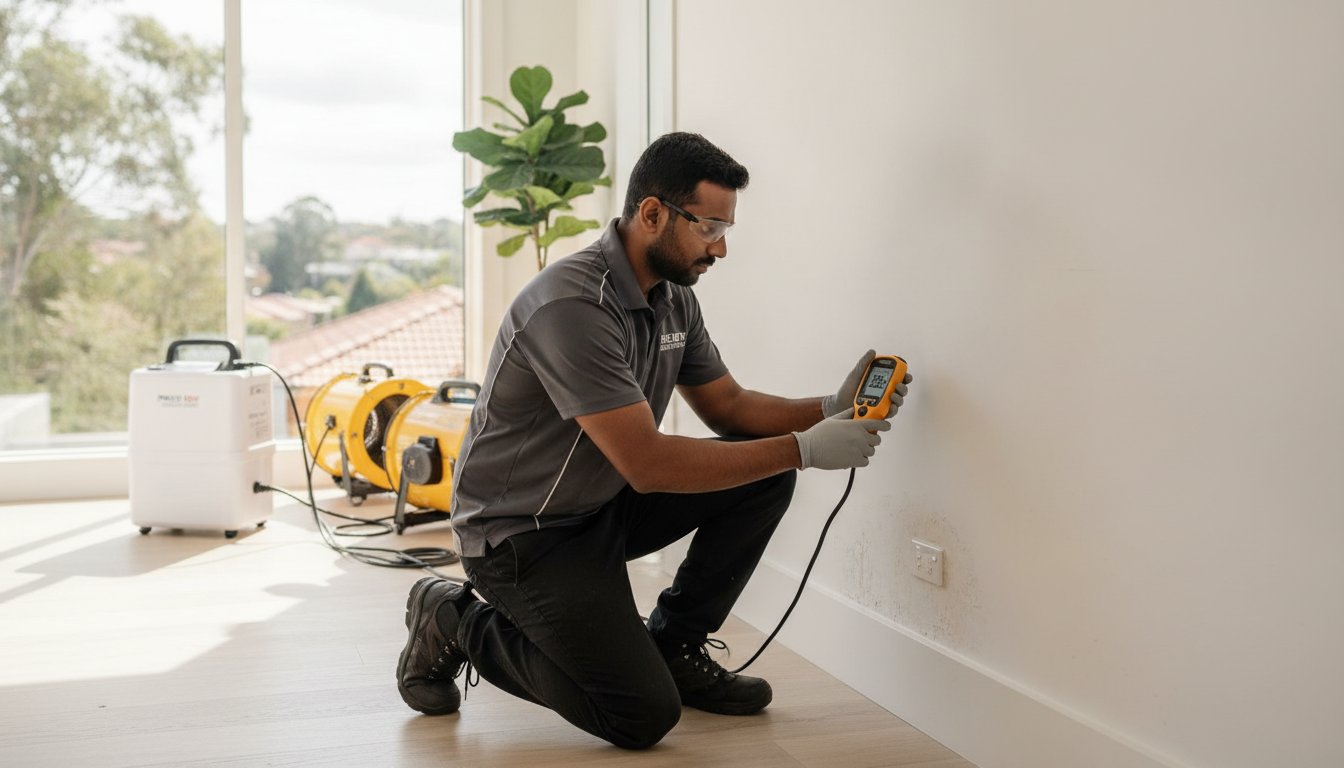
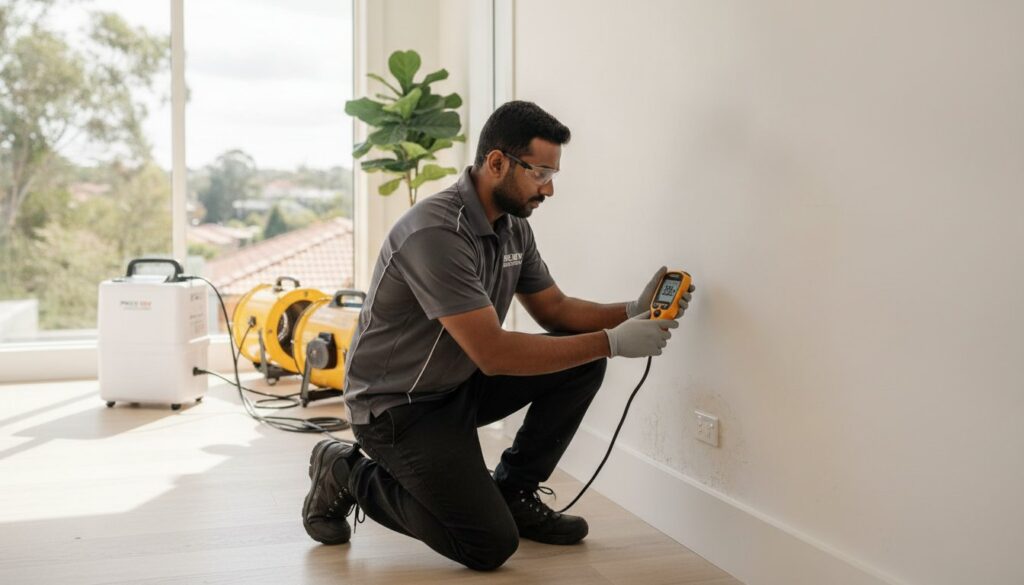
Surface drying is a dangerous illusion. Water has a unique ability to “wick” up porous materials, travelling vertically through wall cavities and insulation where it remains invisible to the naked eye. Our specialists use thermal imaging cameras to detect these temperature variances, identifying exactly where moisture is trapped behind skirting boards. If this trapped water isn’t vented and dried, it leads to long-term structural decay and permanent odours. If you suspect water has entered your wall cavities, it is wise to arrange a professional moisture inspection before the damage becomes irreversible.
Professional Restoration vs. DIY Storm Cleanup
When a storm hits, your first instinct is likely to grab a mop and a bucket. While this is a logical reaction, mopping only addresses the surface water you can see. Professional water damage mould remediation sydney involves deep extraction using high-capacity vacuums that pull hundreds of litres of liquid from carpet underlay, subfloors, and structural cavities. DIY efforts often leave behind significant residual moisture, which acts as a fuel source for a biological explosion. Without industrial extraction, you aren’t solving the problem; you’re just moving it around.
Another dangerous misconception is the use of bleach on porous surfaces like Gyprock or timber. Bleach is primarily composed of water. While it may remove the surface stain, the water content soaks deep into the material, feeding the “roots” of the mould and encouraging it to grow back stronger. The NSW Health fact sheet on mould confirms that proper moisture control is the only way to prevent growth. Professional restoration focuses on scientific drying protocols rather than temporary surface fixes.
Why Consumer Fans Aren’t Enough
Household fans are designed for personal comfort, not structural drying. They lack the static pressure required to push air through timber framing and subfloor gaps. We utilise high-velocity air movers that create a specific airflow pattern to evaporate moisture from the building’s fabric. This moisture is then captured by Low Grain Refrigerant (LGR) dehumidifiers, which are far more powerful than small hardware store units. Additionally, we employ HEPA air scrubbing to remove fine particulates and pathogens that storm water often introduces into your indoor environment.
The Cost of Cutting Corners
Attempting a DIY cleanup after a major storm carries significant financial risk. If moisture remains trapped, the property can quickly transition into a Category 3 “Black Water” scenario, which often results in a total loss of building materials. Insurance companies are increasingly strict regarding documentation. They typically require a certified moisture map and regular readings to prove the property was returned to a pre-loss condition. Without professional water damage repair evidence, you may face a claim denial, leaving you responsible for the full cost of structural repairs and decontamination.
The Step-by-Step Storm Recovery & Mould Prevention Process
Successful water damage mould remediation sydney requires a systematic, multi-phase approach that prioritises speed and scientific accuracy. We don’t just dry the visible surfaces; we manage the entire indoor environment to prevent biological growth. Our specialists follow a rigorous five-phase protocol to ensure your property is restored to a safe, pre-loss condition.
- Phase 1: Urgent Extraction. We deploy truck-mounted vacuums to remove standing water immediately. This high-volume extraction is the most efficient way to prevent moisture from migrating deeper into structural materials.
- Phase 2: Environmental Stabilisation. Once the bulk water is gone, we install industrial LGR dehumidifiers and HEPA air filtration units. This step lowers the relative humidity to stop spore germination.
- Phase 3: Antimicrobial Treatment. Storm water often carries bacterial contaminants. We apply targeted, hospital-grade antimicrobial treatments to neutralise pathogens and sanitise all affected surfaces.
- Phase 4: Structural Drying. Using high-velocity air movers, we force moisture out of timber framing and masonry. We monitor moisture levels daily to ensure the drying process stays on track.
- Phase 5: Final Air Purification. Before we clear the site, we perform a final round of air scrubbing to remove any lingering particles or odours, ensuring the air you breathe is clean.
Advanced Moisture Detection
Surface appearances are often deceptive. We use non-invasive moisture meters and thermal imaging to probe subfloors and wall cavities without causing further damage. This technology allows us to identify unseen water pockets that inevitably cause mould if left unaddressed. By establishing a “Dry Standard” based on Sydney’s specific local conditions, we ensure your property meets professional safety benchmarks before the equipment is removed.
Subfloor and Ventilation Recovery
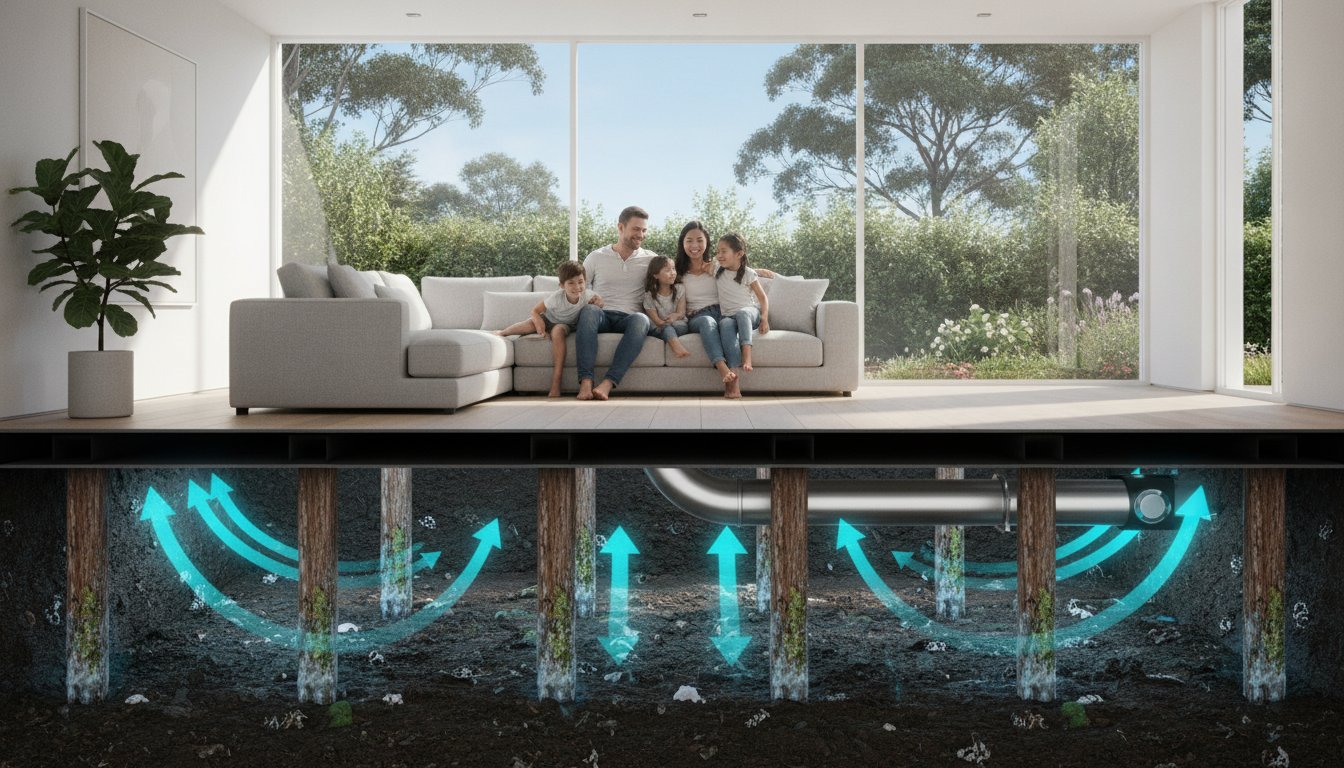
The subfloor is frequently the most neglected area after a heavy rain event. In many Sydney homes, water pools in the crawl space, leading to long-term rising damp and persistent musty odours. We specialise in cleaning and disinfecting these confined spaces to prevent structural rot. If your subfloor remains damp, it can compromise the air quality of the entire home. To protect your property from future issues, we often recommend subfloor ventilation system installation to maintain consistent airflow and keep the foundations dry.
If your property has been affected by a recent storm, don’t wait for hidden moisture to turn into a toxic problem. Our expert team is ready to provide a comprehensive moisture map and restoration plan. Contact our Sydney water damage specialists today for immediate assistance.
Why ABC Mould Cleaning Solutions is Sydney’s Choice for Storm Recovery
Choosing the right partner for water damage mould remediation sydney makes the difference between a temporary fix and a permanent resolution. We don’t just react to storms; we provide a systematic recovery plan designed to protect your property’s long-term value. Our team maintains 24/7 availability for emergency water damage across all Sydney suburbs. We know that every hour counts when your home is saturated. Our primary goal is to alleviate your stress by delivering a safe, dry environment for your family and pets. Professional water damage mould remediation sydney requires an expert hand, and we are ready to assist immediately.
Our competitive edge lies in our proprietary Goldmorr System. This methodology is the superior way to eliminate spores that traditional cleaning methods often miss. We utilise biodegradable fogging that reaches deep into hidden cavities, such as wall voids and ceiling spaces. This ensures that even the most inaccessible areas are treated effectively without leaving behind toxic residues. You don’t have to choose between a clean home and a safe one; our approach provides both through scientific precision and specialized equipment.
The Goldmorr Advantage for Storm Victims
Traditional remediation often relies on abrasive chemicals that can be just as harmful as the mould itself. The Goldmorr Advantage changes this dynamic. Our specialised system eliminates airborne spores during the structural drying process, preventing cross-contamination throughout your property. By using biodegradable solutions, we ensure your home is safe for immediate re-entry once the process is complete. This process is essential for achieving a clean bill of health for your home’s air quality, protecting those with respiratory sensitivities or allergies from lingering pathogens.
Insurance-Ready Reporting
We understand that the stress of a storm is often compounded by the complexity of insurance claims. Our process is pragmatic and results-driven, focusing on getting your life back to normal quickly. We provide the comprehensive documentation your insurer requires, including high-resolution photos and detailed moisture maps. This evidence-based reporting simplifies the claims process and demonstrates that the property has been restored to industry standards. Don’t leave your recovery to chance; rely on our expert team to handle the technical details while you focus on your family’s well-being.
Contact Sydney’s Mould & Water Damage Experts Now to secure your property and start the restoration process today.
Secure Your Property Against Post-Storm Decay
Acting within the first 48 hours is the most effective way to prevent permanent structural rot and toxic growth. While mopping up visible water is a start, professional water damage mould remediation sydney is essential to address the moisture trapped deep within your building’s fabric. We use industrial-grade extraction and the specialised Goldmorr System to ensure total microbial elimination, reaching spores that standard cleaning simply cannot touch. Our expertise in Sydney-specific subfloor ventilation further ensures your foundations remain dry and odour-free long after the clouds clear.
ABC Mould Cleaning Solutions offers a 24/7 rapid emergency response across New South Wales to provide immediate relief when you need it most. We focus on pragmatic, results-driven restoration that satisfies both your health requirements and your insurer’s documentation needs. It’s possible to recover from even the most severe East Coast Low with the right technical support. Don’t wait for the musty smells to begin; take decisive action now to protect your investment.
Emergency Storm Recovery? Call ABC Mould Cleaning Solutions for 24/7 Response
You can return to a safe, dry, and healthy home. We are ready to help you navigate the recovery process with confidence and speed.
Frequently Asked Questions
Is storm water damage covered by my home insurance in Sydney?
Most comprehensive home insurance policies in Sydney cover storm damage, but you must check your specific Product Disclosure Statement (PDS). Insurers typically distinguish between “storm,” which involves water entering from above, and “flood,” which refers to water rising from the ground. We recommend contacting your provider immediately to lodge a claim and documenting all damage with high-resolution photos before any cleanup begins.
How long does the water damage restoration process typically take?
A standard water damage mould remediation sydney project typically takes between three and five days for structural drying. The exact timeline depends on the saturation levels of your building materials and the local humidity. If mould colonies have already established themselves, the remediation phase may extend the process to ensure all spores are safely eliminated using our systematic, evidence-based approach.
Can I stay in my house while it is being dried out after a flood?
Your ability to stay in the property depends on the category of water and the extent of the damage. If the intrusion is Category 3 “Black Water” from a storm surge, the health risks make the property uninhabitable until it is fully decontaminated. Additionally, the noise from industrial air movers and dehumidifiers running 24/7 can be disruptive, so many homeowners choose to relocate temporarily for comfort.
Will my carpets be saved after storm water ingress?
Carpets can often be saved if the water is Category 1 and extraction begins within 24 hours. However, storm water that has travelled over the ground is classified as Category 3 and contains dangerous pathogens. In these cases, the carpet and underlay are considered a total loss and must be removed to prevent toxic mould growth. We prioritise your health over salvageable materials every time.
What is the difference between flood water and storm water for restoration?
The primary difference lies in the contamination level and the source of the water. Storm water usually refers to rain entering through roof leaks or gutter failures, whereas flood water often involves rising ground water. From a restoration perspective, flood water is almost always treated as Category 3 “Black Water,” requiring more aggressive decontamination and the disposal of porous materials to ensure the property is safe.
How much does storm water restoration cost in Sydney?
Industry data indicates that the cost for professional remediation in Sydney can range from A$500 for small areas to over A$6,000 for entire properties. These costs vary based on the volume of water extracted, the number of industrial units required, and whether structural materials like Gyprock need replacement. We recommend obtaining a professional moisture map to get an accurate assessment of the work required for your situation.
Can mould start growing even if I don’t see any standing water?
Yes, mould thrives in high-humidity environments even without visible puddles. When indoor humidity exceeds 60%, airborne spores can settle and grow on porous surfaces like drywall and timber. This is why professional water damage mould remediation sydney focuses on atmospheric management. We use industrial dehumidifiers to pull moisture from the air, stopping the biological growth that occurs invisibly behind your walls.
What should I do immediately after a storm before the professionals arrive?
Your first priority is safety, so turn off the electricity if it is safe to do so. Take detailed photos and videos of all affected areas for your insurance claim. Move light furniture and valuables to a dry area, but avoid walking through saturated zones to prevent cross-contamination. Open windows if the outdoor air is dry, but keep them shut during high-humidity storm conditions to prevent further moisture ingress.