Your standard pre-purchase building inspection is likely blind to the most dangerous threat hiding in your potential new home. While a basic check covers structural integrity, it often misses the microscopic spores and hidden moisture pockets that lead to thousands of dollars in remediation costs. You’re right to feel uneasy about a fresh coat of paint or a suspicious musty odor in a Sydney property. Trusting an agent’s word isn’t enough when your family’s respiratory health and your life savings are on the line.
Professional mould testing for home purchase provides the clinical evidence you need to move forward with absolute certainty. We understand the stress of the Sydney market, where the pressure to sign is high and the humidity is higher. This guide will teach you how to spot red flags that others miss and how to use a scientific report as a powerful tool for price negotiations. You’ll learn the difference between a visual glance and a technical assessment, ensuring you never inherit a toxic environment or a financial disaster.
Key Takeaways
- Standard building inspections are limited to visible defects; learn why they often miss hidden mould concealed by fresh paint or strategic staging.
- Professional mould testing for home purchase utilizes scientific air and surface sampling to detect toxic species that pose serious health risks to your family.
- Identify critical red flags such as musty odors and bubbling paint to spot potential moisture problems during your initial property walkthrough.
- Understand your legal rights under NSW property law and how a technical mould report serves as a powerful lever for price negotiations.
- Secure your financial investment by following an evidence-based inspection protocol to ensure the property is structurally sound and safe before settlement.
Why Standard Building Inspections Often Miss Mould
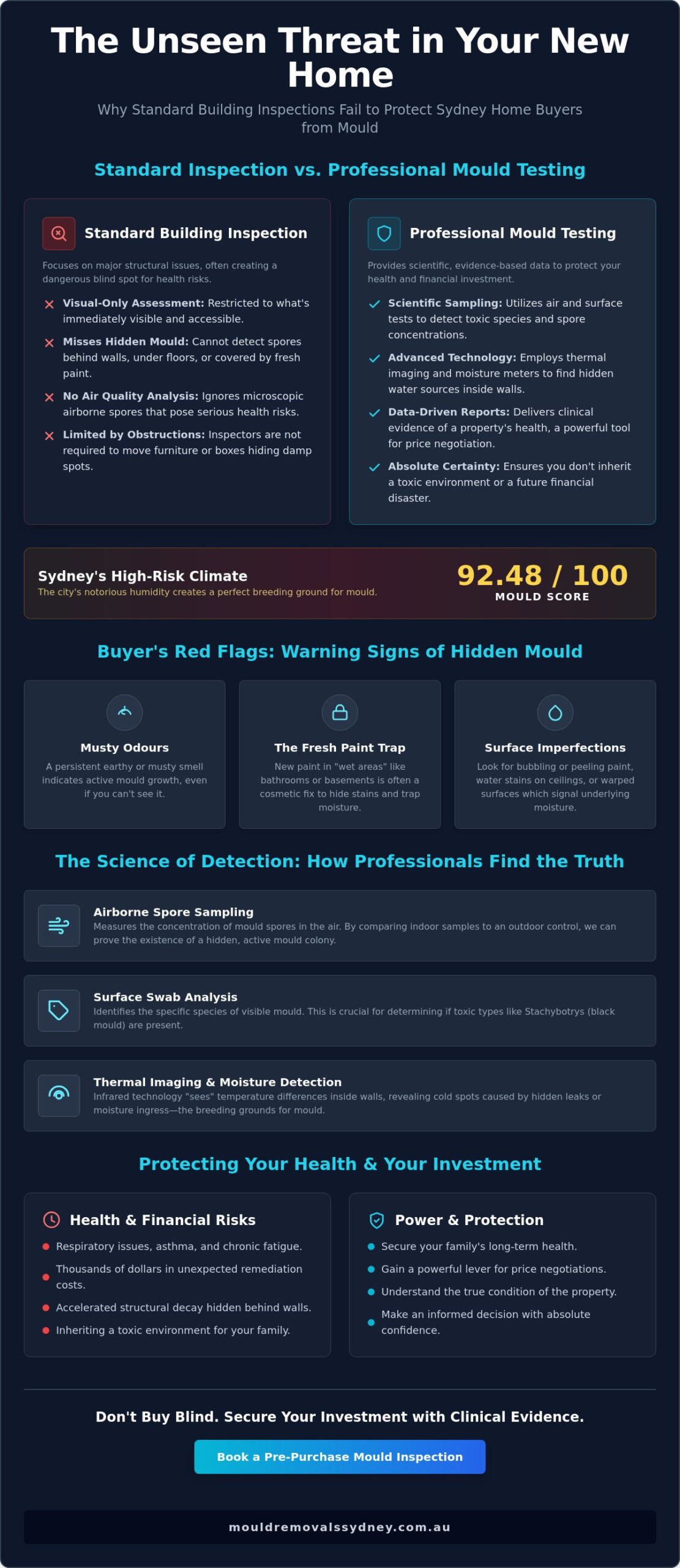
Most buyers assume a “passed” building report means a healthy home. It doesn’t. Standard pre-purchase building inspections in New South Wales are governed by AS 4349.1, which focuses on major structural defects and timber pests. These inspections are legally restricted to visible and accessible areas. If a seller places a heavy wardrobe over a damp patch or stacks boxes against a fuzzy wall, the inspector isn’t required to move them. This creates a dangerous blind spot for anyone considering mould testing for home purchase. An inspector’s job is to ensure the roof won’t fall in, not to verify if the air you’re breathing is toxic.
The Limitation of Visual-Only Assessments
Mould spores are microscopic. By the time you see black spots on a ceiling, the colony is already mature and releasing millions of spores into your living space. A room can look clinically clean while harboring dangerous airborne concentrations that trigger asthma or chronic fatigue. To truly understand the environment, you need to know what is mould and how its biological growth cycle allows it to thrive in hidden cavities. Professional testing goes beyond what the eye can see. By consulting a comprehensive guide to indoor mold, it becomes clear that moisture mapping and air sampling are the only ways to detect a problem before it manifests as a visible colony. Relying on a visual glance in a city like Sydney, which has a notorious “mould score” of 92.48 out of 100, is a high-stakes gamble with your health.
The Fresh Paint Red Flag for Buyers
Be wary of the “renovated” smell. A sudden scent of fresh gloss in a basement, laundry, or bathroom is often a strategic mask used by sellers to cover up active infestations. While it looks aesthetic during an open home, paint is a temporary mask, not a remediation solution. This cosmetic fix actually worsens the problem by trapping moisture within the building materials. Over time, this leads to accelerated structural decay behind the surface, turning a simple cleaning job into a massive restoration project. If you notice new paint localized to “wet areas” or lower wall sections, it’s a primary reason to insist on professional mould testing for home purchase.
Sydney’s humid coastal climate transforms mould from an aesthetic nuisance into a structural threat. High humidity levels mean that moisture doesn’t just sit on surfaces; it penetrates subfloors and wall cavities. Without specialized equipment like thermal imaging and moisture meters, these issues remain invisible until after the contract is signed and the settlement is complete. Don’t let a seller’s quick touch-up become your long-term financial burden.
Professional Mould Testing Methods for Property Buyers
Relying on a basic visual check is a gamble you can’t afford to take. Professional mould testing for home purchase utilizes a scientific arsenal to uncover what is hidden behind fresh paint and polished floorboards. We don’t just look for spots; we use evidence-based protocols to measure the actual health of the building environment. This systematic approach ensures you have a clear, data-driven understanding of the property’s condition before you commit to a lifelong investment.
Airborne Spore Counts vs. Surface Mould
Surface mould is often just the tip of the iceberg. While swabbing a visible patch identifies the specific species, such as the toxic Stachybotrys, it doesn’t tell you what your family is breathing. Air quality sampling measures the concentration of spores per cubic metre of air. To get an accurate reading, specialists compare indoor air samples against an outdoor control sample taken at the same time. If the indoor spore count is significantly higher than the outdoor baseline, it indicates an active, hidden growth source. Following NSW Health advice on mould, it’s vital to recognize that even invisible concentrations can trigger serious health reactions. In a pre-purchase context, these technical reports provide the objective proof needed to demand remediation or a price reduction.
Thermal Imaging and Moisture Detection
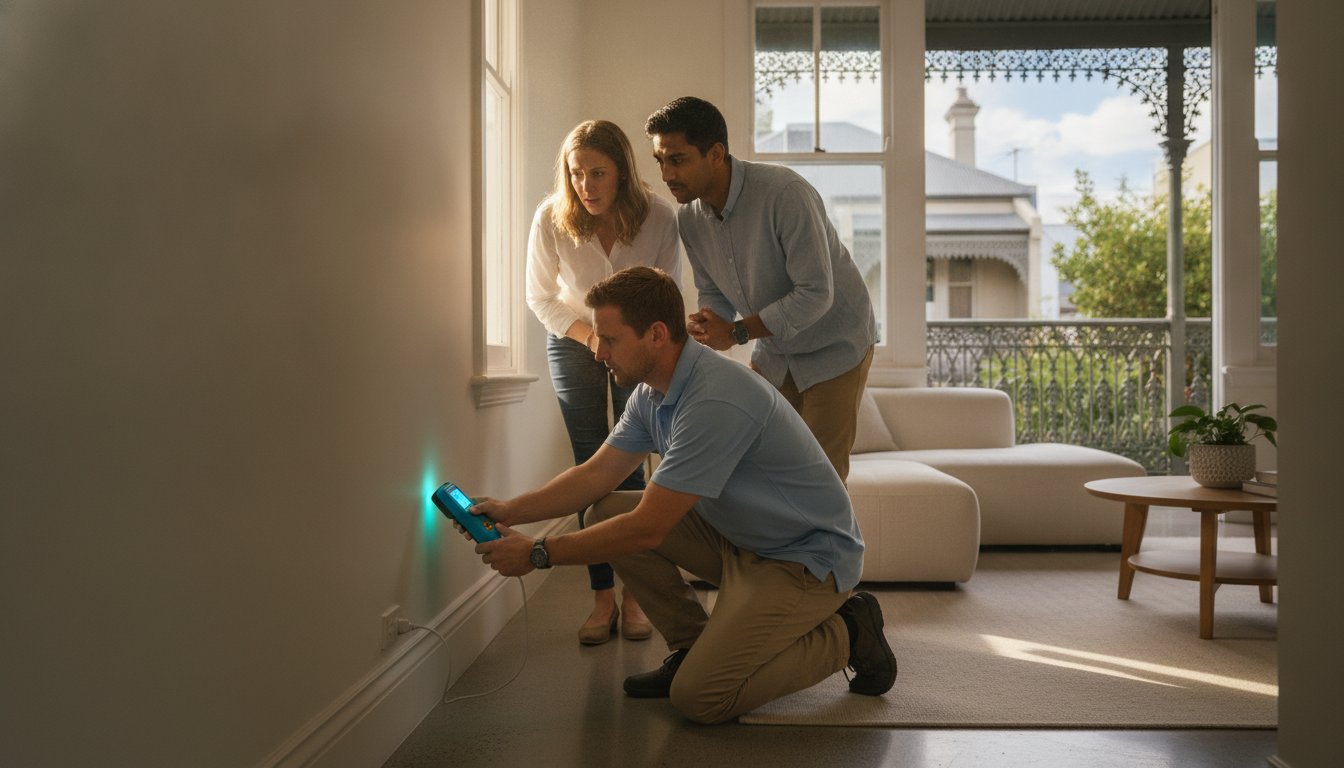
We use infrared technology to see through the “cosmetic fixes” sellers might employ. Thermal imaging cameras identify temperature anomalies inside walls, which often signal hidden water ingress or leaking pipes. These cold spots are the breeding grounds for black mould, allowing it to colonize structural timbers long before it becomes visible to the naked eye. Once a suspect area is found, we use precision moisture meters to check the saturation levels in subfloors and roof cavities. This moisture mapping is a non-invasive way to find the root cause of dampness without damaging the property. If you suspect a property has a hidden history of leaks, securing professional mould inspection services is the only way to confirm your suspicions with certainty.
Every sample collected during our inspection undergoes independent laboratory analysis. Third-party verification is essential because it provides an unbiased, legally defensible document. This report isn’t just a “recommendation”; it’s a technical breakdown of fungal ecology that can be used in court or during intense real estate negotiations. When you have a lab-certified report in hand, the conversation shifts from “I think there’s a problem” to “here is the scientific proof of contamination.” This level of detail is your ultimate protection against inheriting a “sick building” and the massive remediation costs that come with it.
Red Flags: Identifying Potential Mould Issues During an Inspection
Your senses are powerful diagnostic tools during an open house. Don’t just admire the high ceilings; pay attention to the air. The “musty sniff test” is often the most reliable indicator of a problem. That characteristic damp, earthy odor is caused by microbial volatile organic compounds (mVOCs) released during the fungal growth cycle. If a room smells like a wet basement, there is active growth nearby. This is a clear signal that you need professional mould testing for home purchase to find the source before the cooling-off period ends.
Visual cues are often subtle but revealing. Check for efflorescence on masonry, which appears as a white, powdery salt deposit on bricks. It indicates that water is migrating through the structure. Look closely at the baseboards. Warped skirting boards or bubbling paint along the floor line are classic symptoms of moisture ingress. Open the built-in wardrobes and check the back corners. In Sydney’s humid climate, these stagnant pockets are prime locations for condensation-led infestations that hide behind clothes and storage boxes.
Sydney-Specific High-Risk Areas
Sydney’s weather patterns and architectural history create unique risks. East Coast Lows regularly batter the city with intense rainfall, exposing flaws in older roofing and drainage systems. Many heritage properties sit on porous sandstone foundations. These act as a sponge, pulling moisture up from the ground through capillary action. Terrace houses in the Inner West are particularly vulnerable. These properties often suffer from poor subfloor airflow due to their narrow construction and shared walls. This lack of ventilation traps moisture under the floorboards, leading to structural rot. If you’re looking at an older masonry home, you might eventually require specialized water damage repair to address long-standing dampness issues.
The Health Implications of Hidden Infestations
Buying a home is a commitment to your family’s future, so don’t ignore the biological risks. Hidden infestations can trigger persistent respiratory issues, skin irritation, and chronic fatigue. Some toxic species require immediate professional intervention to prevent long-term health complications. It’s vital to conduct mould testing for home purchase before moving children or pets into a new environment. For a detailed breakdown of how these spores affect your well-being, consult the NSW Health guide to mould. Protecting your health is just as important as protecting your equity. Don’t let a “dream home” turn into a health nightmare because of a missed inspection detail.
The Legal and Financial Stakes of Pre-Purchase Mould
In New South Wales, the principle of Caveat Emptor, or “Buyer Beware,” places the burden of discovery squarely on your shoulders. Once you sign the contract and the cooling-off period expires, you inherit every hidden defect, including microbial growth. While sellers are legally required to disclose “material facts” that might influence a buyer’s decision, proving they had prior knowledge of a hidden leak is notoriously difficult. This legal reality makes mould testing for home purchase an essential step in your due diligence process. Without a professional report, you have no recourse if you discover a massive infestation three weeks after moving in.
A technical report serves as more than just a health check; it is a powerful financial lever. If our specialists identify a problem, you can use the findings to negotiate a significant reduction in the sale price. Most sellers prefer to offer a price credit rather than risk losing the sale entirely. Trying to fix these issues yourself using DIY methods often leads to cross-contamination, which eventually doubles the cost of professional remediation later. Professional retail kits often fail to address the root moisture source, meaning the problem returns within weeks. Investing in a technical assessment now prevents you from paying for a seller’s negligence for years to come.
Negotiating Repairs Before Settlement
If the report confirms a problem, don’t just accept a vague promise of a “cleanup.” Insist on a remediation credit based on a quote from an IICRC-certified professional. This ensures the work meets international standards for safety and effectiveness. You should also demand a post-remediation clearance test as a condition of the contract. This provides scientific proof that the spores have been eliminated before you take possession of the keys. Taking these steps transforms a potential deal-breaker into a manageable repair that the seller funds.
The Long-Term Cost of Ignoring Damp
Ignoring a damp issue is a recipe for structural disaster. Untreated moisture leads to timber rot in floor joists and creates dangerous electrical hazards when it penetrates wiring conduits. These repairs can easily run into tens of thousands of dollars if the building’s framework is compromised. In the competitive Sydney market, a documented history of unaddressed mould can slash your future resale value. Buyers are more informed than ever, and a “sick building” reputation is incredibly hard to shake. Utilizing a professional mould removal sydney service protects your asset value and ensures your home remains a sound financial investment. Professional intervention stops the cycle of decay before it compromises the structural integrity of your property.
Securing Your Investment with ABC Mould Cleaning Solutions
Don’t let the high-stakes pressure of the Sydney property market force you into a compromised decision. ABC Mould Cleaning Solutions delivers a rigorous, evidence-based protocol for mould testing for home purchase that replaces anxiety with absolute certainty. Our specialists are highly trained experts who understand that a home is your most significant asset. We don’t just provide a list of problems; we deliver a systematic solution that protects your family and your equity. We’re so confident in our market position that we offer an aggressive price-matching guarantee. You get the benefit of global industry leadership and specialized methodology at the best possible value in the region.
The Goldmorr Advantage for Home Buyers
The Goldmorr System is the cornerstone of our professional identity and the primary reason we lead the Sydney market. This proprietary methodology utilizes a non-invasive, biodegradable fogging process that targets microscopic spores in every corner of the property. Unlike retail alternatives that only treat the surface, our fogging reaches deep into wall cavities, ceiling voids, and subfloors where moisture often hides. It’s a pragmatic, results-driven approach that ensures total spore elimination without the need for destructive demolition in most cases.
Our method is specifically designed for the needs of new homeowners. The biodegradable agents are completely safe for immediate occupancy, meaning there’s no delay in your move-in schedule. For properties with a history of significant water ingress, we deploy industrial-grade Air Purification & Scrubbing equipment. This removes airborne contaminants and restores the air quality to a healthy baseline. We don’t make abstract promises; we use technical evidence to prove the safety of your living environment before you sign the final contract.
Next Steps: Booking Your Pre-Purchase Inspection
We know you’re working against a clock. Our streamlined digital inquiry process is built for maximum efficiency and conversion during your cooling-off period. You don’t need to wait days for a quote. Simply submit your property’s floor plan or clear digital media of any suspect areas through our online portal. This allows our team to triage the risk and provide a fast-tracked inspection window that fits your settlement timeline. Our goal is to transition you from a state of concern to a state of resolution in as few steps as possible.
Upon completion of our mould testing for home purchase or subsequent remediation, we provide a formal Certificate of Clearance. This is a vital document that serves as your professional guarantee of a healthy home. It’s a clear, authoritative signature that the property meets all safety standards for fungal ecology. This certificate gives you the confidence to move forward with your investment, knowing your new home is structurally sound and safe for your family. Don’t settle for amateur opinions when your health and finances are on the line. Contact ABC Mould Cleaning Solutions for an expert inspection today.
Move Toward Settlement with Absolute Confidence
Buying a home in Sydney is a massive commitment. You shouldn’t have to guess whether your investment is safe. We’ve established that standard building inspections often ignore the microscopic threats hiding behind fresh paint and floorboards. Professional mould testing for home purchase is the only way to secure a clinical assessment of your potential property. By identifying hidden moisture and airborne spore counts now, you protect your family’s health and gain a powerful advantage at the negotiation table.
Our IICRC Certified Technicians are ready to help you meet your cooling-off deadlines with precision. We utilize the proprietary Goldmorr System for 100% spore elimination, ensuring your new home is a healthy environment from day one. With our Sydney-wide 24/7 emergency response, we provide the rapid turnaround times required in this competitive market. Don’t let a hidden defect become a lifelong financial burden. Get a Professional Mould Inspection Quote for Your New Home and sign your contract with total peace of mind. Your future home should be a sanctuary, not a restoration project. We’re here to make sure it stays that way.
Frequently Asked Questions
Is mould testing included in a standard building and pest inspection?
No, a standard building and pest inspection does not include specialized mould testing. These reports are limited to visible structural defects and timber pests like termites. They don’t utilize air sampling or thermal moisture mapping to find hidden fungal growth. To identify microscopic spores, you must book a dedicated mould testing for home purchase. This ensures you aren’t blindsided by toxic air quality after settlement.
How much does a professional mould inspection cost for a Sydney home purchase?
The cost of a professional mould inspection in Sydney depends on the size of the property and the number of samples required. A basic visual assessment is more affordable than a comprehensive report involving laboratory analysis of air and surface samples. While we don’t provide flat rates here, our price-matching guarantee ensures you receive the best value for a technical, evidence-based assessment. Contact us for a specific quote based on your target property’s floor plan.
Can I use a DIY mould testing kit from a hardware store instead?
You shouldn’t rely on DIY kits from a hardware store for a property investment. These petri dish tests are notorious for providing false positives because they don’t differentiate between normal outdoor spores and active indoor growth. They lack the scientific rigour and laboratory certification required for legal price negotiations. Professional mould testing for home purchase uses calibrated equipment to provide a defensible report that a real estate agent cannot dismiss.
What happens if the mould test comes back positive during the cooling-off period?
If a test returns a positive result, you have significant leverage during the cooling-off period. You can request a price reduction or a remediation credit to cover the costs of professional treatment. In New South Wales, this evidence allows you to make an informed decision before the contract becomes unconditional. Use our technical report to demand that the seller fixes the moisture source or lowers the price to account for future remediation.
How long does a professional mould inspection take to complete?
A professional on-site inspection typically takes between one and two hours to complete. Our technicians conduct a thorough walkthrough, moisture mapping, and sample collection during this window. Laboratory results for air and surface swabs usually take an additional 24 to 48 hours. We prioritize fast turnaround times because we understand the tight deadlines associated with Sydney real estate contracts and cooling-off periods.
Will the seller be notified if I conduct a mould test?
Yes, the seller or their agent must be notified because they need to grant access to the property. However, the technical report and laboratory findings are your private intellectual property. You aren’t obligated to share the full document unless you’re using specific findings to negotiate the sale price. Most sellers are cooperative as they’re legally required to ensure the property is fit for habitation under NSW regulations.
Is black mould always toxic, and should I walk away from the house?
Not every dark-coloured fungus is toxic black mould, but all infestations pose health risks. You don’t necessarily need to walk away from the house if the issue is manageable. The key is determining the cost of remediation and whether the underlying moisture source can be fixed. Our reports provide the clarity you need to decide if the property is a sound investment or a dangerous health hazard for your family.
Can mould be permanently removed, or will it always come back?
Mould can be permanently removed if you address the root cause of the moisture. Professional remediation using the Goldmorr System eliminates active spores, but the growth will return if a leak or poor ventilation persists. We specialize in identifying these structural failures, such as subfloor dampness or roof leaks. Fixing these issues alongside professional cleaning ensures your new home remains mould-free for the long term.