
That persistent musty scent in your closet is more than just a nuisance; it’s the smell of active fungal colonies feeding on your fabrics. You’ve likely tried scented sachets or leaving the doors open, only to find the damp odour returns within days. It’s incredibly frustrating to wash your favourite clothes only to have them emerge from the wardrobe smelling like a basement. You shouldn’t have to worry about the embarrassment of smelling musty in public or the health risks of breathing in airborne spores every time you get dressed.
If you’re looking for a permanent solution on how to get rid of mould smell in wardrobe spaces, you must look beyond surface cleaning. This professional guide breaks down the scientific causes of closet humidity and the systematic remediation steps required to eliminate odours for good. We’ll preview the professional standards for removal and explain how specialized, biodegradable methods like the Goldmorr System can protect your clothing investment while restoring your home’s air quality. It’s time to stop the cycle of recurring mould and reclaim your confidence.
Key Takeaways
- Understand that musty smells are actually Microbial Volatile Organic Compounds (mVOCs), signaling that you’re already inhaling microscopic mould spores.
- Identify how external walls and Sydney’s climate contribute to the cold wall effect, making built-in wardrobes a magnet for condensation and fungal growth.
- Discover the professional steps for how to get rid of mould smell in wardrobe spaces by moving beyond temporary DIY fixes to permanent decontamination.
- Learn how the Goldmorr System and professional air scrubbing eliminate 99.9% of contaminants to protect your expensive clothing and respiratory health.
Understanding the Musty Wardrobe Smell: Why Your Closet Smells Like Damp
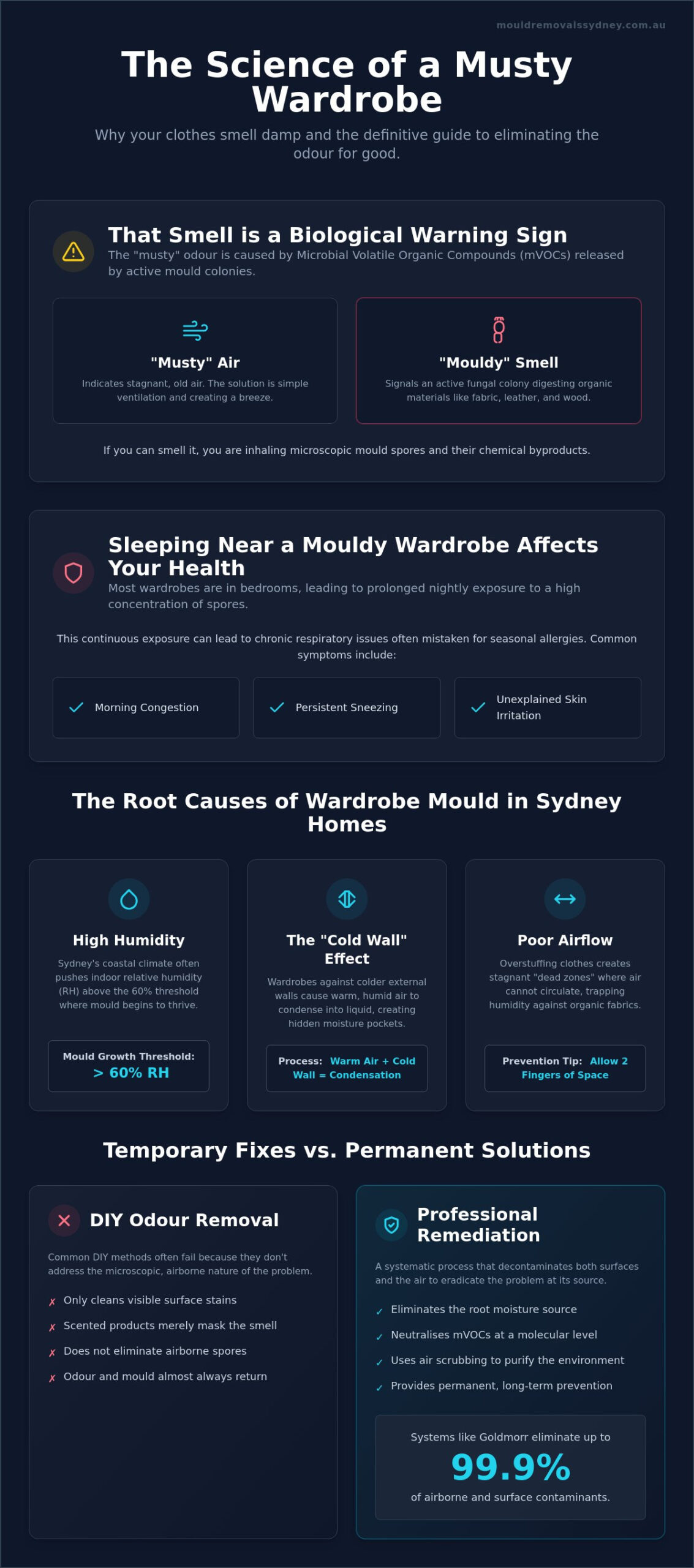
The smell of a damp closet is unmistakable. It’s often described as earthy, pungent, or sour. While many homeowners dismiss it as a simple lack of ventilation, this odour is actually a biological warning sign. When you are researching how to get rid of mould smell in wardrobe areas, you must first understand what you are actually smelling. The scent is a physical byproduct of an active infestation that is currently spreading through your storage space.
This distinct scent is caused by Microbial Volatile Organic Compounds, or mVOCs. These are chemicals released by Indoor mold as it grows and consumes organic material. If your nose detects this scent, it means you are currently inhaling microscopic mould spores and chemical byproducts. There is a distinct difference between “musty” air and a “mouldy” wardrobe. Musty air usually indicates stagnant, old air that needs a breeze. A mouldy smell indicates an active, thriving fungal colony that is currently digesting your property. Ignoring the issue leads to irreversible fabric damage and potential structural rot.
The Science of mVOCs in Small Spaces
Fungal colonies function as living organisms. They eat, grow, and produce waste. This waste includes gases that “off-gas” into the confined space of your closet. Wardrobes are the perfect incubator for these colonies because they are dark, rarely disturbed, and filled with organic food sources like cotton, wool, and leather. mVOCs are the chemical byproduct of fungal metabolism. Because wardrobes lack airflow, these gases concentrate until they permeate every fibre of your clothing. Professional remediation is required to neutralise these compounds at a molecular level.
Health Risks of Sleeping Near a Mouldy Wardrobe
Most wardrobes are located in bedrooms. This significantly increases your daily exposure time to these contaminants. The average person spends eight hours per night in their bedroom, often just metres away from the source of the smell. If your closet is infested, you are sleeping in a high-concentration spore zone. This often leads to chronic respiratory issues that people mistake for seasonal allergies. Common symptoms include morning congestion, persistent sneezing, or unexplained skin irritation. Knowing how to get rid of mould smell in wardrobe enclosures is not just about saving your clothes; it is about protecting your long-term health and ensuring your indoor air is safe to breathe.
The Root Causes of Wardrobe Mould in Sydney Homes
Sydney’s coastal geography creates a unique set of challenges for property owners. High humidity levels, particularly in regions like the Northern Beaches or the humid pockets of the Western Suburbs, provide the exact environment fungi need to flourish. The key to mould control is moisture control, yet many built-in wardrobes are designed without adequate airflow. When environmental moisture is trapped in a confined space, it’s only a matter of time before an infestation begins.
A common culprit is the “cold wall” effect. Many wardrobes are installed against external walls. During cooler months, these walls remain significantly colder than the rest of the room. When warm, humid air enters the wardrobe and hits that cold surface, it reaches its dew point and condenses into liquid droplets. This hidden moisture sits behind your hanging clothes, creating a breeding ground that makes it difficult to figure out how to get rid of mould smell in wardrobe areas using simple cleaning sprays. You’re fighting a structural temperature imbalance, not just a surface stain.
Your storage habits also play a role. Overstuffing a wardrobe is one of the fastest ways to trigger a growth cycle. When clothes are packed tightly together, they act as an insulator, creating stagnant pockets where air cannot circulate. These “dead zones” trap humidity against organic fabrics like wool or leather. If you want to know how to get rid of mould smell in wardrobe spaces permanently, you must allow for at least two fingers of space between every hanging item to facilitate air movement.
Humidity and the Coastal Sydney Climate
Mould begins to thrive once relative humidity exceeds the 60% threshold. In Sydney, outdoor humidity often sits well above this level, especially during the summer and autumn months. We recommend using a digital hygrometer to track the micro-climate inside your closet. If the reading consistently stays above 60%, you have an active risk. Tracking these levels is a critical first step in professional moisture management.
Structural Issues: Rising Damp and Subfloor Ventilation
Surface cleaning often fails because the moisture source is actually beneath your feet. In many older Sydney homes, moisture from the ground rises through the brickwork or floorboards, a process known as rising damp. This subfloor moisture migrates into bedroom walls and settles inside built-in closets. Addressing this requires more than a cloth and bucket; it often necessitates a professional subfloor ventilation system to stop the water at its source. If you notice the smell is strongest near the floor, booking a professional mould inspection is a pragmatic way to protect your property investment.
DIY Odour Removal vs. Professional Remediation
Your first instinct when noticing a musty closet is likely to reach for a home remedy. While these methods are popular in online forums, they often provide a false sense of security. If you want to know how to get rid of mould smell in wardrobe spaces permanently, you must distinguish between masking a scent and eliminating a biological hazard. Passive odour absorbers like charcoal bags or bowls of baking soda only capture the gases released by fungi. They do nothing to stop the reproductive spores that continue to settle on your clothing and shelving.
Professional remediation offers a systematic advantage that DIY efforts cannot match. A professional approach focuses on decontamination rather than just cosmetic cleaning. While a homeowner might wipe down a visible stain, specialists use high-grade equipment to neutralise airborne contaminants. Wiping a surface often spreads spores further into the air, potentially worsening the infestation. True removal requires killing the fungal roots embedded within the porous surfaces of your wardrobe, a task that retail-grade cleaning products rarely achieve.
The Limits of Vinegar and Baking Soda
Vinegar is often praised as a natural solution because its acidity can kill approximately 82% of mould species. However, that leaves a significant margin for resilient strains to survive and recolonise. In Sydney’s high-humidity environments, baking soda fails quickly. Once the powder becomes saturated with moisture from the air, it loses its ability to absorb mVOCs. You should also avoid the common “bleach trap.” Bleach is primarily composed of water. When applied to porous materials like wardrobe timber, the chlorine stays on the surface while the water soaks in. This actually provides the internal fungi with the hydration they need to grow deeper into the wood.
When to Call a Professional Mould Remover
Deciding when to transition from DIY to professional help is a matter of safety and effectiveness. If you discover an area of visible growth larger than one square metre, you are dealing with a significant infestation that requires containment. Persistent odours that remain after cleaning or recurring growth after multiple DIY attempts are clear indicators of a hidden moisture source. A professional mould inspection is essential in these cases to locate hidden leaks or structural defects. For urgent situations involving pipe bursts or heavy rain intrusion, we provide 24/7 water damage repair to prevent the smell from becoming a permanent fixture in your home. Don’t wait for the damage to become irreversible before seeking expert intervention.
How to Get Rid of Mould Smell in Wardrobe: The Step-by-Step Recovery Process
Eliminating a persistent odour requires a methodical strategy. You can’t just spray air freshener and hope for the best. To truly understand how to get rid of mould smell in wardrobe systems, you must follow a professional-grade decontamination sequence. This process ensures you remove the biological source and the lingering airborne particles that cause the scent to return week after week.
- Step 1: Total Evacuation. Remove every single item from the space. This is the only way to perform a thorough inspection for black mould on the back panels and floorboards.
- Step 2: Decontamination of Clothing. Spores cling to fibres. Every item removed must be treated or cleaned before it returns to the wardrobe to prevent cross-contamination.
- Step 3: Surface Treatment. Clean the wardrobe carcass using professional-grade, non-porous cleaners to neutralise any remaining fungal roots embedded in the timber or laminate.
- Step 4: Air Purification. This is the missing step in most DIY guides. You must scrub the air to remove the mVOCs and floating spores that cause the smell to linger even after the surfaces look clean.
- Step 5: Environmental Control. Reconfigure the space to ensure proper airflow and humidity management. This involves spacing out hangers and potentially installing moisture-wicking solutions.
Cleaning the Wardrobe Interior Safely
Start by vacuuming all surfaces using a machine equipped with a HEPA filter. Standard vacuums often exhaust small spores back into the room, which actually spreads the infestation. Focus on hidden areas like the tracks behind drawers, the corners of the ceiling, and the underside of top shelves. Use a slightly damp microfibre cloth to capture, not spread, dust and spores from the wardrobe walls. If the infestation is extensive, you need professional intervention to ensure every spore is neutralised. Contact our team for expert Mould Remediation services to restore your home’s safety.
Salvaging Your Clothes
Be ruthless during the sorting process. While most cotton and synthetic fabrics can be saved, porous items like mouldy leather or heavily infested shoes may need to be discarded. Spores can penetrate deep into leather grains, making them nearly impossible to fully decontaminate at home. For washable items, use the highest heat setting recommended on the care label. Add an antifungal laundry additive to the rinse cycle to kill resilient spores. Delicate garments or designer pieces should be taken to a professional dry cleaner who specialises in spore removal. Don’t risk re-contaminating your clean wardrobe with “half-cleaned” clothes that still harbour microscopic fungi.
Permanent Solutions: Professional Air Scrubbing and Prevention
Surface cleaning is often just a temporary pause in a much larger biological cycle. If you truly want to know how to get rid of mould smell in wardrobe spaces for good, you must address the microscopic reality of the infestation. Standard retail cleaners simply cannot reach the fungal roots embedded within the grains of your wardrobe’s timber carcass. Achieving a permanent result requires a combination of molecular-level decontamination and professional air filtration to ensure that the “ghost” of the smell doesn’t linger in your bedroom long after the visible stains are gone.
The Goldmorr Advantage for Wardrobes
We utilize the Goldmorr System, a proprietary methodology that represents the gold standard in modern remediation. This process involves a biodegradable fogging agent that expands to fill every cubic centimetre of your wardrobe. Unlike liquid sprays that can warp timber, this fine mist penetrates deep into porous wood and hard-to-reach tracks where spores hide. It’s a highly efficient, no-nonsense approach that is significantly faster than traditional “scrub and bleach” methods. Because the formula is biodegradable, it’s completely safe for bedroom environments and won’t leave behind the harsh, toxic chemical odours associated with industrial cleaners.
Maintaining a Mould-Free Wardrobe in 2026
Prevention is a results-driven process that requires consistent habits. Once your wardrobe is professionally decontaminated, you must maintain an environment that discourages regrowth. Follow the “two-finger rule” by ensuring at least two fingers of space exist between every hanging garment to allow for natural convection. Avoid placing your wardrobe directly against external “cold walls” if possible, or leave a small gap between the furniture and the wall to prevent condensation build-up.
You should also consider the role of your home’s ventilation system. Recirculating spores through dirty vents will quickly undo your hard work. Regular air duct cleaning is a pragmatic way to ensure your indoor air quality remains high and your wardrobe stays fresh. ABC Mould Cleaning Solutions is the logical choice for Sydney residents facing persistent fungal issues. We offer a systematic, evidence-based approach to restore your property’s safety. Contact ABC Mould Cleaning Solutions for a professional inspection today and eliminate the musty smell from your life permanently.
Reclaim Your Closet and Your Health
A musty wardrobe is a biological warning sign that puts your clothing investment and your family’s respiratory health at risk. You’ve learned that moisture control is the foundation of prevention and that simple DIY masking agents cannot neutralize active spores. Truly understanding how to get rid of mould smell in wardrobe spaces requires moving beyond surface cleaning toward professional-grade decontamination and air scrubbing.
ABC Mould Cleaning Solutions utilizes the safe and biodegradable Goldmorr System to eliminate fungal colonies at the source. As Sydney’s #1 rated mould experts, we provide a systematic approach that includes professional air purification to remove 99.9% of airborne contaminants. We stand by our specialized methodology with a bold price match guarantee, ensuring you receive the highest value for your home’s safety. Don’t let a damp smell compromise your lifestyle or ruin your favourite garments any longer.
Get a Free Quote for Professional Mould Removal in Sydney
Take the first step toward a fresh, odour-free home and enjoy the confidence of a professionally sanitized wardrobe today. Once your space is restored, you might even feel inspired to explore Boudoir Photography Session options to celebrate your renewed sense of empowerment.
Frequently Asked Questions
Why does my wardrobe smell musty but I can’t see any mould?
The smell is caused by Microbial Volatile Organic Compounds (mVOCs) released by fungi growing in hidden areas. Check the back panels of the furniture or the gaps behind drawers. Mould often thrives in the dark spaces between the wardrobe and the wall where condensation builds up. If you can smell it, an infestation is already active and off-gassing into your storage space.
Can I just use a dehumidifier to get rid of the mould smell?
A dehumidifier only removes the moisture that allows fungi to grow; it does not kill existing spores or neutralize lingering smells. While it is a great preventative tool, it cannot solve an active infestation. You must physically remove the colonies and scrub the air to eliminate the mVOCs. Use a dehumidifier only after professional remediation to maintain relative humidity below 60%.
Will washing my clothes get rid of the musty mould smell?
Standard washing may remove the scent temporarily, but it rarely kills all microscopic spores embedded in the fabric fibres. If you return “clean” clothes to an infested wardrobe, they will quickly absorb the smell again. For effective results, use high-heat settings and antifungal additives. However, this only works if you also address the primary issue of how to get rid of mould smell in wardrobe carcasses first.
Is the mould smell in my wardrobe dangerous to my health?
Yes, persistent musty odours indicate high concentrations of airborne spores and chemical byproducts. Inhaling these contaminants daily can lead to respiratory issues, morning congestion, and skin irritation. Because wardrobes are typically located in bedrooms, your exposure time is significantly higher than in other rooms. Do not ignore the scent; it is a physical indicator that your indoor air quality is compromised.
Does vinegar actually kill mould in wardrobes?
Vinegar is effective against approximately 82% of mould species, but it is not a complete solution for wardrobes. It often fails to penetrate porous timber surfaces where fungal roots are established. Additionally, vinegar does nothing to remove airborne spores or neutralize the concentrated mVOCs trapped in the space. Professional systems like the Goldmorr fogging process are required for total decontamination and permanent results.
How long does it take for a professional to remove wardrobe mould?
Most professional wardrobe remediation jobs are completed within a single day. The process involves a systematic inspection, surface treatment, and air scrubbing. Using advanced methodologies like the Goldmorr System allows for rapid decontamination without the need for long drying times. This efficiency ensures your bedroom is safe to occupy again quickly, minimizing disruption to your routine while providing a long-term solution.
What is the best way to prevent mould from returning to my closet?
Effective prevention requires consistent moisture management and improved airflow. Maintain a gap between your clothes and ensure the wardrobe is not packed tightly against external walls. Use digital hygrometers to monitor humidity levels and keep them below 60%. If your home suffers from structural dampness, consider a subfloor ventilation system to address the root cause of the moisture before it reaches your bedroom.
Can mould spores travel from my wardrobe to the rest of my house?
Mould spores are microscopic and travel easily through air currents. Every time you open your wardrobe doors, you release spores and mVOCs into your bedroom. These particles can settle on other furniture or enter your HVAC system, leading to cross-contamination. This is why professional air scrubbing is essential; it captures these floating particles before they can establish new colonies elsewhere in your property.