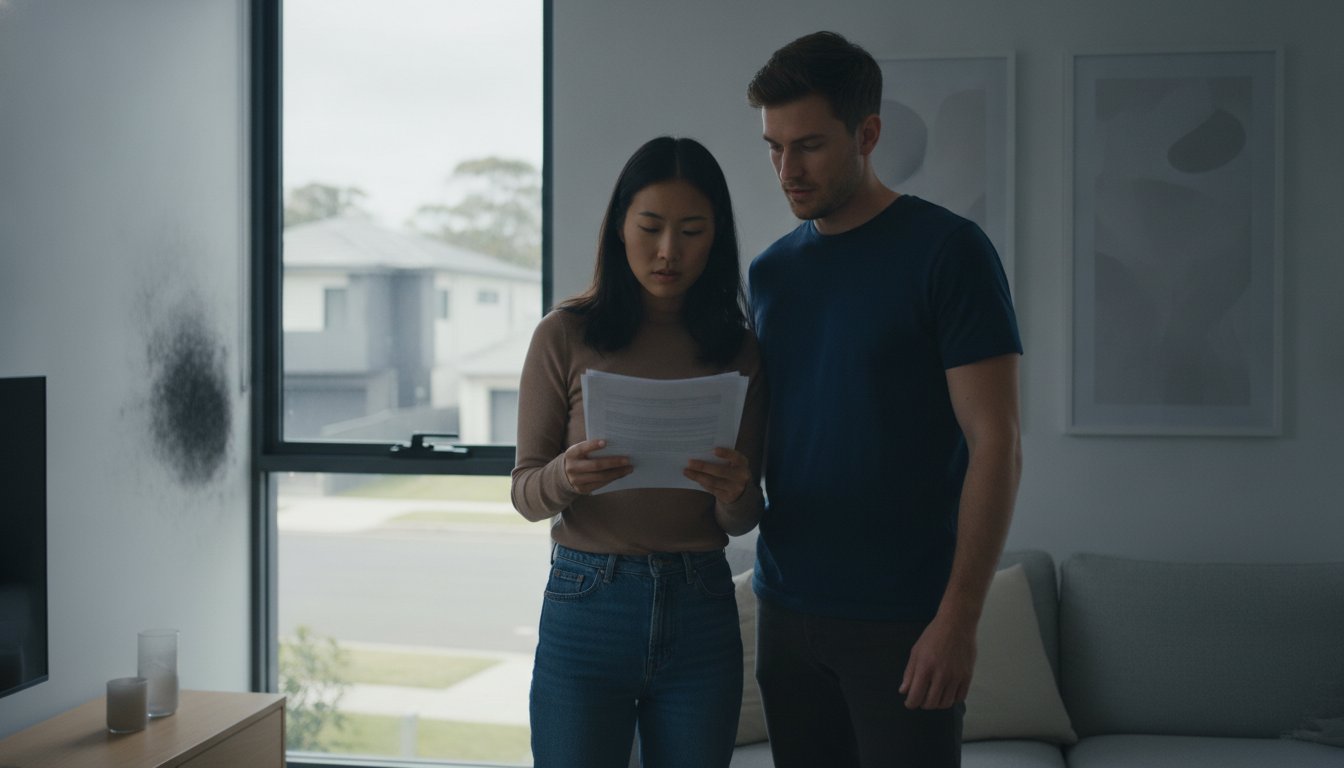
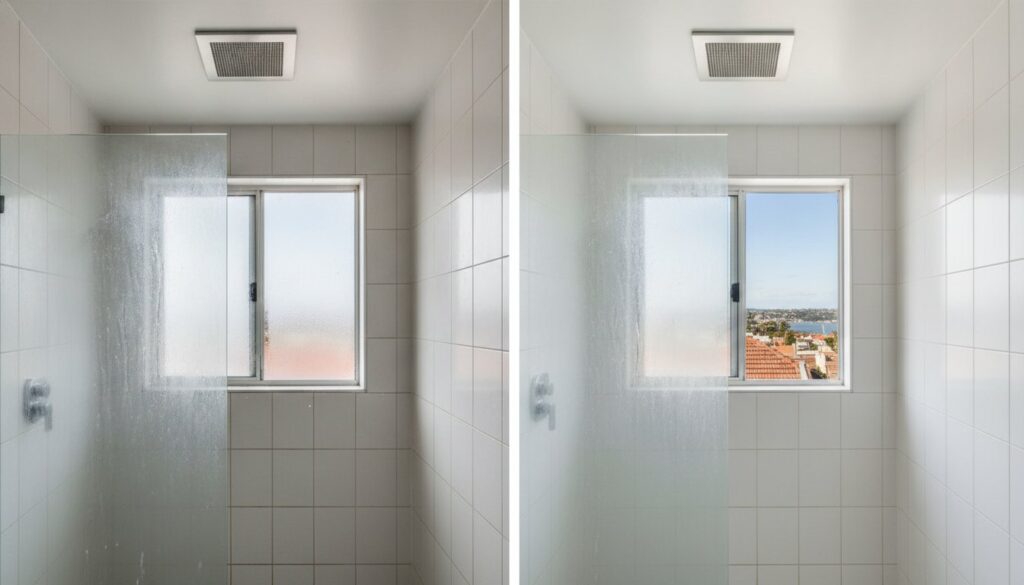
Did you know Sydney is officially the mouldiest capital city in Australia, with a staggering mouldiness score of 92.48 out of 100? If you’re constantly scrubbing recurring black spots or worrying about the health risks for your children, you need professional bathroom mould removal Sydney to break the cycle. It’s exhausting to feel like you’re losing the battle against dampness despite your best efforts. You need a solution that protects your property and your family’s well-being for the long term.
Cleaning visible growth is only half the battle. Discover how to transform your bathroom from a damp mould trap into a dry, healthy sanctuary by fixing fundamental airflow issues. This article provides clear guidance on the latest Australian standards for airflow, explains why venting into ceiling spaces is a critical error, and offers a roadmap to a permanent, mould-free finish using specialized remediation and professional ventilation strategies.
Key Takeaways
- Learn why standard exhaust fans often fail and how venting directly into your roof cavity creates hidden moisture traps that fuel mould growth.
- Calculate the precise airflow requirements for your space to select the right fan type, ensuring your ventilation moves enough volume to prevent condensation.
- Adopt the “Pre-Steam” rule and ensure a 10-20mm door undercut to provide the essential replacement air your extraction system needs to work at peak efficiency.
- Discover why professional bathroom mould removal Sydney must happen before you upgrade your hardware to prevent spreading existing spores throughout your newly ventilated home.
The Humidity Trap: Why Standard Bathroom Ventilation Often Fails in Sydney
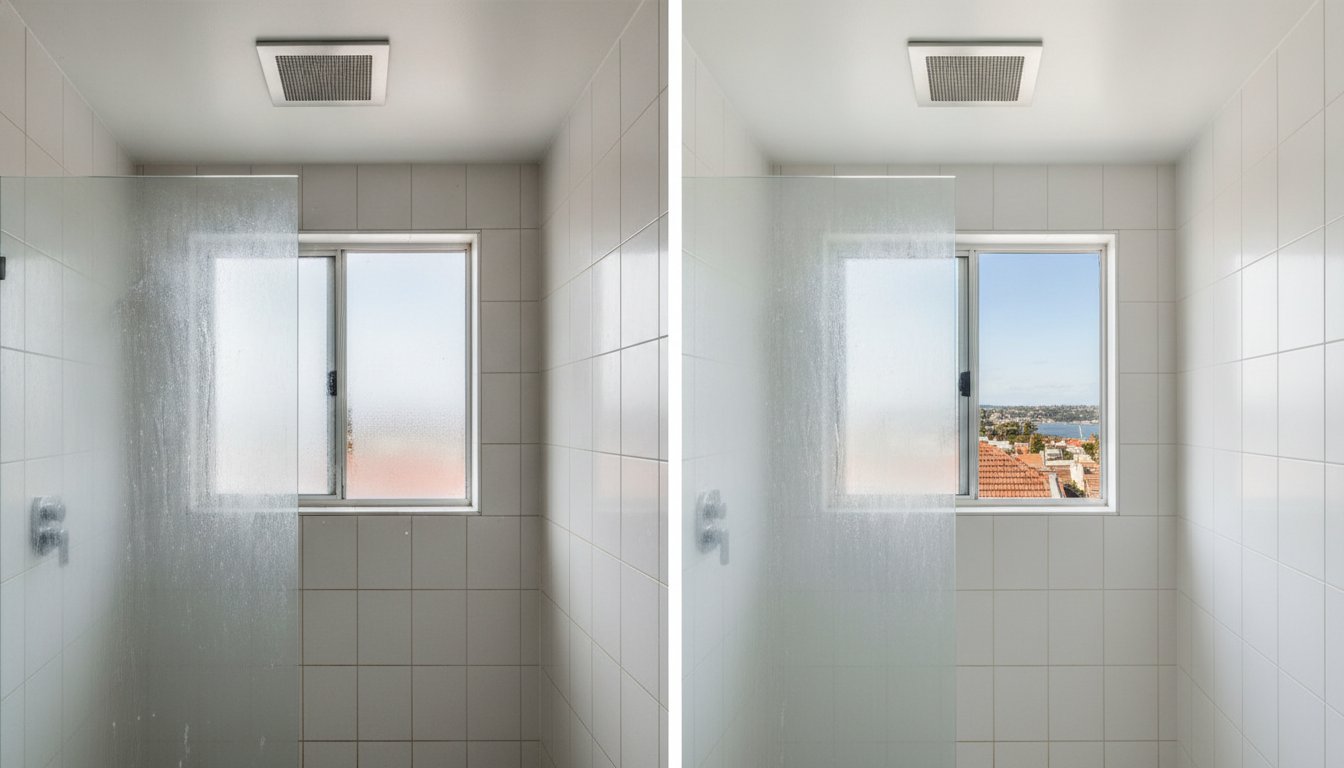
In many Sydney homes, bathrooms become “humidity traps.” This occurs when hot steam from your shower has nowhere to go, turning into stagnant, spore-laden air that clings to every surface. You might see the fan spinning, but that doesn’t mean it’s actually removing the moisture. Understanding how indoor mould grows is essential for every homeowner. Mould requires consistent moisture and organic material to thrive. When steam stays trapped, your bathroom provides the perfect laboratory for a colonisation that can spread to your bedroom and beyond.
The physics are simple but destructive. Moist, warm air naturally targets the coldest surfaces in the room, usually your tiles, mirrors, and ceiling. This leads to immediate condensation. In our city, we face a unique challenge often called the “Sydney Factor.” Our high coastal humidity, especially during East Coast Lows, means that even opening a window often fails to solve the problem. If the air outside is just as damp as the air inside, natural evaporation stops. This is why professional bathroom mould removal Sydney specialists focus so heavily on mechanical extraction rather than just relying on natural airflow.
Airflow vs. Extraction: The ‘Make-Up Air’ Secret
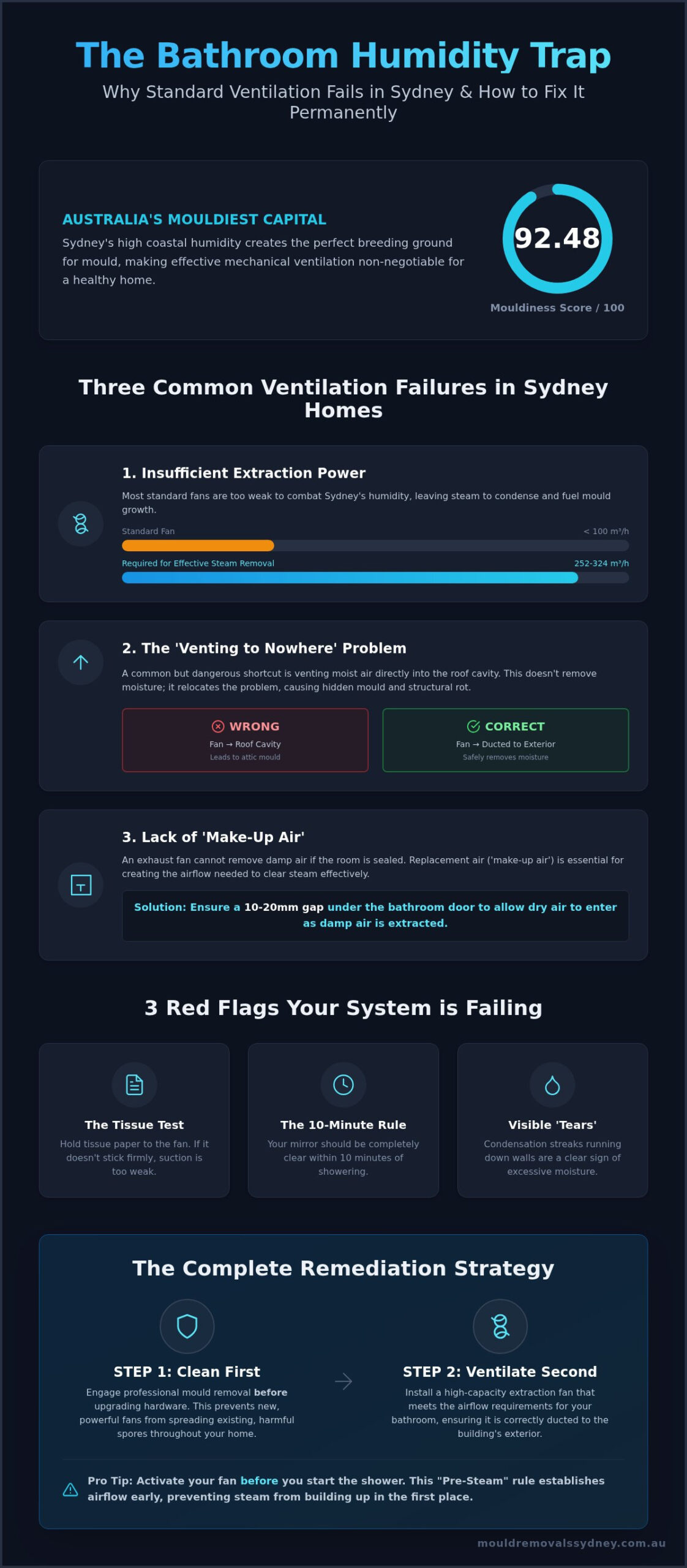
A common mistake is thinking an exhaust fan works in isolation. It doesn’t. A fan cannot pull air out of a bathroom if the room is hermetically sealed. For every litre of damp air the fan removes, a litre of dry air must enter the room. This is called “make-up air.” Without it, the fan struggles against a vacuum, spinning fast but moving nothing. To fix this, ensure your bathroom door has a 10-20mm undercut. This small gap allows the fan to pull fresh air from the rest of the house, creating the cross-ventilation needed to flush out steam before it settles.
Signs Your Current System is Failing
You don’t need a degree in engineering to know if your ventilation is failing. Watch for these three red flags:
- The Tissue Test: Hold a single square of toilet tissue up to the fan intake while it’s running. If the fan doesn’t hold the paper firmly in place, the suction is insufficient for the room’s volume.
- The 10-Minute Rule: Your mirror should be completely clear within 10 minutes of finishing your shower. If it stays fogged for longer, your extraction rate is dangerously low.
- Visible ‘Tears’: Look for condensation streaks running down your walls or pooling on skirting boards. These “tears” are a clear sign that professional bathroom mould removal Sydney is required to address the underlying moisture load and prevent structural damage.
Identifying Common Ventilation Failures in Sydney Properties
Many Sydney residents struggle with recurring growth because their hardware simply isn’t up to the task. If your fan sounds like a jet engine but the air remains thick with steam, you’re likely dealing with a mechanical mismatch. Standard exhaust fans often move less than 100 m³/h. For effective steam removal in a modern Australian bathroom, you actually need a flow rate between 252 and 324 m³/h. Without this power, the moisture lingers long enough to settle into your grout and paintwork.
Placement is another frequent point of failure. We often see fans installed near the bathroom door because it’s easier for the electrician to wire. This creates “dead zones” in the corners of the room or over the shower itself where air remains stagnant. In coastal areas like the Northern Beaches or Eastern Suburbs, salt air plays a role too. Coastal corrosion can seize external louvres and block soffit vents with a crust of salt and dust, effectively choking your fan’s ability to exhaust air. If you’ve noticed your fan getting louder without becoming more effective, it’s time to consider professional bathroom mould removal Sydney to assess the entire extraction path.
The ‘Venting to Nowhere’ Problem
One of the most dangerous shortcuts in Sydney construction is ducting that terminates directly into the roof cavity rather than through the roof or eave. This doesn’t solve the moisture problem; it simply hides it. Pumping litres of steam into a dark, enclosed attic creates massive black mould colonies on your rafters and insulation. Roof space condensation is the #1 cause of structural rot in Sydney. Following NSW Health advice on mould, all damp air must be ducted to the building’s exterior to protect both your health and the building’s integrity.
Structural Obstruction in Heritage Sydney Homes
Sydney’s iconic Victorian terraces and heritage cottages present unique challenges. Double-brick construction often means there are no wall cavities to hide modern ducting. Additionally, the high ceilings found in Glebe or Paddington homes significantly increase the total volume of air that needs to be moved. A fan that works in a modern apartment will fail in a high-ceilinged heritage bathroom. Retrofitting these spaces requires specialist knowledge, especially when dealing with strict Strata regulations in older apartment blocks. If you are battling persistent dampness, a professional mould inspection can identify these structural bottlenecks before they lead to expensive repairs.
Engineering the Solution: Upgrading Fans, Ducts, and Airflow
Fixing a mouldy bathroom isn’t about buying the cheapest fan at a hardware store. It requires a focused engineering approach. You must calculate your specific room volume to determine the required Air Changes per Hour (ACH). For a high-moisture zone like a shower, you need at least 15 air changes every hour. This ensures steam is removed before it can condense. If you skip this step, you’re just guessing, and the dampness will return. Following a recognized EPA guide to mould cleanup, controlling moisture is the most critical step in any remediation project.
Not all fans are equal. Axial fans are common but often weak; they fail if they have to push air through a long duct. Centrifugal fans are much more powerful and handle high-pressure duct runs well. Mixed flow fans are usually the best choice for Sydney homes, combining high pressure with quiet operation. When you invest in professional bathroom mould removal Sydney, specialists will match the fan type to your specific ducting layout to ensure maximum extraction efficiency. Your ducting should be short, straight, and properly insulated to prevent steam from cooling and turning back into liquid inside the pipe.
Choosing the Right Exhaust Fan Capacity
To find your required capacity, use this formula: Room Volume (Length x Width x Height) x 15. If your bathroom is 3m x 2m x 2.4m, your volume is 14.4 cubic metres. Multiplying this by 15 gives you a requirement of 216 m³/h. You should always round up to the nearest commercial standard, such as 250 m³/h or 300 m³/h. Continuous “trickle” ventilation systems are also gaining popularity in Sydney because they maintain a constant low-level airflow even when the room is not in use, preventing the air from ever becoming stagnant.
The Role of Subfloor Ventilation in Bathroom Dryness
There’s a direct link between your subfloor and your bathroom health that many homeowners overlook. Dampness under your home often migrates up through porous bathroom tiles and grout. If the ground beneath your bathroom is saturated, even the best exhaust fan will struggle to keep the room dry. This is why we often recommend subfloor ventilation as part of a holistic fix. In low-lying or flood-prone Sydney suburbs, mechanical subfloor fans are essential to stop rising damp from fueling a never-ending mould cycle. Without addressing the moisture coming from below, professional bathroom mould removal Sydney is only a temporary fix.
Beyond the Fan: Strategic Airflow Management Habits
Even the most powerful extraction system will fail if your daily habits create a moisture backlog. Proper airflow is a management strategy, not just a hardware installation. One of the most effective habits you can adopt is the ‘Pre-Steam’ Rule. Trigger your fan at least 2 minutes before you turn on the shower. This establishes a clear directional air current, ensuring that the very first puff of steam is immediately captured and moved toward the exhaust rather than settling on cold surfaces. It’s a simple step that significantly reduces the initial condensation load on your ceiling.
Once the shower is off, the job isn’t done. Use a 20-minute overrun period to clear latent moisture. This is especially important in Sydney’s humid climate where wet towels can act as a secondary moisture source for hours. If your fan doesn’t have a built-in timer, you’re likely turning it off too early, leaving enough humidity behind to support new growth. When these habits fail to stop the cycle, you need professional bathroom mould removal Sydney to reset the environment and eliminate deep-seated spores that have already taken hold in the plasterboard.
The Door Gap and Make-Up Air
Passive airflow is the most neglected part of bathroom design. Your fan cannot pull air out of the room if it cannot get fresh air in. This creates a vacuum effect where the fan motor works hard but moves zero volume. Ensure your bathroom door has a 10-20mm undercut to allow for “make-up air.” If a door gap isn’t possible, consider installing a door grille or an active make-up air vent in the wall. Without this intake path, your ventilation system is essentially suffocated, regardless of the fan’s power.
Smart Controls and Automation
Removing human error is the final step in a permanent fix. Smart ventilation tools like humidity sensors, or hygrostats, automatically trigger the fan when moisture levels rise above a set threshold. These sensors stay active until the air is truly dry, not just until you leave the room. Delay-off timers are also a vital addition for busy family bathrooms, ensuring the system runs for that critical post-shower window. If you’re unsure if your current setup is effective, book a professional mould inspection to identify the gaps in your airflow strategy.
Be strategic with your windows. While natural air is often helpful, Sydney’s coastal humidity can sometimes be higher outside than inside, particularly during East Coast Lows. On a rainy or muggy day, opening the window might actually introduce more moisture into the room. In these conditions, rely entirely on your mechanical extraction. If you’ve already noticed spotting on the ceiling, professional bathroom mould removal Sydney is necessary to ensure these spores don’t migrate to other parts of your home during the next humid spell.
The Complete Remediation Strategy: Clean First, Ventilate Second
Installing a high-performance fan is a vital step, but it’s not a magic bullet for an existing problem. A common misconception among homeowners is that improved airflow will kill established colonies. It won’t. Ventilation is a preventative measure designed to stop new growth; it cannot eliminate mature mould that has already colonised your plasterboard or grout. If you have visible spotting, you must invest in professional bathroom mould removal Sydney to reset the environment before relying on your new ventilation hardware.
Attempting to “scrub away” the problem often makes it worse. When you agitate a dry mould colony, you release millions of microscopic spores into the air. Your new ventilation system then picks up these spores and distributes them throughout the ducting and into other rooms. This is why professional intervention is critical. We use the specialized Goldmorr System, which involves biodegradable fogging to neutralise airborne spores without the need for aggressive, destructive scrubbing. This process ensures the air you breathe is safe before we even begin treating the surfaces.
By choosing professional mould removal, you address the root of the infestation. Our methodology focuses on a systematic, evidence-based approach that clears the “biological load” of the room. Once the existing colonies are neutralised and removed, your upgraded ventilation system can finally do its job: keeping the space dry and preventing a secondary outbreak.
Why DIY Cleaning and Bleach Often Fails
Most supermarket cleaners and bleach solutions only provide a temporary cosmetic fix. This is known as the ‘Iceberg Effect.’ Bleach is a high-surface-tension chemical that cannot penetrate porous materials like grout, silicone, or plasterboard. It simply “bleaches” the colour out of the surface mould while the microscopic root system stays alive deep within the substrate. Within weeks, the mould returns. Furthermore, DIY scrubbing without proper containment risks cross-contaminating your entire home, turning a single-room issue into a whole-property crisis.
The ABC Mould Cleaning Solutions Approach
We solve “unsolvable” recurring mould problems using a proven four-step methodology:
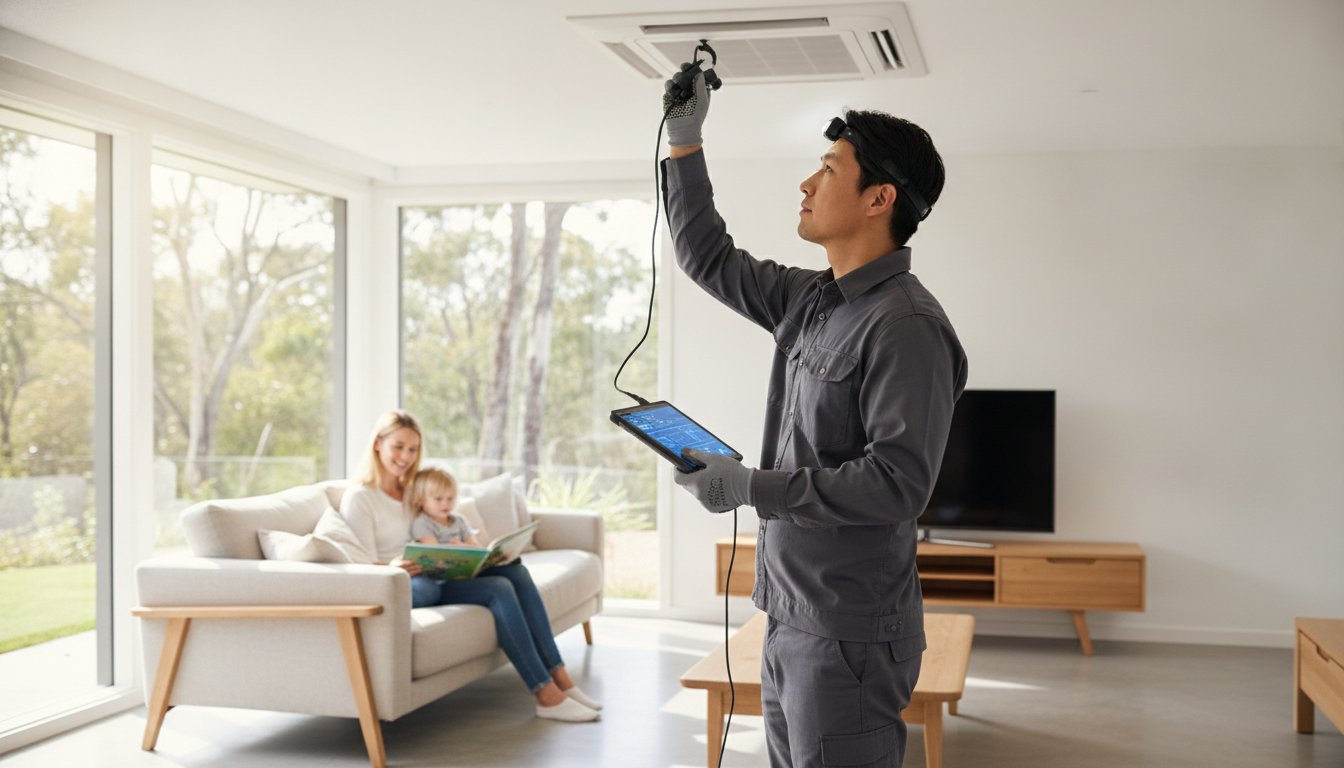
- Step 1: Professional Inspection. We use moisture mapping to identify exactly where the dampness is coming from, whether it’s a structural leak or a ventilation failure.
- Step 2: Goldmorr Fogging. We deploy a biodegradable fog to neutralise all airborne contaminants, ensuring the room is safe for occupants.
- Step 3: Physical Remediation. We treat and remove affected surfaces using industry-leading antimicrobial agents that outperform retail alternatives.
- Step 4: Long-Term Prevention. We implement structural fixes, including subfloor ventilation or water damage repair, to ensure the moisture never returns.
Don’t let a damp bathroom compromise your family’s health. Our team provides the competent authority and specialized technical knowledge required to end the mould cycle for good. We offer a pragmatic, results-driven service that transforms your home into a safe, dry sanctuary. Reach out to us today for a definitive solution to your professional bathroom mould removal Sydney needs.
Take Control of Your Home’s Air Quality Today
Breaking the cycle of dampness requires more than a simple hardware upgrade. Effective moisture control is a three-part ecosystem consisting of professional remediation, engineered extraction, and strategic daily habits. You’ve learned that installing a new fan won’t kill deep-seated colonies already hiding in your walls. You need a systematic approach that resets your environment and addresses root causes like subfloor dampness. For a permanent end to the mould cycle, professional bathroom mould removal Sydney is the only reliable path forward.
As Sydney-owned and operated specialists, we combine world-class remediation using the Goldmorr System with advanced expertise in preventative ventilation. We don’t just clean the surface; we engineer solutions that keep the air dry and safe for your family. Don’t let recurring black spots or musty smells compromise your peace of mind any longer. Take action to protect your property and your health.
Get a Professional Mould Inspection and Ventilation Audit in Sydney Today. You can reclaim your bathroom from the humidity trap and enjoy a dry, mould-free space for years to come.
Frequently Asked Questions
Is it better to open a window or use an exhaust fan in a Sydney bathroom?
Using a high-quality exhaust fan is significantly more effective than opening a window. Sydney’s coastal humidity is often high enough to prevent natural evaporation, especially during the humid summer months or rain events. A mechanical fan creates consistent, forced extraction that removes steam before it can settle on your cold bathroom surfaces.
How much airflow (m3/h) does a standard bathroom actually need?
While Australian Standards require a minimum of 90 m³/h, we recommend a much higher rate for effective steam removal. Aim for a fan capable of moving 252 to 324 m³/h to ensure your bathroom stays dry. Choosing a fan with sufficient capacity is a key part of professional bathroom mould removal Sydney strategies to prevent the cycle of regrowth.
Can I vent my bathroom exhaust fan directly into the attic or roof space?
No, you should never vent damp air directly into your roof cavity. This practice is prohibited under the National Construction Code if your roof has sarking or is lined. Pumping moisture into your ceiling void creates hidden mould colonies and leads to structural rot that is extremely expensive to repair.
Why does mould keep growing back even after I clean it with bleach?
Bleach is a surface-level cleaner that fails to reach the microscopic root systems of mould in porous materials. It often removes the colour but leaves the living organism intact within your grout or plasterboard. Professional remediation is required to neutralise the entire colony and fix the underlying moisture issue permanently.
Does a bathroom window provide enough ventilation to prevent mould?
A window rarely provides enough airflow on its own because it relies on external wind conditions and lacks a forced extraction path. Without a mechanical fan, steam lingers in stagnant “dead zones” in the corners of the room. This moisture quickly turns into a breeding ground for spores regardless of whether the window is cracked open.
What is the best type of exhaust fan for a small bathroom with no windows?
Centrifugal or mixed-flow fans are the best choice for windowless bathrooms. These units are designed to handle the high pressure required to push damp air through long duct runs to the building’s exterior. They offer much stronger extraction power than standard axial fans often found in basic retail kits.
How long should I leave my bathroom fan running after a shower?
Run your exhaust fan for at least 20 minutes after you finish your shower. This ensures that all latent moisture, including dampness from wet towels and floor mats, is fully extracted from the room. Installing a simple delay-off timer can automate this process and remove the risk of human error.
What should I do if I find mould inside my bathroom ventilation ducts?
If you find growth inside your ducts, you should have the flexible ducting replaced entirely rather than attempted to be cleaned. Cleaning flexible ducts is often ineffective and can spread spores throughout your home. Contact a specialist in professional bathroom mould removal Sydney to assess the system and ensure your new ducting has a clear, unobstructed path to the outside.