Is your Sydney home slowly rotting from the foundations up while you’re busy scrubbing the walls? If you’ve noticed a persistent, earthy odor or recurring mould on your ground floor, the real enemy isn’t on your paintwork; it’s trapped beneath your floorboards. Finding the right subfloor dampness solutions Sydney property owners need is a race against time to prevent permanent structural rot and rising damp in your brickwork.
You aren’t alone in this struggle. Most homeowners feel trapped in a cycle of cleaning and repainting, only to watch the moisture return within weeks. It’s exhausting to deal with musty smells that won’t go away. This guide promises to provide a professional roadmap to reclaiming your home’s health by stopping moisture at the source. We’ll explore how to address the root causes of dampness in Sydney’s humid climate. You’ll learn about the latest in subfloor ventilation technology and specialized remediation methods like the Goldmorr System to ensure your foundations stay dry and your air stays pure.
Key Takeaways
- Learn to spot the early warning signs of foundation moisture, including earthy odors and skirting board mould, before they cause permanent structural rot.
- Understand why Sydney’s unique clay soil and double-brick architecture require specialized subfloor dampness solutions Sydney homeowners can rely on for long-term protection.
- Discover why standard passive vents often fail in high humidity and how mechanical extraction fans provide the forced airflow needed to keep foundations dry.
- Explore the benefits of the biodegradable Goldmorr System for eliminating subfloor spores in confined spaces that traditional cleaning methods cannot reach.
- Follow a professional remediation roadmap that includes moisture mapping and clearing debris to ensure your home remains healthy and mould-free.
Identifying the Signs of Subfloor Dampness in Sydney Homes
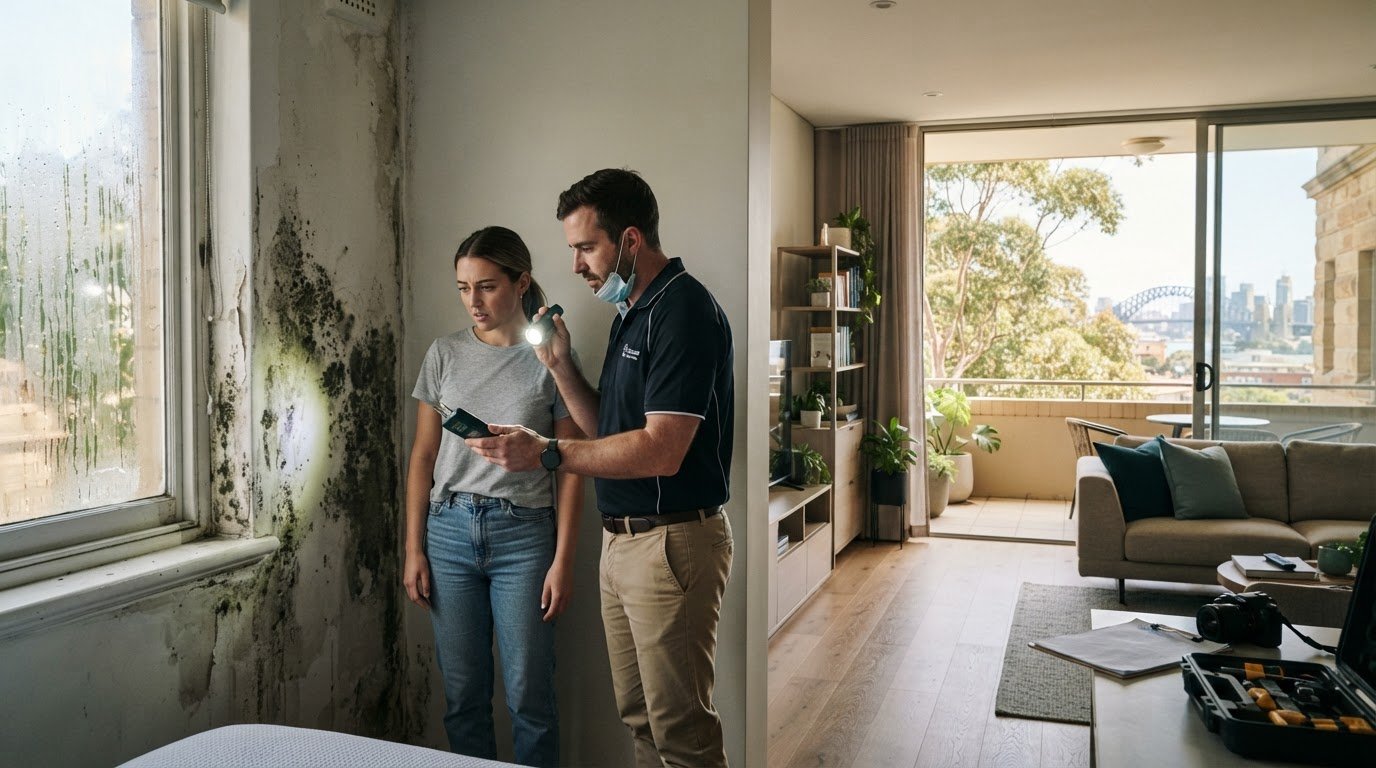
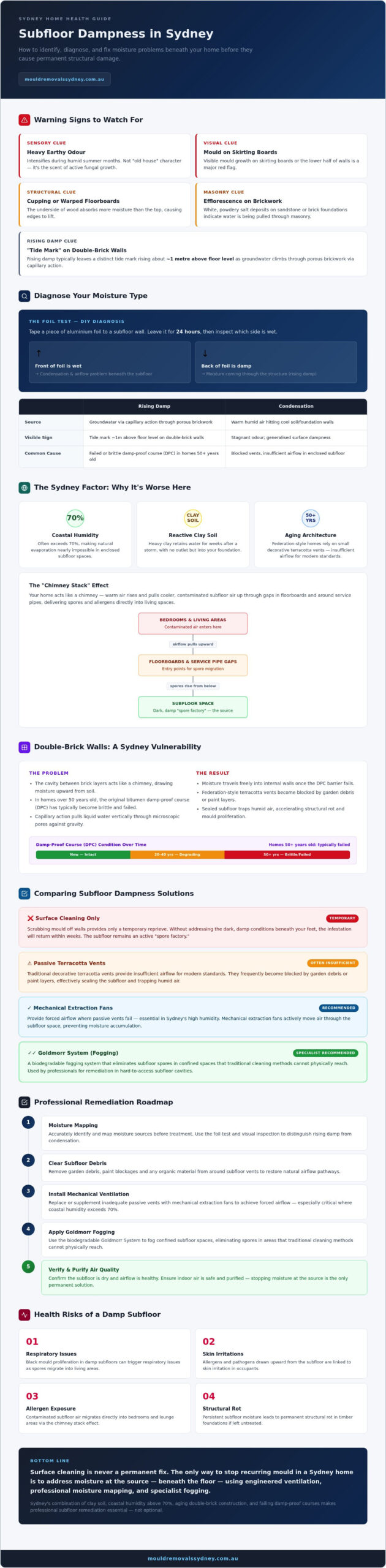
Detecting moisture issues early can save you thousands in structural repairs. In Sydney, the first indicator is often sensory. You might notice a heavy, earthy odor that seems to intensify during our humid summer months. This smell isn’t just “old house” character; it’s the scent of active fungal growth. When air stagnates beneath your home, it creates a breeding ground for spores that eventually find their way into your living spaces.
Look closely at your ground-floor walls. Visible mould growth on skirting boards or the lower half of walls is a major red flag. You might also see your timber floorboards beginning to cup or warp. This happens because the underside of the wood absorbs more moisture than the top, causing the edges to lift. If your home sits on sandstone or brick foundations, watch for efflorescence. This white, powdery salt deposit indicates that water is being pulled through the masonry, a clear sign you need to investigate subfloor dampness solutions Sydney experts recommend. High-quality construction and proper foundation work are essential for preventing such issues, a standard that professional building companies like Swiss Build Ltd prioritize in every project.
Rising Damp vs. Condensation: Which One Are You Facing?
It’s vital to distinguish between different types of structural dampness to apply the correct fix. Rising damp usually leaves a distinct “tide mark” on double-brick walls, typically rising about a meter above the floor level. This occurs when groundwater climbs through the porous brickwork via capillary action. In contrast, condensation happens when warm, humid air hits the cool soil or foundation walls under your house, turning into liquid droplets.
Try the “foil test” to diagnose the source. Tape a piece of aluminium foil to a subfloor wall and leave it for 24 hours. If the front of the foil is wet, you have a condensation and airflow problem. If the back of the foil is damp, you’re likely dealing with moisture coming through the structure itself. Identifying this accurately is the first step in choosing effective subfloor dampness solutions Sydney properties require.
The Health Risks of a Damp Subfloor
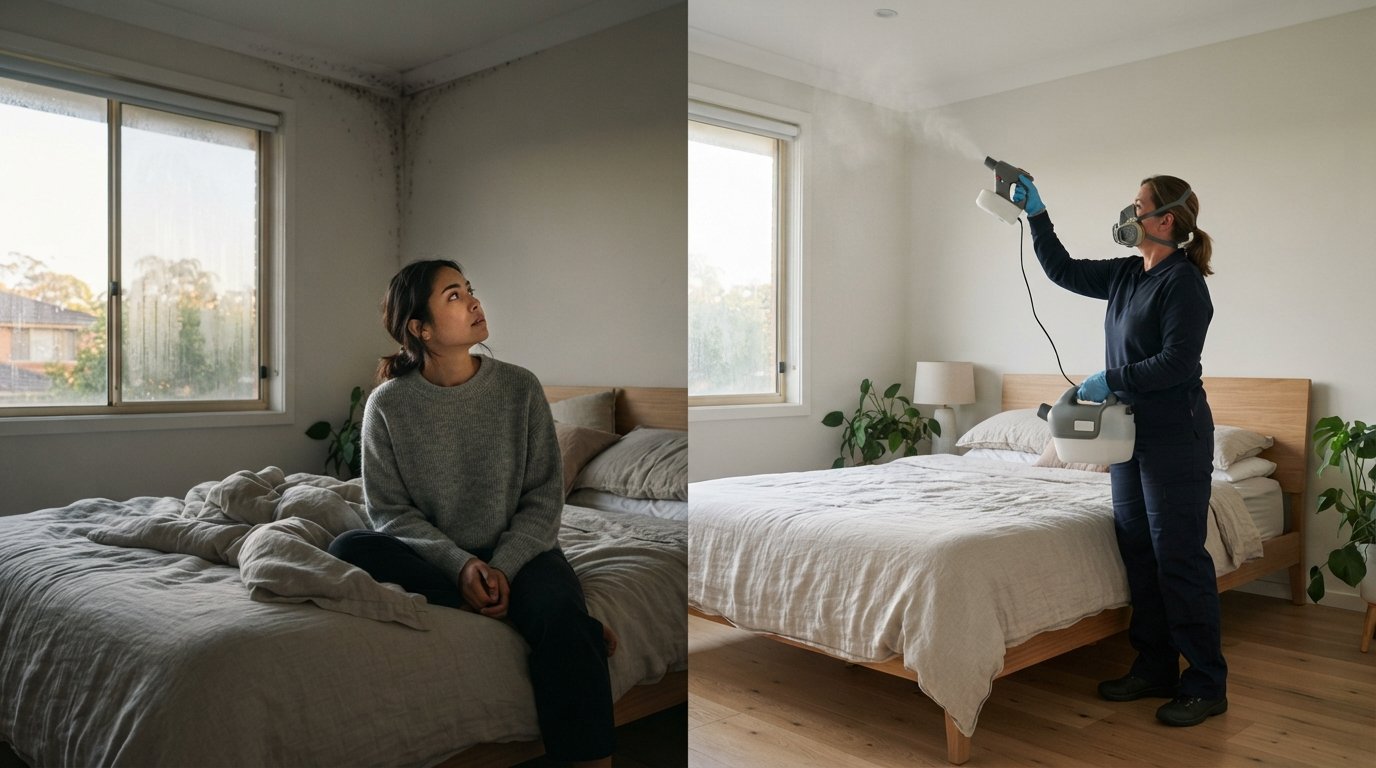
A damp subfloor isn’t just a building issue; it’s a health hazard. Your home acts like a chimney; warm air rises and pulls cooler, contaminated air from the subfloor up through gaps in floorboards and around service pipes. This migration brings allergens and pathogens directly into your bedrooms and lounge areas. This environment is the primary driver for black mould proliferation, which can trigger respiratory issues and skin irritations.
Don’t be fooled by surface cleaning. Scrubbing the mould off your walls provides only a temporary reprieve if the subfloor remains a “spore factory.” Without addressing the dark, damp conditions beneath your feet, the infestation will return within weeks. Professional remediation focuses on stopping the moisture at the source, ensuring the air your family breathes is purified and safe.
The Sydney Factor: Why Subfloor Dampness Is So Prevalent
Sydney’s unique combination of reactive clay soil and historic architecture creates a perfect storm for moisture problems. While other regions deal with occasional damp, Sydney homeowners face a constant battle against ground saturation. Much of our city sits on heavy clay that retains water for weeks after a storm. This water has nowhere to go but into your foundation. Combined with coastal humidity that often exceeds 70%, natural evaporation becomes nearly impossible in enclosed spaces.
Older Federation-style homes exacerbate the issue. These properties typically rely on small, decorative terracotta vents. While they look beautiful, they provide insufficient airflow for modern standards. Over time, these vents become blocked by garden debris or layers of paint, effectively sealing the subfloor and trapping humid air. This is why specialized subfloor dampness solutions Sydney experts provide are essential for protecting the structural integrity of older builds.
Rising Damp in Double Brick Walls: A Sydney Specialty
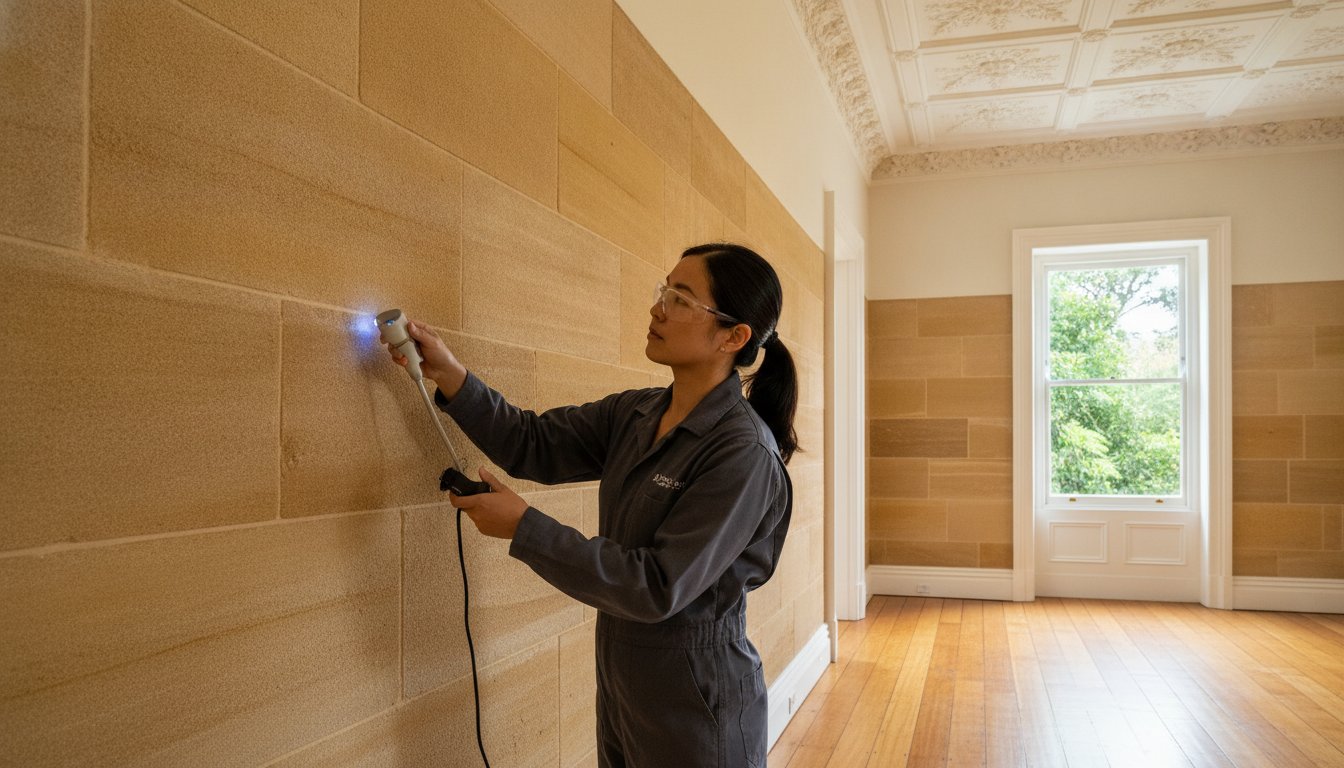
Double-brick construction is a hallmark of Sydney’s older suburbs, but it presents a specific vulnerability. The cavity between the brick layers often acts as a chimney, drawing moisture upwards from the soil into the wall structure. In homes over 50 years old, the original bitumen damp-proof course (DPC) has usually become brittle and failed. Capillary action is the physical process where surface tension pulls liquid water vertically through the microscopic pores of Sydney bricks against the force of gravity.
When this barrier breaks, moisture travels freely into your internal walls. This leads to the “tide marks” and peeling paint that signal a serious problem. Following NSW Health guidance on mould is critical here, as these damp walls quickly become colonized by fungi. If you suspect your home’s natural defenses have failed, a professional mould inspection can confirm the extent of the risk before structural damage sets in.
Topography and Drainage Issues
Sydney’s hilly topography adds another layer of complexity. Homes built on slopes frequently suffer from “run-off” seepage, where groundwater from uphill properties drains directly against your foundation walls. Modern renovations often make this worse. We frequently see several common obstructions that choke the subfloor’s ability to breathe:
- Concrete paths poured above the original vent line
- Raised garden beds that trap water against the brickwork
- New decking that restricts external airflow
Internal dividing walls under the house also create “dead air” pockets. These zones receive zero cross-ventilation, allowing humidity to settle and rot floor joists. Effective subfloor dampness solutions Sydney must account for these architectural obstacles by engineering forced airflow into every corner. Addressing these drainage and airflow gaps is the only way to ensure a permanently dry foundation and a healthy living environment.
Comparing Subfloor Dampness Solutions: What Actually Works?
Selecting the right remediation strategy requires a clear understanding of your home’s specific moisture profile. Passive ventilation is the traditional approach, but it frequently fails in Sydney’s coastal environment. These systems rely entirely on natural wind to push air through the subfloor. On still, humid days, the air stagnates and collects moisture from the clay soil, allowing spores to settle. According to NSW Fair Trading advice on damp and condensation, a solution must address the root cause of the moisture to be effective long-term.
For homes with persistent dampness, ground moisture barriers and subsoil drainage provide essential protection. A ground moisture barrier involves laying heavy-duty polythene liners over the soil to physically block evaporation. This simple step can reduce subfloor humidity levels by up to 90%. If your property suffers from groundwater seepage, “ag-lines” or subsoil drainage pipes are necessary to divert water away from the foundation before it can penetrate the subfloor. These physical barriers are the first line of defense in the subfloor dampness solutions Sydney homeowners need to prevent structural decay.
Mechanical Ventilation: AC vs. EC Motors
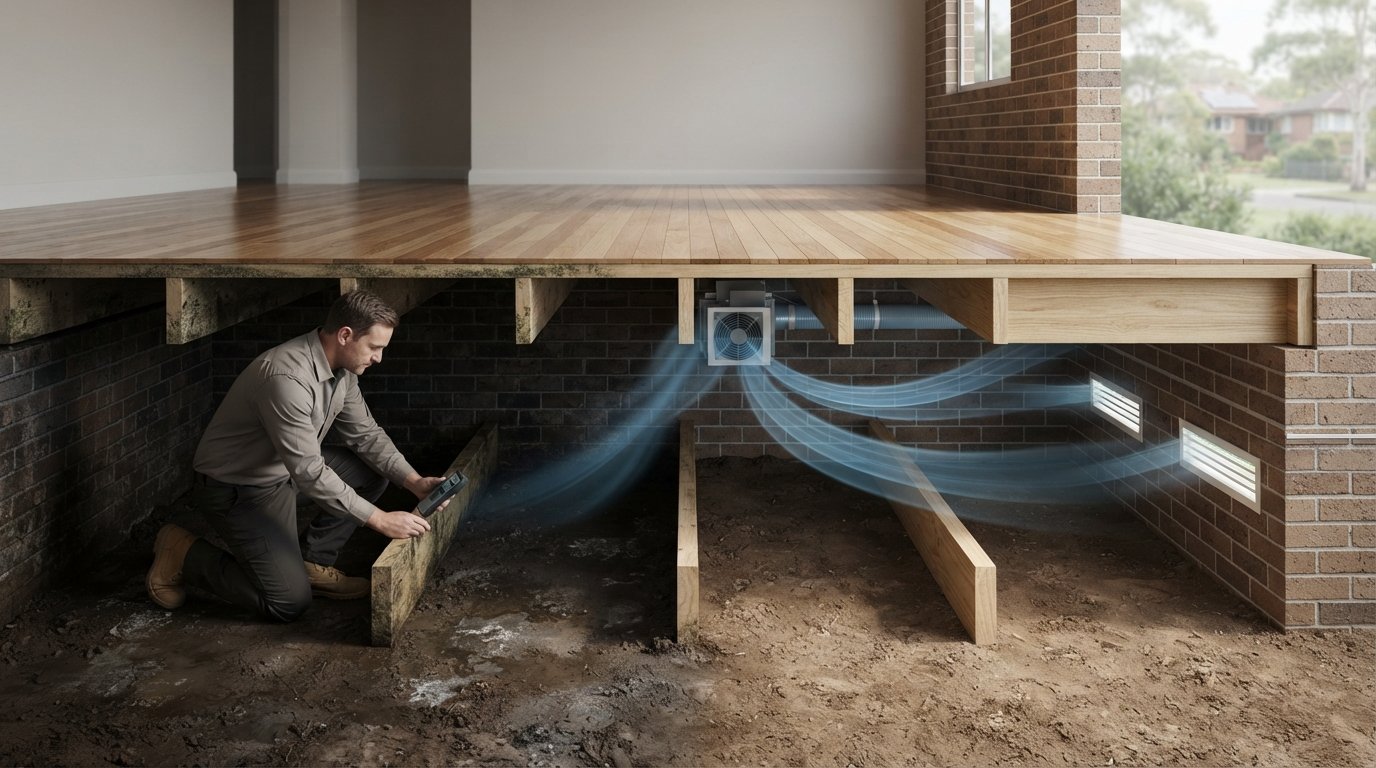
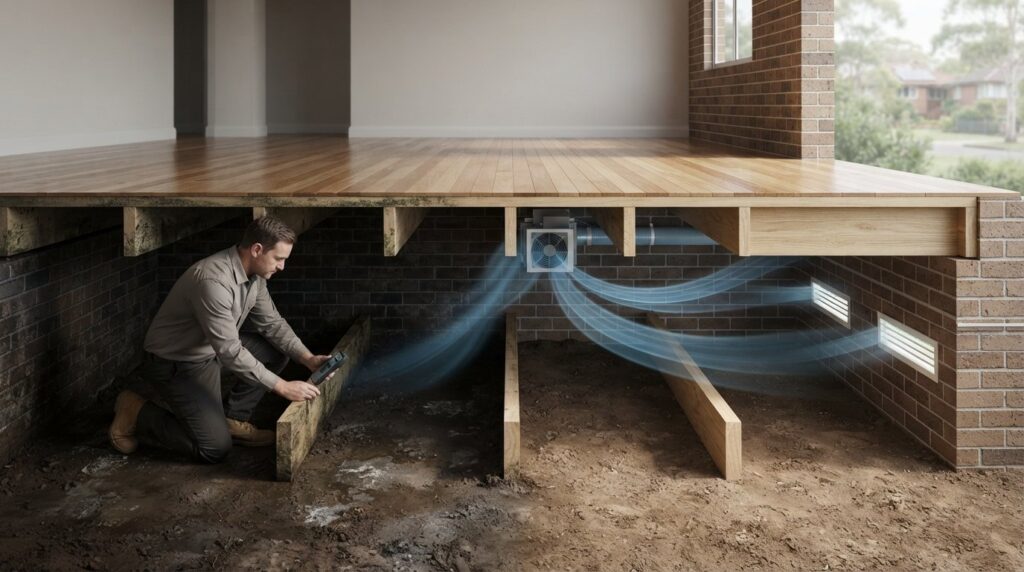
Mechanical ventilation is the most reliable way to guarantee consistent airflow. When choosing a system, the motor technology is a critical factor. Traditional AC motors are robust, but they often generate significant noise and have higher running costs. Modern EC (Electronically Commutated) motors are the superior choice for subfloor dampness solutions Sydney properties require. They are whisper-quiet, consume significantly less power, and offer variable speed control.
Smart sensors further enhance these systems. Automated controllers trigger the fans only when humidity levels spike or when the external air is drier than the subfloor air. This precision prevents you from accidentally drawing humid outside air into your foundations during a rainstorm. An engineered “cross-flow” pattern ensures that every “dead air” pocket is flushed out, leaving no room for mould to take hold.
Passive Vent Upgrades
Existing vents often need a complete overhaul to meet modern standards. Replacing restrictive, original terracotta vents with high-flow brass or plastic mesh can double your natural air intake. However, placement is everything. Vents must remain completely clear of mulch, garden beds, and low-lying decks that choke airflow. While upgrades help, passive systems have major limitations in low-wind suburbs or densely built-up areas. They should be viewed as a supplementary measure rather than a primary fix for established subfloor moisture problems.
Step-by-Step Implementation: Fixing Your Subfloor Dampness
Knowing the cause of your moisture problem is one thing. Fixing it permanently is another. Too many Sydney homeowners skip straight to buying a fan and hoping for the best. That approach wastes money and leaves the real problem untouched. Effective subfloor dampness solutions Sydney properties need follow a specific sequence, and every step builds on the last.
Here’s the professional roadmap specialists use:
- Step 1: Professional moisture inspection and airflow mapping. Before any equipment is installed, a technician maps your subfloor using hygrometers and thermal imaging cameras. This reveals exactly where humidity is highest and where airflow is stagnant. Without this data, you’re guessing.
- Step 2: Clear debris and eliminate timber-to-soil contact. Old formwork, timber off-cuts, and organic debris left by builders are common culprits. Any wood touching the soil creates a direct pathway for moisture and termites. All of it must be removed before ventilation can work effectively.
- Step 3: Address external drainage and leaking pipes. Redirecting stormwater, repairing leaking irrigation lines, and clearing blocked downpipes reduces the volume of water entering the subfloor zone. Ventilation can’t keep up with an active water source.
- Step 4: Install a tailored ventilation system. Based on your moisture map, a specialist designs either a passive vent upgrade or a mechanical extraction system engineered to flush every dead-air pocket. One-size solutions don’t work in Sydney’s varied housing stock.
- Step 5: Treat existing mould with professional-grade remediation. The final step eliminates the contamination already present on your joists and bearers before sealing the system.
The Critical Importance of a Moisture Report
A moisture report isn’t a formality; it’s the entire foundation of a successful fix. Thermal imaging identifies cold spots where condensation is actively forming, while hygrometer readings establish a humidity baseline. This data determines fan placement, the number of units required, and whether a ground moisture barrier is needed. Skipping it is the primary reason DIY ventilation kits fail. Book a comprehensive mould inspection to get an accurate picture of your subfloor’s condition before spending a dollar on equipment.
Dealing with Existing Contamination
A new ventilation system will stop future moisture, but it won’t kill the mould colony already growing on your floor joists. That contamination continues releasing spores into your living areas until it’s physically eliminated. Scrubbing timber in a confined subfloor space is genuinely dangerous; disturbing dry spores without specialist containment equipment causes a significant exposure risk. Professional mould removal using the Goldmorr System treats the entire subfloor environment safely, reaching every surface that a brush simply can’t. Once the contamination is cleared and your ventilation is running, you’ve addressed the problem completely, not just cosmetically. That’s the standard effective subfloor dampness solutions Sydney experts deliver.
The ABC Advantage: Goldmorr Fogging and Engineered Ventilation
Installing a fan is only half the battle. If you don’t eliminate the billions of spores already clinging to your floor joists, you’re simply blowing contaminated air around your home. ABC Mould Cleaning Solutions provides the most comprehensive subfloor dampness solutions Sydney homeowners can access by combining mechanical engineering with advanced microbial science. We don’t just “dry” the space; we purify the entire environment beneath your feet.
Our approach is tailored to the specific architectural challenges of Sydney’s diverse suburbs. We understand how the heavy clay soils of the Inner West differ from the sandstone foundations of the North Shore and the salt-laden humidity of the Eastern Suburbs. This local expertise allows us to design integrated systems that combine high-performance ventilation with the proprietary Goldmorr System for total spore eradication. This dual-strike method ensures your home’s structural health and your family’s respiratory safety are restored simultaneously.
The Goldmorr System Explained
The cornerstone of our remediation process is the Goldmorr System. This specialized methodology uses a non-invasive, biodegradable fogging process that reaches deep into the grain of timber and the porous surfaces of brickwork. Unlike traditional scrubbing, which can’t access tight corners or the tops of bearers, our fogging particles stay suspended in the air to target airborne spores instantly. It’s a systematic, evidence-based approach that eliminates the need for toxic chemicals.
Safety is our primary concern. The fogging agent is biodegradable and safe for all occupants, including children and pets. Beyond immediate eradication, the process leaves behind a treated surface that actively resists future fungal growth. When combined with our engineered subfloor dampness solutions Sydney installations, it provides a permanent barrier against the return of musty odors and structural rot.
Professional Air Purification and Scrubbing
Once the subfloor work is complete, our specialists focus on the air health of your living spaces. We utilize professional-grade HEPA air scrubbers and purifiers to capture any microscopic particles that may have migrated upstairs during the remediation process. We treat “air health” as being just as critical as “structural health.” A dry subfloor is useless if the air inside your bedrooms remains contaminated with lingering allergens.
Our results-driven process transitions your property from a state of moisture-related stress to a state of long-term security. We take a no-nonsense approach to results, providing visual evidence of successful outcomes and a simplified path to a healthy home. Don’t let foundation moisture compromise your biggest investment. Book your Sydney subfloor inspection today and stop the mould at its source.
Secure Your Home’s Foundation and Air Quality Today
Addressing subfloor moisture is a race against structural rot and persistent health issues. You now understand that ignoring musty smells or relying on outdated terracotta vents isn’t enough for Sydney’s reactive clay soils. Success requires a dual-strike approach: engineering consistent airflow and utilizing the specialized Goldmorr System to eradicate existing spores. By mapping moisture and installing high-performance mechanical ventilation, you transform your subfloor from a damp breeding ground into a dry, protective barrier for your family.
Don’t wait for rising damp to compromise your brickwork or for mould to spread further into your living spaces. As Sydney-wide local experts, we offer a 24/7 response for water damage and use a systematic, evidence-based approach to deliver the permanent subfloor dampness solutions Sydney homeowners trust. Our Goldmorr System certified technicians are ready to restore your property’s safety and well-being with modern, biodegradable technology.
Get a Professional Subfloor Inspection & Mould Assessment Today and breathe easier knowing your home is protected at its source. You’ve taken the first step by educating yourself; now it’s time to act and reclaim a healthy, dry home.
Frequently Asked Questions
Is subfloor ventilation enough to stop rising damp in Sydney?
No, ventilation alone isn’t a complete fix for rising damp. While it manages surface moisture, rising damp is a structural failure where water climbs through porous bricks. Effective subfloor dampness solutions Sydney homeowners need often involve a combination of ventilation and structural barriers. We focus on engineering the airflow to prevent the stagnation that worsens dampness, but we always recommend a full moisture inspection to identify if your damp-proof course requires professional repair.
How much does it cost to install subfloor ventilation in a Sydney home?
Installation costs are determined by the specific architecture of your property and the severity of the moisture issue. Factors such as the square meterage of the subfloor, the number of extraction units needed, and the complexity of the electrical wiring all play a role. Because every Sydney home is unique, we provide comprehensive inspections to map out an engineered solution. This ensures your investment delivers tangible results rather than a generic, ineffective fix.
Can I install subfloor fans myself, or do I need a professional?
While DIY kits exist, professional installation is essential for a system that actually works. Our technicians perform scientific airflow mapping to ensure there are no stagnant pockets where mould can still grow. We also handle the specialized electrical requirements and ensure all vents meet current building codes. Professional installation guarantees that your system is balanced, whisper-quiet, and energy-efficient, providing long-term security that amateur setups simply cannot match.
How do I know if my subfloor is damp without crawling under the house?
You don’t need to crawl into tight spaces to spot the warning signs. Keep an eye out for cupping or warping timber floorboards and a persistent, musty smell that intensifies in humid weather. White, powdery salt deposits on your foundation brickwork are another clear indicator of moisture migration. If you notice these symptoms, our professional mould inspection services can use non-invasive thermal imaging to confirm exactly what is happening beneath your floorboards.
Will a dehumidifier work for a damp subfloor?
Dehumidifiers are not a viable solution for the vast scale of a subfloor environment. They are designed for enclosed rooms, not for spaces where moisture is constantly rising from the earth. A dehumidifier would run continuously, leading to high energy bills without ever solving the root cause. Engineered subfloor dampness solutions Sydney rely on forced air exchange to flush out humid air and replace it with drier external air, which is significantly more effective.
What happens if I leave subfloor dampness untreated?
Ignoring the problem leads to structural failure and serious health complications. Persistent moisture causes timber rot in your floor joists and creates an ideal environment for termite infestations. Stagnant air becomes a factory for mould spores that eventually penetrate your living areas. This can trigger chronic respiratory issues and allergic reactions for your family. Taking immediate action with professional remediation is the only way to stop these escalating risks and protect your property.
How long does the Goldmorr fogging process take?
The Goldmorr fogging process is remarkably efficient and typically takes only a few hours to complete for a standard residential property. This specialized methodology targets airborne spores and surface contamination simultaneously, reaching into crevices that manual cleaning misses. Because the system is biodegradable and non-toxic, your family can return to a safe environment shortly after the treatment. It is a fast, results-driven solution that forms the foundation of a healthy, mould-free home.
Does subfloor ventilation help with termite prevention?
Maintaining a dry subfloor is one of the most effective ways to deter termites from your property. These pests are naturally drawn to damp timber and high-humidity environments for nesting. By installing a high-performance ventilation system, you eliminate the moisture they need to thrive. While we don’t provide pest control, our moisture management systems create a hostile environment for termites; for more information on managing other household pests, you can visit Dale’s Pest Control to learn about identifying common infestations. This helps to safeguard your home’s structural integrity alongside your regular pest inspections.