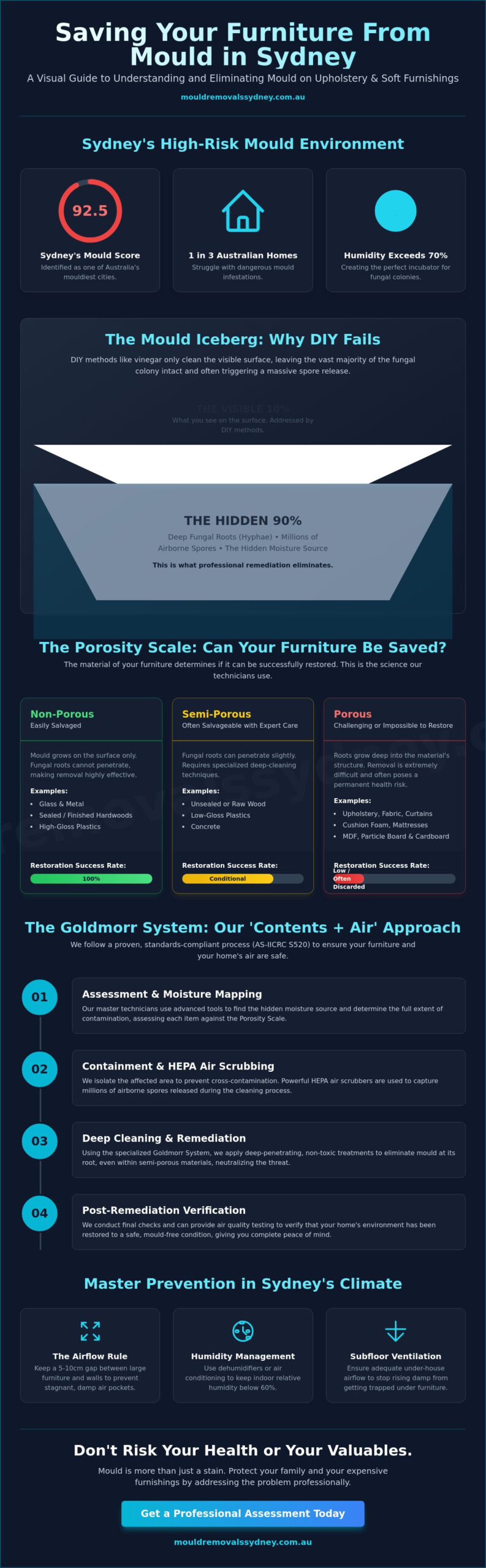
Did you know that Sydney was recently identified as one of Australia’s mouldiest cities with a “mould score” of 92.48 out of 100? If you’ve just discovered a fuzzy patch on your designer sofa or a musty scent in your curtains, you aren’t alone. One in three Australian homes now struggles with mould growth, and the fear of toxic spores spreading to every room is a valid concern. You might feel frustrated that DIY vinegar sprays have failed, but don’t rush to the curb with your expensive pieces just yet.
Professional mould removal for upholstery and soft furnishings Sydney is about more than just a surface wipe; it requires a “Contents plus Air” approach to be truly effective. We use the specialized Goldmorr System to save your valuable furniture and restore your home’s air quality to safe levels. This guide explains the AS-IICRC S520:2025 standards adopted in December 2025 and details how our master technicians determine what can be salvaged. You’ll discover how we eliminate the root cause of the problem to prevent future growth and provide the peace of mind you deserve. It’s that simple.
Key Takeaways
- Understand why Sydney’s high relative humidity, often exceeding 70%, makes indoor furnishings a primary target for toxic mould growth.
- Learn how to use the “Porosity Scale” to identify which materials can be saved and why foam or upholstery are the most challenging to restore.
- Discover why DIY methods like vinegar only treat the visible 10% of the problem and how professional mould removal for upholstery and soft furnishings Sydney addresses the root cause.
- Explore the specialized Goldmorr System process, which combines moisture mapping with HEPA air scrubbing to ensure a safe, mould-free home environment.
- Master the “Airflow Rule” and humidity management techniques to prevent future infestations in Sydney’s coastal suburbs.
Why Furniture Mould is a Major Concern in Sydney Homes
Furniture mould remediation is a specialized branch of property restoration that focuses on the complex task of extracting fungal growth from porous materials. It isn’t just about a surface wipe; it’s about deep-cleansing the fibres that hold your home together. In Sydney, this is a constant battle for property owners. Our city regularly experiences relative humidity levels exceeding 70%, which creates a perfect incubator for fungal colonies. Because furniture often sits in stagnant corners or flush against walls, it suffers from restricted airflow. This makes your designer sofa or antique wardrobe the first place mould appears. When these items become infested, they act as a “spore factory,” compromising the air quality of your entire NSW property.
Sydney’s Micro-Climates and Your Furniture
Sydney isn’t a monolith when it comes to moisture. Coastal suburbs like Bondi or Manly face unique pressures from salt-laden air that traps moisture directly in fabric fibres. In contrast, Western Sydney experiences higher temperature fluctuations that lead to heavy condensation inside built-in wardrobes. During the record-breaking La Niña events of 2021 and 2022, we saw a 40% increase in furniture-related remediation requests across the Sydney basin. Many of these issues are exacerbated by poor subfloor ventilation. When damp air rises through floorboards, it gets trapped under rugs and behind heavy bedheads, leading to rapid, hidden growth that you might not smell until the damage is extensive.
The Hidden Danger of Airborne Spores
Seeing a fuzzy green or black patch on your upholstery is just the tip of the iceberg. That visible growth indicates that millions of invisible spores are already circulating in your room’s breathing zone. If you try to scrub it off with a dry brush or a rag, you trigger a “spore release” survival mechanism. The fungus perceives the physical threat and launches its offspring into the air to find new surfaces to colonize. This is why professional mould removal for upholstery and soft furnishings Sydney is essential for a safe home. Understanding the dangers of indoor mould is the first step to protecting your family from respiratory irritation and allergic reactions.
Cross-contamination is the primary risk of moving mouldy furniture, as it effectively transports an active fungal colony into unaffected areas of your home. We’ve seen entire homes contaminated because a single mouldy armchair was dragged through a hallway without professional containment. Don’t risk your health or your property with DIY mistakes. Expert mould removal for upholstery and soft furnishings Sydney uses HEPA air scrubbing and the Goldmorr System to ensure those spores are captured, not spread. It’s that simple. We handle the technical side so you can enjoy your home again.
Material Science: Can Your Furniture Be Saved?
Before you decide to throw away a valuable lounge or an heirloom table, you need to understand the “Porosity Scale.” This scientific framework categorizes furniture by how deeply the hyphae, or fungal roots, can penetrate the surface. In Sydney’s high-moisture environment, the material of your furniture determines whether it can be salvaged or if it poses a permanent health risk. Professional mould removal for upholstery and soft furnishings Sydney relies on this material science to choose the right remediation path. While non-porous items are easily restored, porous materials like foam and fabric require deep-penetrating techniques to reach the roots hidden beneath the surface.
Finished hardwoods like Australian Jarrah or Oak are remarkably resilient. Their dense grain and protective sealants prevent hyphae from digging deep, often allowing for a 100% success rate in restoration. On the other hand, modern MDF and particle board are highly vulnerable. These materials use urea-formaldehyde glues that actually provide a food source for fungi. Once moisture causes MDF to swell, the mould becomes structural, and the item usually must be discarded. For Sydney’s antique collectors, the risk is even more specific. Old varnishes and animal-based glues found in pre-1950s furniture are highly attractive to spores, requiring delicate, pH-balanced cleaning to avoid stripping the history along with the fungus.
Porous vs. Non-Porous Furniture
Understanding where your item sits on the scale is vital for your safety. Following a professional mould and moisture guide is the best way to ensure you don’t accidentally spread contamination. We categorize items into three main groups:
- Non-porous (Metal, Glass, Plastic): These surfaces don’t allow roots to penetrate. They have a 99% salvage rate with professional-grade antimicrobial cleaning.
- Semi-porous (Finished Wood, Leather): These materials have a high salvage rate if treated before structural rot occurs. The key is killing the roots without damaging the finish.
- Porous (Unfinished wood, Fabric, Mattresses): These are the most challenging. Spores get trapped deep inside foam and weave. These items require specialized Goldmorr fogging to ensure the air pockets inside the material are treated.
The Leather Dilemma
Leather furniture is a “buffet” for mould during humid Sydney summers. Because leather is an organic material, it holds microscopic amounts of moisture and oils that fungi love. Many owners make the mistake of using alcohol-based DIY cleaners on expensive leather lounges. This is a mistake. Alcohol dries out the hide, causing it to crack and creating even more surface area for spores to hide. Professional remediation preserves the leather’s vital pH balance while using biodegradable agents to eliminate the infestation. If you’ve noticed a white film or a musty scent on your lounge, it’s best to send us images for an expert assessment before the damage becomes permanent. It’s that simple. Expert care saves your investment and your health.
Professional Remediation vs. DIY: Why Vinegar Fails
Many Sydney homeowners reach for white vinegar at the first sign of a musty smell on their sofa. While it’s a popular natural remedy, it often fails because of the “Iceberg Effect.” The visible spots on your upholstery represent only about 10% of the total infestation. The remaining 90% consists of hyphae, or roots, that are embedded deep within the foam and fabric layers. Professional mould removal for upholstery and soft furnishings Sydney is necessary because standard household cleaners simply cannot penetrate these deep, porous structures. You might clear the surface, but the colony remains alive and ready to resurface as soon as the humidity peaks again.
There’s also the significant risk of “Wet Cleaning.” When you spray vinegar or water onto a porous surface, you’re introducing more moisture into an environment that is already struggling with dampness. If you don’t extract every drop of that liquid using professional-grade equipment, you’re essentially feeding the fungus. Scrubbing also poses serious safety hazards. Disturbing an active colony without HEPA-rated PPE (Personal Protective Equipment) can lead to the immediate inhalation of concentrated spores. This is why NSW Health advice on mould emphasizes that large areas of growth or persistent infestations should be handled by trained experts. Our master technicians use the Goldmorr System to kill the mould without adding unnecessary moisture to your delicate items.
The ‘Save vs. Toss’ Decision Framework
How do you know when to fight for a piece of furniture and when to let it go? You should consider the replacement cost, sentimental value, and the extent of penetration. As a general rule, if mould covers more than 1 square metre of the item, it’s considered a significant infestation that requires expert intervention. You should also check the backing of the furniture. If the mould has moved from the surface fabric into the internal structural timber or foam, DIY methods will almost certainly fail. To better understand the specific health risks of different fungi found in NSW, read our guide on What Is Black Mould? A Complete Guide for Sydney Homeowners.
Common DIY Mistakes to Avoid
Avoid the “Bleach Myth” at all costs. Bleach is mostly water; it removes the colour of the mould but leaves the roots alive and hydrated. Clove oil is another common Australian DIY tip, but it carries a high risk of permanently staining delicate fabrics and can be toxic to pets if used incorrectly. Finally, never use a standard household vacuum on a mouldy chair. Without a certified HEPA filter, your vacuum becomes a “spore cannon,” sucking up spores from the furniture and blasting them out the exhaust into every other room in your house. Professional help is more accessible than you think. At ABC Mould Cleaning Solutions, we will beat any written quote by 10%, ensuring you get expert results that protect your family’s health. It’s that simple.
The ABC Process: Restoring Your Furniture with Goldmorr
Our master technicians don’t just “clean” furniture. We execute a scientific four-step process designed to neutralize fungal colonies at a molecular level. This rigorous approach ensures that your valuable items are safe to use and won’t re-contaminate your living space. By following the AS-IICRC S520:2025 standards, we provide a level of safety that standard cleaning companies simply cannot match. It’s that simple.
- Step 1: Visual Inspection and Moisture Mapping: We start by identifying the “hidden” source of the moisture. Using advanced thermal imaging and moisture meters, we find pockets of dampness inside cushions or behind timber frames that are invisible to the naked eye.
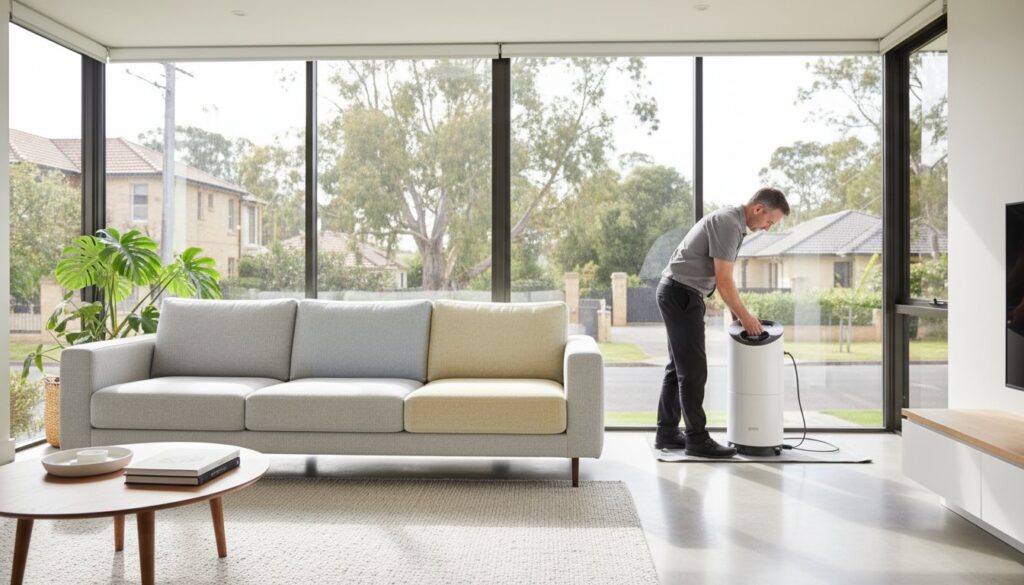
- Step 2: Containment and HEPA Air Scrubbing: Before we touch the mould, we secure the area. We use commercial-grade HEPA 500 air scrubbers to create a negative pressure environment. This prevents millions of airborne spores from drifting into other rooms during the restoration.
- Step 3: Goldmorr System Fogging: This is the cornerstone of our service. We apply a specialized, biodegradable fog that seeks out spores in every crevice. This precision is why the Goldmorr System is the industry leader for mould removal for upholstery and soft furnishings Sydney.
- Step 4: Post-Remediation Air Purification: Once the furniture is treated, we scrub the air one last time. This ensures the room is safe for your family and pets to occupy immediately after we finish.
The Goldmorr Advantage for Upholstery
Traditional liquid cleaners often saturate furniture, which can lead to structural rot or secondary mould growth. The Goldmorr System uses a unique biodegradable fogging process. This fog consists of microscopic droplets that stay suspended in the air and penetrate deep into foam, cushions, and intricate fabric weaves where traditional liquids can’t reach. It targets the mould’s cellular structure without soaking the material. This system is completely non-corrosive and leaves no toxic residue behind. It’s safe for your most delicate fabrics and your most precious family members.
Air Purification & Scrubbing
Cleaning a sofa is useless if the air around it remains thick with invisible spores. Fungi are opportunistic; they will simply land back on the furniture and start growing again if the indoor environment isn’t addressed. During every restoration, we deploy commercial-grade HEPA 500 air scrubbers. These machines cycle the air through multi-stage filtration to remove 99.97% of particles as small as 0.3 microns. If your furniture has visible growth, your ventilation system has likely been exposed as well. You can learn more about whole-home protection in our guide to Air Duct Cleaning Sydney. Don’t wait for the problem to spread to every room. Call our master technicians now for a professional assessment and a quote that we promise to beat by 10%.
Preventing Furniture Mould in the Sydney Climate
Sydney’s humidity is relentless. Even after professional mould removal for upholstery and soft furnishings Sydney, your items remain at risk if you don’t change the environment. The most effective preventative tactic is the “Airflow Rule.” Never push heavy lounges, bedheads, or wardrobes flush against external walls. These walls are often colder than the indoor air, creating a dew point where condensation forms. Leave a gap of at least 5 to 10 centimetres. This small space allows air to circulate, preventing the stagnant, damp conditions that spores need to thrive. It’s that simple.
In coastal suburbs like Cronulla or Maroubra, humidity management is a daily requirement. Standard moisture absorbers can help in small drawers, but they aren’t enough for a whole room. Invest in a high-quality dehumidifier. Set it to maintain a relative humidity level below 60%. This is the biological “kill zone” for most common household moulds. If you live on the ground floor of an older Sydney terrace, consider subfloor ventilation. Stale, damp air trapped beneath your floorboards is a major cause of recurring infestations. It’s much cheaper to install a fan system than to replace a A$5,000 designer lounge every two years.
To further assist with keeping your space functional and clutter-free during these environmental adjustments, you can discover Mega Office Supplies for a comprehensive range of Australian office and storage products designed to keep your workspace in top shape.
Wardrobe and Closet Best Practices
Wardrobes are often the “ground zero” for infestations because they stay dark and closed. Don’t rely solely on supermarket moisture tubs. They often overflow and can cause chemical stains on your flooring. Instead, schedule regular “airing out” sessions. Open your wardrobe doors and use a pedestal fan to circulate air once a week. This is vital for leather jackets and boots, which act as a buffet for fungi. If you’re unsure about the air quality in your storage areas, book one of Sydney’s #1 Mould Removal Service preventative inspections. We find the moisture before the mould finds your clothes.
When to Seek Professional Recommendations
Sometimes the problem isn’t your furniture; it’s the building. Structural issues like rising damp or leaking window seals can ruin a new lounge in weeks. While we specialize in mould removal for upholstery and soft furnishings Sydney, our goal is to ensure you never need us again. Our master technicians provide “Causation & Prevention” reports after every job. These documents give you a clear roadmap to keep your home mould-free. We identify the exact moisture source and tell you how to fix it permanently. Don’t wait until your furniture is unsalvageable and the air is toxic. Contact ABC Mould Cleaning Solutions for a quote today. We’ll beat any written quote by 10% and give you back your peace of mind. Its that easy.
Restore Your Home Safety and Save Your Furniture
Your furniture is often one of the largest investments in your home. Don’t let toxic spores turn your designer lounge or family heirloom into a health hazard. As we have explored, surface cleaning with vinegar only addresses 10% of the problem. True mould removal for upholstery and soft furnishings Sydney requires a deep-penetrating, molecular approach. By using our safe, biodegradable fogging process, our Certified Goldmorr Master Technicians can often save items that others would simply throw away. We handle the technical remediation so you can breathe easy again. It’s that simple.
Ready to reclaim your living space? We are committed to providing the most effective and affordable service in NSW. We will beat any written quote by 10%, ensuring you get world-class expertise at the best possible price. Don’t wait until the infestation spreads to your walls or air ducts. Book Your Professional Furniture Mould Inspection & Get a Free Estimate now. Our team is here to provide the peace of mind and professional results you deserve. Its that easy.
Frequently Asked Questions
Can professional mould removal save a sofa with black mould?
Yes, professional remediation can often save high-value sofas and lounges that appear unsalvageable. We use the specialized Goldmorr System to penetrate deep into the fabric and foam to kill the fungal roots. This process is much more effective than surface cleaning because it neutralizes the colony at a molecular level. It’s that simple. If the structural timber inside hasn’t rotted, we can usually restore the item to a safe, like-new condition.
Is it safe to keep furniture after it has had mould on it?
It is only safe to keep previously infested furniture if it has undergone professional mould removal for upholstery and soft furnishings Sydney. Fungi leave behind invisible spores and mycotoxins that can trigger respiratory issues long after the visible stains are gone. Our master technicians use HEPA air scrubbing and biodegradable fogging to ensure the item is chemically and biologically safe for your family. Don’t risk your health by keeping items that have only been wiped down with household cleaners.
How much does professional furniture mould removal cost in Sydney?
Professional mould removal for a single room in Sydney typically costs between $500 and $1,000 depending on the severity. For a full property, prices can range from $500 to over $5,000. A professional inspection including moisture mapping generally costs between $200 and $600. At ABC Mould Cleaning Solutions, we promise to beat any written quote by 10%, making expert remediation affordable for every Sydney homeowner. Send us images of your furniture today for a fast, accurate estimate.
Will the Goldmorr System damage my leather furniture or silk fabrics?
No, the Goldmorr System is specifically designed to be non-corrosive and safe for delicate materials. The biodegradable fogging process targets the mould spores without saturating the fabric or leather hide. This prevents the shrinking, cracking, or staining that often occurs with traditional liquid-based cleaners. Our master technicians have successfully treated thousands of designer items across Sydney without any damage to the original finish. It’s that easy.
Can I just use clove oil or vinegar to clean my mouldy wardrobe?
No, DIY methods like clove oil or vinegar are usually ineffective for long-term results in wardrobes. Vinegar only addresses the surface growth, leaving the roots to thrive inside the timber or backing. Clove oil carries a high risk of permanently staining your clothing and delicate wardrobe linings. These methods also fail to address the airborne spores that remain trapped in the stagnant air of a closet. Professional intervention is the only way to ensure the colony is completely eradicated.
How do I know if the mould has got into the foam of my mattress?
A persistent musty smell after you have cleaned the surface is the most common sign of deep penetration. You might also see dark, circular spotting on the underside of the mattress where it meets the bed base. Because mattresses are highly porous, they are the most difficult items to remediate. We use moisture mapping tools to determine the extent of the dampness inside the foam. If the infestation is structural, we will provide an honest assessment of whether the item can be saved.
Does Sydney’s humidity mean mould will always come back to my furniture?
Mould will not return if you address the underlying moisture source and follow our prevention roadmap. While Sydney’s humidity often exceeds 70%, proper airflow and dehumidification can keep your home below the 60% threshold where mould thrives. We provide every customer with a causation report that identifies structural issues like rising damp or poor ventilation. By fixing these root causes, you can enjoy a mould-free environment regardless of the coastal weather. Our mould removal for upholstery and soft furnishings Sydney includes this expert advice.
What should I do if I find mould on the back of my wooden bedhead?
Move the bedhead away from the wall immediately to stop the spread and improve airflow. Do not attempt to scrub the mould while it is dry, as this will launch millions of spores into your sleeping area. Call a professional for an inspection to see if the mould has spread into the wall or carpet. We can treat the timber using the Goldmorr System, which kills the spores without warping the wood. It’s a fast, efficient process that restores your bedroom’s air quality.


