
What if those black spots spreading across your bedroom ceiling aren’t just a cleaning chore, but a legal battle you’re losing because you don’t know the 2026 strata mould cleaning guidelines NSW? It’s exhausting to be told “it’s your fault” by a strata committee while you’re breathing in toxic airborne spores and watching dampness ruin your expensive furniture. You deserve a home that meets the “fit for habitation” standards set by the Residential Tenancies Act 2010 without the constant finger-pointing from the owners corporation.
We understand the stress of dealing with property damage while trying to decipher complex bylaws. This guide provides the expert clarity you need to determine if liability falls on the building’s common property or your specific lot, especially since NSW Fair Trading saw a 25% increase in mould disputes last year. You’ll learn how to implement a professional remediation plan using the Goldmorr System to clear the air and stop the spores from returning. We’ll walk through the exact steps to secure a safe environment, protect your carpets, and ensure your strata scheme follows the current NSW health and safety regulations.
Key Takeaways
- Understand how ‘Fit for Habitation’ standards classify mould as an urgent repair, ensuring you know when immediate action is legally required to protect health.
- Identify the source of moisture using the “Source of Entry” rule to clearly determine whether the Owners Corporation or the lot owner is responsible for remediation costs.
- Explore your legal protections under Section 106 of the Strata Schemes Management Act and how recent case law has expanded the potential for mould-related compensation.
- Learn why following professional strata mould cleaning guidelines NSW is critical for long-term safety, moving beyond ineffective surface cleaning to advanced, scientific remediation.
- Discover how to generate comprehensive reporting that satisfies strict insurance requirements and NCAT standards to protect your property and legal standing.
NSW Strata Mould Regulations and Habitability Standards
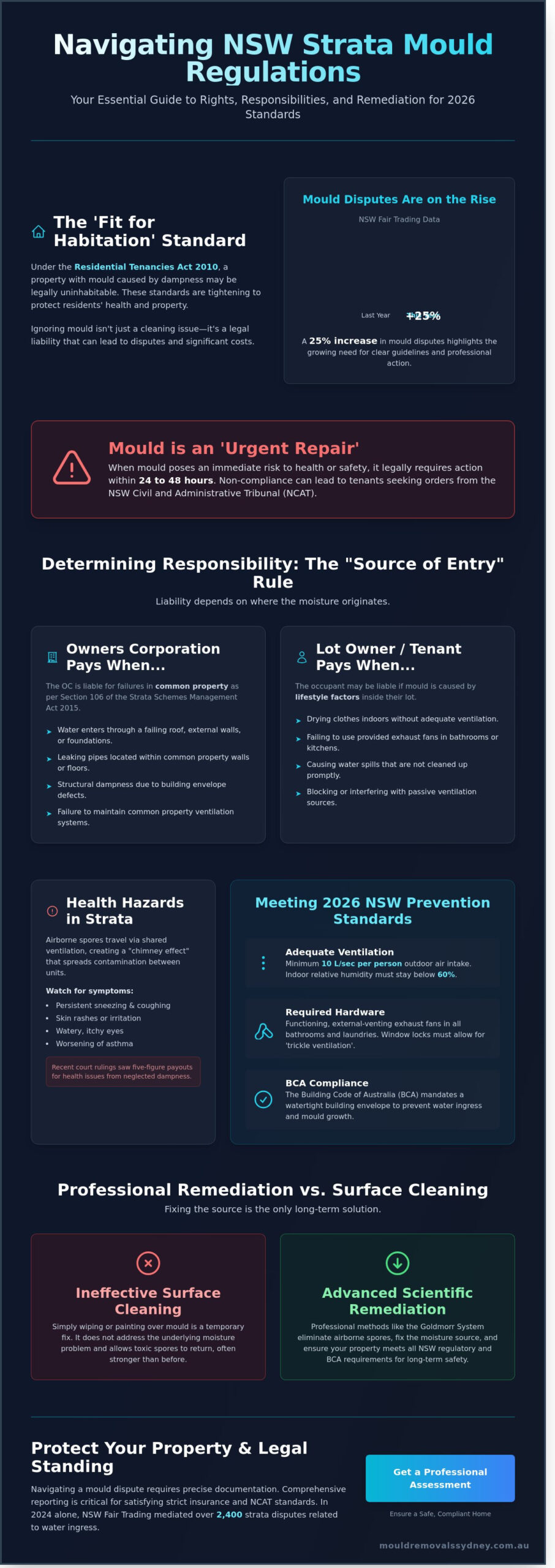
Living in a Sydney strata complex brings unique legal and health challenges. Under the Residential Tenancies Act 2010, every rental property in NSW must meet strict ‘fit for habitation’ standards. These rules aren’t optional. If a property has a dampness problem that leads to fungal growth, it’s often legally uninhabitable. By 2026, these standards have become even tighter to protect residents from the dangers of Indoor mold. You need to act fast when you spot a problem. Following the strata mould cleaning guidelines NSW ensures your building stays compliant and safe for everyone.
Mould is classified as an ‘urgent repair’ in NSW when it poses an immediate risk to occupant health or property safety. This classification means landlords or Owners Corporations must respond within 24 to 48 hours. If they don’t, tenants have the right to seek orders from the NSW Civil and Administrative Tribunal (NCAT). NSW Fair Trading plays a vital role here. In 2024, they mediated over 2,400 strata disputes related to water ingress and dampness. They provide a pathway to resolve conflicts without expensive legal fees. Our team works within these regulations to provide certified remediation that satisfies both Fair Trading and health inspectors.
Adequate ventilation as per the 2026 NSW building codes is defined as a system that ensures a minimum outdoor air intake of 10 litres per second per person while keeping indoor relative humidity levels below 60 percent.
Mould as a Health Hazard in High-Density Living
In high-density buildings, you aren’t just breathing your own air. Airborne spores travel through shared ventilation shafts, lift wells, and common hallways. This creates a “chimney effect” that spreads contamination between floors. Residents should look out for black mould symptoms like persistent sneezing, skin rashes, or watery eyes. If these health issues go ignored, the legal implications for an Owners Corporation are severe. Recent 2025 court rulings have seen five-figure payouts for tenants whose health was compromised by neglected structural dampness. Don’t let your building become a liability.
Minimum Standards for Ventilation and Damp
Modern NSW strata laws require specific hardware to prevent moisture buildup. Every bathroom and laundry must have a functioning exhaust fan that vents directly to the outside air. Window locks must be designed to allow for “trickle ventilation” while maintaining security. When these systems fail, or when structural dampness occurs, the responsibility shifts:
- Structural Dampness: If water enters through the roof, outer walls, or floor, it’s an Owners Corporation liability.
- Internal Condensation: If a tenant fails to use provided fans, they may be responsible for surface cleaning.
- BCA Compliance: The Building Code of Australia (BCA) dictates that the building envelope must be watertight to prevent mould.
The intersection of the BCA and the strata mould cleaning guidelines NSW means that cleaning the surface isn’t enough. You must fix the source of the dampness. Our master technicians use the Goldmorr System to eliminate spores at the source, ensuring your strata scheme meets every 2026 regulatory requirement. It’s that simple. It’s that easy.
Determining Responsibility: Common Property vs. Lot Property
Determining who is responsible for mould remediation relies on the “Source of Entry” rule. You must track where the moisture originates to settle any disputes. If water penetrates the building envelope through a failing roof, cracked external masonry, or leaking window seals, the Owners Corporation (OC) is usually liable. These elements are classified as common property. However, if the moisture builds up because a tenant dries clothes indoors without ventilation, the responsibility shifts to the occupant. Following the strata mould cleaning guidelines NSW helps clarify these boundaries before legal costs escalate. You should always refer to your Property Condition Report. This document provides a baseline from the start of the tenancy, making it easier to prove if mould is a pre-existing structural issue or a new development caused by lifestyle factors.
When the Owners Corporation Must Pay
Under Section 106 of the Strata Schemes Management Act 2015, the Owners Corporation has a strict duty to maintain and repair common property. If a leaking balcony seal, rising damp, or a burst common pipe causes an outbreak, the OC must cover the remediation costs. They’re legally required to keep common property in good repair at all times. You have a 2-year window from the date you first become aware of the loss to claim damages against a strata plan for a failure to maintain common property. This timeline is critical for owners facing expensive repairs. Don’t wait until the spores spread through the building ventilation. If you notice damp patches on a ceiling, request a professional inspection immediately to document the source before structural damage worsens.
When the Lot Owner or Tenant is Liable
Liability often falls on the individual if the moisture is “lifestyle-related.” If a tenant fails to use provided exhaust fans in the bathroom or keeps windows shut during humid Sydney months, they may be held responsible for the resulting cleaning costs. The NSW Health mould factsheet explains that consistent airflow is essential to prevent indoor fungal growth. Additionally, if a lot owner carries out unapproved renovations, such as a DIY bathroom update that compromises the original waterproofing, they’re liable for any subsequent leaks. Every resident has a legal duty to “mitigate loss.” This means you can’t ignore a small patch of mould and expect the OC to pay for a full-scale remediation six months later. You must report or treat the issue as soon as it appears to satisfy strata mould cleaning guidelines NSW requirements. It’s that simple. It’s that easy.
The Legal Framework: Strata Schemes Management Act 2015
The Strata Schemes Management Act 2015 is the primary legislation governing apartment living in Sydney. Section 106 of this Act creates a strict duty for the Owners Corporation to repair and maintain common property. This isn’t a suggestion; it’s a legal mandate. If a roof leak, failing balcony seal, or cracked external wall allows moisture to enter your home, the strata must fix the source and remediate the damage. Failure to act can lead to significant legal penalties and compensation claims.
The legal landscape shifted significantly with the Byrne v Strata Plan 1284 [2021] case. This ruling confirmed that owners can seek damages for a breach of statutory duty if the Owners Corporation fails to maintain common property. For residents, this means you can hold the strata accountable for the toxic spread of fungi. Understanding these rules is vital. Consult the REINSW on mould responsibility to see how the industry defines these boundaries.
To win a dispute, you need a paper trail. Don’t rely on verbal promises. You must document everything immediately.
- Take high-resolution photos of the mould and the suspected moisture source.
- Keep a log of all communication with the Strata Manager.
- Obtain medical certificates if residents suffer from respiratory issues or allergies.
- Request expert reports from certified mould technicians to prove the extent of the infestation.
Seeking Financial Compensation for Mould Damage
Mould destroys more than just walls. It ruins carpets, curtains, and expensive personal belongings. Under current NSW laws, you can claim for these losses if the mould resulted from common property defects. Landlords can also claim for loss of rent if the unit becomes uninhabitable for tenants. Following the latest strata mould cleaning guidelines NSW is the best way to support your claim. Our master technicians provide the detailed “Goldmorr System” assessment reports that NCAT members look for when awarding compensation.
The Dispute Resolution Process in NSW
If your strata committee ignores your requests, you must follow the formal NSW dispute path. It’s a structured process designed to resolve issues without immediately heading to the Supreme Court.
- Formal Written Notice: Send a “Notice to Comply” or a formal letter of demand to the Strata Manager. This starts the clock on their legal obligations.
- Mediation: Apply for free mediation through NSW Fair Trading. An independent mediator helps both parties reach an agreement.
- NCAT Orders: If mediation fails, apply to the NSW Civil and Administrative Tribunal (NCAT). The tribunal has the power to order the strata to carry out specific repairs and pay damages.
Professional Remediation Guidelines for Strata Buildings
Standard cleaning by a local handyman often fails in complex strata environments. Most general cleaners use bleach, which is 90% water and actually feeds the root system of mould on porous surfaces like gyprock. This creates a cycle of regrowth that frustrates tenants and costs strata schemes more over time. Professional remediation follows the IICRC S520 standard, ensuring every spore is neutralized rather than just hidden. Following the latest strata mould cleaning guidelines NSW requires a scientific approach that addresses both visible growth and invisible airborne threats. Our master technicians use the Goldmorr System to provide a fast, effective solution that restores safety to any apartment or common area.
The Goldmorr Advantage: Non-Invasive Mould Removal
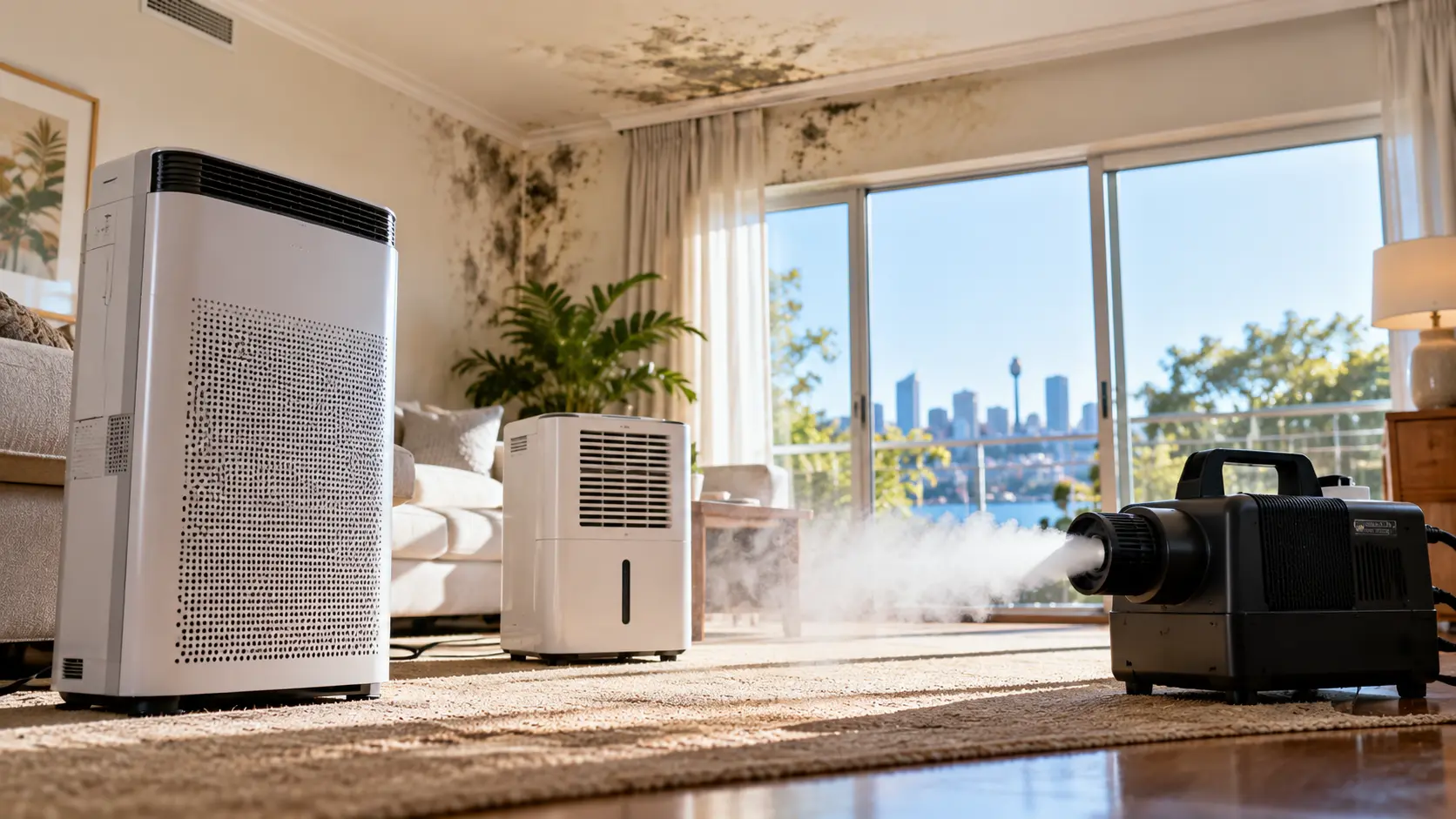
Fogging is the cornerstone of our process. It eliminates airborne spores without the need to strip paint or tear down drywall. This non-invasive method is a massive advantage for high-density apartments where major construction is disruptive. The formula is biodegradable and completely safe for pets and children. You won’t have to worry about harsh chemical residues lingering in the carpet or upholstery. We also utilize industrial-grade air scrubbing. This process uses HEPA filtration to capture 99.97% of particles as small as 0.3 microns. To prevent the spread of spores between units, professional air duct cleaning is essential. It ensures the building’s HVAC system isn’t acting as a delivery vehicle for contaminants.
Preventative Maintenance for Strata Managers
Proactive management is the only way to avoid the massive costs associated with structural dampness. Scheduling regular mould inspections for common areas, basements, and stairwells allows our team to catch moisture ingress early. We often recommend upgrading subfloor ventilation in older buildings. This single change can reduce humidity levels in ground-floor units by as much as 35%, effectively stopping rising damp before it starts. Education is your best tool for long-term prevention. We help strata managers teach tenants about condensation management. Simple habits, like using exhaust fans in winter, can reduce internal moisture by 50% and stop mould from taking hold on window sills and ceilings.
Once remediation is complete, we conduct post-remediation verification testing. This provides documented proof that the indoor air quality has returned to safe levels. It’s the peace of mind every owner and tenant deserves. If you’ve spotted a musty smell or visible growth, don’t wait for it to spread. Send us images of the damage to get an affordable quote and we’ll beat any written competitor quote by 10%.
Why ABC Mould Cleaning Solutions is the Strata Choice
Selecting a contractor requires finding a team that fully understands the technical demands of the strata mould cleaning guidelines NSW. ABC Mould Cleaning Solutions brings specialized expertise to the Sydney strata market. We recognize the delicate balance between lot owner privacy and common property maintenance. Our team works directly with executive committees and strata managers to ensure every remediation project aligns with current building bylaws and 2026 safety standards. We know that strata mould issues often involve complex liability, and we are equipped to handle them with professional precision.
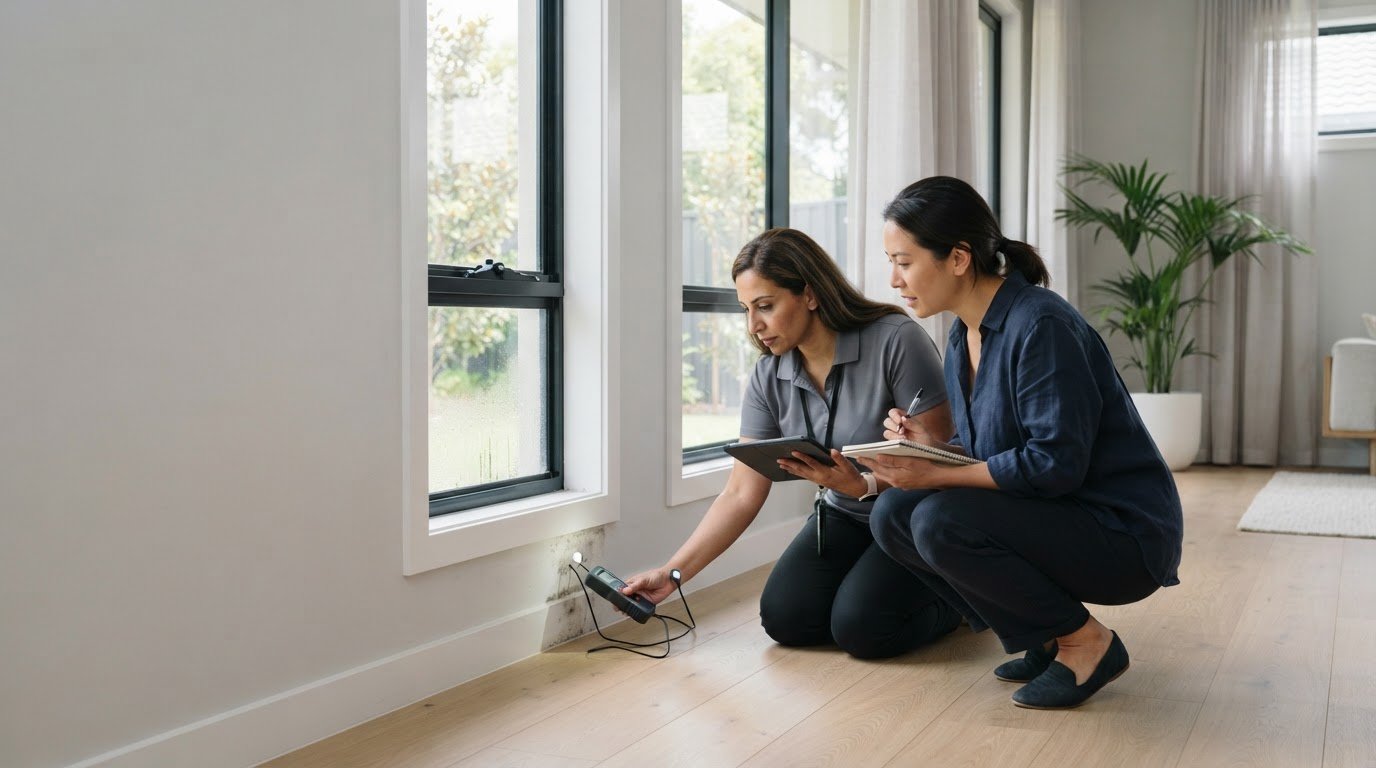
Documentation is the backbone of effective strata management. We provide comprehensive reporting that serves as a vital tool for insurance claims and NCAT proceedings. These reports identify moisture sources, quantify spore counts, and outline the exact steps taken for remediation. This level of detail protects owners corporations from liability and ensures tenants live in a healthy environment. We don’t just scrub surfaces; we provide the scientific evidence you need to resolve disputes quickly. Our technicians use thermal imaging to find leaks that the naked eye misses, ensuring the root cause is addressed.
Budgeting for strata repairs is often a point of contention. To assist, we provide a 10% price-beat guarantee for all written professional quotes. You receive master-level service without the premium price tag. When disaster strikes, such as a burst pipe or flash flooding, our team responds fast. We prioritize emergency water damage calls to prevent a small leak from turning into a building-wide mould crisis within 48 hours.
Certified Master Technicians at Your Service
Our technicians are certified experts in the Goldmorr System, an industry-leading approach to mould removal. This system uses biodegradable products that are safe for pets, children, and the environment. We utilize specialized equipment like high-grade air scrubbers and moisture detectors to find hidden dampness behind walls. We act as a professional liaison between all parties. This streamlines the approval process and reduces the administrative burden on strata managers. Our master technicians handle the communication, so you don’t have to worry about the logistics.
Get Your Strata-Ready Quote Today
Starting your remediation journey is easy. You don’t need to wait days for a site visit just to get a ballpark figure. Send us images of the mould growth via our website for a rapid, affordable estimate. We offer peace of mind through guaranteed results and strict safety-first protocols. Our goal is to restore your property to a pristine state while ensuring total compliance with NSW regulations. Contact ABC Mould Cleaning Solutions for an Expert Strata Inspection now. It’s that simple. It’s that easy.
Protect Your Investment and Health Today
Navigating the Strata Schemes Management Act 2015 requires a clear understanding of where liability rests. Whether the issue involves common property structural defects or individual lot maintenance, following the current strata mould cleaning guidelines NSW ensures your building remains compliant and safe. Delaying treatment leads to escalating repair costs and increased health risks for every resident. Our Goldmorr System Certified Technicians are specialists in NSW Strata Regulations, providing the technical expertise needed to resolve persistent infestations. We’re committed to providing the best value in the industry; we’ll beat any written quote by 10%. Don’t wait for the situation to worsen. It’s time to restore your property’s habitability with a proven, scientific approach that delivers permanent results.
Book a Professional Strata Mould Inspection & Get a Guaranteed Quote
Taking action now prevents long-term damage. Our team is ready to provide the expert support you need to keep your strata scheme mould-free and fully compliant.
Frequently Asked Questions
Is the strata committee always responsible for mould in NSW?
The strata committee isn’t always responsible because liability depends on the moisture source. Under the Strata Schemes Management Act 2015, the Owners Corporation must maintain common property like external walls or roofs. If a leak starts there, they pay. If the mould grows because a tenant keeps windows closed while drying clothes, the tenant is liable. Our master technicians identify the root cause quickly to settle these disputes.
Can I stop paying rent if there is mould in my strata apartment?
You cannot stop paying rent in NSW even if mould makes a room unusable. Withholding rent is a breach of the Residential Tenancies Act 2010 and can lead to an eviction notice. You should instead request a rent reduction or compensation through the NSW Civil and Administrative Tribunal (NCAT). Send us images of your mould today so we can provide the professional evidence you need for your claim.
How long does a strata committee have to fix a mould problem?
Strata committees must act within a reasonable timeframe, which NCAT generally views as 14 to 28 days for non-emergency repairs. If the mould poses a serious health risk as defined in NSW health reports, it may qualify as an urgent repair requiring immediate action. Don’t wait until the problem worsens because it will. Call us now to schedule a professional inspection and get a fast, effective solution.
What evidence do I need to win a mould claim at NCAT?
You need a comprehensive evidence trail including high-resolution photos, a chronological log of emails, and a professional remediation report. Reports from our certified master technicians carry weight at NCAT because we use the scientific Goldmorr System. Providing a written quote that we’ve promised to beat by 10% also demonstrates you’ve sought affordable, professional solutions. This documentation proves the strata failed their duty under the 2015 Act.
Does insurance cover mould removal in NSW strata buildings?
Most strata insurance policies in NSW only cover mould removal if it results from a sudden, defined event like a pipe bursting. They typically exclude coverage for mould caused by gradual wear, poor ventilation, or rising damp. Review your policy’s Product Disclosure Statement (PDS) for specific exclusions. Our team provides detailed reports that help insurance adjusters understand if the damage meets their 2026 coverage criteria.
Is bleach effective for cleaning strata mould according to NSW guidelines?
Bleach is not an effective tool for long-term removal because it only hides the surface stain while the water in the bleach feeds the roots. Following professional strata mould cleaning guidelines NSW, our experts use the Goldmorr System to eliminate spores at the source. This biodegradable fogging process is safe for pets and people. It’s that simple. It’s that easy to restore your home’s safety.
What is the difference between rising damp and condensation in strata units?
Rising damp occurs when ground moisture climbs up through porous masonry due to a failed damp-proof course, whereas condensation is caused by indoor humidity hitting cold surfaces. Rising damp is almost always a common property issue under the 2015 Act. Condensation often falls on the resident to manage through ventilation. Our master technicians use moisture meters to provide a 100% accurate diagnosis between these two distinct issues.
Can a strata manager enter my lot to inspect for mould without permission?
A strata manager or their contractor can enter your lot if they provide at least 2 days’ written notice under Section 122 of the Strata Schemes Management Act 2015. In a genuine emergency, such as a bursting pipe causing mould, they can enter immediately without your permission. We respect your privacy and provide clear scheduling for all inspections to ensure the process is professional, reliable, and hassle-free.