
Wiping away that patch of mould with a damp cloth might feel like a win, but you’ve likely just launched millions of invisible spores into the air your family breathes. When you’re staring at a dark stain on your ceiling or behind a wardrobe, it’s natural to feel a sense of urgency. You want to protect your family’s health and stop property damage before repair costs spiral out of control. However, understanding what not to do when you find mould is the most critical step in keeping your Sydney home safe.
We know how overwhelming the conflicting advice online can be, especially when you’re worried about the air quality in your bedrooms. This guide will show you the dangerous DIY mistakes that actually accelerate mould growth and how to apply professional-grade safety protocols instead. You’ll learn how to move past temporary cover-ups and find a permanent, scientific solution for your property. We’re going to break down the five most common errors homeowners make in 2026 so you can ensure your home remains a healthy environment for everyone inside.
Key Takeaways
- Stop yourself from wiping or painting over stains immediately; these common reactions often spread invisible spores and hide structural damage.
- Learn why standard household vacuums act as “spore cannons” and the specific risks of dry scrubbing infested surfaces.
- Discover why retail bleach products often fail to kill the roots of mould and how their high water content can actually feed the fungus.
- Master the “1-Square-Metre Rule” to identify what not to do when you find mould and when it’s essential to call in Sydney based specialists.
- Understand how professional remediation using the Goldmorr System eliminates airborne particles that traditional cleaning methods simply cannot reach.
The First 24 Hours: Common Mistakes People Make When Finding Mould
Finding a dark patch of fungus in your Sydney home often triggers an immediate “fight or flight” response. Most homeowners choose “fight” by grabbing a sponge and a bucket of soapy water. This is exactly what not to do when you find mould if you want to protect your family’s health and your property. To understand what mould is and how it behaves, you must realise it isn’t just a surface stain. It’s a living organism that thrives on being disturbed. Within the first 24 hours of discovery, your actions will either contain the problem or turn a single patch into a whole-house infestation.
Don’t wait for a black spot to appear before you take action. A persistent musty smell is often a more reliable indicator of an active colony than visual growth. Ignoring that “old basement” scent in your wardrobe allows the fungus to establish deep roots in your plasterboard while you wait for visual proof. Similarly, many people instinctively close the door to a mouldy room to keep the smell out. This is a mistake. Sealing a room without active air scrubbing traps concentrated spore clouds. These microscopic particles then find their way through gaps in floorboards or under doors, settling elsewhere in your home.
The ‘Scrub and Spray’ Trap
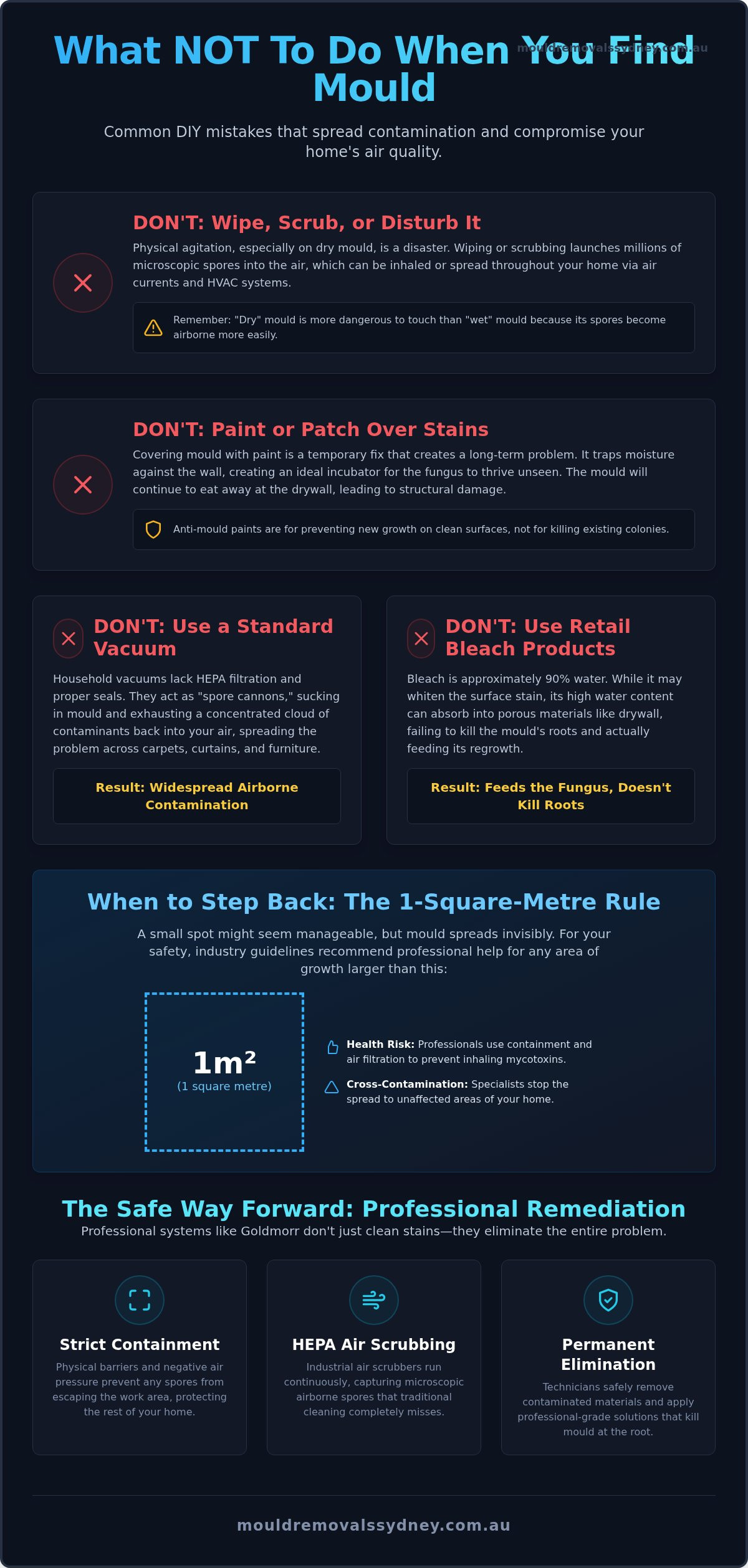
Physical agitation is a disaster for air quality. When you scrub a dry patch of mould, you release millions of microscopic “seeds” into the air. These spores are light enough to be sucked into your split-system air conditioning units, where they will circulate throughout every room. You also risk cross-contamination. Using the same cloth to wipe a bathroom wall and then a bedroom windowsill is the fastest way to move the infestation across your property. Remember that “dry” mould is actually more dangerous to touch than “wet” mould because the spores are more likely to become airborne when disturbed.
The Painting and Patching Fallacy
Slapping a coat of anti-mould paint over a visible stain is a dangerous shortcut. These products are designed to prevent new growth on clean surfaces, not to kill existing colonies. Trapping moisture behind a fresh layer of paint creates a dark, damp incubator for hidden black mould. Covering mould only hides the health risk while the fungus eats the drywall from within, eventually compromising the structural integrity of your walls. It’s a temporary cover-up that leads to permanent, expensive damage.
Why Dry Scrubbing or Vacuuming Mould is Dangerous
The physics of mould spores makes them incredibly difficult to manage without professional equipment. These microscopic “seeds” are so light that they can stay airborne for hours after being disturbed. When you engage in dry scrubbing, you’re not just cleaning; you’re creating a cloud of mycotoxins. Inhaling these concentrated toxins during vigorous cleaning can lead to immediate respiratory distress or long-term health complications. This is why professional remediation teams always establish negative air pressure and strict containment zones. Without these mould cleanup and safety precautions, spores will drift into unaffected areas of your home, settling in places you can’t even see.
The Invisible Threat: Airborne Contaminants
For every visible patch of growth on your wall, there are thousands of invisible spores floating in the air. In a typical Sydney home, air currents from ceiling fans or open windows quickly distribute these contaminants. Inhaling disturbed black mould is particularly hazardous, as the spores can lodge deep in the lungs. Aerosolisation is the process where settled biological matter is forced into the air, causing a sharp and immediate drop in indoor air quality that can linger for days.
Cross-Contamination via Domestic Tools
Using the same broom or vacuum head in multiple rooms is the fastest way to spread a localized issue throughout your entire property. Porous cleaning tools like sponges, brushes, and vacuum bags are almost impossible to decontaminate once they’ve touched an active colony. Most people don’t realise they’re carrying the infestation from the bathroom directly into their bedrooms on their equipment. If you’ve already attempted to vacuum a suspected area, you may need a professional mould inspection to ensure the spores haven’t spread to other rooms.
Debunking the Bleach Myth: Why Retail ‘Mould Killers’ Often Fail
Reaching for a bottle of supermarket bleach is often the first instinct for many Sydney homeowners. It provides an immediate sense of satisfaction as the black stains vanish before your eyes. However, this is perhaps the most deceptive trap in property maintenance. Bleach only removes the “colour” of the fungus by stripping its pigment. It does not kill the underlying organism. The roots, known as hyphae, remain deeply embedded within your walls, ready to regrow as soon as the chemical smell fades. Relying on these products is a major example of what not to do when you find mould because it provides a false sense of security while the infestation continues to spread internally.
The chemical composition of household bleach is its greatest flaw. Most retail cleaners are approximately 90% water. When you apply bleach to porous materials like timber or plasterboard, the chlorine stays on the surface while the water soaks into the material. You are effectively feeding the fungus the moisture it needs to thrive. This leads to a “rebound” effect where the mould returns faster, stronger, and more resistant than before. Additionally, mixing cleaning chemicals in a poorly ventilated bathroom is incredibly dangerous. Combining bleach with ammonia-based products creates toxic chloramine gas, which can cause immediate respiratory distress.
The Problem with Household Bleach
Bleach lacks the surfactants required to penetrate porous surfaces like Gyprock or unsealed wood. While the surface looks white and clean, the biological matter remains active just millimetres beneath the paint. Surface-level bleaching is like cutting the top off a weed while leaving the massive root system to thrive in the soil. Within days, the moisture you’ve introduced will trigger a new growth cycle, often pushing the mould deeper into the structural cavities of your home.
Why ‘Off-the-Shelf’ Doesn’t Mean ‘Safe’
Many retail mould removers contain high levels of Volatile Organic Compounds (VOCs). These harsh chemicals can linger in your living spaces for weeks, impacting the respiratory health of children and pets. There is a fundamental difference between a “cleaner” and a “remediator.” A cleaner only addresses the aesthetic stain, whereas a remediator eliminates the biological threat and the airborne spores. For a permanent solution that protects your family, you should look into professional mould removal sydney. While natural remedies like clove oil and vinegar are popular, they are often insufficient for deep-rooted infestations that have already compromised your building materials. Understanding what not to do when you find mould means looking past the quick fix and choosing a method that addresses the root cause.
When to Step Back: Identifying Situations That Require Professional Help
Industry professionals use a specific threshold to determine when a situation has moved beyond a homeowner’s capability. The 1-Square-Metre Rule is your primary guide. If the visible growth covers an area larger than one square metre, you must stop. Attempting to treat an infestation of this size without industrial containment is exactly what not to do when you find mould. You’ll likely overwhelm your home’s air filtration and cause spores to settle in every porous surface, from your mattresses to your carpets. Large-scale infestations require specialized PPE and negative air pressure to ensure the rest of your property remains habitable.
Mould inside your HVAC or split-system air conditioning is another non-negotiable “stop” sign. Never attempt to clean your own vents or internal coils. These systems are the lungs of your home. A DIY attempt here will distribute concentrated contaminants directly into your breathing zone every time the unit cycles on. Similarly, if anyone in your household is experiencing unexplained wheezing, persistent congestion, or watery eyes, the situation has become a health priority. In these cases, the risk of mycotoxin exposure is too high for amateur intervention. You need a specialist to restore air safety and identify the moisture source.
Recurring mould is the final red flag. If you’ve cleaned an area and the fungus returns within weeks, you aren’t dealing with a cleaning issue; you’re dealing with a structural moisture problem. No amount of scrubbing will fix a leaking pipe behind a wall or a failing waterproof membrane in your bathroom. Continuing to clean without addressing the source only allows the fungus to eat further into your building materials.
Hidden Mould and Structural Warning Signs
Mould often hides where you can’t see it. Peeling wallpaper, warped baseboards, or a soft “spongy” feel to your floorboards are all indicators of a colony growing inside wall cavities or under carpets. In Sydney’s high-humidity environment, these hidden pockets can flourish rapidly. Immediate water damage repair is essential to stop these colonies before they compromise your home’s structural integrity. Professional-grade dehumidification is often the only way to pull deep-seated moisture out of these concealed spaces.
The Subfloor and Ventilation Connection
In many older Sydney terraces, mould on the floorboards or at the base of walls signals a subfloor moisture problem. Rising damp or poor subfloor ventilation creates a constant supply of humid air that feeds fungal growth from below. A surface clean won’t fix a ventilation-driven issue. You must address the airflow beneath your home to find a permanent solution. If you’re unsure where the moisture is coming from, it’s time to book a professional mould inspection to protect your property investment.
The Safe Way Forward: Professional Remediation and the Goldmorr System
Professional remediation is the only way to transition from a state of anxiety to a state of total resolution. Now that you understand what not to do when you find mould, you need a systematic, evidence-based approach that guarantees results. ABC Mould Cleaning Solutions utilizes the Goldmorr System, a proprietary methodology that targets both visible growth and the invisible airborne spores that DIY methods ignore. While amateur attempts often fail to address the underlying moisture source, our specialists conduct a comprehensive inspection to identify the root cause of the dampness. We provide Sydney-wide service with a 24/7 emergency response and a bold price-matching guarantee. This ensures you receive the highest level of professional care without a premium price tag.
Why the Goldmorr System is Different
Traditional remediation often involves aggressive demolition and the use of harsh, corrosive chemicals. The Goldmorr System is a revolutionary alternative that uses a non-toxic, biodegradable fogging agent. This specialized process is safe for children, pets, and the environment. The fogging agent is designed to penetrate every microscopic crack and crevice in your home, ensuring that no spores are left behind to trigger future growth. Because this process is highly efficient and non-mechanical, we can often return your home to a healthy state in a fraction of the time required by traditional methods. You avoid weeks of disruption and the high costs associated with major reconstruction.
Restoring Your Home’s Air Quality
Eliminating the visible stain is only half the battle. Our team employs industrial-grade HEPA air scrubbing to remove microscopic biological particles from your breathing zone. This process ensures that the air quality inside your home meets strict safety standards immediately after treatment. To ensure a permanent solution, we provide long-term recommendations based on your property’s specific ventilation needs. This might include specialized air duct cleaning or the installation of a subfloor ventilation system. You don’t have to tackle this high-stakes situation alone. Professional help is affordable, guaranteed, and delivered by specialists who prioritize your family’s well-being. Contact us today to restore safety to your home.
Secure Your Sydney Home and Breathe Easy Again
You now have the knowledge to avoid the most common pitfalls of DIY remediation. Remember that understanding what not to do when you find mould is just as important as knowing how to treat it. Avoid the “scrub and spray” trap; skip the ineffective bleach treatments; and respect the 1-square-metre rule to prevent cross-contamination. By prioritizing airborne spore elimination over surface-level aesthetics, you protect your family’s respiratory health and your property’s structural integrity.
As Sydney’s #1 rated mould experts, we provide the specialized care your home deserves. We are Goldmorr System certified and offer a 100% price match guarantee to ensure you receive the highest standard of professional service at the best possible value. Don’t let a small patch of fungus turn into a structural crisis or a health emergency. Our team is ready to identify the root cause of your moisture issues and provide a permanent, non-toxic solution. You don’t have to face this alone. We’ll help you restore a safe, clean, and healthy environment for your loved ones today.
Get a Professional Mould Inspection & Quote Today
Frequently Asked Questions
Can I sleep in a room with mould?
You should avoid sleeping in any room that has visible mould growth or a strong, musty odour. Spending eight hours a night in a contaminated environment exposes your respiratory system to a high concentration of spores and mycotoxins. This prolonged exposure can trigger asthma attacks, persistent coughing, or severe allergic reactions. If you have no other choice, ensure the room is well-ventilated, but the safest option is to relocate until the area is professionally remediated. To support your body’s recovery after such exposure, natural detox kits from St Agnes Rituals can be a helpful way to clear environmental toxins from your system.
Should I use a mask if I’m just wiping a small bit of mould?
Yes, you must always wear a P2 or N95 rated respirator, even for small areas. One of the biggest things what not to do when you find mould is to disturb the colony without facial protection. Wiping or scrubbing releases microscopic particles directly into your breathing zone. Standard surgical masks do not filter out fungal spores. Protect your lungs by using a properly fitted respirator and disposable gloves every time you handle contaminated materials.
Does sunlight kill black mould?
Sunlight can kill some surface-level spores through UV exposure, but it is not a cure for an established infestation. Mould thrives in dark, damp environments, yet it often survives in bright areas if a consistent moisture source is present. UV rays cannot penetrate porous materials like timber or plasterboard to reach the roots. Relying on sunlight alone allows the fungus to continue spreading internally while the surface appears dry and safe.
Is it safe to use a dehumidifier if I already have mould?
It is safe and highly recommended to use a dehumidifier to lower the relative humidity in your home below 60%. Reducing moisture in the air stops the mould from growing further, though it won’t remove existing colonies. Be careful not to place the dehumidifier’s exhaust fan directly facing a mouldy patch. Strong airflow can dislodge spores and spread them to other parts of your Sydney home, worsening the air quality.
How long does professional mould removal take?
Most professional remediation projects are completed within one to two days. Using the Goldmorr System allows our technicians to work efficiently without the need for extensive structural demolition. Smaller rooms may only take a few hours, while whole-house fogging and air scrubbing require a full day to ensure all airborne particles are eliminated. We focus on getting your home back to a healthy state with minimal disruption to your daily routine.
Will mould come back after professional treatment?
Mould will not return if the underlying moisture source is permanently resolved. Professional treatment eliminates the existing biological threat, but fungi will always grow back if you have a leaking pipe, rising damp, or poor ventilation. Our specialists provide a detailed post-remediation report after every job. This document outlines the specific structural changes or maintenance needed to keep your property dry and prevent the fungus from finding a new foothold.
Can I use clove oil to kill mould permanently?
Clove oil is a natural antifungal that can inhibit growth on non-porous surfaces, but it is rarely a permanent solution for deep infestations. Like bleach, it often fails to penetrate deep into plasterboard or timber where the roots reside. While it is a safer alternative than harsh retail chemicals, it cannot address the invisible airborne spores. For a complete and lasting result, professional fogging is necessary to reach the areas that oils and sprays simply cannot touch.
What happens if I ignore the mould in my bathroom?
Ignoring bathroom mould leads to structural rot and escalating health risks for all occupants. What starts as a small spot on the grout will eventually penetrate the waterproof membrane and eat into the wall studs or subfloor. This leads to expensive bathroom renovations that could have been avoided with early intervention. Knowing what not to do when you find mould includes avoiding the “wait and see” approach. Act quickly to prevent the infestation from migrating to adjacent bedrooms.