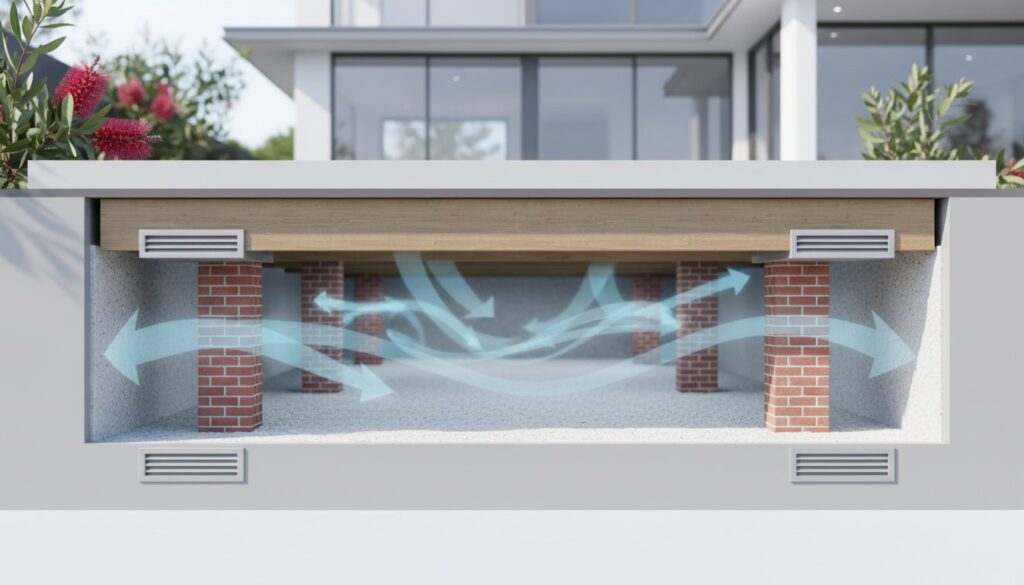
What if the musty smell in your hallway is actually the scent of your home’s foundation slowly rotting away? Many Sydney homeowners ignore that damp, earthy odor until they notice sticking doors or visible mould on their floor joists. It is a stressful situation, especially when you are facing conflicting advice about whether to seal your vents or open them. You deserve a dry, healthy environment that protects your investment. Learning how to improve air circulation under house is the most effective way to protect your structural integrity and your family’s health from the ground up.
In our local climate, where high humidity and coastal moisture are constant threats, a passive approach is rarely enough to keep a crawl space dry. This guide provides a professional roadmap to mastering subfloor health through a “Detect, Divert, and Drive” strategy. You will discover how to eliminate persistent dampness, prevent expensive structural rot, and determine when a DIY fix needs to be upgraded to a professional mechanical system. Let’s transform your damp crawl space into a dry, secure foundation.
Key Takeaways
- Understand the “Stack Effect” and how poor subfloor air quality migrates into your living spaces, directly affecting your family’s health.
- Identify critical warning signs of subfloor failure, including sticking doors and condensation on pipes, before they lead to expensive structural rot.
- Learn practical steps on how to improve air circulation under house by clearing debris from vents and removing internal crawl space obstructions.
- Discover why mechanical ventilation is essential for high-humidity areas where passive vents often fail to prevent moisture buildup.
- Follow a professional remediation sequence to ensure all existing mould is safely removed before you invest in new ventilation hardware.
Why Subfloor Air Circulation is Critical for Your Home’s Health
Subfloor air circulation is the continuous movement of fresh air through the area beneath your floorboards to regulate humidity levels. This space, commonly known as a Crawl space, acts as the lungs of your property. If these lungs are choked by moisture, the entire structure suffers. Many homeowners only search for how to improve air circulation under house after they notice a lingering scent of dampness, but the structural damage often starts much earlier. When air remains stagnant, it creates a reservoir of high relative humidity that directly threatens the integrity of your floor joists and bearers.
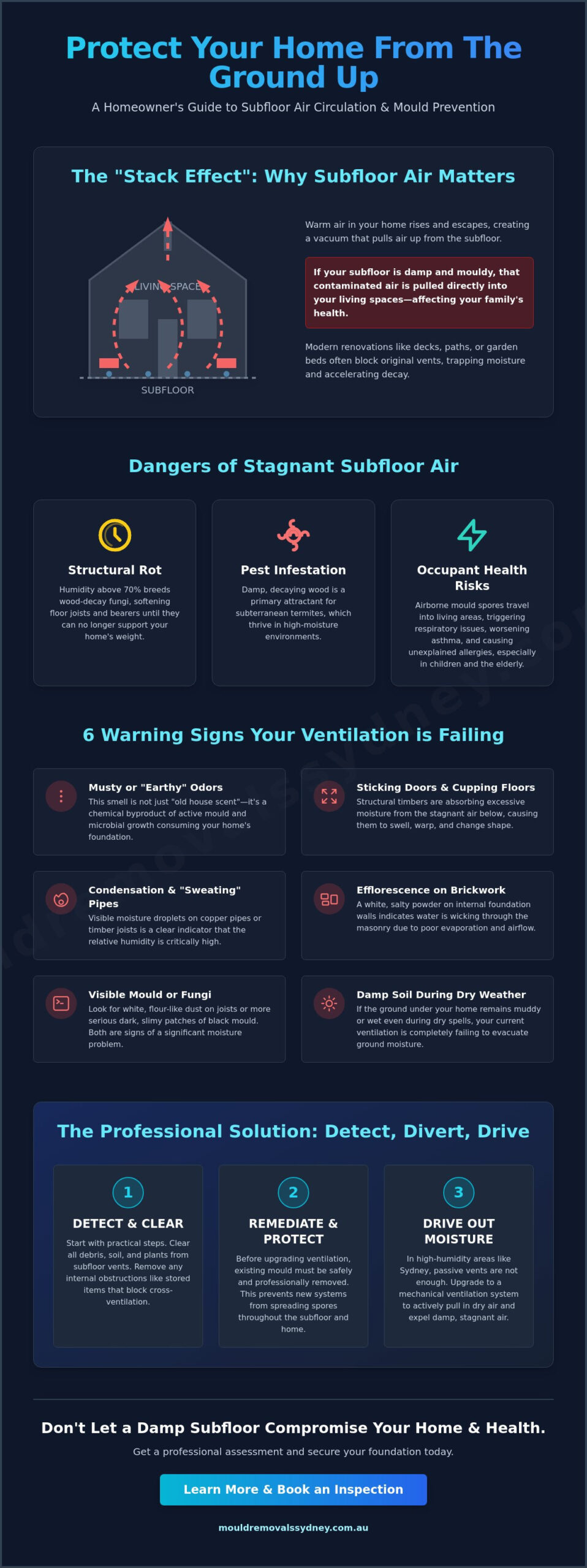
The “Stack Effect” is a critical concept for every property owner to understand. Warm air inside your home naturally rises and escapes through the upper levels or roof, creating a vacuum that pulls air upward from the subfloor. This means you aren’t just living above a damp area; you are breathing the air that originated there. If that air is saturated with moisture and microbial toxins, it compromises the environment in every room. Modern renovations frequently worsen this issue. New decks, concrete paths, or raised garden beds often accidentally block original terracotta or brass vents. This chokes the original ventilation paths and traps humid air, leading to rapid timber decay.
The Dangers of Stagnant Subfloor Air
When air stops moving, humidity often rises above 70%, creating a perfect breeding ground for wood-decay fungi. This leads to “wet rot,” a condition that softens structural timbers until they can no longer support the weight of your home. In Sydney, damp subfloors are a primary attractant for subterranean termites. These pests thrive in high-moisture environments where wood is already softened by decay. Those musty odors you smell in the hallway are a specific chemical byproduct of active microbial growth. They are a clear warning that mould is currently consuming your foundation timbers.
Health Impacts for the Occupants Above
Airborne mould spores are microscopic and easily bypass floorboards to enter bedrooms and living areas. For families, this often manifests as persistent respiratory issues, worsened asthma, or unexplained allergies. Children and the elderly are particularly vulnerable to these environmental triggers. Cross-ventilation is the primary mechanism for natural subfloor drying. Without a consistent stream of air moving from one side of the house to the other, moisture remains trapped. Learning how to improve air circulation under house is a vital step in protecting your family’s long-term well-being and ensuring your home remains a safe, dry sanctuary.
Signs Your Subfloor Ventilation is Failing
Sydney’s high humidity and dense clay soil create a unique moisture trap for local properties. When your foundation holds water, it isn’t just a maintenance issue; it’s a structural threat. Recognizing the early warning signs is the first step in learning how to improve air circulation under house before permanent damage occurs. Look for condensation forming on copper pipes or “sweating” on the timber joists. You might also see efflorescence, a white, salty powder, appearing on your internal brickwork. This indicates that water is being pulled through the masonry due to poor airflow.
Structural changes are even more alarming. If your floorboards begin cupping or your internal doors suddenly stick in their frames, the timber is reacting to excessive moisture. These aren’t just quirks of an old building. They are evidence that the wood is absorbing humidity from the stagnant air below. Even during dry Sydney summers, the soil beneath your home should not remain muddy or damp. If it does, your current ventilation is failing to evacuate the ground moisture. That unmistakable “old house” smell is actually the scent of microbial volatile organic compounds being released by fungi.
Identifying Mould and Fungal Growth
Surface “white” mould often looks like a light dusting of flour on your joists. While it’s a concern, dangerous black mould is far more serious. It appears as dark, slimy patches that penetrate deep into the wood grain. Never attempt a DIY inspection without a P2-rated mask and protective eyewear. Inhaling these spores can cause immediate respiratory distress. If you suspect an infestation, it’s vital to understand the risks of black mould before disturbing the area.
Measuring Subfloor Humidity Levels
A professional approach involves more than just a visual check. Use a digital hygrometer to track the relative humidity (RH) under your house. Scientific research on moisture control in crawl spaces confirms that an RH above 70% is the critical threshold for fungal growth. If your readings consistently stay in this “danger zone,” natural cross-ventilation isn’t enough. You must distinguish between rising damp, which requires a new damp-proof course, and poor air circulation, which can be solved with mechanical fans. For a definitive diagnosis, a professional mould inspection can pinpoint exactly where the moisture balance has failed.
5 Practical Ways to Improve Airflow Under Your House
Take immediate control of your property’s foundation health by implementing a systematic approach to moisture management. Improving the environment beneath your home requires a combination of physical clearing and strategic planning. If you want to know how to improve air circulation under house, start by addressing the most common physical barriers that trap humid air. Follow these five steps to restore a dry, healthy subfloor.
- Step 1: Clear all existing vents. Inspect every terracotta or brass vent around your perimeter. Remove garden debris, spider webs, and accumulated soil that restrict natural airflow.
- Step 2: Remove crawl space obstructions. Clear out stored timber, cardboard boxes, or old insulation. These items act as physical blocks and moisture sponges that prevent air from reaching the center of the subfloor.
- Step 3: Correct external landscaping. Ensure garden beds are not built up against the walls. If soil levels are higher than the vents, you are effectively sealing your house and inviting moisture in.
- Step 4: Install additional passive vents. Identify “dead zones” in corners where air remains stagnant. Adding new openings in these specific areas encourages better circulation.
- Step 5: Address external drainage. Fix leaking gutters and ensure downpipes direct water far away from the foundation. Stop water from pooling near the footings to reduce the amount of ground moisture the air needs to carry away.
The Role of Passive Vents
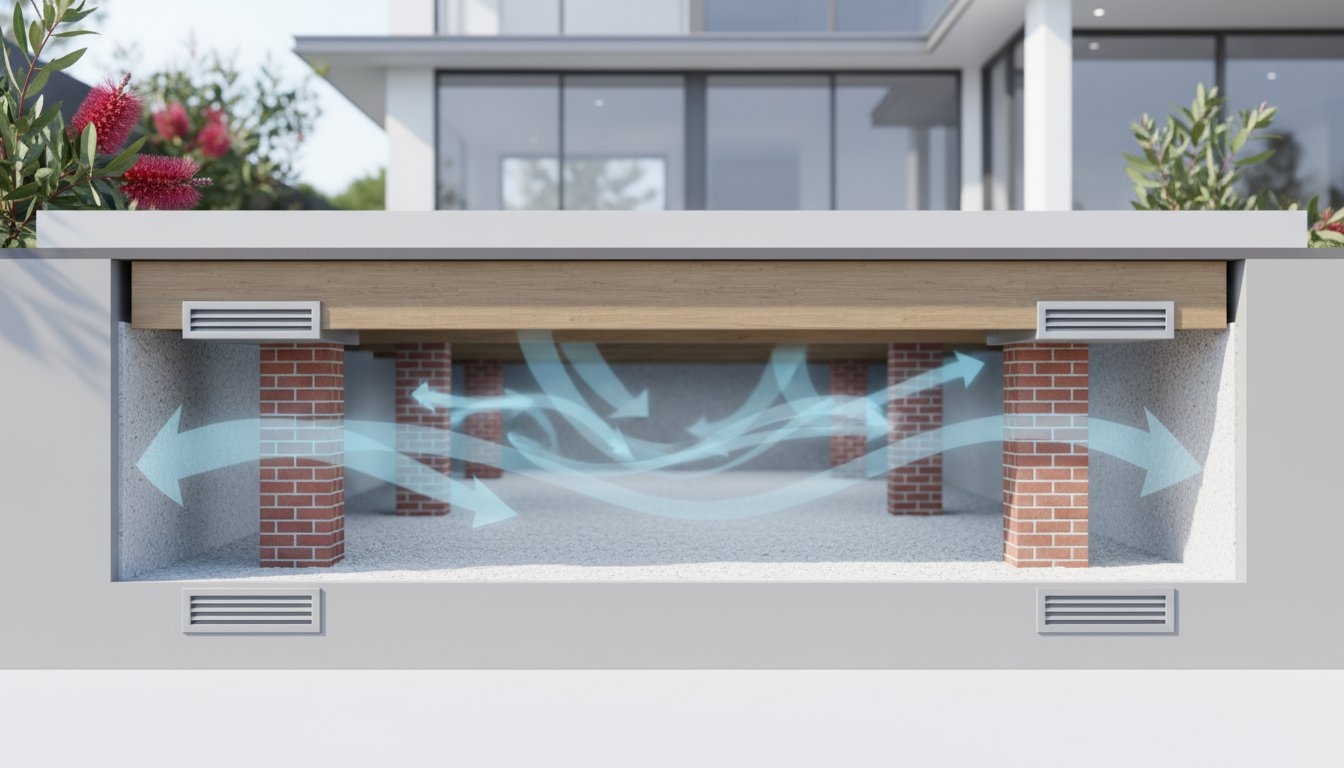
Effective ventilation depends on more than just the number of holes in your walls. You must calculate the required vent area based on the total square meterage of your home. However, “cross-flow” is more important than the total number of vents. For air to move, it needs an entry point and an exit point on opposite sides of the structure. Plastic vents often outperform traditional terracotta in airflow volume because they feature larger apertures and thinner profiles that allow for a higher volume of air exchange. If your home has a complex internal wall structure, simple passive vents may struggle to reach the middle sections.
Managing External Moisture Sources
Stop moisture at the source to make your ventilation efforts more effective. Saturated soil around the perimeter significantly increases the workload for any airflow system. Check for leaking downpipes that dump water directly into the footings during heavy rain. You must grade the soil to slope away from the house footings at a rate of at least 50mm over the first meter. Wood mulch in garden beds often acts as a moisture sponge against your vents, trapping humidity exactly where you don’t want it. Consider replacing mulch with decorative stone or gravel near vent openings to maintain a clear path for fresh air. This is a vital part of how to improve air circulation under house while keeping the foundation dry.
When to Upgrade to Mechanical Subfloor Ventilation
Passive vents rely entirely on natural wind pressure to move air. In high-humidity zones like Sydney’s coastal or riverside suburbs, the external air is often too heavy and still to circulate effectively on its own. This is where passive systems fail. If you’re struggling with persistent dampness despite clearing your vents, you need to understand how to improve air circulation under house using mechanical force. Mechanical subfloor fans actively “drive” air exchange, ensuring that moisture is evacuated regardless of external weather conditions.
Effective systems often use a combination of supply and exhaust fans. Supply fans push fresh, drier air into the crawl space, while exhaust fans pull damp, stagnant air out. This creates a pressurized stream that leaves no “dead zones” for mould to take hold. Modern units are designed for maximum energy efficiency. By using humidity sensors or timers, these systems only operate when the subfloor environment reaches a specific moisture threshold. This keeps running costs low while maintaining a permanent barrier against structural decay.
Benefits of High-Quality Subfloor Fans
Professional-grade systems aim to achieve at least 10 air exchanges per hour. This rapid turnover is necessary to drop humidity levels quickly after heavy rain. While older fans were notorious for being loud, modern whisper-quiet technology ensures your home remains peaceful. For Sydney homeowners concerned about electricity usage, solar-powered options provide a sustainable solution. However, mains-powered fans like the AprilAire 8145 provide a powerful 250 CFM airflow suitable for large footprints. Other specialized units, such as the Tjernlund V2D crawl space ventilator, include built-in thermostats and dehumidistats to automate the process. This ensures the system only activates when necessary, protecting your home while minimizing energy consumption.
Professional Installation vs. DIY Fans
Installing a fan yourself might seem straightforward, but poor placement often leads to “short-circuiting.” This happens when air moves in a small loop between a fan and the nearest vent, leaving the rest of the subfloor stagnant. Professional placement ensures that the airflow path covers every corner of the foundation. Our specialists use advanced diagnostic tools to map the most effective extraction points. If you’ve already discovered growth under your floorboards, you should consult Sydney’s #1 Mould Removal Service to clear the area before installing new hardware. Attempting to ventilate an active mould colony will only spread spores throughout your home. To secure your property’s future, book a professional subfloor ventilation system installation today.
Professional Subfloor Remediation and Protection
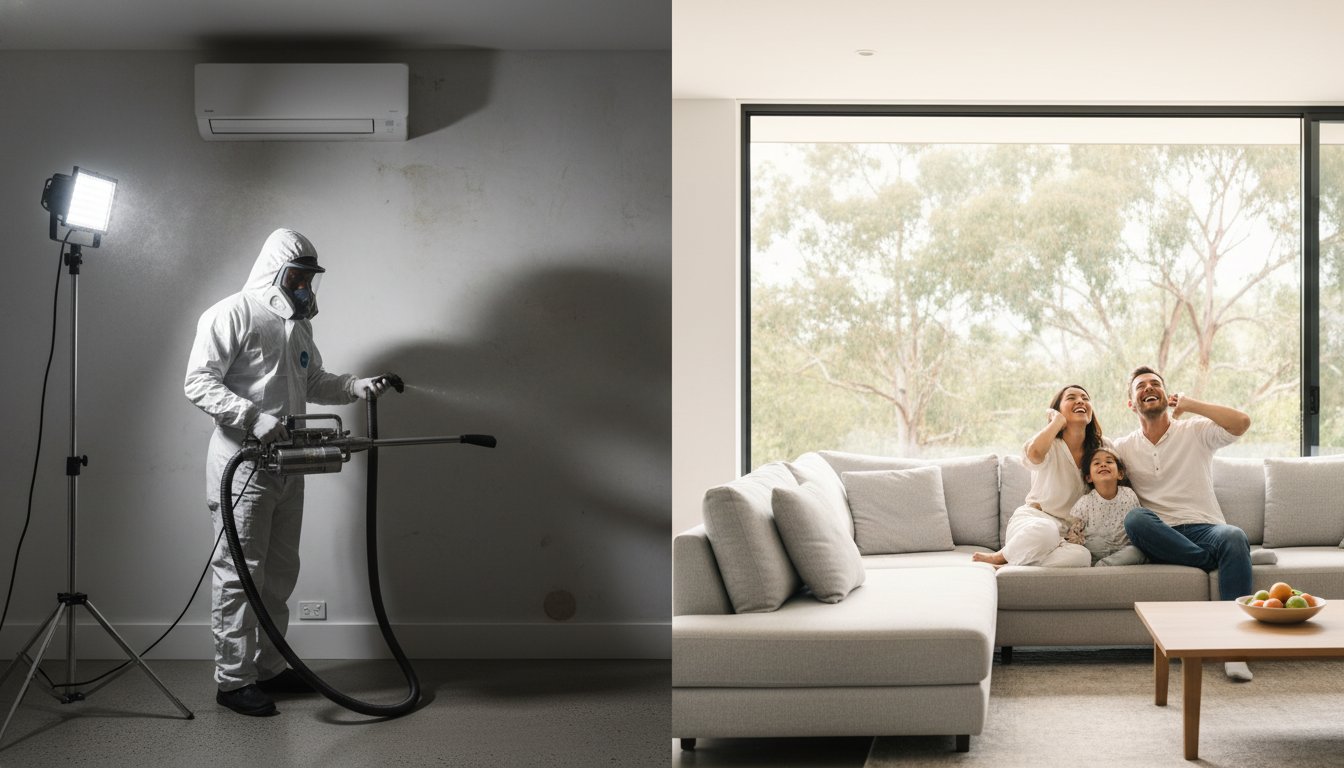
Mastering how to improve air circulation under house is only the second half of a successful restoration. If your crawl space already contains active fungal colonies, simply turning on a fan will distribute millions of microscopic spores throughout your home. This cross-contamination risks the health of every occupant. At ABC Mould Cleaning Solutions, we utilize a systematic “Inspection, Removal, and Prevention” methodology to ensure your foundation is biologically safe before we implement permanent ventilation hardware. Our goal is to restore your property’s structural integrity and air quality using evidence based remediation techniques.
Sydney’s high humidity and clay soil often mean that moisture problems have been present for years before they are discovered. Long term maintenance requires more than a “set and forget” attitude. You must conduct regular checks of your subfloor, especially after periods of heavy rain or local flooding. Ensuring your foundation remains dry for the life of the home involves monitoring external drainage and keeping vents clear of garden mulch or debris. By combining professional remediation with high performance mechanical airflow, you create an environment where mould cannot survive.
Comprehensive Mould Inspection
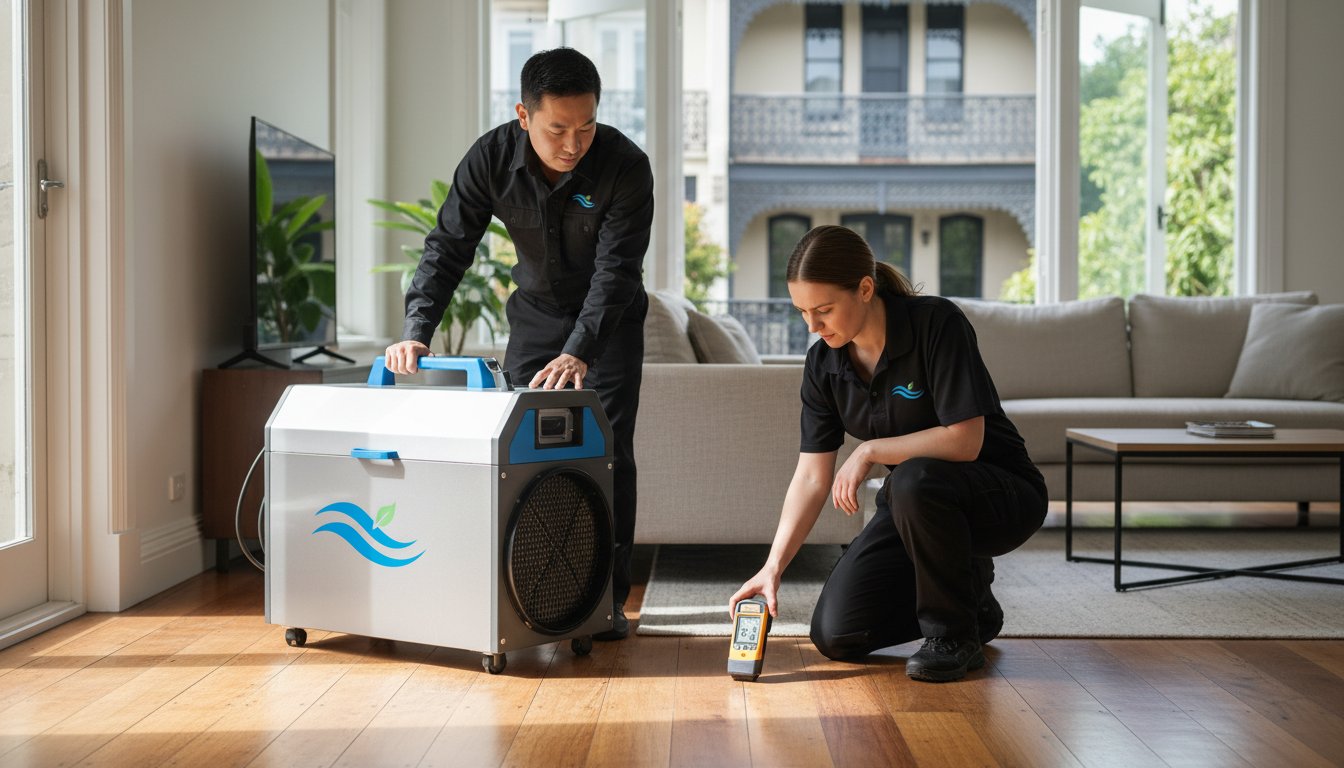
We don’t rely on guesswork. Our specialists use advanced thermal imaging cameras and pinpoint moisture meters to identify hidden dampness within your brickwork and soil. We assess the structural integrity of your joists and bearers to ensure that “wet rot” hasn’t already compromised the safety of your flooring. This diagnostic phase provides you with a clear, technical roadmap. We detail exactly where drainage has failed and where stagnant air pockets have formed. This data allows us to design a custom ventilation and cleaning strategy that addresses your home’s specific environmental challenges.
The Goldmorr Advantage for Subfloors
Our proprietary Goldmorr System represents the gold standard in subfloor protection. We use a biodegradable fogging process that reaches deep into the porous grain of your floor timbers. Unlike surface scrubbing, this methodology eliminates airborne spores and neutralized fungal roots at the source. This process is essential for removing that persistent “musty smell” that often migrates into your living areas through the stack effect. Our solutions are safe for all occupants and the surrounding environment, providing immediate emotional relief and physical security. Don’t let a damp foundation devalue your property or threaten your family’s health. Book your subfloor inspection with ABC Mould Cleaning Solutions today and take the final step in learning how to improve air circulation under house properly.
Secure Your Home’s Foundation and Family Health
Your property’s structural integrity depends on the air moving beneath your feet. We’ve explored how stagnant air leads to timber decay and how modern landscaping can accidentally choke your foundation’s lungs. Mastering how to improve air circulation under house is a vital process that starts with basic maintenance but often requires specialized mechanical solutions for long term success. You now understand that active mould must be professionally remediated before any ventilation system is installed to prevent the spread of toxic spores into your living areas.
Don’t let moisture problems escalate into permanent structural damage. Our team of Certified Goldmorr Technicians is ready to provide a systematic solution tailored to your specific environment. We offer a Sydney-wide 24/7 emergency response and a price-matching guarantee to ensure you receive the best professional value. Request a Professional Subfloor & Mould Inspection today to restore your property’s safety and secure your family’s well-being with total confidence.
Frequently Asked Questions
How many vents does my subfloor actually need?
Your subfloor generally requires one vent for every 1.5 to 2 linear meters of external wall to maintain adequate cross-flow. This calculation varies based on the total square meterage of your foundation and local building regulations. It’s essential to place vents on opposite walls to ensure air moves through the entire space rather than just swirling near the perimeter.
Can I just use a regular house fan to dry out my subfloor?
You shouldn’t use a standard household fan because it isn’t designed for the high-humidity, dusty environment of a crawl space. These fans lack the motor protection required to operate safely in damp conditions and can quickly become a fire hazard. Professional subfloor fans are sealed units built to move large volumes of air through restricted openings without overheating.
Will subfloor ventilation stop my floorboards from cupping?
Installing a proper system will often stop floorboards from cupping by stabilizing the relative humidity beneath the timber. When the air is too damp, the underside of the wood expands faster than the top, causing it to curl. By learning how to improve air circulation under house, you remove the excess moisture that causes this structural distortion, though severely damaged boards may require mechanical sanding once dry.
How much does it cost to run a subfloor ventilation fan in Sydney?
Running a modern, energy-efficient subfloor fan in Sydney typically costs very little per day. Most high-quality units consume between 20 and 40 watts of power, which is similar to a single LED lightbulb. If your system is connected to a humidity sensor or a timer, it only operates during peak moisture periods, further reducing your quarterly electricity expenses.
Is it better to push air into the subfloor or pull it out?
A balanced system using both supply and exhaust fans is the most effective way to manage moisture. Extraction fans pull damp air out, while supply fans push fresh air into “dead zones” that natural wind cannot reach. This combination creates a pressurized stream that ensures no moisture remains trapped in corners, which is a key strategy for those researching how to improve air circulation under house effectively.
Does subfloor ventilation help with termite prevention?
Effective ventilation is a critical deterrent for termites because these pests are naturally attracted to damp, decaying timber. While ventilation isn’t a substitute for a chemical barrier, it removes the environmental conditions that make your home a target. Dry soil and joists are significantly less appealing to subterranean colonies looking for a new food source.
Can poor subfloor airflow affect the air quality inside my house?
Poor airflow beneath your home directly impacts your indoor air quality through a process called the stack effect. As warm air rises through your living spaces, it pulls air up from the subfloor through gaps in floorboards and service penetrations. If the subfloor is damp and mouldy, you are effectively breathing in those spores and musty odors throughout your home.
What is the best time of year to install subfloor ventilation in NSW?
You should install ventilation systems in late winter or early spring before Sydney’s humid summer peak arrives. Installing during the dryer months allows the subfloor soil to dry out completely before the high-humidity season begins. This proactive approach ensures your foundation is already protected when the risk of mould growth and timber expansion is at its highest.