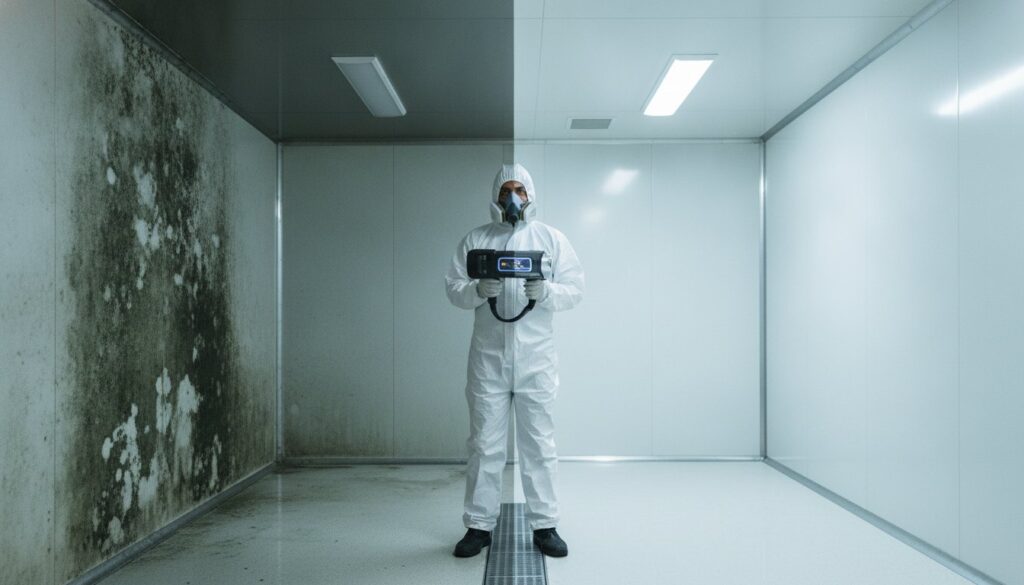
The High Stakes of Cool Room Mould in Sydney Businesses
For any Sydney business that relies on commercial cool rooms—from restaurants and cafes to pharmaceutical storage and food processing plants—a mould outbreak is more than an inconvenience. It is a critical bio-hazard event that threatens stock, safety, and your bottom line. Commercial mould remediation is not a cleaning task; it is a specialised, scientific response designed to eradicate a complex biological threat and prevent its return. Ignoring it is a gamble with your business’s future.
- A Specialised Bio-Hazard Response: Unlike surface dust or grime, mould is a living fungal colony. Its removal requires a deep understanding of microbiology, containment protocols, and air purification. This is far beyond the scope of standard janitorial services.
- Sydney’s Humidity: The Inevitable Threat: Sydney’s coastal climate, with its high humidity, creates a constant battle against moisture. Inside a cool room, the condensation that forms as warm, moist air meets cold surfaces provides the perfect breeding ground for mould spores. It’s not a matter of if condensation will occur, but how you manage its consequences.
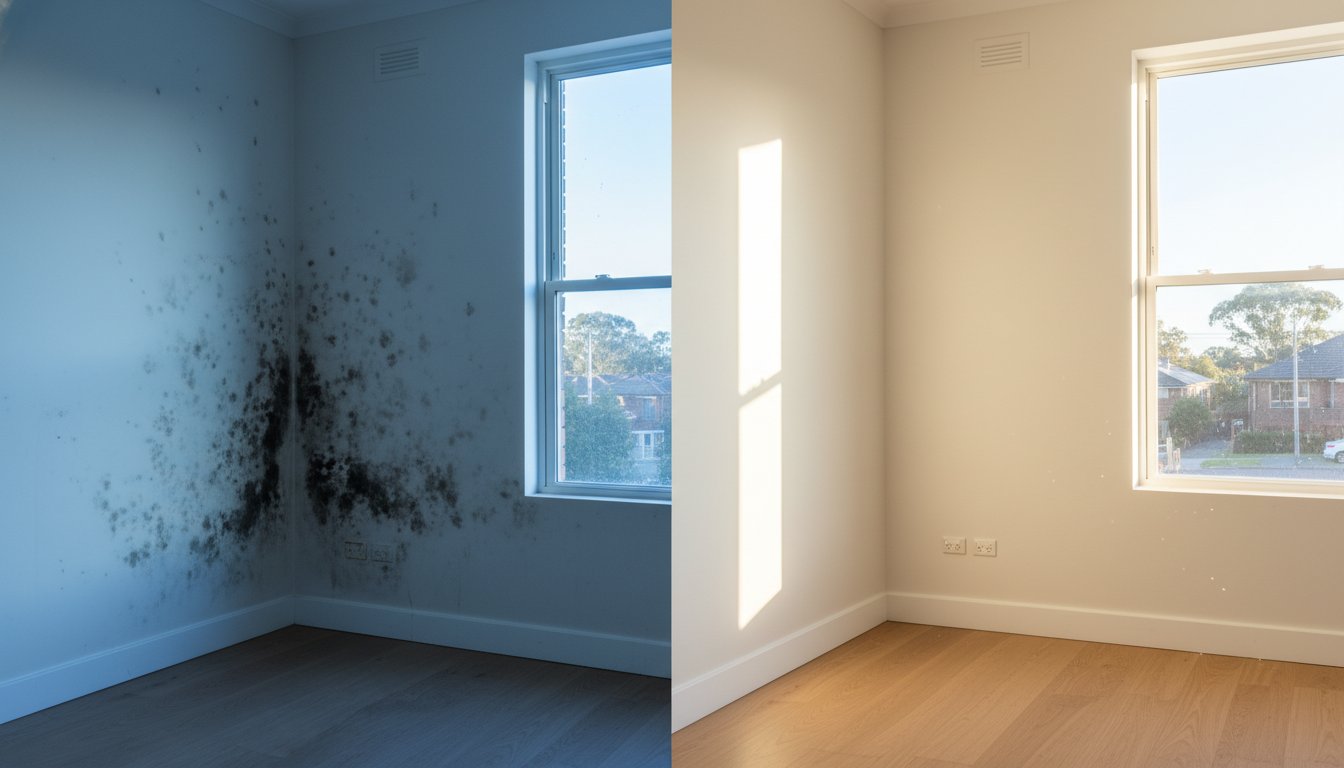
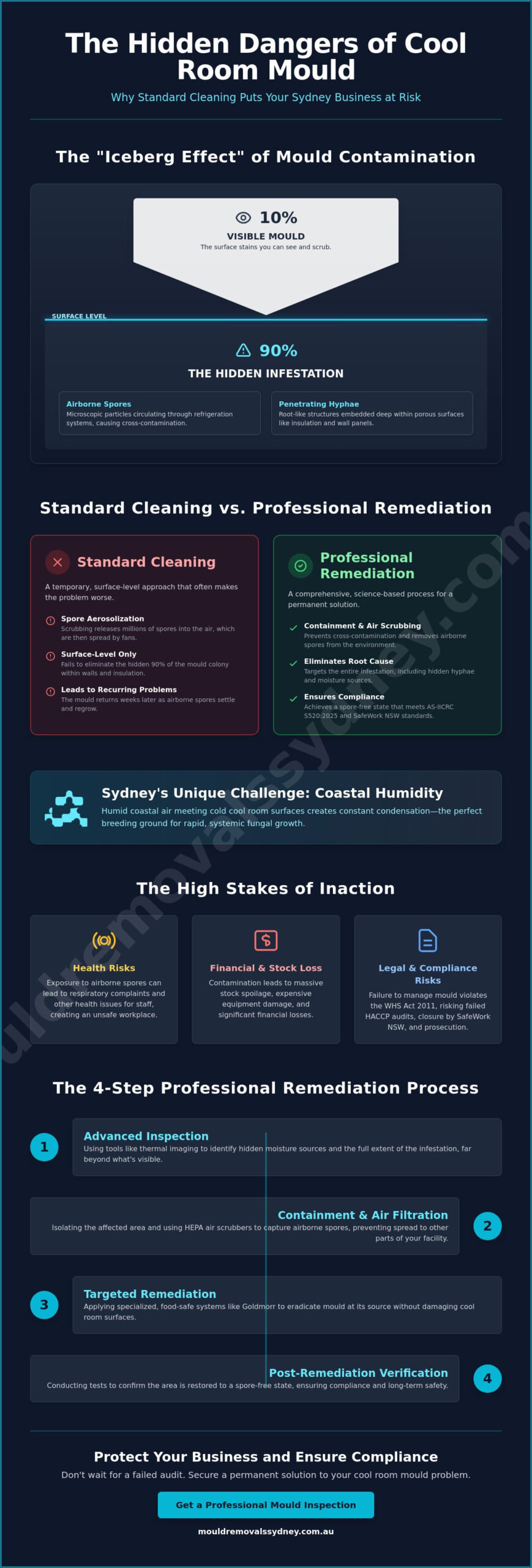
- Visible Spotting vs. Systemic Infestation: The black or green spots you see on a cool room wall or ceiling are merely the fruiting bodies of the mould. The bulk of the organism—a network of microscopic roots called mycelium—is often hidden deep within porous materials like insulation panels, grout, or silicone seals. What you see is just the tip of a much larger, more dangerous iceberg.
- The Business Impact: The consequences of a cool room mould infestation are severe and multifaceted. They include immediate stock spoilage, long-term damage to expensive refrigeration equipment, failed health inspections, and irreparable harm to your business’s reputation.
The Science of Cool Room Contamination
Understanding why mould thrives in a cold environment is the first step to controlling it. A cool room is not a sterile box; it’s a dynamic micro-climate where small changes can lead to widespread contamination. The constant operation of refrigeration systems creates unique conditions that are surprisingly hospitable to fungal growth.
- Temperature Fluctuations and Micro-Climates: Every time a cool room door is opened, warm, humid air from outside rushes in. As this air cools, it releases its moisture as condensation on walls, ceilings, and stock. These pockets of moisture, combined with organic dust particles, create the ideal environment for mould spores to germinate and flourish.
- Common Growth Hotspots: Mould is opportunistic. It will colonise any area that provides moisture and a food source. In commercial cool rooms, this includes door seals, fan units where dust accumulates, behind shelving, and especially within porous insulated wall panels where moisture can become trapped.
- The Role of Stagnant Air: While fans circulate cold air, they don’t always reach every corner of the unit. These “dead zones” of stagnant air allow moisture to settle and spores to land without disturbance, creating hidden colonies that can grow undetected for months, silently releasing millions of spores into the air that is then circulated throughout the unit.
Sydney Regulations and Compliance
For a commercial mould remediation business in Sydney, compliance is not optional. Business owners in New South Wales have a legal duty of care to provide a safe working environment, and this explicitly includes managing biological hazards like mould. Failing to address a known mould issue can result in significant legal and financial penalties.
- SafeWork NSW Requirements: Under the Work Health and Safety (WHS) Act, mould is classified as a biological hazard. Employers must take all reasonably practicable steps to eliminate or minimise the risk it poses to workers. This includes proper identification, assessment, and professional remediation.
- HACCP and Food Safety Audits: For any business in the food industry, a Hazard Analysis and Critical Control Points (HACCP) plan is essential. Mould is a critical failure point in these audits. Its presence indicates a breakdown in sanitation and temperature control, which can lead to immediate closure orders, hefty fines, and loss of certification.
- Legal Liabilities for Business Owners: Ignoring recurring mould is not a viable strategy. If an employee’s health is affected by workplace mould exposure, or if a customer becomes ill from contaminated products, the business owner can be held liable. Professional remediation provides a documented, defensible process that demonstrates you have met your duty of care.
Why Standard Cleaning Isn’t Enough for Commercial Remediation
One of the most dangerous misconceptions business owners have is that cool room mould can be handled by their regular cleaning crew. This approach not only fails to solve the problem but actively makes it worse. Standard cleaning methods are fundamentally unequipped to deal with a microbial infestation, often leading to cross-contamination and more aggressive regrowth.
- The ‘Iceberg Effect’: As mentioned, visible mould is only a fraction of the total infestation. Scrubbing the surface removes the “symptom” but leaves the hidden root system intact within the material. The mould will inevitably regrow, often stronger than before.
- The Danger of Scrubbing: Aggressively scrubbing or wiping at a mould colony with a cloth or brush causes the organism to release a massive cloud of microscopic spores as a defense mechanism. These spores become airborne and are then circulated by the cool room’s fans, spreading the contamination to previously clean areas.
- Failure to Penetrate Porous Surfaces: The insulated panels common in cool rooms are porous. Standard cleaning detergents sit on the surface and cannot penetrate deep enough to kill the mould’s root structure. The moisture from cleaning can even get trapped, providing more fuel for the hidden infestation.
- Lack of Specialised Training and PPE: Janitorial staff are not trained bio-hazard technicians. They lack the knowledge of containment procedures and are not equipped with the proper Personal Protective Equipment (PPE), such as P3 respirators, to protect themselves from inhaling dangerous concentrations of mould spores.
The Danger of Spore Agitation
The single greatest failure of DIY or standard cleaning is spore agitation. When a mould colony is disturbed, it triggers a survival response, releasing millions of spores to colonise new areas. This process, known as aerosolization, turns a localised problem into a facility-wide crisis.
- The Mechanism of Spore Aerosolization: Imagine puffing on a dandelion. The same principle applies when you scrub mould. The physical force dislodges the spores, making them light enough to be carried on air currents. A single square inch of mould can contain over one million spores, all of which can become airborne in seconds.
- Distribution via Cooling Systems: Once airborne, these spores are drawn into the cool room’s fan and evaporator coil units. The refrigeration system then efficiently distributes them throughout the entire space, ensuring every surface, product, and corner is coated with a fresh layer of contamination.
- Secondary Growth in Hidden Cavities: These airborne spores travel beyond the cool room, settling in air conditioning ductwork, wall cavities, and other hidden spaces. This leads to secondary mould outbreaks in areas far from the original source, creating a much more complex and expensive problem to solve.
Inadequate Chemicals vs. Professional Solutions
Many business owners, facing a recurring mould problem, reach for stronger chemicals like bleach or vinegar. This is a critical mistake. Not only are these solutions ineffective for deep remediation, but they can also be dangerous in a food storage environment.
- Why Bleach Fails on Porous Surfaces: Bleach (sodium hypochlorite) is a powerful sanitiser on non-porous surfaces like stainless steel. However, on porous materials like insulation panels or grout, the chlorine component evaporates quickly, leaving behind its main ingredient: water. This water soaks into the material, feeding the very mould roots you were trying to kill.
- The Problem with ‘Off-the-Shelf’ Products: Most retail mould killers are simply not formulated for the persistent, low-temperature mould species found in commercial refrigeration. Furthermore, their harsh chemical residues can be unsafe in food-sensitive environments, potentially contaminating stock and violating food safety standards.
- The Professional Advantage: Non-Toxic, Biodegradable Agents: A professional commercial mould remediation business in Sydney uses specialised, non-toxic, and biodegradable agents. These solutions are designed to penetrate porous surfaces and eliminate mould at the root without leaving harmful residues, ensuring the space is safe for food, pharmaceuticals, and staff.
Health Risks and the Pathogenic Threat to Workers
A mouldy cool room isn’t just a threat to your products; it’s a direct threat to the health of your employees. Constant exposure to high concentrations of mould spores in an enclosed space can lead to a range of health issues, impacting productivity and creating significant liability.
- The Three Categories of Health Effects: Mould-related health issues fall into three main categories: Allergenic (causing allergic reactions), Pathogenic (capable of causing infection), and Toxigenic (producing toxic substances called mycotoxins).
- Common Symptoms in Cold-Storage Workers: Staff working in contaminated environments frequently report symptoms such as persistent coughing, sneezing, sore throats, headaches, fatigue, skin rashes, and irritated eyes. These are often dismissed as common colds, but they are classic signs of mould exposure.
- Increased Sick Leave and Reduced Productivity: A workplace with poor air quality directly leads to more sick days and lower overall productivity. Employees who feel unwell cannot perform at their best, affecting your entire operation’s efficiency.
- ‘Sick Building Syndrome’: Over time, prolonged exposure can contribute to a condition known as Sick Building Syndrome, where occupants experience acute health effects that are linked directly to time spent in a building, with no other identifiable cause.
Respiratory and Skin Irritations
The most immediate health impacts of mould are often respiratory and dermatological. Inhaling spores can trigger a powerful inflammatory response in the body, particularly for individuals with pre-existing conditions.
- Impact on Asthma and Lung Conditions: For employees with asthma or other chronic lung conditions, exposure to mould spores can trigger severe attacks, leading to difficulty breathing and requiring medical attention. You can learn more about the diverse health effects of mould and why professional intervention is critical.
- Skin Rashes and Eye Irritation: Direct contact with mould or high levels of airborne spores can cause contact dermatitis, resulting in red, itchy rashes. Spores can also irritate the mucous membranes of the eyes, leading to redness, watering, and a persistent gritty sensation.
- Pathogenic Mould and Vulnerable Individuals: Pathogenic mould poses a direct infection threat, particularly to any staff members who may be immunocompromised.
Mycotoxins and Food Safety
Perhaps the most insidious danger comes from toxigenic moulds, which produce toxic chemical compounds called mycotoxins. These substances can contaminate stock and pose a serious risk to the entire supply chain.
- The Production of Mycotoxins: Certain species of mould, such as some strains of Aspergillus and Stachybotrys chartarum (often referred to as black mould), produce mycotoxins as part of their metabolic process. These toxins can remain on a surface even after the mould itself has been killed.
- Risk of Leaching into Products: Mycotoxins can leach into unsealed or improperly packaged food, beverage, or pharmaceutical products. This contamination is invisible and can render entire batches of stock unsafe for consumption or use, leading to catastrophic financial losses and potential public health crises.
- Protecting Your Supply Chain: Ensuring your cool room is free from toxigenic mould is a critical step in protecting your brand and your customers. Professional remediation is the only way to guarantee that both the mould and its toxic byproducts are completely and safely eliminated.
The Professional Remediation Process: A Strategic Approach
Professional commercial mould remediation is a systematic, multi-stage process grounded in scientific principles. It goes far beyond mere cleaning to address the infestation at its source, eliminate airborne contaminants, and restore a safe, healthy environment. The goal is not just to remove the visible mould but to break the cycle of regrowth for good.
- Initial Inspection: The process begins with a thorough assessment using more than just the naked eye. Technicians use tools like thermal imaging cameras and moisture meters to detect hidden moisture in walls and ceilings—the fuel for mould growth. This step is crucial for identifying the full scope of the problem.
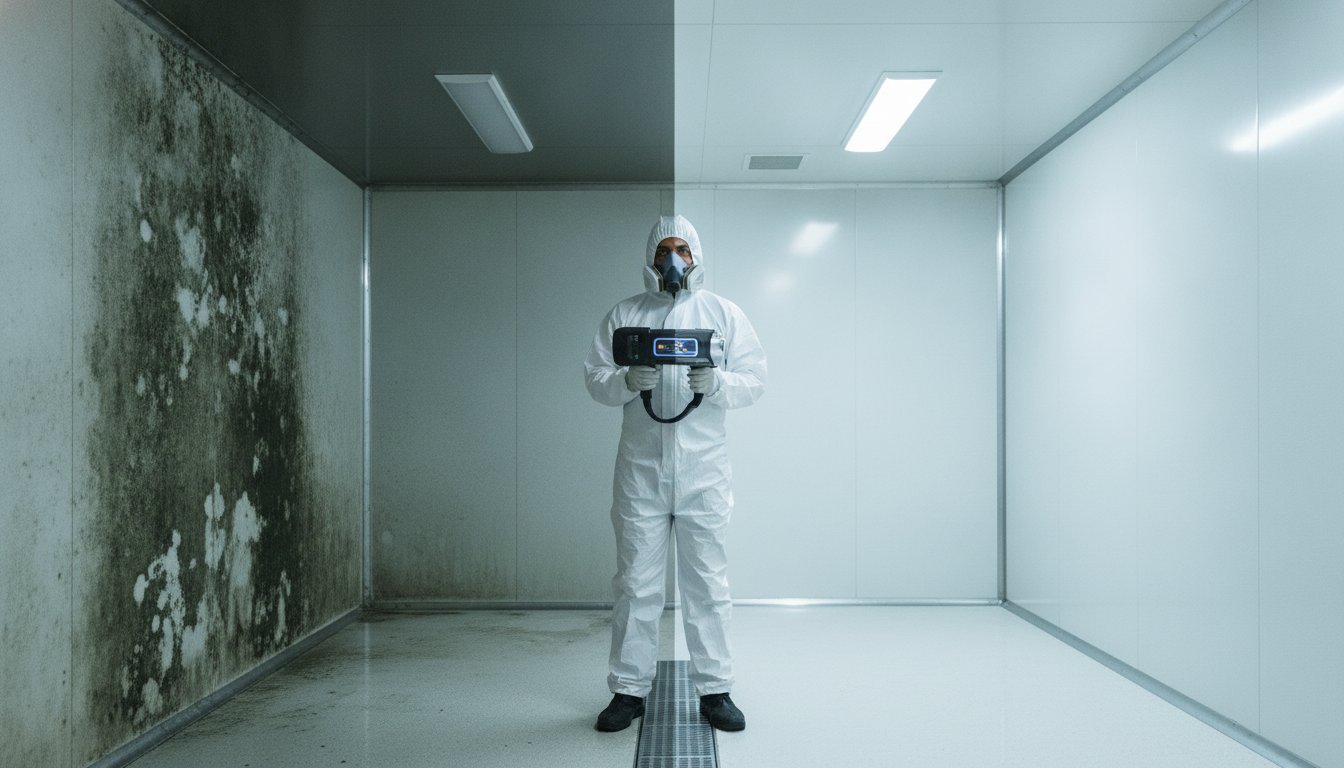
- Containment: Before any removal begins, the affected area is sealed off from the rest of the facility using heavy-duty plastic sheeting and negative air pressure systems. This containment protocol is non-negotiable; it prevents the cross-contamination of spores to other areas of your business during the remediation process.
- HEPA Air Scrubbing: During and after mould removal, industrial-grade air scrubbers fitted with High-Efficiency Particulate Air (HEPA) filters run continuously. These machines capture microscopic airborne mould spores, dust, and other contaminants, physically removing them from the environment.
- The Goldmorr® System: We utilise the specialised Goldmorr® System, a proven methodology for commercial eradication that targets both surface mould and airborne spores with minimal disruption to your business.
Advanced Inspection Techniques
A successful remediation outcome depends entirely on an accurate initial diagnosis. Visual checks are notoriously unreliable and often lead to incomplete treatment. A professional mould inspection for a commercial facility is a technical audit.
- Beyond Visual Checks: Technicians are trained to identify the subtle signs of hidden mould, such as faint discolouration, musty odours, or peeling paint. They understand the building science behind moisture intrusion and know where to look for problems that an untrained eye would miss.
- Identifying ‘Dead Zones’: Using airflow meters and smoke pencils, specialists can identify areas within the cool room that have poor air circulation. These “dead zones” are prime locations for hidden fungal colonies to develop undisturbed.
- Air Quality Testing: To establish a baseline and verify the success of the remediation, air quality samples may be taken. These tests quantify the concentration and types of mould spores in the air before and after treatment, providing scientific proof that the environment has been returned to a safe state.
Air Purification and Scrubbing
The most critical difference between professional remediation and standard cleaning is the focus on airborne contaminants. You cannot have a clean facility if the air is filled with mould spores. Air purification is a core component of the process.
- How HEPA Filters Work: A true HEPA filter is certified to trap 99.97% of particles as small as 0.3 microns. This includes mould spores, bacteria, and dust. Air scrubbers pull contaminated air through these filters, releasing purified air back into the room.
- The Importance of Negative Air Pressure: Within the containment zone, powerful fans vent air to the outside. This creates negative air pressure, ensuring that air flows into the contaminated area but cannot flow out. This simple principle of physics is a powerful tool for preventing spores from escaping and contaminating the rest of your business.
- A Cleaner Environment Post-Treatment: The objective of professional remediation is to leave the air in your cool room measurably cleaner than it was before the infestation. This focus on air quality is what ensures a long-lasting solution and a safe environment for your staff and products.
ABC Mould Cleaning Solutions: Sydney’s Cool Room Specialists
When your business is on the line, you need a commercial mould remediation business in Sydney that understands the unique challenges of cool room environments. At ABC Mould Cleaning Solutions, we don’t just clean mould; we provide a comprehensive remediation strategy designed to protect your assets, ensure compliance, and restore the safety of your facility. We are your partners in microbial control.
- The Proprietary Goldmorr® System: We are certified applicators of the industry-leading Goldmorr® System. This is not a standard cleaning product; it’s a multi-step process engineered for complete mould eradication with minimal downtime.
- Safe for Sensitive Environments: Our biodegradable fogging process is non-toxic and leaves no harmful residues. This makes it the ideal solution for food storage, pharmaceutical facilities, restaurants, and any environment where safety and compliance are paramount.
- 24/7 Emergency Response: A failed audit or a sudden discovery of mould can bring your business to a halt. We offer a 24/7 emergency mould removal service across Sydney to address urgent situations quickly and professionally, helping you get back to business faster.
- Long-Term Prevention: Our service doesn’t end with remediation. We provide expert advice on moisture control, airflow management, and subfloor ventilation to address the root causes of mould growth and prevent future outbreaks.
The Goldmorr® System Advantage
The Goldmorr® System is what sets our service apart. This innovative, non-invasive approach allows for a more thorough and efficient remediation process, saving you time and money while delivering superior results.
- Reaching Inaccessible Spores: The system’s unique fogging process atomises a specialised, non-toxic formula into a fine mist. This mist penetrates deep into every crack, crevice, and inaccessible area—including evaporator coils and ductwork—neutralising spores that scrubbing could never reach.
- No-Scrub, Non-Invasive Methodology: For many surface types, the Goldmorr® process eliminates the need for abrasive and destructive scrubbing. This protects delicate equipment, painted surfaces, and cool room panels from damage during the remediation.
- Faster Business Re-Entry: Because the process is less invasive and uses non-toxic agents, it significantly reduces the time your cool room needs to be out of commission. This means less disruption to your operations and a faster return to profitability.
Your Next Steps to a Clean Facility
Don’t let cool room mould compromise your business’s safety, compliance, and reputation. The recurring cycle of scrubbing and regrowth is a battle you can’t win with standard methods. It’s time to implement a professional, permanent solution.
- Request a Professional Inspection: Contact our team to schedule a comprehensive inspection of your Sydney commercial property. We will identify the full extent of the infestation and pinpoint the underlying moisture issues contributing to the problem.
- Receive Customised Recommendations: Based on our findings, we will provide a detailed remediation plan tailored to your facility’s specific needs, outlining the exact steps required to eradicate the mould and prevent its return.
- Take Action Now: Protect your staff, your stock, and your business. Contact ABC Mould Cleaning Solutions for a professional quote and take the first step towards a guaranteed mould-free environment.