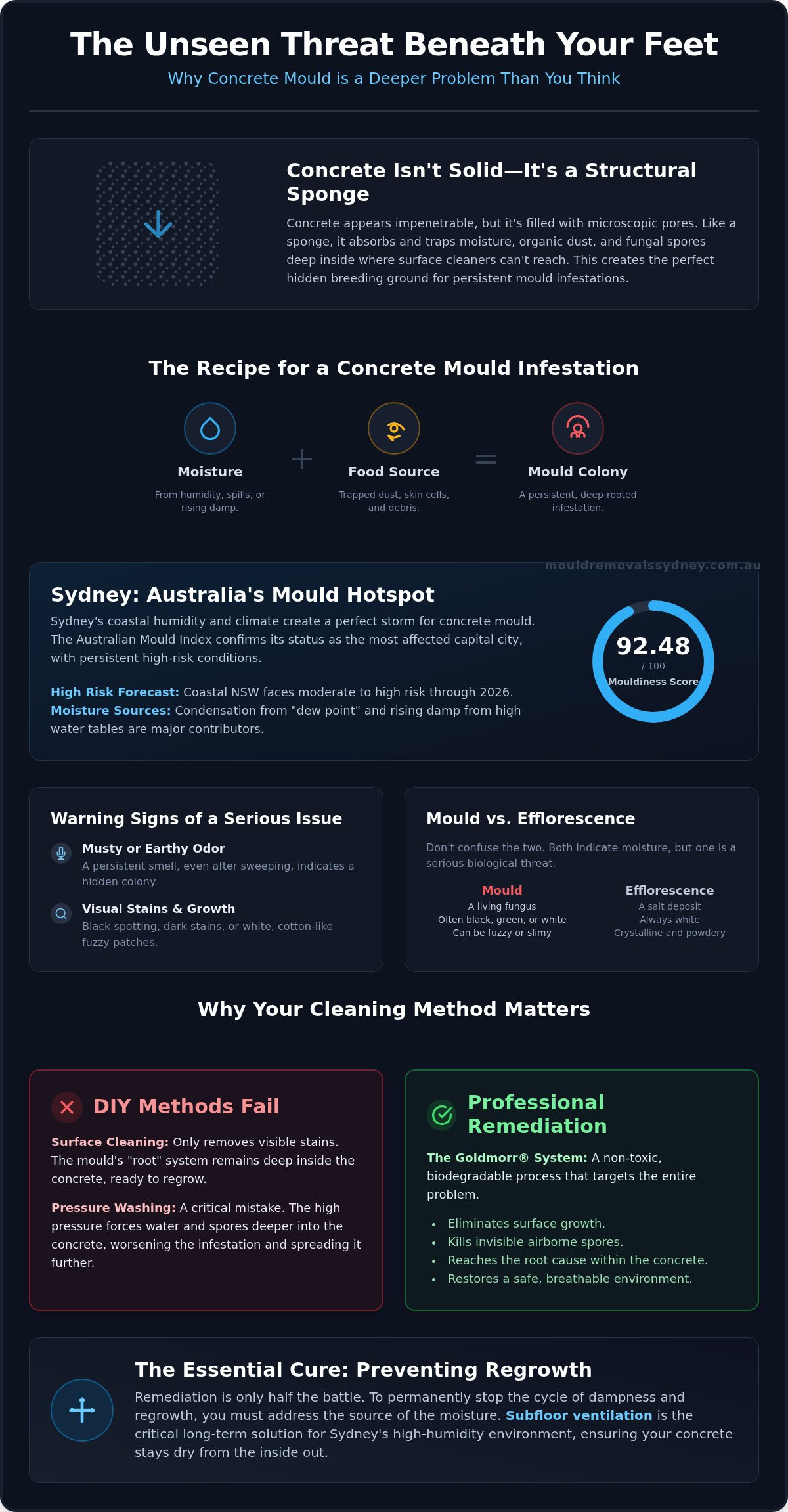
Concrete is a structural sponge, not an impenetrable shield. While it looks solid, its porous nature allows moisture and fungal spores to settle deep within the surface where household cleaners simply cannot reach. If you’ve noticed recurring black spots or a heavy, musty odor in your basement, you’re likely dealing with a colony that’s already established itself in the foundations of your property.
It’s frustrating to watch mould return weeks after a heavy scrub, and we know the health concerns this creates for your family or employees. This guide shows you how to achieve permanent concrete floor mould removal Sydney by utilizing professional remediation techniques that target the root cause. We’ll explain how the non-toxic Goldmorr System eliminates both visible growth and invisible airborne spores. You’ll also learn why subfloor ventilation is the essential cure for Sydney’s extreme 2026 mould risk, providing you with a safe, breathable environment for the long term.
Key Takeaways
- Understand why concrete acts as a sponge, trapping moisture and organic dust that fuels persistent fungal infestations deep within the slab.
- Discover why DIY surface cleaning fails to reach the root cause and how pressure washing can actually worsen the problem by driving spores deeper.
- Learn how professional concrete floor mould removal Sydney services use the non-toxic Goldmorr System to safely eliminate both surface growth and airborne spores.
- Identify the critical role of subfloor ventilation in managing Sydney’s high 2026 humidity levels and preventing the cycle of dampness and regrowth.
- Gain peace of mind with a results-driven, biodegradable remediation process that restores the safety and structural integrity of your property.
Why Concrete Floor Mould is a Persistent Problem in Sydney
Concrete floors are often viewed as indestructible barriers. In reality, they are porous structures that act like a slow-motion sponge. Mould on concrete isn’t just a surface stain; it’s a complex fungal infestation. The science of mould growth dictates that fungi require three primary elements: moisture, a food source, and a stable temperature. Concrete slabs provide all three by trapping organic dust and moisture within their microscopic pores.
If you’re investigating concrete floor mould removal Sydney, you’ve likely noticed that standard cleaning doesn’t stop the cycle. The mould simply retreats into the slab and waits for the next humid day to reappear. This is especially dangerous in enclosed spaces like garages, basements, and subfloors where airborne spores can reach high concentrations, posing serious health risks to your family or staff. Without addressing the moisture trapped in the porous surface, the infestation will continue to return.
The Role of Sydney’s Climate and Coastal Humidity
Sydney’s unique geography makes it a breeding ground for concrete-based fungi. During the cooler months, the “dew point” becomes a critical issue. Cold concrete slabs meet warm, moist indoor air, causing condensation to form directly on the surface. The Australian Mould Index identifies Sydney as the most mould-affected capital in Australia, carrying a mouldiness score of 92.48 out of 100. Throughout 2026, coastal NSW is forecasted to remain at a moderate to high risk, with suburbs around the Harbour facing extreme risk levels year-round.
Moisture doesn’t just fall from the sky; it’s often pulled up from the earth through a process called capillary action. When high rainfall or La Niña cycles occur, the water table rises, forcing dampness through the slab. This persistent moisture turns garages and warehouse floors into active incubators for mould colonies. The constant coastal humidity ensures that once a slab is damp, it rarely has the chance to dry out completely without mechanical assistance.
Signs You Have a Serious Concrete Mould Issue
Distinguishing between simple dirt and an active infestation is vital for property maintenance. Use your senses to evaluate the space. A heavy, earthy, or musty smell is often the first indicator of a hidden colony. If the odor persists after you’ve swept the floor, spores are likely colonizing the pores of the concrete. Visual indicators include black spotting, dark staining, or white fuzzy patches that look like cotton wool.
Don’t confuse mould with efflorescence. Efflorescence is a white, crystalline salt deposit left behind by evaporating water. While it indicates a moisture problem, it isn’t a living organism. Active mould, however, is a biological threat that requires professional remediation to ensure it doesn’t spread to your walls, storage, or respiratory system. Look for these signs in garages, basements, and subfloors to catch the problem before structural damage or health issues escalate.
The Science of Mould Growth on Concrete Surfaces
Many property owners believe that concrete is too hard for mould to penetrate. This is a dangerous misconception. While fungi don’t “eat” the concrete itself, they feast on the organic matter trapped within its pores. Dust, skin cells, and microscopic debris settle into the surface, providing a perfect food source. When you combine this with the moisture held deep in the slab, you create an ideal environment for toxic strains like Stachybotrys to thrive.
Concrete is naturally porous. It functions like a rigid sponge. Even if the surface looks dry to the naked eye, the internal matrix of the slab can remain saturated for weeks. This “Sponge Effect” is why concrete floor mould removal Sydney requires more than a quick scrub. Professionals must address the moisture trapped within these microscopic tunnels. Following EPA mould cleanup guidelines, the priority must always be identifying and stopping the moisture source before attempting remediation.
Capillary Action and Rising Damp in Slabs
Moisture often enters a concrete floor from below. Through a process known as capillary action, liquid water is pulled upward from the soil through the concrete’s internal network. You can learn more about how this biological process starts in our guide on what is mould. In many Sydney properties, poor external drainage or high water tables increase hydrostatic pressure. This pressure literally forces water vapour and liquid through the slab and into your living or working space. If your foundations aren’t properly protected, your concrete floor becomes a permanent moisture injector for your property.
Biofilms and the Porous Micro-Environment
Once mould spores settle on a damp concrete surface, they send out hyphae. These are root-like structures that anchor deep into the concrete matrix. Over time, these colonies develop a biofilm; a protective layer that shields the fungi from standard household cleaners. This is why surface-level bleaching is ineffective. You might kill the visible “bloom” on top, but the hyphae remain protected deep inside the pores. Applying a sealant over an untreated slab often backfires. It traps the moisture and the mould inside, allowing the colony to expand unseen beneath the coating. If you suspect your slab is holding onto hidden moisture, it’s time to request a professional mould inspection to map the extent of the growth.
Professional Remediation vs. DIY: Why Surface Cleaning Fails
Most property owners reach for a bucket of bleach when they see black spots on their garage or basement floor. It’s an instinctive reaction. However, this approach ignores the porous biology of the slab. Surface cleaning is merely a cosmetic fix. It fails to address the microscopic hyphae anchored deep within the concrete matrix. If you don’t eliminate the colony at its root, the “clean” look will only last until the next humid day in Sydney.
The Bleach Myth: Why It Makes Concrete Mould Worse
Bleach is a common household go-to, but it’s largely ineffective on porous surfaces. Standard household bleach is approximately 90% water. When you apply it to concrete, the chlorine, which is the active killing agent, evaporates quickly. This leaves behind the water, which soaks into the concrete pores and provides a fresh drink for the mould roots. Instead of killing the colony, you’re inadvertently feeding it. There’s also a chemical concern; bleach can react with the minerals in the concrete, potentially leading to surface degradation or salt crystallization that further weakens the slab.
Avoid the temptation to use a high-pressure washer. While it seems like an efficient way to clear a large warehouse or garage floor, the force of the water drives moisture and spores deeper into the slab’s microscopic cracks. This creates a hidden reservoir of dampness that fuels future growth. Similarly, applying “mould-resistant” paint over an active infestation is a recipe for failure. The gas produced by the living mould beneath the paint will cause the coating to bubble and peel within months. For effective concrete floor mould removal Sydney, you must eliminate the biological load before applying any aesthetic finishes.
The Professional Advantage: Air Scrubbing and Fogging
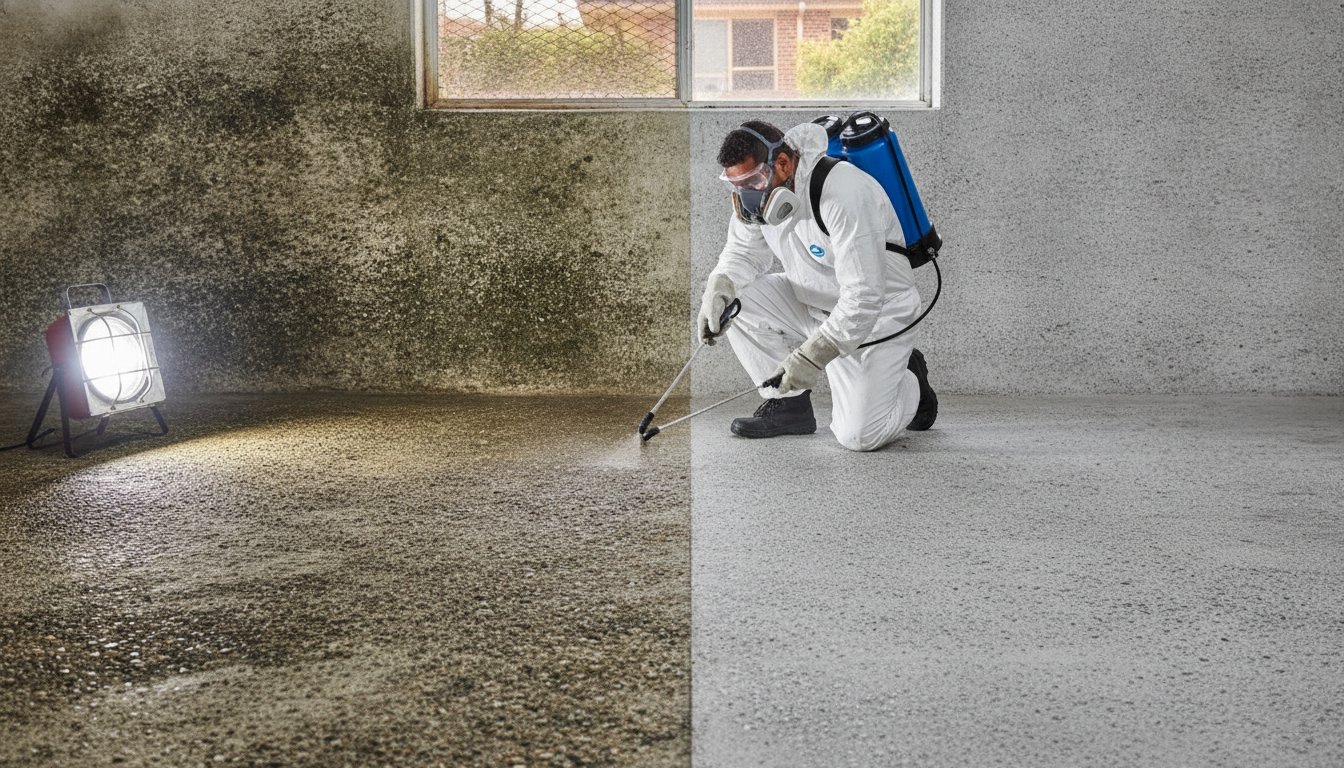
Professional remediation is a systematic process that goes far beyond the floor surface. Since a significant portion of a mould problem is often invisible, specialists use advanced tools to ensure a complete clean. We utilize high-precision moisture meters to map the dampness within the slab, identifying exactly where the moisture source resides. This diagnostic phase is crucial. Without it, you’re just guessing where the problem ends.
Every time you scrub or disturb a colony, you release millions of spores into the air. These spores carry significant health risks of mould exposure, including respiratory irritation and allergic reactions. To protect occupants, Sydney’s #1 mould removal service employs HEPA air scrubbing. This technology captures 99.97% of airborne particles, preventing cross-contamination while the floor is being treated. Surface wiping is only 20% of the solution; the real work happens in the air and deep within the substrate to ensure the infestation is truly gone.
Preventing Recurrence: Addressing Sydney’s Unique Moisture Challenges
Eliminating active colonies is only half the battle. If you don’t change the environmental conditions that allowed the fungi to thrive, you’re simply waiting for the next outbreak. Sydney’s coastal humidity and high 2026 rainfall forecasts mean that moisture management must be a proactive, multi-step process. To achieve lasting concrete floor mould removal Sydney, you must transform your slab from a damp incubator into a dry, stable surface.
The first step involves a thorough inspection of the property’s exterior. We often find that recurring mould on a garage or basement floor is driven by blocked downpipes, cracked external drainage, or garden beds that sit too high against the foundation. These issues create a constant supply of liquid water that the concrete slab absorbs. Once these external factors are repaired, you can focus on internal moisture. However, never rush to seal a concrete floor. Professional sealing should only occur after deep remediation and confirmed structural drying. If you seal a damp slab, you trap the moisture inside, leading to hydrostatic pressure that will eventually blow the sealant off the surface.
Subfloor Ventilation: The Permanent Cure for Ground Moisture
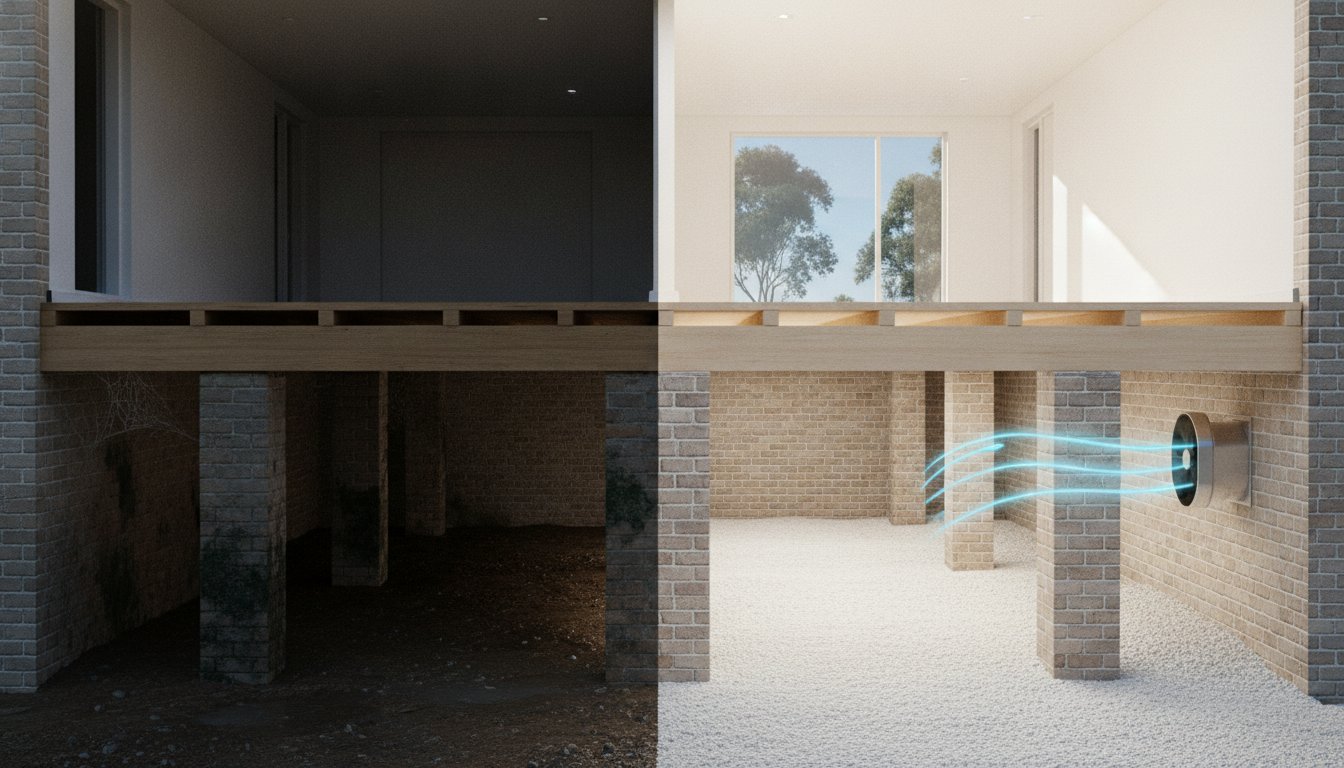
Stagnant air is a primary driver of fungal growth in Sydney. When air remains trapped in subfloors or poorly ventilated garages, humidity levels rise, and condensation forms on the cold concrete. This is where mechanical intervention becomes necessary. Installing a subfloor ventilation system creates consistent airflow that carries moisture away before it can settle into the pores of the slab.
Positive pressure ventilation is particularly effective for Sydney basements and warehouses. By forcing fresh, dry air into the space and extracting damp air, these systems protect the structural integrity of your slab and prevent the “musty smell” from returning. Unlike passive vents, which rely on wind, mechanical systems provide 24/7 protection regardless of the weather outside. If your property suffers from persistent dampness, you should explore our subfloor ventilation system installation to provide a permanent solution.
Structural Drying and Moisture Management
During a humid Sydney summer or a wet winter spell, simply “airing out” a room by opening windows isn’t enough. In fact, if the outdoor humidity is higher than the indoor level, you’re actually inviting more moisture into the slab. Professionals use industrial-grade dehumidifiers and air movers to pull deep-seated moisture from the concrete matrix. This process, known as structural drying, is essential after any water ingress event.
Managing condensation also requires a look at insulation and temperature control. When warm indoor air hits a cold concrete floor, it reaches its dew point and turns into liquid water. Improving the thermal barrier or using high-capacity dehumidifiers during peak wet seasons ensures the surface stays above the dew point. By maintaining indoor humidity levels below 60%, you create an environment where mould cannot survive. If you have recently experienced a leak or flooding, our water damage restoration experts can help dry your slab to prevent an infestation before it starts.
ABC Mould Cleaning Solutions: Our Goldmorr System for Concrete Remediation
When you’re dealing with a substrate as challenging as concrete, you need a methodology that goes beyond the surface. ABC Mould Cleaning Solutions utilizes the Goldmorr System, a specialized two-part process designed to penetrate the microscopic tunnels of your slab. This isn’t a harsh industrial chemical treatment that damages your property; it’s a biodegradable, non-toxic approach that ensures your home or warehouse is safe for immediate re-entry. For effective concrete floor mould removal Sydney, we focus on total eradication rather than temporary masking.
Our fogging technology is the cornerstone of our success in large concrete spaces. While traditional cleaning only addresses what you can see, our fogging process fills the entire volume of the room. It neutralizes airborne spores that have settled in the hidden crevices of unfinished concrete floors. This is vital for property owners in 2026 as humidity levels remain at record highs across the harbour suburbs, creating a constant risk of cross-contamination from invisible fungal particles.
The Goldmorr Difference: Safe for Your Family and Environment
Why settle for toxic alternatives that leave behind dangerous residues? Our formula is completely biodegradable, making it safe for families, pets, and the environment. One of the biggest advantages is our “no-scrub” methodology. By using specific surface treatments like GM6000 to break down the mould at a molecular level, we reduce the risk of spreading spores during the cleaning process. The fogging agent, GM2000, is non-corrosive and non-bleaching. This ensures your concrete remains structurally sound while becoming biologically clean. It reaches the deep pores where standard cleaners fail, providing a level of hygiene that retail products simply cannot match.
Our Comprehensive 4-Step Process
We follow a rigorous, evidence-based path to restore your property and provide peace of mind. Our specialists are trained to handle the unique challenges of Sydney’s climate with a systematic approach:
- Inspection: We don’t guess. We use thermal imaging and professional moisture meters to find exactly where the water is hiding behind or beneath the slab.
- Removal: We apply targeted treatments to eradicate surface growth and penetrate deep into the concrete matrix to kill the roots.
- Purification: Using HEPA air scrubbing and Goldmorr fogging, we eliminate the invisible threat in the air and ensure the space is safe to breathe.
- Prevention: We provide expert guidance on subfloor ventilation and drainage to ensure the moisture never returns. If you’ve recently suffered a burst pipe or flooding, check out our emergency guide for Sydney homes to mitigate damage early.
Stop the cycle of regrowth today. Our Sydney-wide team is ready to provide a permanent solution for your concrete floor mould removal Sydney needs, prioritizing your health and property value with a results-driven, professional service.
Secure Your Foundations and Breathe Clean Air Again
Mould on concrete is more than an aesthetic eyesore; it’s a deep-seated biological threat that compromises your air quality and property value. You now understand that surface scrubbing with bleach only feeds the problem. For lasting concrete floor mould removal Sydney, you must address the moisture trapped within the slab’s pores. By choosing a professional remediation approach, you eliminate the root cause while protecting your family from toxic airborne spores.
Our specialized Goldmorr System provides a 100% biodegradable and non-toxic solution that reduces airborne spores by 99%. We don’t just clean; we purify your environment. As Sydney’s local experts in subfloor ventilation, we ensure your concrete surfaces remain dry and stable regardless of the coastal humidity. Don’t let a hidden infestation escalate into a structural or health crisis. Take the first step toward a safer, mould-free property today.
Get a Free Quote for Professional Concrete Mould Removal in Sydney
Your property deserves a permanent solution delivered by specialists who understand the unique challenges of the Sydney climate. We’re here to help you restore safety and comfort to your space. You’ll soon enjoy a clean, healthy environment once again.
Frequently Asked Questions
Can mould grow on solid concrete floors?
Yes, mould thrives on concrete because it is a porous material that traps moisture and organic dust. While the concrete itself isn’t a food source, the microscopic debris, dust, and skin cells within its pores provide everything a colony needs to grow. This is why you often see dark spotting in damp garages or subfloors across Sydney where airflow is restricted.
Is black mould on a concrete garage floor dangerous?
Yes, black mould on concrete poses significant health risks because it releases airborne spores into enclosed spaces. These spores can lead to respiratory issues, allergic reactions, and persistent musty odors that permeate your entire property. You shouldn’t ignore these spots; they indicate a thriving colony that can easily spread to your storage items and vehicle interiors.
Why does mould keep returning to my basement concrete after I clean it?
Mould returns because DIY cleaning only targets the surface, leaving the root like hyphae alive deep within the concrete pores. Without professional concrete floor mould removal Sydney techniques, the fungus simply waits for the next humid day to reappear. You must address the moisture source and the internal contamination within the slab to stop the cycle of regrowth permanently.
What is the best professional mould killer for concrete?
The Goldmorr System is the industry leading solution for concrete remediation because it uses biodegradable agents that penetrate the slab’s internal matrix. Unlike bleach, which stays on the surface and eventually evaporates, this system targets the biological load at its core. It combines specialized surface treatments with fogging to ensure both the slab and the surrounding air are completely purified.
How much does professional concrete floor mould removal cost in Sydney?
The cost for professional remediation varies based on the size of the affected area, the severity of the infestation, and the required moisture management steps. Every property is unique, so we provide tailored quotes after a thorough inspection of the slab. Your final investment depends on whether you need simple removal or a complete subfloor ventilation overhaul to prevent future issues.
Does subfloor ventilation really stop mould on concrete?
Yes, subfloor ventilation is a highly effective long term solution because it removes the stagnant, damp air that causes condensation on concrete. By maintaining consistent airflow, these systems lower the humidity levels around the slab. This prevents moisture from settling into the pores, effectively starving the mould of the damp environment it needs to survive and expand.
Is the Goldmorr System safe for pets and children?
Yes, the Goldmorr System is 100% biodegradable and non-toxic, making it safe for all occupants, including pets and children. We prioritize safety by using formulas that break down into harmless components shortly after application. You don’t have to worry about harsh chemical residues or dangerous fumes lingering in your garage or basement after the remediation process is complete.
How long does the concrete mould removal process take?
Most residential concrete remediation jobs are completed within a single day. However, the timeline can extend if the slab requires intensive structural drying or if we are installing a complex mechanical ventilation system. Our goal is always maximum efficiency, ensuring your property is safe and ready for use as quickly as possible without compromising on the thoroughness of the clean.