Did you know that Sydney is currently ranked as the mouldiest capital city in Australia, with a staggering “mould score” of 92.48 out of 100? For many residents, this isn’t just a statistic; it’s a daily reality felt through heavy air and persistent musty odours. If you’ve noticed dampness clinging to your walls or fear that termites are being drawn to rotting structural timbers, your concerns are valid. Utilizing professional subfloor ventilation western sydney is no longer optional for those living in our region’s unique climate and clay-heavy soils, which create a perfect environment for moisture issues that threaten your home’s integrity.
You deserve to feel secure in a house that stays dry and odour-free. This article will show you how specialized ventilation systems serve as a critical defense against rising damp, structural decay, and toxic mould growth. We’ll explore the latest NCC 2022 requirements for condensation management and explain why a professional, evidence-based approach is necessary to lower indoor humidity. You will learn how high-performance systems, often paired with expert remediation like the Goldmorr System, can transform your living environment and provide the long-term protection your property requires.
Key Takeaways
- Understand why Western Sydney’s reactive clay soils trap moisture and necessitate specialized ventilation to prevent long-term structural damage.
- Learn how professional subfloor ventilation western sydney reduces relative humidity below the 60% threshold where toxic mould thrives.
- Discover the critical differences between passive vents and high-performance mechanical fans for effectively clearing moisture from subfloor “dead zones.”
- Identify the early warning signs of subfloor dampness, including persistent earthy smells and visible mould growth on skirting boards or inside wardrobes.
- See why implementing the Goldmorr System to remediate existing spores is a vital first step before installing ventilation for a complete, permanent solution.
What is Subfloor Ventilation and Why Does Western Sydney Need It?
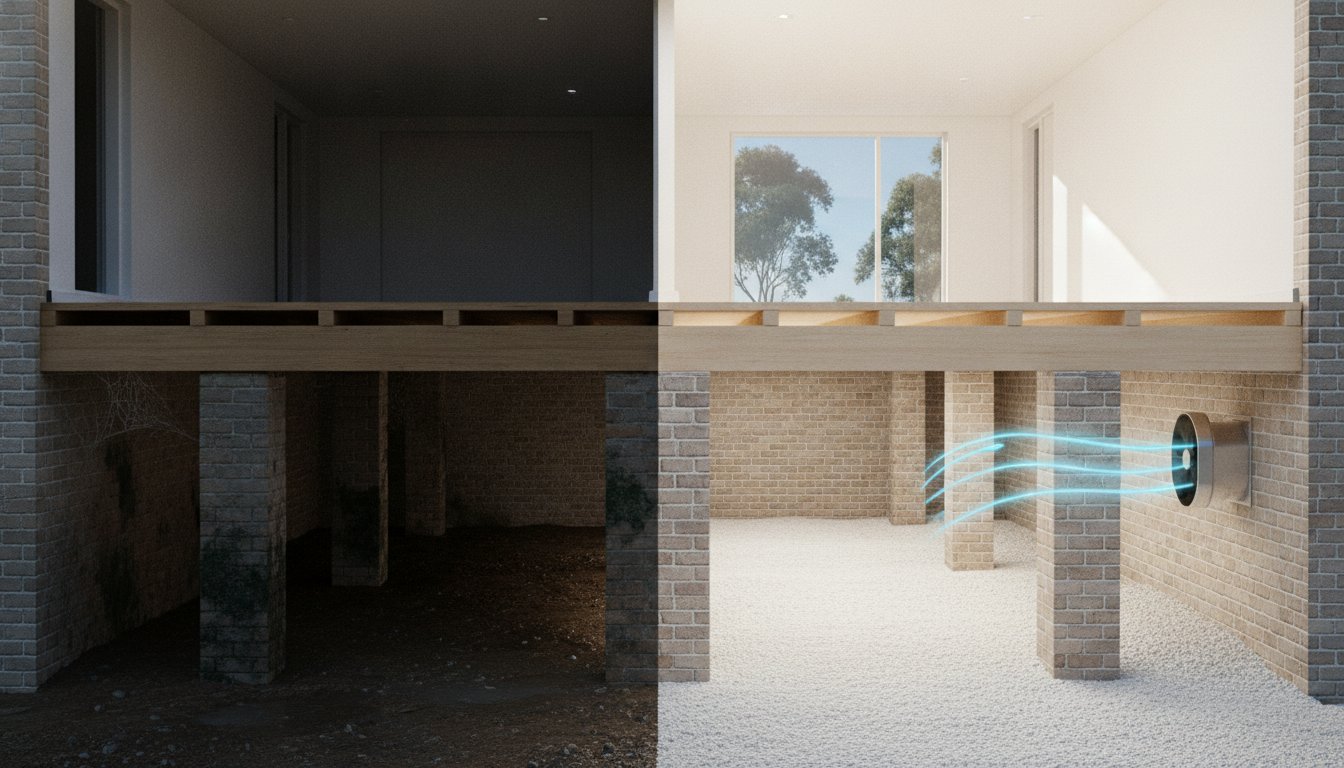
Subfloor ventilation is a specialized system designed to replace damp, stagnant air trapped beneath your home with a continuous flow of fresh, dry air. For many residents, this process is the primary defense against structural decay and indoor air contamination. While coastal Sydney suburbs enjoy sandy, well-draining soils, the Western Sydney landscape is dominated by reactive clay. These clay soils act like a sponge, retaining moisture significantly longer than sand and keeping the ground beneath your home saturated for weeks after a storm. When you factor in the Western Sydney ‘heat island’ effect, where urban surfaces trap heat and raise local temperatures, the air in your Crawl space becomes a literal pressure cooker of humidity. This stagnant air eventually migrates upward, fueling mould colonies and damaging your furniture, carpets, and health.
Without intervention, this cycle of heat and moisture creates a permanent breeding ground for pathogens that compromise your home’s air quality and safety.
The Science of Subfloor Moisture in Western Sydney
Suburbs like Blacktown and Penrith face unique drainage challenges because dense clay prevents water from dissipating. This leads to water ‘pooling’ directly under your floorboards. You might notice your indoor air feels ‘heavy’ or smells earthy, which is caused by the ‘stack effect’. As warm air rises, it creates a vacuum that sucks damp, spore-filled air from the subfloor into your breathing zone.
Traditional brick vents often leave ‘dead zones’ where air remains trapped, making professional subfloor ventilation western sydney a critical structural requirement.
Structural Risks of Neglect
High subfloor humidity levels lead to ‘cupping’ or warping of timber floorboards as they swell from the bottom up. These damp, dark environments are also the primary attractant for subterranean termites in New South Wales. You must also guard against rising damp, which is defined as the capillary action of water through porous masonry. Without an active system to dry the area, moisture will climb your walls and compromise your foundations. Professional subfloor ventilation western sydney stops this process by keeping the subfloor dry and inhospitable to rot.
How Subfloor Ventilation Systems Protect Your Health and Home
Mould is an opportunistic organism that requires specific environmental conditions to thrive. Scientific research confirms that when relative humidity levels exceed 60%, mould spores begin to colonize surfaces rapidly. In our region, the combination of reactive clay soil and high summer temperatures often pushes subfloor humidity well above 80%. Installing high-performance subfloor ventilation western sydney homeowners can rely on effectively drops these levels below the critical 60% threshold. This simple physical change renders the environment inhospitable to fungal growth, protecting your home’s structural integrity before the first spore can take root.
Beyond visible growth, stagnant air produces microbial volatile organic compounds (mVOCs). These gases are responsible for that persistent, “musty” odour that permeates your curtains and upholstery. They aren’t just unpleasant; they indicate an active biological process occurring beneath your feet. By forcing a consistent air exchange, ventilation systems exhaust these compounds and replace them with filtered, dry air. This process is vital for residents living with asthma or chronic respiratory sensitivities, as it significantly reduces the toxic load on their immune systems. For more detailed information on these risks, you can consult the NSW Health fact sheet on mould.
The Connection Between Subfloors and Indoor Air Quality
Airborne spores are microscopic and easily migrate from the subfloor into your main living zones through floorboard gaps and service penetrations. If your home utilizes a ducted HVAC system, these spores can be pulled into the return air vents and redistributed throughout every room. We often recommend air duct cleaning alongside ventilation upgrades to ensure your entire air delivery path is sanitized. This comprehensive approach prevents allergens from settling deep into your carpets and furniture, creating a measurably healthier indoor environment for your family.
Preventing Rising Damp and Efflorescence
Structural timber is highly susceptible to “wet rot” and “dry rot” when exposed to constant moisture. When air remains stagnant, moisture eventually soaks into the internal brickwork and masonry. This leads to efflorescence, which appears as white, powdery salt deposits on your subfloor walls. If left unmanaged, this “salt damp” weakens the mortar and can lead to expensive foundation issues. Investing in subfloor ventilation western sydney is a pragmatic financial decision. The cost of prevention is a fraction of what you would pay for major water damage repair or structural underpinning later. If you suspect your subfloor is currently damp, it’s wise to book a professional mould inspection to assess the extent of the moisture ingress before it escalates.

Passive vs. Mechanical Ventilation: Which is Right for You?
Choosing the right system for your property depends on your home’s orientation, surrounding landscape, and existing moisture levels. Passive ventilation is the traditional approach. It relies on natural air pressure differences to move air through strategically placed terra cotta or brass vents. While this method is cost-effective, it depends entirely on “cross-flow” physics. For air to move, it must have a clear path to enter one side of the house and exit the other. In many Western Sydney suburbs, houses are built with limited setbacks or have been modified over time. These obstructions block natural wind paths, leaving the air beneath your home stagnant. Without active movement, the moisture rising from the clay soil has nowhere to go.
If your home is in a high-density area or has a history of musty odours, you likely require a more robust solution. Professional subfloor ventilation western sydney often involves transitioning from passive to mechanical systems to ensure consistent results regardless of the weather.
When Passive Vents Aren’t Enough
Passive vents require at least a 2-knot breeze to be effective, which is a condition that rarely occurs in sheltered or low-clearance subfloor spaces. Modern renovations often make this problem worse. Concrete driveways, new patios, and house extensions frequently seal off original air paths. If your home has a low-clearance subfloor, natural convection is physically restricted. These conditions create “dead zones” where moisture accumulates, even if you have several wall vents installed. Technical standards, such as those outlined in the WA Government Subfloor Ventilation Guidelines, emphasize that air movement must be sufficient to prevent the degradation of structural timber. When natural paths are blocked, moisture levels will inevitably climb.
The Benefits of Mechanical Subfloor Fans
Mechanical subfloor ventilation western sydney systems solve these physical limitations by using high-performance fans to force air exchange. These units aren’t simple exhaust fans. They utilize smart sensors that monitor both internal and external humidity levels. The system only activates when the outside air is drier than the air trapped under your house. This prevents you from inadvertently pumping humid storm air into your crawl space during wet weather.
Modern units utilize low-voltage, energy-efficient motors designed for 24/7 operation. They provide a predictable, evidence-based solution that natural vents simply cannot match in high-risk areas. Because Western Sydney streets are often quiet at night, these systems incorporate noise-reduction technology. You won’t hear a distracting hum through the floorboards while you sleep. We place these fans strategically to eliminate dead zones, ensuring every corner of your subfloor remains dry and protected from rot.
Signs Your Western Sydney Home Needs Professional Ventilation
Identifying subfloor moisture issues early can save you thousands in structural repairs and medical bills. Because Western Sydney’s clay soil retains water so effectively, your home may be struggling with high humidity long before you see a drop of liquid water. One of the most reliable indicators is a persistent, earthy, or “old book” smell. This odour doesn’t go away with surface cleaning because the source is the soil beneath your feet. If you notice that your indoor air feels heavy or that your family is suffering from frequent respiratory issues and unexplained allergies, it’s time to look deeper. These symptoms often point to a need for professional subfloor ventilation western sydney homeowners can trust to restore their air quality.
Visual cues are equally critical. You should regularly inspect the following areas for signs of distress:
- Lower Walls and Skirting Boards: Look for dark spots, peeling paint, or “bubbling” plaster near the floor.
- Built-in Wardrobes: Check the back corners for mould growth on shoes, bags, or the walls themselves.
- Foundation Brickwork: Look for efflorescence, which appears as white, powdery salt deposits on the subfloor walls.
- Floor Insulation: Check for condensation or “sweating” on the underside of your floorboards or insulation batts.
The Professional Inspection Process
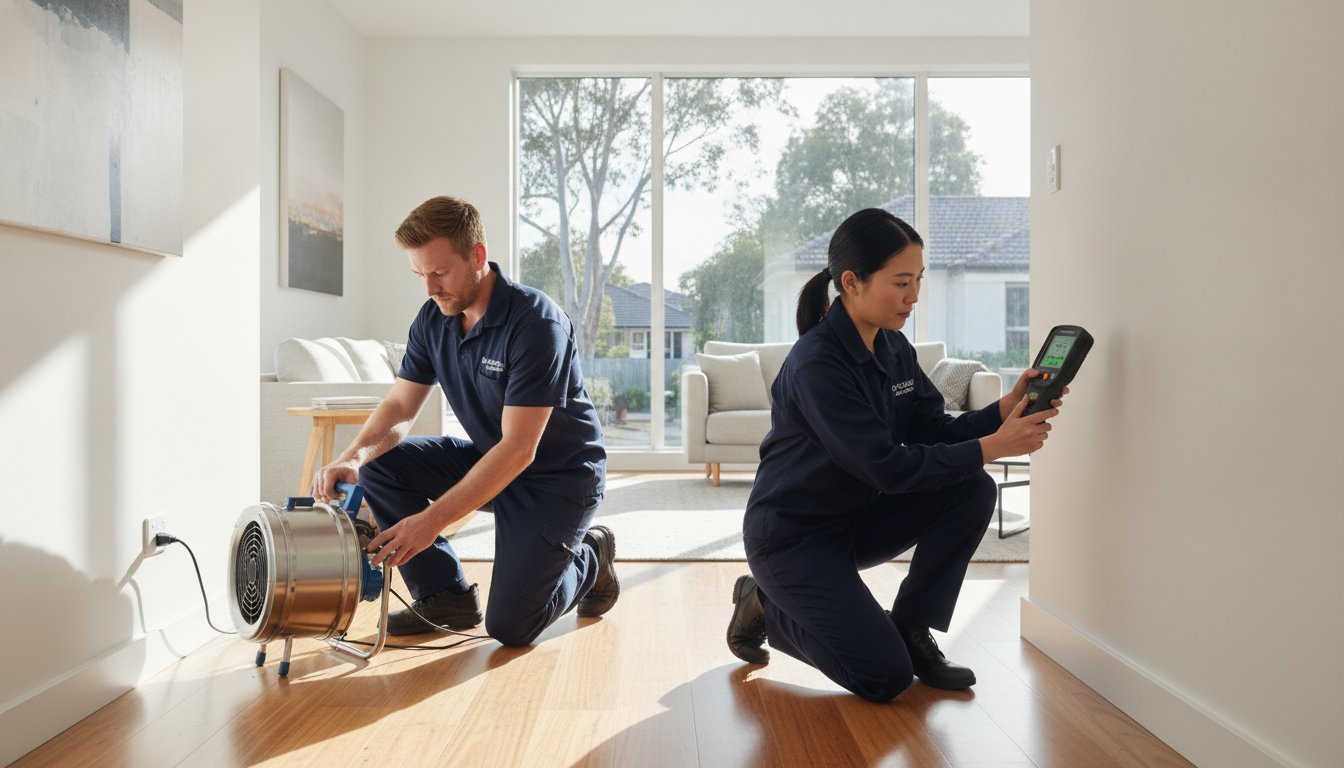
Our specialists don’t rely on guesswork. We use precision hygrometers to measure the exact difference between your subfloor humidity and the ambient air outside. This data allows us to perform moisture mapping, identifying specific “wet spots” often caused by poor external drainage or leaking pipes. In older Federation or mid-century homes across Western Sydney, we frequently find that original vents have been blocked by garden beds or painted over during renovations. We systematically check every vent to ensure your subfloor ventilation western sydney system has a functional air path before recommending any mechanical upgrades.
DIY Checks vs. Expert Assessment
You can perform a basic check by looking for “white fuzz” on the dirt beneath your home. This is mycelium, the root structure of mould, and its presence confirms that your subfloor is far too damp. However, some signs are more dangerous than others. If your floors feel “springy” or soft when you walk on them, you’re likely dealing with advanced timber decay or rot in your joists. Ignoring these signs can lead to total floor failure. Booking an ABC Mould Cleaning Solutions inspection is the most effective way to identify these hidden threats. We provide a clear, evidence-based roadmap to dry your home and protect your property’s value.
The ABC Solution: Combining Goldmorr Remediation with Ventilation
Installing high-performance fans is only half the battle if your subfloor already hosts active mould colonies. If you simply activate a subfloor ventilation western sydney system without addressing existing growth, you risk circulating millions of airborne spores throughout your home. We provide a comprehensive, two-stage solution that combines professional remediation with precision-engineered airflow. This approach ensures you aren’t just moving damp air; you’re creating a clinically clean environment that protects your family’s health and your property’s structural integrity. We focus on identifying the root cause of moisture to prevent any recurrence, rather than just treating the symptoms.
The Goldmorr Advantage for Subfloors
Our proprietary Goldmorr System utilizes specialized, biodegradable fogging technology to reach deep into timber crevices and porous masonry where mechanical fans cannot penetrate. This process eliminates surface mould and neutralizes airborne spores on contact. We ensure your subfloor is clinically clean before your new ventilation system is activated. These treatments are safe for families and pets, using non-toxic products that don’t require you to vacate your home for days. Our highly trained specialists use this systematic, evidence-based approach to restore safety and well-being to your property immediately.
Western Sydney Case Studies
We have a proven track record of solving moisture crises in high-risk areas like the Hawkesbury and Nepean regions, where river proximity and reactive clay soils create extreme humidity challenges. Recently, we addressed a severe “black mould” crisis in a Parramatta terrace by implementing our dual-action remediation strategy. By first eradicating the established spores and then installing a custom-designed subfloor ventilation western sydney layout, we transformed a damp, odorous crawl space into a dry, safe environment. We tailor every layout to the specific property style, whether it’s a modern extension or a Federation-era cottage.
We understand that property maintenance is a significant investment. This is why we offer an aggressive price-matching guarantee for Western Sydney residents, ensuring you receive the highest level of specialist care at the best possible value. Once your system is installed, we offer ongoing maintenance and humidity monitoring for long-term peace of mind. Don’t settle for amateur fixes that leave the root cause untouched. Trust our systematic, no-nonsense approach to protect your home. Submit your digital media through our streamlined inquiry process today for a professional assessment of your subfloor needs. We’ll make the process of restoring your home’s health straightforward and manageable.
Secure Your Home Against Moisture Today
Protecting your property from the unique moisture challenges of our region requires a systematic, professional approach. Passive vents often fail in the face of reactive clay soils and urban heat; this makes high-performance subfloor ventilation western sydney systems the most reliable defense for your foundations. Moving air is only half the solution. You must also eradicate existing spores using the Goldmorr System to truly restore your indoor air quality and prevent structural rot. Our Goldmorr Certified Technicians specialize in this dual-action process, ensuring your home remains a safe haven for your family.
We provide a Price Match Guarantee to ensure you get the best value, alongside a 24/7 Emergency Response for Water Damage if a crisis strikes. Don’t wait for “springy” floors or persistent, musty odours to signal a total structural failure. Take action now to eliminate the humidity that fuels mould growth. Get a Free Subfloor Ventilation Quote for Your Western Sydney Home today and secure your property’s future. You can breathe easy knowing your home is in the hands of experts who understand the science of subfloor health.
Frequently Asked Questions
How much does it cost to run a subfloor ventilation fan in Sydney?
Modern mechanical fans are designed for 24/7 operation with minimal impact on your electricity bill. Most units consume about the same power as a single LED light bulb. Because these systems use low-voltage DC motors, the annual running cost is typically negligible. You don’t need to worry about a spike in your utility expenses while protecting your home from dampness and structural rot.
Will subfloor ventilation stop rising damp?
Ventilation is a critical management tool, but it doesn’t repair a failed damp proof course. It works by rapidly drying out the masonry and soil, which prevents moisture from climbing higher into your internal walls. By maintaining a dry environment, you stop the capillary action of water. For a complete solution, we recommend a professional inspection to determine if your home requires additional remediation alongside the ventilation system.
Is subfloor ventilation noisy for me or my neighbours?
High-quality mechanical systems utilize noise-reduction technology and insulated ducting to ensure near-silent operation. You won’t hear a distracting hum through your floorboards or receive complaints from neighbours on quiet Western Sydney streets. We use specialized fans with low decibel ratings that are specifically engineered for residential environments. The goal is to provide a dry, healthy home without compromising your acoustic comfort or peace.
How many vents does a standard Western Sydney home need?
The number of vents depends on the total area of your subfloor and the severity of the moisture ingress. A standard three-bedroom home usually requires multiple intake and exhaust points to eliminate “dead zones” where air becomes trapped. Our specialists calculate the necessary air exchange rate based on your property’s specific layout and soil type. This ensures the subfloor ventilation western sydney system provides complete coverage across every corner of the crawl space.
Can I install subfloor ventilation myself?
DIY installation is not recommended because effective ventilation requires precise airflow calculations and electrical expertise. Incorrectly placed fans can actually pull humid air into your subfloor or create new moisture pockets in hidden corners. Professional installers understand the science of cross-flow physics and use specialized tools to map moisture levels. You also need a licensed electrician to safely wire the low-voltage sensors and motors for permanent, 24/7 operation.
Does subfloor ventilation help with termite prevention?
Yes, maintaining a dry subfloor is one of the most effective ways to deter subterranean termites. These pests are naturally drawn to damp, decaying timber and high-humidity environments. By using subfloor ventilation western sydney to lower humidity levels below the threshold they prefer, you make your home a much less attractive target. While it doesn’t replace a chemical barrier, it serves as a vital preventative layer for your property’s structural safety.
How long does a professional installation take?
Most professional installations are completed within a single day. Our team arrives with all the necessary equipment to install fans, ducting, and sensors without disrupting your daily routine. If your property requires pre-remediation using the Goldmorr System, the process might take slightly longer to ensure the area is clinically clean. We aim for maximum efficiency to transition your home from a state of concern to a state of resolution as quickly as possible.
What is the best type of fan for Western Sydney’s climate?
The best choice for our region is a smart, sensor-driven mechanical fan system. Because Western Sydney experiences high humidity fluctuations, you need a system that only activates when external air is drier than the air beneath your house. This prevents you from inadvertently pumping moist storm air into your crawl space. We recommend high-performance, low-voltage fans that are specifically rated for the environmental demands and clay-heavy soils found in our local suburbs.