If mould keeps coming back after you’ve cleaned it, the visible growth may only be part of the problem.
Surface cleaning can remove mould you can see, but recurring mould usually means the moisture conditions or contamination affecting the property need further attention. Depending on the building, that might involve condensation, poor ventilation, a leak, subfloor moisture, or rising damp in a house.
The right approach depends on identifying both the affected areas and the source of the moisture.
Key Takeaways
- Surface cleaning removes visible mould but may not address contamination in difficult-to-reach areas or the moisture conditions allowing it to return.
- Mechanical HEPA air purifiers capture airborne particles that pass through the unit, but they don’t correct the moisture source causing mould growth.
- Non-mechanical fogging disperses treatment throughout the treatment area rather than relying only on direct surface cleaning.
- Subfloor moisture and inadequate ventilation can affect both houses and apartments where a relevant subfloor cavity is present.
- Rising damp is a separate moisture issue that ABC Mould Cleaning Solutions addresses in houses.
- For bathroom mould, ABC Mould Cleaning Solutions focuses on ceilings and walls rather than bathroom tiles.
- ABC Mould Cleaning Solutions are approved master technicians for the Goldmorr System and provide service across Sydney Metro, the Blue Mountains, and Wollongong.
Why Does Mould Keep Coming Back After You’ve Cleaned It?
Recurring mould usually means the cause needs further investigation.
Cleaning the visible patch may improve the appearance of a wall or ceiling, but it doesn’t necessarily explain why that area became damp enough for mould to grow.
Possible causes include:
- Condensation
- Inadequate ventilation
- Plumbing or roof leaks
- Previous water damage
- Moisture trapped in building materials
- Subfloor moisture
- Rising damp in houses
Mould can affect both houses and apartments.
The construction may be different, but either property type can experience recurring mould where moisture and ventilation conditions support growth.
This is why professional mould removal from walls involves looking beyond the visible patch and considering the conditions around it.
The important question isn’t simply whether the mould can be wiped away.
It’s why the mould is developing in that location in the first place.
What Does Each Approach Actually Do?
Different mould-control methods perform different jobs. Understanding those differences helps avoid expecting one product or technique to solve every part of the problem.
Surface Cleaning
Surface cleaning removes visible mould from accessible areas.
For bathroom mould, ABC Mould Cleaning Solutions concentrates on ceilings and walls rather than bathroom tiles.
Surface treatment may be appropriate for isolated visible contamination, but if mould keeps returning, the moisture source should also be investigated.
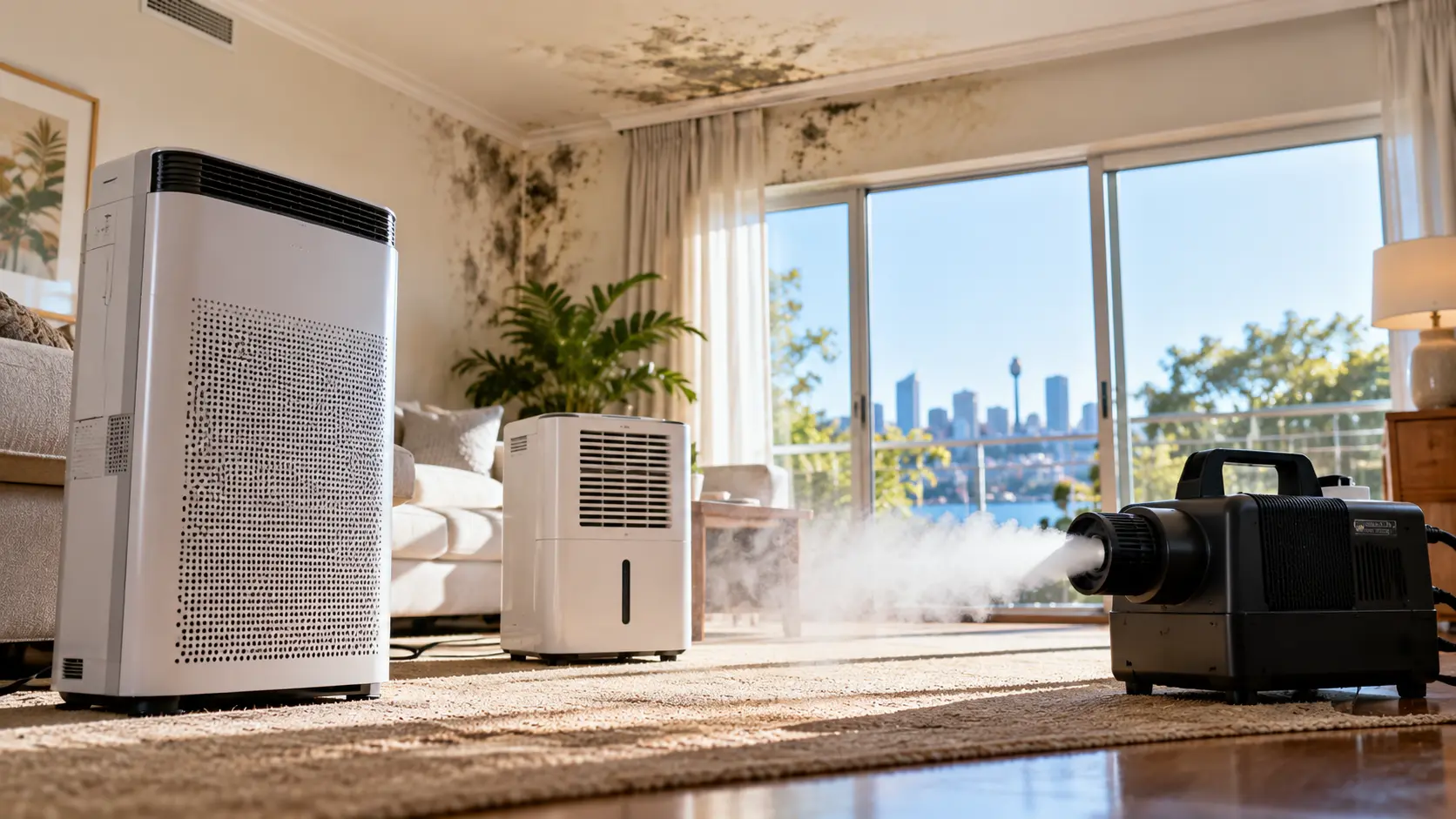
Mechanical HEPA Air Purifiers
A HEPA purifier works by drawing room air through a filter that captures particles passing through the machine.
This can help reduce airborne particles in the area where the purifier operates.
However, a purifier doesn’t repair a leaking roof, improve subfloor drainage, correct inadequate ventilation, or fix another moisture source contributing to mould growth.
It also doesn’t directly treat areas of the property that air isn’t moving through effectively.
Dehumidifiers
Dehumidifiers reduce moisture in the surrounding room air.
They can be useful where excess humidity is part of the problem, but they don’t necessarily identify or repair the original source of that moisture.
For example, if there is a plumbing leak, persistent subfloor moisture, or another building issue, reducing indoor humidity alone won’t resolve the cause.
Non-Mechanical Fogging
Non-mechanical fogging disperses treatment as a fine mist throughout the designated treatment area.
ABC Mould Cleaning Solutions uses the Goldmorr System as part of this process.
Fogging allows treatment to spread beyond the specific visible patch being addressed rather than relying exclusively on direct wiping or spraying.
Subfloor Ventilation
Subfloor ventilation deals with airflow beneath a building.
Where an enclosed or poorly ventilated subfloor remains damp, moisture can contribute to mould growth beneath the property.
Subfloor moisture problems can affect both houses and apartments where the building has an applicable subfloor or enclosed space beneath the occupied area.
The appropriate solution depends on the actual cause, ventilation, drainage, construction, and extent of moisture present.
Is a HEPA Air Purifier Enough to Deal With Mould?
A HEPA purifier can be useful as part of indoor air management, but it shouldn’t automatically be considered a complete mould solution.
The unit can only filter air that passes through it.
If mould growth is associated with an unresolved leak, damp subfloor, condensation issue, or another moisture source, filtering the air doesn’t correct that underlying condition.
For example, imagine mould developing on a bathroom ceiling while a purifier is running in a nearby living room.
The purifier may help filter some airborne particles in the living area, but it doesn’t determine why the bathroom ceiling continues to become damp.
That’s why the moisture source still needs to be assessed.
HEPA filtration and professional mould treatment perform different roles.
A purifier may support ongoing indoor air quality after remediation, but it isn’t a substitute for identifying and treating active mould and correcting the conditions contributing to it.
For properties where product safety is an important consideration, this guide to non-toxic mould removal explains more about treatment approaches using biodegradable products.
What Does Non-Mechanical Fogging Do?
Non-mechanical fogging disperses treatment as a fine mist throughout the designated area.
This allows product to reach more than the single visible patch that might otherwise be treated with a cloth or spray bottle.
ABC Mould Cleaning Solutions uses the Goldmorr System for its fogging-based mould treatment.
The Goldmorr Group has supplied mould treatment products since 1998, and ABC Mould Cleaning Solutions are approved master technicians for the Goldmorr product range.
The appropriate use of fogging depends on the property and extent of contamination.
For example, a Sydney property may have visible mould on a bathroom ceiling as well as a musty smell elsewhere.
The visible bathroom mould should be assessed together with possible humidity, ventilation, or moisture conditions rather than assuming the bathroom surface is the only affected area.
For more significant cases involving black mould, the appropriate treatment scope should be determined based on the actual areas affected.
Fogging also has an important limitation.
It doesn’t repair a leaking pipe, waterproof a wall, correct drainage, or solve a structural moisture problem.
If the conditions contributing to mould remain active, those conditions need to be addressed separately.
Comparing the Main Approaches
| Approach | What It Can Help With | What It Doesn’t Do |
|---|---|---|
| Surface cleaning | Removes visible mould from accessible surfaces | Doesn’t automatically resolve an underlying moisture source |
| HEPA air purifier | Captures airborne particles passing through the filter | Doesn’t treat building moisture problems or hidden contamination |
| Dehumidifier | Reduces humidity in room air | Doesn’t repair leaks, drainage, or structural moisture sources |
| Non-mechanical fogging | Disperses treatment throughout the designated treatment area | Doesn’t repair the building condition causing moisture |
| Subfloor ventilation improvements | Helps address inadequate airflow beneath applicable buildings | Doesn’t automatically remove existing mould contamination |
| Professional assessment and treatment | Identifies affected areas and appropriate treatment requirements | Building repairs may still require separate work |
No single method performs every job.
The goal is to determine what is causing the mould, what areas are affected, and which treatment or repair addresses each part of the problem.
What About Rising Damp and Subfloor Ventilation?
These are two different issues and shouldn’t be treated as interchangeable.
Rising Damp
Rising damp is a ground-moisture problem that ABC Mould Cleaning Solutions deals with in houses.
Where rising damp is present, moisture can continue affecting lower sections of the building structure.
Treating mould growing on an affected wall without dealing with the damp problem may leave the conditions that allowed the mould to develop.
If rising damp has been correctly identified in a house, one possible treatment may involve a chemical injection damp-proof course, depending on the construction and cause.
Subfloor Moisture and Ventilation
Subfloor moisture is different and can affect both houses and apartments where there is an applicable space beneath the building or occupied area.
Poor airflow, drainage issues, ground moisture, leaks, or other conditions can contribute to excessive dampness below the floor.
Possible signs include:
- Persistent musty odours
- Excess moisture beneath the building
- Mould in the subfloor area
- Recurring mould in nearby rooms
- Restricted subfloor airflow
These signs don’t prove that the subfloor is responsible, but they can indicate that further investigation is worthwhile.
This guide to subfloor ventilation issues explains how moisture beneath a property can contribute to mould problems.
For more detail on recurrence, see the science of mould recurrence.
What About Bathroom Mould?
Bathroom mould should be considered separately because bathrooms naturally produce high levels of humidity and condensation.
ABC Mould Cleaning Solutions focuses its bathroom mould treatment on ceilings and walls, not bathroom tiles.
Mould in these areas may be associated with:
- Poor bathroom ventilation
- Persistent condensation
- High indoor humidity
- Plumbing leaks
- Water entering from above
- Moisture remaining in wall or ceiling materials
If bathroom mould keeps returning after cleaning, the next step should be identifying why the affected ceiling or wall continues to become damp.
That may involve improving ventilation or correcting another moisture issue in addition to mould treatment.
How Does ABC Mould Cleaning Solutions Quote and Assess?
For many jobs, the process starts with photos.
Send clear images of the affected ceilings, walls, subfloor areas, or other visible mould to:
abcmouldcleaningsolutions@gmail.com
ABC Mould Cleaning Solutions can use those photos to assess the visible scope and provide a quote where appropriate.
If the situation is more complicated or requires an in-person assessment, Warren can inspect the property on-site for $275.
An inspection may be useful when:
- The source of the mould isn’t clear
- Several areas of the property are affected
- Subfloor moisture is suspected
- Rising damp is suspected in a house
- Previous treatment hasn’t resolved the problem
- The issue can’t be properly assessed from photographs
ABC Mould Cleaning Solutions services Sydney Metro, the Blue Mountains, and Wollongong and will beat any written quote by 10%.
For urgent enquiries, call 0488 866 853.
For buyers wanting more information about a property’s condition before purchasing, a pre-purchase mould inspection may also be appropriate.
FAQ
Why does mould keep coming back after I clean it?
Recurring mould can mean the moisture conditions contributing to the growth haven’t been resolved.
Possible causes include condensation, inadequate ventilation, leaks, subfloor moisture, previous water damage, or rising damp in a house.
Cleaning the visible mould may therefore be only one part of the solution.
Is a HEPA air purifier enough to deal with mould?
Not necessarily.
A HEPA purifier captures airborne particles that move through the filter, but it doesn’t identify or correct the moisture source responsible for mould growth.
It can be useful as part of indoor air management, but it shouldn’t replace proper assessment and remediation where active mould is present.
Does this only apply to apartments?
No.
Mould, poor ventilation, leaks, subfloor moisture, and other damp-related problems can affect both houses and apartments.
The appropriate treatment depends on the property’s construction and the actual moisture source.
Can apartments have rising damp?
ABC Mould Cleaning Solutions’ rising damp treatment relates to houses.
Apartments can experience other moisture issues, including leaks, condensation, inadequate ventilation, and subfloor moisture, but these shouldn’t automatically be described as rising damp.
Can houses and apartments both have subfloor mould?
Yes.
Subfloor moisture and mould can occur in both houses and apartments where the property has an applicable subfloor or enclosed area beneath the occupied space.
Does ABC Mould Cleaning Solutions treat bathroom tiles?
No. For bathroom mould, ABC Mould Cleaning Solutions concentrates on ceilings and walls rather than tiles.
What’s the difference between fogging and surface spraying?
Surface spraying applies treatment directly to an accessible surface.
Fogging disperses product throughout the designated treatment area as a fine mist, providing broader coverage than direct surface application alone.
The appropriate method depends on the property and extent of contamination.
How does ABC Mould Cleaning Solutions provide a quote?
Send clear photos of the affected areas to abcmouldcleaningsolutions@gmail.com.
For many standard jobs, those photos are enough to establish the visible scope and provide a quote.
If the issue can’t be properly assessed from photos, Warren can attend the property for an on-site inspection for $275.
Are Goldmorr products suitable around families and pets?
ABC Mould Cleaning Solutions uses Goldmorr products as part of its professional mould treatment process. If you have specific concerns about children, pets, allergies, or preparation before treatment, discuss them with Warren when arranging the job so the correct treatment and property instructions can be provided.
Do I need treatment in every room?
Not automatically.
Treatment should be based on which areas are actually affected and how the spaces relate to each other.
ABC Mould Cleaning Solutions determines the required scope from the property conditions, photos, or on-site assessment rather than applying a blanket rule to every room.
Get the Cause Identified Before Repeating the Same Clean
When mould keeps returning, repeatedly cleaning the same visible patch doesn’t necessarily address why the problem exists.
In both houses and apartments, the cause could involve condensation, ventilation, leaks, subfloor moisture, or another building condition.
For houses, rising damp may also need to be considered where the symptoms and construction support that diagnosis.
ABC Mould Cleaning Solutions treats mould in residential and commercial properties throughout Sydney Metro, the Blue Mountains, and Wollongong.
For bathroom mould, treatment concentrates on ceilings and walls, not tiles.
For an initial quote, send photos to abcmouldcleaningsolutions@gmail.com or call 0488 866 853.
Same-day service is available subject to scheduling, and ABC Mould Cleaning Solutions will beat any written quote by 10%.
About the Author
Warren Bailey is the principal technician at ABC Mould Cleaning Solutions and an approved master technician for the Goldmorr System.
He works across professional mould treatment, rising damp in houses, subfloor moisture and ventilation issues affecting houses and apartments, and related mould services throughout Sydney Metro, the Blue Mountains, and Wollongong.
ABC Mould Cleaning Solutions provides mould treatment for houses, apartments, strata properties, and commercial buildings across New South Wales.