
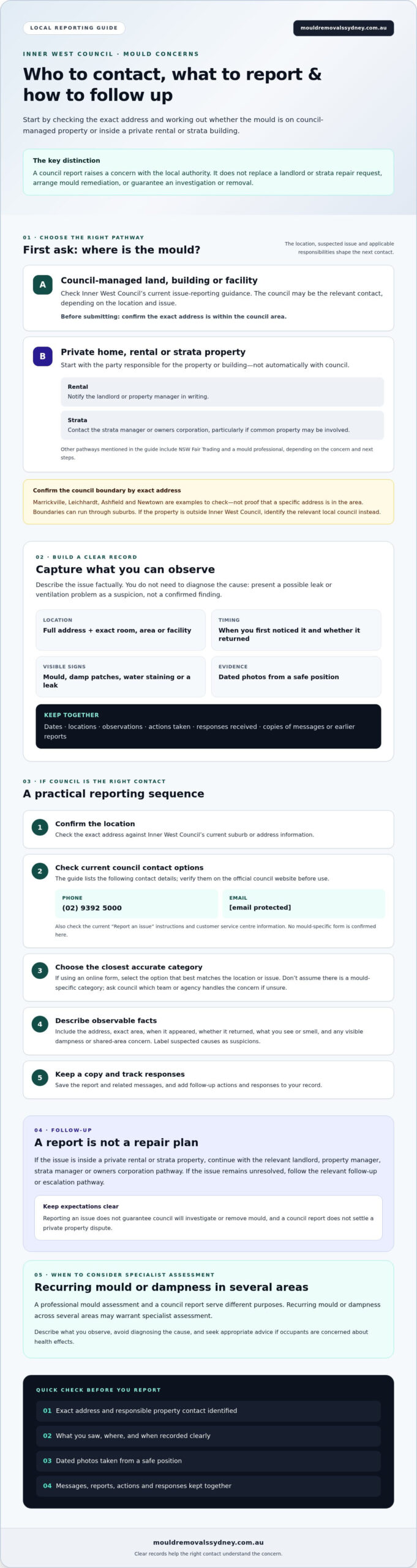
Before deciding how to report mould to Inner West Council, check that the property is within the council area and consider whether the issue involves a neighbouring property or a broader public concern. If mould is inside a rental or strata property, the landlord, property manager or owners corporation may need to act first.
It can be hard to know where to begin, especially when the cause might be a leak, poor ventilation or a shared building issue. Start with a clear record: note where the mould appears and when you noticed it, take dated photos from a safe position, and keep copies of messages or reports you’ve already made.
This 2026 guide explains how to identify the appropriate first contact, what to include in a report to Inner West Council and how to follow up. It also covers when to contact a landlord or property manager, a strata manager or owners corporation, NSW Fair Trading, or a mould professional. Reporting to council can raise a concern, but it doesn’t replace the steps needed to address a private tenancy or strata issue.
Key Takeaways
- Before reporting mould to Inner West Council, check the council’s current official reporting options and confirm the property is within its area.
- Choose your first contact based on the property: rentals, strata and council-managed premises may have different responsibility pathways.
- Keep a record of dates, locations, observations, actions and responses. Take photos from a safe position to track changes.
- A council report and a professional mould assessment serve different purposes. Recurring mould or dampness in several areas may warrant specialist assessment.
- If the issue isn’t resolved, follow the relevant follow-up or escalation pathway. A council report doesn’t settle a private property dispute.
Before reporting mould to Inner West Council, confirm who is responsible
Before choosing a reporting channel, confirm the property’s exact address and identify where the mould is appearing. Inner West Council may be the relevant contact for concerns involving council-managed land or facilities. Mould inside a private home may need to be reported to a landlord, property manager or owners corporation instead. The right pathway depends on the location, the suspected issue and the rules that apply.
A council enquiry raises a concern with the local authority. It isn’t a request for your landlord or strata to repair the property, and it doesn’t arrange mould remediation. Reporting an issue doesn’t guarantee that council will investigate or remove mould. The health effects of mould can vary. Describe what you’ve observed factually, and seek appropriate advice if occupants are concerned.
Does the property fall within Inner West Council?
Check the complete street address against Inner West Council’s current suburb or address information before submitting a report. Marrickville, Leichhardt, Ashfield and Newtown are useful examples to check, but a suburb name alone may not confirm which council covers a particular property. Boundaries can run through suburbs, so verify the specific address rather than relying on a suburb-level search or postal address.
If the address is outside Inner West Council’s local government area, identify the relevant local council and check its current reporting information. Confirming the boundary first can help prevent your concern being sent to the wrong authority.
What kind of mould concern are you reporting?
Distinguish mould inside a private home from a concern involving a council-managed building, facility or piece of land. For a private rental, notify the landlord or property manager in writing. In a strata property, contact the strata manager or owners corporation, particularly if you suspect the issue relates to common property. Council may be the relevant contact for concerns connected to council-managed places, depending on the issue and applicable rules.
Describe what you can see without diagnosing the cause. Include the affected room or area, its approximate size, when you noticed the mould, and any visible signs of moisture, such as damp patches or water staining. If you suspect a leak or ventilation problem, say so as a suspicion rather than a confirmed cause.
- Inside a private home: Contact the landlord, property manager or owners corporation as appropriate.
- On council-managed land or at a council facility: Check Inner West Council’s current issue-reporting guidance.
A report records a concern. It doesn’t remove mould or repair a leak. Keep your description clear so the recipient can understand what you’ve observed and decide whether it falls within their responsibilities.
How to report mould to Inner West Council, step by step
To report mould to Inner West Council, confirm the address, check the council’s current contact options, describe what you observed, submit the concern and keep a record. There’s no mould-specific form confirmed here, so don’t assume one exists. Check Inner West Council’s official website for its current Report an issue form and contact instructions before you start.
- Confirm the location. Check that the exact property or site is within Inner West Council’s local government area. If it isn’t, contact the relevant council instead.
- Choose a current council channel. Contact details verified for this guide include phone (02) 9392 5000 and email council@innerwest.nsw.gov.au. Confirm these details on the official site before using them. You can also check the council’s current information about customer service centres.
- Select the closest accurate category. If you use an online form, choose the option that best matches the location or issue. Don’t label it as a mould-specific service unless the live form explicitly offers that category. If you’re unsure, ask council which team or agency handles the concern you describe.
- Describe observable facts. Give the full address and exact room, area or facility. Include when you first noticed the mould, whether it has returned, and what you can see or smell. Note visible dampness, water staining, a leak or an affected shared area. Don’t present a suspected cause as a confirmed diagnosis.
- Submit and save. Follow the form or staff instructions, then keep a copy of what you sent and any confirmation or reference number.
What information should a mould report include?
Make your description specific enough for the recipient to locate the concern. Identify a bedroom wall or shared corridor, for example, rather than writing only “mould in the building.” Add clear, relevant photos taken from a safe position. Don’t enter unsafe spaces to take pictures. Include contact details so council can respond, but avoid adding unnecessary personal or health information. For general health guidance, refer to NSW Health advice on mould.
How to submit and keep a useful record
Save the submission date, your report, attached photos, confirmation or reference number, and any later council correspondence. Note who you spoke with and what they advised. Council may acknowledge or respond to a report, but confirm expected response times, any inspection and possible outcomes directly with council. If you want help assessing mould or possible dampness separately from council reporting, consider a professional mould inspection.
Mould in an Inner West rental or strata property: who should you contact?
For mould inside a private property, contact the person or body responsible for managing it before treating a council report as a repair request. The right first contact depends on whether you rent, own a standalone home, live in strata or are reporting a concern at council-managed premises. Council reporting, tenancy remedies, strata decisions and mould remediation are separate processes.
| Situation | First contact | Keep in mind |
|---|---|---|
| Tenant | Landlord or managing agent, in writing | Keep dated photos and a record of repair requests and replies. |
| Owner-occupier | Relevant repair professional or, if the issue may involve shared property, strata manager or owners corporation | Clarify whether the affected area appears to be within your lot or shared, without assuming who is legally responsible. |
| Strata resident | Strata managing agent or owners corporation | Report suspected common-property concerns in writing and retain a copy. |
| Council-managed premises | Inner West Council through its current official contact route | Describe the location and visible issue. Council will determine whether it falls within its role. |
If you rent your Inner West home
Notify your landlord or managing agent in writing. State where the mould is, when you noticed it and whether it appears to be spreading or returning. Keep the message, any response, dated photographs and a timeline of follow-up. NSW Fair Trading offers dispute resolution and mediation for tenancy disputes. Check its current mould guidance and contact options if the matter isn’t resolved. You can call NSW Fair Trading on 13 32 20. For unresolved disputes, check the NSW Civil and Administrative Tribunal’s current information about applying for orders. Don’t assume a council enquiry replaces these tenancy steps.
If mould affects strata common property
Note whether the mould appears inside your lot or in a shared area, such as a hallway. Don’t decide who is responsible based on appearance alone. Send the details to the strata manager or owners corporation, and save your written report and any response. NSW strata guidance identifies owners corporations as responsible for maintaining and repairing common property. If there’s disagreement about the boundary or next steps, check current NSW Fair Trading guidance before escalating.
If you’re deciding how to report mould to Inner West Council, contact council about concerns connected to council-managed premises or where its role may apply. A council report doesn’t replace a tenant’s written repair request, an owners corporation’s consideration of a strata issue or an assessment of the mould itself.
After reporting mould in the Inner West: document evidence and follow up
A clear record makes it easier to explain what has changed and what action you’ve already taken. Keep your notes, photographs and council correspondence together. To follow up, use the process council gave you and quote your enquiry or reference number. Ask for an update or clarification rather than assuming when an inspection or response will happen.
Build a clear mould and moisture timeline
Use a simple log and update it whenever you notice a change. Record what you observe, not what you think caused it.
- Date: When you first noticed the mould or dampness, and each date you checked again.
- Location: The room, wall, ceiling, window or shared area affected.
- Observation: Visible mould, water staining, damp patches, odour or a leak you can see.
- Action taken: A repair request, reported leak, ventilation change or other step taken.
- Contact and response: Who you contacted, how you contacted them and what they said or did next.
Take photographs from a safe position, using similar angles and lighting where possible. This makes visible changes easier to compare over time. Don’t enter unsafe areas or disturb materials to get a closer image. If the issue followed water damage, the guide Water Damage Repair: Your Emergency Guide for Sydney Homes may provide useful context.
When a council report does not resolve the source
If you haven’t received clarity about the next step, ask the relevant contact whether they need more information or whether another process applies. A council report and an assessment of mould inside a property are different things. Council may not be responsible for resolving a private repair issue, and submitting a report doesn’t identify or fix the source of moisture.
For persistent indoor mould, recurring dampness or signs that the affected area may extend beyond what’s visible, consider whether a professional assessment is appropriate. An inspection can help assess the affected area and possible moisture source. Remediation is a separate service. The general guide What is Mould? A Complete Guide for Australian Homeowners can help explain mould in homes.
For help assessing persistent mould or possible moisture issues, explore professional mould inspection services. Keep that assessment separate from your council follow-up and any repair request to a landlord or strata contact.
When to seek professional mould assessment after contacting Inner West Council
A council report and a professional property assessment serve different purposes. Council can advise whether a concern falls within its role, while a mould professional can assess affected indoor areas and possible contributing moisture conditions. One doesn’t replace the other. If the issue is inside a private rental or strata property, keep the relevant landlord, managing agent or strata contact informed about repairs and access.
Consider specialist assessment if mould keeps returning after it’s been addressed, dampness persists, you suspect moisture may be concealed, or more than one area is affected. These signs don’t confirm a particular cause, but they can make it harder to understand the extent of the issue through visible checks alone. An assessment may help clarify which areas need attention and whether further investigation is appropriate.
What a professional inspection can help clarify
An inspection can document visible mould and assess areas where dampness or moisture may be contributing to the problem. Share your timeline, photos and any repair or ventilation history with the assessor. This information can help explain what you’ve observed, but an inspection shouldn’t be treated as a guaranteed diagnosis or a promise that mould won’t return. For more background, see Mould Testing: Do You Need a Professional Mould Inspection?, if available in the publishing plan.
Keep expectations practical. Council reporting may help route a concern, while professional assessment focuses on the property. Neither step should be confused with arranging repairs through a landlord or owners corporation. If you’re still deciding how to report mould to Inner West Council, keep the council enquiry and any property repair request on separate tracks.
A practical next step for persistent indoor mould
Continue keeping your report records and follow up with the appropriate property contact about the suspected moisture issue. If an assessment is suitable, ABC Mould Cleaning Solutions provides mould inspection, mould remediation and air purification across Sydney and surrounding regions. Its process includes inspection, removal, air purification and recommendations intended to help prevent recurrence. Those recommendations can support next steps, but they aren’t a guarantee against future mould.
For more detail on mould in homes, consult What is Mould? A Complete Guide for Australian Homeowners, if available. Once you’ve clarified the council and property-management pathways, you can discuss whether a professional mould assessment may suit your situation.
Take the right next step for your mould concern
Knowing how to report mould to Inner West Council starts with confirming the address and whether the concern falls within council’s role. For mould inside a rental or strata property, contact the landlord, managing agent or owners corporation as appropriate. Whichever route you take, keep dated photos, correspondence and a simple timeline, then follow up using the process you were given.
A council report and a professional property assessment serve different purposes. If mould keeps returning, dampness persists or several areas are affected, a specialist assessment may help clarify the visible issue and possible contributing moisture conditions. Keep council reporting, property repairs and mould remediation as separate steps.
ABC Mould Cleaning Solutions serves Sydney and surrounding regions, offering mould inspection, mould remediation and air purification, with recommendations intended to help prevent recurrence. If you need a closer assessment of persistent indoor mould, arrange a professional mould assessment with ABC Mould Cleaning Solutions.
With the right contact and a clear record, you can move forward with greater confidence.
Frequently Asked Questions
How do I report mould to Inner West Council?
First confirm the address and whether the concern relates to council-managed land or facilities, or to a private property. Check Inner West Council’s official website for its current Report an issue form and contact details. Contact options verified for this guide include (02) 9392 5000 and council@innerwest.nsw.gov.au. Describe the location and visible issue, attach relevant photos if the channel allows, and save your submission or reference number.
Will Inner West Council investigate mould inside my home?
Not necessarily. Council’s role depends on the location and nature of the concern, so a report doesn’t guarantee an investigation or inspection. Mould inside a private home may need to be raised with a landlord, property manager or owners corporation. If you’re unsure whether council is the right authority, describe the issue and ask which team or agency handles it. Keep any separate property repair request in writing.
Can a tenant report mould to Inner West Council?
Yes. A tenant can contact council if the concern may fall within its role, but council reporting doesn’t replace notifying the landlord or property manager. NSW tenancy guidance recommends putting the repair concern in writing and keeping copies of messages, dated photographs and responses. For unresolved tenancy disputes, NSW Fair Trading offers dispute resolution and mediation. Check its current guidance to understand which options fit your circumstances.
What evidence should I include in a mould complaint?
Include the property address, exact room or area, when you first noticed the mould and whether it has returned. Describe visible mould, damp patches, water staining, odour or a leak as observations, not a confirmed diagnosis. Add clear photographs taken from a safe position, plus relevant contact details. Keep a copy of the report, submission date, any reference number and replies so you can follow up with an accurate timeline.
How long does Inner West Council take to respond to a mould report?
Don’t assume a fixed response or inspection timeframe. The available information doesn’t confirm a mould-specific response target, and timing or next steps may depend on the concern and council’s process. Check the current instructions when submitting your report. To request an update, follow the process council provides and quote your enquiry or reference number. Ask council directly whether it expects to respond or needs more information.
What should I do if mould in my rental is not fixed?
Keep your written repair request, photos, dates and the landlord or agent’s responses together. If the issue remains unresolved, contact NSW Fair Trading on 13 32 20 to ask about its dispute resolution and mediation service. You can also check current NSW Civil and Administrative Tribunal information about tenancy applications and possible orders. Follow official guidance for your situation, and don’t withhold rent without getting appropriate advice.
Should I contact council or a mould removal specialist first?
For mould in a rental, notify the landlord or property manager. For suspected strata common-property issues, contact the strata manager or owners corporation. Contact council if the concern may involve council-managed premises or another matter within its role. A professional assessment serves a different purpose and can help assess affected indoor areas and possible moisture conditions. ABC Mould Cleaning Solutions offers mould inspection and remediation across Sydney and surrounding regions.