Is a persistent musty smell permeating your home? Do you worry that the damp, stale air under your house is a breeding ground for mould, rot, and termites? You are not alone in this concern. Many homeowners are unsure how to fix the problem at its source, often because they don’t understand the official crawl space ventilation requirements Australia mandates for a healthy home. This confusion can lead to ineffective solutions that fail to address the root cause of the dampness, allowing the problem to worsen.
Don’t wait for minor dampness to become a major structural issue. This definitive guide is here to provide the clarity you need. We will break down the essential building code standards in plain English, explaining exactly what your property requires to eliminate subfloor moisture for good. You will learn how to achieve a dry, healthy subfloor, get rid of musty odours permanently, and gain the peace of mind that comes from knowing your home’s foundation is safe and secure.
Key Takeaways
- Poor subfloor ventilation is a direct cause of dampness, musty odours, and dangerous mould growth that can compromise your home’s structural integrity and your family’s health.
- The National Construction Code (NCC) outlines the minimum legal crawl space ventilation requirements Australia mandates for all new builds and major renovations.
- Understand the critical differences between passive vents and mechanical fan systems to choose the most effective solution for your property’s specific moisture issues.
- A simple calculation based on your subfloor’s volume can help you estimate the exact ventilation capacity your home needs to stay dry and healthy.
- Discover why a professionally designed system is your most effective defence, addressing the unique sources of moisture under your home where simple fans fail.
Why Crawl Space Ventilation is a Non-Negotiable for Australian Homes
Beneath your feet lies a critical, yet often ignored, part of your home: the crawl space. Also known as a subfloor, this is the shallow area between the ground and your home’s first floor. While its main purpose is to provide access to plumbing, wiring, and other utilities, its condition directly impacts your property’s structural integrity and your family’s health. You can learn more about the fundamentals by reading this guide on What is a Crawl Space?, but the most critical factor is air circulation.
Without adequate ventilation, this dark space becomes a trap for moisture. Stagnant, humid air creates the perfect breeding ground for mould, which releases harmful airborne spores that can travel up into your living areas. This isn’t just an aesthetic problem; it’s a direct threat to your home and health. Don’t wait until the problem worsens-because it will.
The consequences of poor subfloor ventilation are severe. Trapped dampness is a dinner bell for termites, who thrive in moist timber. It also leads to wood rot, which can compromise the structural joists and bearers supporting your entire home. A damp subfloor directly contributes to poor indoor air quality, triggering allergies, asthma, and other respiratory issues. Meeting the basic crawl space ventilation requirements Australia outlines is not just about compliance; it’s about proactively protecting your biggest investment.
The Tell-Tale Signs of a Ventilation Problem
Your home will often signal that there’s a problem brewing below. Be alert for these common warning signs:
- A persistent musty or earthy smell inside the house, particularly in rooms above the crawl space.
- Condensation on the inside of windows or a general feeling of dampness and humidity indoors.
- Peeling paint or visible damp patches appearing on walls, especially near the floor.
- Floorboards that feel bouncy, soft, warped, or are starting to cup.
Common Moisture Sources in Australian Subfloors
Understanding where the moisture comes from is the first step in creating an effective ventilation strategy. Common culprits include:
- High ambient humidity, a significant issue in coastal areas like Sydney, Brisbane, and Melbourne.
- Poor site drainage, allowing rainwater or groundwater to seep into the subfloor area.
- Undetected leaks from plumbing pipes, drains, or bathroom fixtures.
- An inadequate or non-existent vapour barrier (ground sheet), allowing moisture from the soil to evaporate directly into the crawl space.
The Official Ventilation Requirements: What the National Construction Code (NCC) Says
When it comes to building standards and the official crawl space ventilation requirements Australia wide, the National Construction Code (NCC) is the definitive authority. It sets out the non-negotiable, minimum legal standards for all new homes and major renovations. This isn’t just a best-practice guide; it’s the law designed to protect your property from structural damage caused by damp and rot.
However, there’s a critical catch: many older homes were built before these standards were enforced and may be dangerously under-ventilated. Furthermore, simply meeting the bare minimum might not be enough for properties in high-humidity areas, on sloped blocks, or with existing moisture problems. Don’t wait until you smell that musty odour—understand what the code demands.
Breaking Down NCC Ventilation Rules
To ensure adequate air circulation and prevent moisture buildup, the official National Construction Code (NCC) requirements mandate a specific, measurable approach to sub-floor ventilation. These rules are the baseline for a healthy home foundation.
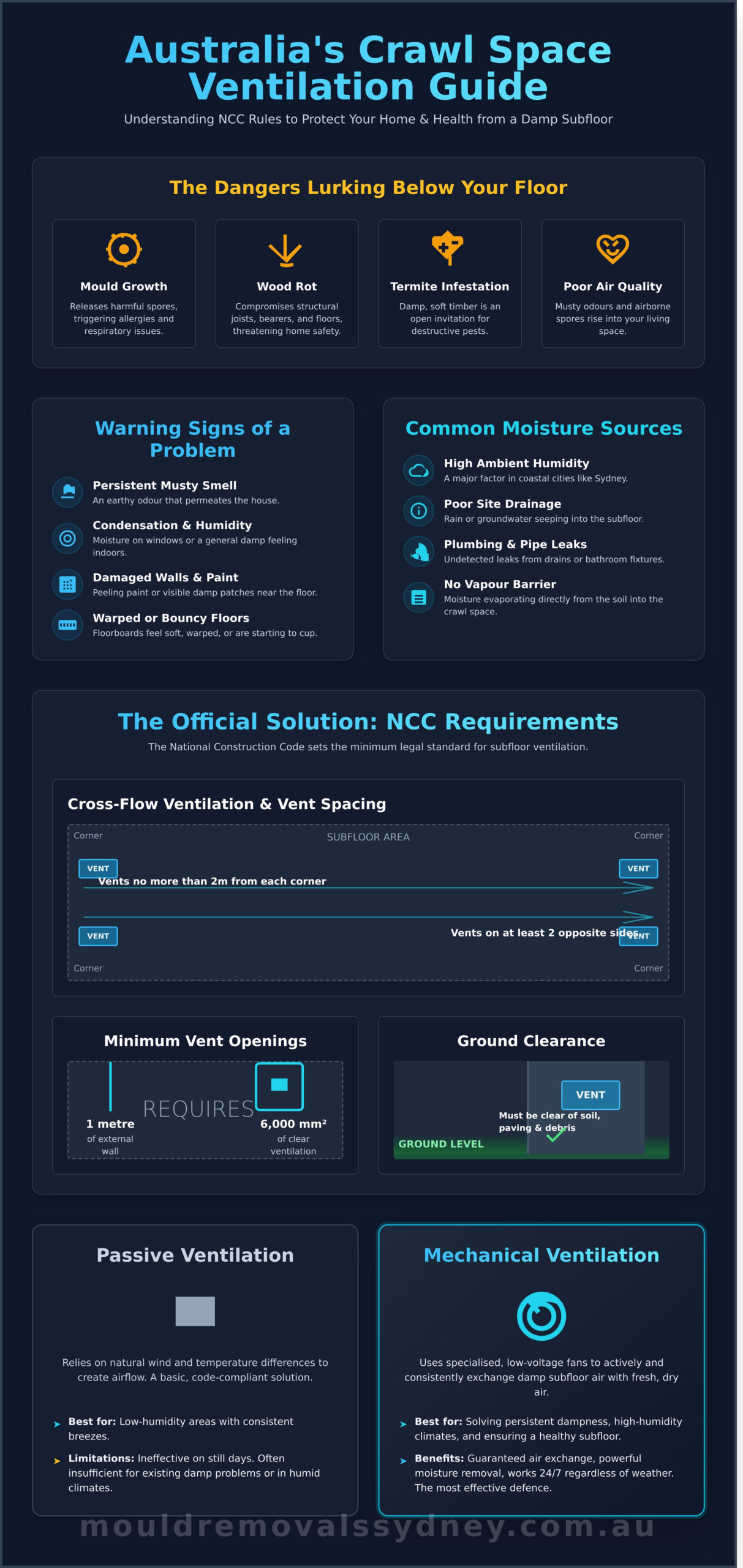
- Minimum Vent Openings: Your home must have at least 6,000 square millimetres of clear ventilation opening for every 1 metre of external sub-floor wall.
- Cross-Flow Ventilation: Vents must be placed on at least two opposite sides of the building to allow air to flow freely across the entire crawl space. Pockets of stagnant, damp air are a breeding ground for mould.
- Strategic Spacing: Vents must be positioned no more than 2 metres from each corner to ensure air reaches every part of the sub-floor.
- Ground Clearance: All vents must be installed clear of ground level, so they are not blocked by soil, paving, garden beds, or debris.
Does Your Home Comply? A Quick Checklist
You don’t need to be a builder to spot potential red flags. A simple walk around your property can reveal serious ventilation problems. Grab a notepad and check for these common issues:
- Can you see ventilation bricks or grilles on at least two opposite sides of your home’s foundation?
- Are the vents completely clear of obstructions like soil, overgrown plants, decks, or stored items?
- Do you notice long stretches of foundation wall (more than 4-5 metres) with no vents at all?
- Is your home built on a slope where the uphill side has no ventilation because it’s buried in the ground?
If you answered “no” to the first two questions or “yes” to the last two, your home likely fails to meet even the minimum standards. If you already have issues with dampness or a musty smell, your property needs a professional solution that goes beyond the basics.
Passive vs. Mechanical Ventilation: Choosing the Right System for Your Home
When it comes to your subfloor, there are two primary approaches to ventilation: passive and mechanical. While basic passive vents may satisfy the minimum crawl space ventilation requirements Australia outlines in the National Construction Code (NCC), they are often not enough to protect your home from the serious threat of damp and mould. The right choice depends entirely on your home’s specific conditions and the severity of the moisture problem you face.
Understanding the difference is the first step to ensuring your home’s structural integrity and your family’s health.
Passive Ventilation: The Basic Standard
Passive ventilation is the simplest method, relying on strategically placed grilles or vents in the foundation walls. These openings allow natural air currents and wind to move air through the subfloor. However, their effectiveness is completely at the mercy of the weather.
- Pros: No running costs, completely silent, and can meet basic building codes for new, low-risk homes.
- Cons: Ineffective on still, windless days, fails to ventilate enclosed or hard-to-reach subfloor pockets, and is often insufficient to handle significant ground moisture.
Best for: Homes built on high ground with sandy, well-draining soil and minimal risk of moisture issues.
Mechanical Systems: The Guaranteed Solution for Damp
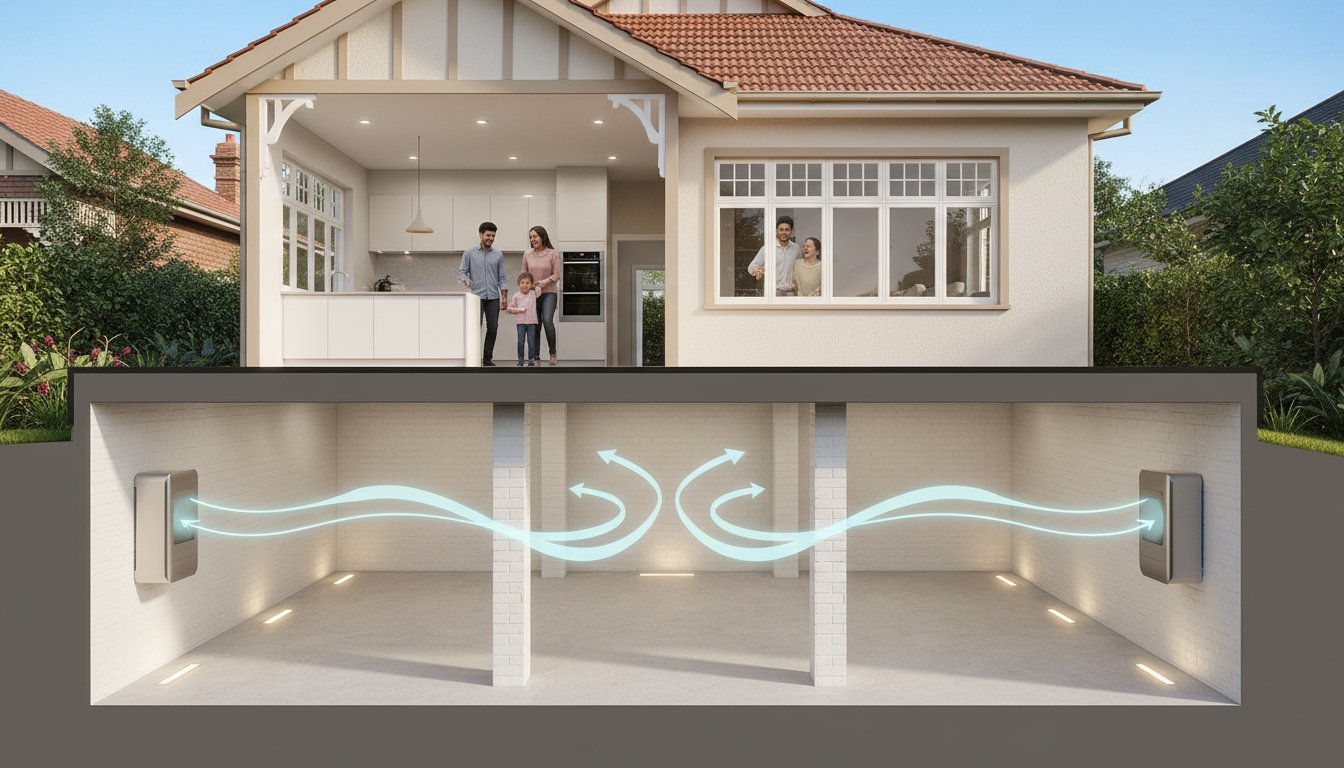
Mechanical ventilation systems use low-voltage, fan-forced units to actively and consistently exchange the air in your crawl space. Unlike passive vents, these systems guarantee airflow 24/7, regardless of external conditions. This professional approach is central to effective moisture management in Australian homes, actively pulling damp, spore-laden air out and replacing it with fresh, drier air from outside.
- Pros: Forces consistent and reliable air exchange, works around the clock, and can be configured to target specific problem zones.
- Cons: Involves an initial installation cost and minor ongoing electricity usage (typically less than a standard light bulb).
Best for: Homes with existing damp, properties built on reactive clay soil, or any subfloor with a persistent musty smell.
When to Upgrade to a Mechanical System
If your home already has passive vents but still suffers from subfloor issues, it’s a clear sign that a basic system is not enough. Don’t wait for a damp smell to turn into a costly mould infestation. You should urgently consider an upgrade if:
- The musty, earthy smell in your home persists despite having passive vents.
- You can see visible damp patches, water stains, or mould growth on subfloor timbers.
- Your home is built on a slope, has poor drainage, or is surrounded by moisture-retentive clay soil.
Choosing the wrong system means you’re just guessing with your property’s health. Get a professional assessment to find the right solution.
How to Calculate Your Crawl Space Ventilation Needs
Determining the right size for a mechanical ventilation system isn’t guesswork. The goal is to achieve a specific number of Air Changes Per Hour (ACH), which ensures stale, moisture-laden air is consistently replaced with fresh, dry air. This calculation gives you a powerful estimate to understand what your property needs and helps you grasp the fundamental crawl space ventilation requirements Australia has for healthy homes.
Follow this simple, three-step guide to estimate your needs. Remember, this is a reliable guide; our certified technicians will take precise measurements on-site to confirm the exact system requirements for your property.
Step 1: Calculate Your Subfloor’s Air Volume
First, you need to know the total volume of air in your crawl space. This is a straightforward calculation:
- Measure the length and width of your home’s foundation to find the floor area in square metres (m²).
- Estimate the average height of your crawl space from the soil to the underside of the floor joists in metres (m).
- Multiply these figures: Area (m²) x Height (m) = Total Air Volume (m³).
Step 2: Determine Your Required Air Changes Per Hour (ACH)
ACH tells you how many times the entire volume of air in your subfloor should be completely replaced each hour. The target ACH depends on the condition of your crawl space:
- Relatively Dry Space (3-5 ACH): For subfloors with no major moisture issues, a lower rate is sufficient to maintain good air quality.
- Damp & Musty Space (5-10+ ACH): If you have existing dampness, musty odours, or visible mould, a more aggressive ventilation rate is critical to remove moisture and prevent further damage. Don’t wait-a higher ACH is non-negotiable in these cases.
Step 3: Find the Required Fan Capacity
Mechanical fan capacity is measured in cubic metres per hour (m³/hr). To find the right size, simply multiply your air volume by your desired ACH.
The formula is: Air Volume (m³) x Desired ACH = Required Fan Capacity (m³/hr).
For example: If your crawl space has an air volume of 80m³ and you’ve identified it as a damp area requiring 6 ACH, your calculation would be:
80 m³ x 6 ACH = 480 m³/hr
In this scenario, you would need a fan system capable of moving at least 480 cubic metres of air per hour. Getting this right is essential for meeting crawl space ventilation requirements Australia and protecting your home. If your calculations point to a significant moisture problem, contact our expert team for a professional assessment and guaranteed solution.
Why Professional Installation is Your Best Defence Against Mould
While DIY subfloor ventilation kits are readily available, managing underfloor moisture is not as simple as just installing a fan. Effective ventilation is about creating a complete, engineered system tailored to your property’s unique challenges. Getting it wrong doesn’t just waste your time and money-it can trap moisture, concentrate dampness in certain areas, and make your mould problem significantly worse. A professional solution is not an expense; it’s a crucial investment in your property’s long-term health and value.
The Hidden Risks of a DIY Approach
Attempting to install a subfloor ventilation system without expert knowledge can lead to serious issues. Common mistakes ABC Mould Cleaning Solutions often encounters include:
- Incorrect Fan Placement: Placing fans in the wrong spots creates ‘dead spots’ where air remains stagnant, allowing mould and mildew to thrive unchecked.
- Ignoring the Root Cause: A fan only moves damp air. It won’t fix the source of the moisture, such as a leaking pipe, rising damp, or poor site drainage.
- Unsafe Electrical Work: Any electrical work in a damp subfloor area must be performed by a licensed professional to prevent fire hazards and ensure safety compliance.
- Wrong Equipment Choice: A fan that is too weak won’t move enough air, while one that is too powerful can be noisy and inefficient, potentially even drawing in more moisture from outside.
The Professional Advantage: A Comprehensive Solution
Engaging a certified expert removes the guesswork and delivers a reliable, effective result. ABC Mould Cleaning Solutions’ professional technicians provide a holistic service that goes far beyond a simple fan installation. They conduct an expert inspection to identify all moisture sources and design a custom system for optimal cross-flow ventilation, eliminating damp pockets entirely. You get the peace of mind that your system is not only effective but also fully compliant with all crawl space ventilation requirements Australia has set out in the National Construction Code (NCC) and electrical codes. All work performed by ABC Mould Cleaning Solutions is backed by a comprehensive warranty on both parts and labour, safeguarding your investment and your home.
Don’t leave the health of your home to chance. Contact ABC Mould Cleaning Solutions’ master technicians for a professional assessment and protect your property from the ground up.
Protect Your Home From the Ground Up: Final Thoughts
Understanding your subfloor is the first line of defence in protecting your entire home. As we’ve detailed, proper crawl space ventilation is not a ‘nice-to-have’-it’s a fundamental requirement for structural integrity and healthy indoor air quality. While the National Construction Code provides a baseline, effectively managing moisture requires a strategic approach. Getting this wrong can lead to costly structural repairs and the persistent threat of mould, which can compromise your family’s well-being. Navigating the official crawl space ventilation requirements australia is your crucial first step.
Don’t leave the health of your home to guesswork. A professional assessment is the only way to guarantee your ventilation system is right for your property. Our certified and experienced technicians specialise in creating solutions tailored specifically to Sydney’s challenging climate. We design and install systems proven to prevent mould growth at the source, giving you complete peace of mind. Why risk it? Stop subfloor moisture for good. Get your free, no-obligation quote today!
Frequently Asked Questions About Subfloor Ventilation
How much does professional subfloor ventilation cost in Australia?
The cost for a professional subfloor ventilation system in Australia typically ranges from A$2,000 to A$5,000+. The final price depends on factors like the size of your crawl space, the number of fans needed, and the complexity of the installation. A smaller home with a straightforward layout will be at the lower end of that scale. For a precise and competitive quote that guarantees a solution to your moisture problem, contact our expert team for a full assessment.
Will subfloor ventilation get rid of my existing mould problem?
Subfloor ventilation is a preventative measure designed to stop mould from growing in the future. It controls the damp, stagnant air that mould needs to thrive but does not kill or remove an existing infestation. If you already have visible mould, you need professional mould remediation to safely eliminate the colony and its harmful spores first. A ventilation system is then the essential second step to ensure the problem does not return. Don’t wait-tackle both issues for a permanent solution.
Can you have too much ventilation in a crawl space?
Yes, an improperly designed or overly powerful system can cause problems. It’s not about maximum airflow, but balanced airflow. An unbalanced system can create negative pressure, which can draw conditioned air from your home, increasing energy bills. A professional assessment is vital to ensure your system is correctly sized and configured, meeting all crawl space ventilation requirements Australia for a healthy, efficient, and safe home environment without any negative side effects.
Do mechanical ventilation fans need to run 24/7?
Not always. While constant operation may be needed in severe cases, most modern, professional systems are designed for efficiency. They often include humidistats, which automatically turn the fans on only when moisture levels in the subfloor rise above a pre-set threshold. This smart operation provides powerful moisture control exactly when needed, saving you money on electricity costs while effectively protecting your home’s structural integrity and air quality.
What are the best types of fans for subfloor ventilation?
For most residential applications, high-quality in-line duct fans are the best choice. These fans are specifically designed for durability and continuous operation, and they are powerful enough to move large volumes of air effectively. When selecting a system, it’s crucial to choose fans with reliable, long-life motors and low-noise ratings. Our technicians use only professional-grade components to ensure your ventilation system is effective, quiet, and built to last.
How long does it take to install a subfloor ventilation system?
A standard subfloor ventilation installation is a very efficient process. For an average-sized home, our certified technicians can typically complete the entire installation and have the system fully operational within a single day. Larger or more complex properties may require more time, but we always provide a clear and accurate timeline before any work begins. Our goal is to resolve your subfloor moisture issues quickly, effectively, and with minimal disruption to you.