
Are you trapped in a frustrating cycle of unexplained illness? The constant fatigue, brain fog, and respiratory issues that mysteriously improve when you’re away from home, only to return the moment you walk back through your door. You suspect mould is the culprit, but getting your doctor or landlord to listen is another story. The greatest challenge isn’t just feeling unwell; it’s figuring out how to prove mould is making you sick when you’re met with scepticism and dismissed as having ‘just an allergy’.
You do not have to fight this battle unarmed. This guide provides the expert, evidence-based framework you need to take back control. We will walk you through a clear, step-by-step process for systematically documenting your symptoms and your home environment, creating a powerful record that connects the two. You will learn how to build an undeniable case to present to medical professionals, your property manager, or for an insurance claim, empowering you to finally get the answers and the action you deserve.
Key Takeaways
- Create a systematic symptom diary to turn vague health complaints into concrete evidence. This is the critical first step in building your case.
- Learn how to investigate your property like a professional. Documenting your environment is essential to connect your symptoms directly to a potential mould problem.
- Discover which medical tests are most effective for mould exposure and how to find a doctor trained in environmental illness, as a standard GP may miss the signs.
- Understand how to combine your evidence-symptom logs, environmental data, and medical reports-to successfully prove mould is making you sick for a doctor, landlord, or insurance claim.
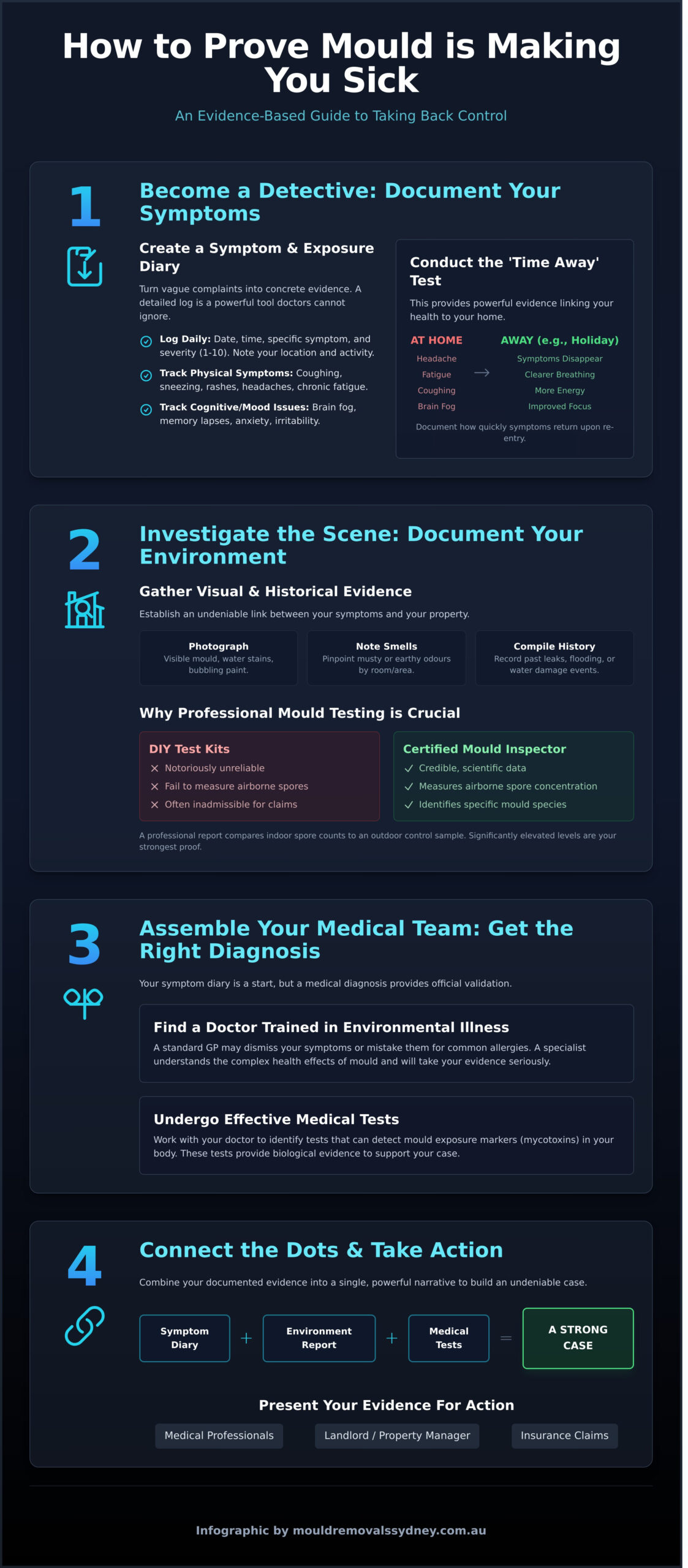
Step 1: Become a Detective – Document Your Symptoms Systematically
Feeling unwell without a clear cause is frustrating, especially when you suspect your home is the culprit. The critical first step in learning how to prove mould is making you sick is to stop guessing and start gathering evidence. Many doctors may dismiss vague complaints of fatigue or brain fog, but a detailed, data-driven journal is a powerful tool they cannot ignore. This systematic log helps you and your healthcare provider identify clear patterns, linking your physical and cognitive symptoms directly to your environment.
Think of yourself as a health detective building a case. Your daily entries will become the undeniable proof needed to take effective action, transforming your general feelings of sickness into a clear, compelling record.
Create a Comprehensive Symptom & Exposure Diary
Your memory is not reliable enough when dealing with chronic symptoms. You must document everything. Use a simple notebook or a notes app on your phone to create a daily log. For each entry, record the date, time, the specific symptom, and its severity on a scale of 1-10. It is crucial to note what you were doing and where you were when the symptom occurred. The wide range of potential health effects of mould means you should track everything, including:
- Physical Symptoms: Persistent coughing, sneezing, sore throat, skin rashes, unexplained headaches, dizziness, or chronic fatigue.
- Cognitive & Mood Issues: Brain fog, difficulty concentrating, memory lapses, unusual anxiety, or irritability.
Track Your ‘Time Away’ Test
One of the most powerful pieces of evidence you can gather is comparing how you feel inside your home versus away from it. This is your ‘Time Away’ test. The next time you are away for a weekend or a holiday, pay close attention to your health. Did your persistent headache finally disappear? Did your breathing feel clearer? Document this improvement meticulously. Then, note exactly when-and how quickly-your symptoms return after you come back home. This simple cause-and-effect observation provides powerful anecdotal evidence that your property is the source of your health problems.
Step 2: Investigate the Scene – Document Your Environment
Your health diary tracks when you feel sick; your property investigation will show why. To build a solid case, you must establish an undeniable link between your symptoms and your environment. While visible mould is a clear warning sign, the real danger often lies in what you can’t see: millions of airborne spores circulating through your home or office. This is where professional documentation becomes non-negotiable.
Gather Visual and Historical Evidence
Start by becoming a detective in your own property. Meticulous documentation creates a powerful timeline that can connect water damage events to the onset of your symptoms. Be thorough and systematic:
- Photograph everything: Take clear, well-lit photos of any visible mould patches, no matter how small. Also, photograph water stains on ceilings or walls, bubbling paint, and any areas that are persistently damp.
- Note sensory clues: Document any musty or earthy smells. Pinpoint where they are strongest-is it a specific room, a cupboard, or near a window?
- Compile a property history: Record any past incidents of leaks, flooding, or known water damage. This history provides crucial context for a mould infestation.
Why Professional Mould Testing is Crucial for Proof
While your photos are a good start, they don’t provide the scientific data needed to prove your case. DIY test kits are notoriously unreliable and often fail to measure the most significant threat: airborne spores. A certified mould inspector uses specialised equipment to gather credible evidence. They can conduct air sampling to identify the types and concentration of spores you are breathing in, which is vital for understanding the potential health effects associated with mould exposure. Surface sampling can then confirm the exact species present, such as toxigenic Stachybotrys chartarum (black mould). A formal report from an expert is the definitive proof you need.
Understanding Your Mould Test Report
A professional mould assessment report provides the hard data to connect your illness to your environment. It should clearly identify the mould species found and their concentration levels (spores per cubic metre). Crucially, the report will compare your indoor air quality to an outdoor (control) sample. Significantly elevated indoor levels, especially of known toxigenic moulds, provide the strongest possible evidence. This is the cornerstone of learning how to prove mould is making you sick. Don’t leave it to guesswork. Schedule a professional inspection to get the proof you need.
Step 3: Assemble Your Medical Team – Finding the Right Doctor and Tests
Armed with your environmental evidence and symptom diary, the next critical step is to get a medical diagnosis. However, not all doctors are equipped to connect the dots between mould exposure and complex health issues. A standard GP may only screen for common allergies, potentially missing the more severe impact of mycotoxins on your system. To truly how to prove mould is making you sick, you need a medical professional who understands environmental illness.
Bring all your documentation to your appointment-your photos, inspection reports, and detailed symptom log. This provides the practitioner with a complete picture and shows you have done your research, allowing for a more productive consultation.
Finding a Mould-Literate Doctor
Finding the right practitioner is essential. Standard medical training in Australia often doesn’t cover biotoxin illness in depth, so you may need to look for a specialist. Here’s where to start:
- Search for Integrative or Functional Medicine doctors in your area, as they often take a more holistic approach to diagnosing chronic conditions.
- Look for practitioners who specifically mention expertise in environmental medicine, biotoxin illness, or Chronic Inflammatory Response Syndrome (CIRS).
- When booking, don’t hesitate to ask the clinic if the doctor has experience treating patients for mycotoxin exposure.
Key Medical Tests to Discuss with Your Doctor
Objective data is your most powerful tool. The right tests can provide the biological proof needed to confirm that mould toxins are the root cause of your symptoms. Discuss these specific, effective tests with your doctor:
- Mycotoxin Urine Test: This is a direct and powerful test that measures the specific types of mycotoxins present in your body. It provides clear evidence of exposure.
- CIRS Blood Panel: For more complex cases, a doctor may check for key inflammatory markers associated with biotoxin illness, such as TGF-Beta-1, C4a, and MSH. These markers show if your body is in a state of chronic inflammation.
- Allergy Testing (IgE): This test confirms or rules out a classic mould allergy. While an allergy is different from mycotoxin poisoning, identifying one is a key part of the puzzle. The Mayo Clinic offers a clear overview of the methods for diagnosing a mold allergy through skin and blood tests.
With this medical evidence, your case becomes undeniable. The final step is to eliminate the source of the problem to ensure your long-term recovery.
Step 4: Connect the Dots and Take Action
You have systematically gathered the evidence. With your detailed symptom logs, professional environmental data, and conclusive medical tests, you now hold three pillars of proof. This combined information creates a compelling case that is difficult for landlords, insurers, or even skeptical doctors to dismiss. You have everything you need to move from suspicion to certainty, providing a clear answer to how to prove mould is making you sick. Now is the time to use this evidence to take decisive action for your health and your property.
Presenting Your Case to a Landlord or Insurer
An organised, professional approach is crucial. Compile all your evidence into a single, chronological file to present your case clearly and effectively. A strong evidence package can prevent lengthy and stressful disputes, forcing the other party to take your claim seriously from the start.
- Formal Letter: Outline your symptoms, the timeline of events, and the results of your environmental and medical tests. Clearly state the required action (i.e., professional mould remediation).
- Supporting Documents: Include copies of your symptom log, the mould inspector’s report, lab results, and any relevant medical reports.
- Know Your Rights: In Australia, landlords have a duty of care to provide a safe and healthy living environment. Reference your rights under your state’s residential tenancies act.
The Ultimate Proof: Recovery After Remediation
While data and documents build your case, the most powerful evidence is your own recovery. Once the environmental trigger-the mould-is professionally and completely removed, your body finally has a chance to heal. Documenting your health improvements after remediation is the final piece of the puzzle. This undeniable improvement confirms the causal link between the mould and your symptoms, providing you with absolute peace of mind.
Why Professional Remediation is Non-Negotiable
Attempting a DIY cleanup is one of the worst mistakes you can make. Scrubbing mould often releases millions of toxic spores into the air, spreading the contamination and making you even sicker. Professionals use industry-leading techniques like containment barriers and air scrubbing to ensure the problem is eliminated safely and permanently, not just spread around.
Proving the problem is only half the battle. The final, most critical step is removing the source for good. Don’t just prove it, solve it. Get a quote for professional mould removal.
From Suspicion to Certainty: Your Final Steps to Reclaim Your Health
Connecting your documented symptoms with a thorough investigation of your environment is the foundation for getting answers. By working with the right medical team and presenting clear, systematic evidence, you can move past uncertainty. This structured approach is the most effective answer for how to prove mould is making you sick and finally get the validation you deserve.
But the final, undeniable piece of your puzzle is a professional assessment of your property. Our certified technicians provide the detailed inspection reports you need, using the industry-leading Goldmorr System to identify the source and scope of the problem. This gives you the credible evidence required to build a powerful case for doctors and landlords.
Don’t let mould control your well-being any longer. The problem will only worsen. Stop guessing and start proving. Schedule a professional mould inspection today. Take decisive action and trust our team to provide the peace of mind you need to breathe easier and reclaim your home.
Frequently Asked Questions About Mould Sickness
What’s the difference between a mould allergy and mould toxicity?
A mould allergy is your immune system’s overreaction to inhaling mould spores, causing symptoms like sneezing, itchy eyes, and rashes-similar to hay fever. Mould toxicity (mycotoxicosis) is a more severe condition. It is a direct poisoning from mycotoxins, toxic compounds produced by mould, which can lead to serious systemic issues like chronic fatigue, cognitive problems, and neurological symptoms. Both are serious health risks that demand immediate professional attention to remove the source.
Can a single blood test prove that mould is making me sick?
No single blood test can offer a definitive diagnosis on its own. While certain tests can detect mould antibodies or mycotoxins in your system, they are just one piece of the puzzle. The most effective approach for understanding how to prove mould is making you sick is to combine medical testing with professional environmental testing of your property. This provides the comprehensive evidence needed to link your symptoms directly to your environment and take action.
How long does it take to start feeling better after professional mould removal?
Recovery time varies based on the individual, the type of mould, and the duration of exposure. However, many people report a significant improvement in symptoms within days to a few weeks after the mould source has been professionally eliminated. The critical step is a thorough remediation process that removes not only visible mould but also airborne spores. This creates a safe environment, giving your body the best chance to heal and recover its normal function.
What should I do if my GP dismisses my concerns about mould illness?
It can be frustrating when your health concerns are dismissed. If this happens, it is important to advocate for yourself. We recommend seeking a second opinion from a doctor who specialises in environmental or integrative medicine, as they often have more experience with mould-related illness. You should also arrange for a professional mould inspection report. Providing your doctor with tangible data about the species and spore counts in your home makes your case much harder to ignore.
Will my home insurance or landlord cover the cost of mould testing and remediation?
In Australia, coverage depends on the cause. Most home insurance policies won’t cover mould caused by gradual issues like poor maintenance or condensation. However, if the mould is a direct result of an insured event, like storm damage, you may be covered. For renters, Australian tenancy laws generally hold the landlord responsible for fixing issues that cause mould, such as leaking pipes or a faulty roof, and for the subsequent remediation costs. Always check your specific policy and lease agreement.
Is black mould (Stachybotrys) the only dangerous type of mould to worry about?
Absolutely not. This is a common and dangerous myth. While Stachybotrys chartarum (“black mould”) is known for producing potent mycotoxins, many other common indoor moulds like Aspergillus and Penicillium can also trigger severe allergies, respiratory infections, and other serious health problems. Any visible mould growth, regardless of its colour or type, is a potential health hazard that requires immediate and professional remediation to ensure your home is safe.