
That musty, damp smell hits you the moment you turn on the air conditioner. Maybe your allergies have been acting up inside the house, or you’ve spotted suspicious black specks on the vents. These aren’t just minor annoyances; they are classic warning signs of a serious problem hiding within your unit: ac mould. Ignoring it is not an option when your family’s health is at stake, as airborne spores can pose significant health risks.
You’ve arrived at the right place for a solution. This checklist is your definitive guide to taking control of the air quality in your Sydney home. We’ll walk you through how to confidently identify the signs, understand the real health dangers, and give you a clear, professional action plan to fix the issue for good. Don’t wait until the problem worsens-let’s get you the peace of mind you deserve. It’s that simple.
The Telltale Signs: Your AC Mould Detection Checklist
Your air conditioner is designed to bring comfort, but its dark, damp internal environment is also a perfect incubator for mould growth. Ignoring the initial warnings can expose your family to serious health risks and lead to expensive property damage. Don’t wait until the problem worsens, because it will. Early detection is your most effective defence against ac mould.
You don’t need special equipment to start your investigation. Trust your senses-what you can see, smell, and even how you feel are the most reliable first indicators of a problem. Use this checklist to identify the common warning signs.
Visible Clues to Look For
A visual inspection is the fastest way to confirm your suspicions. Grab a torch and check your unit carefully for any of these telltale signs:
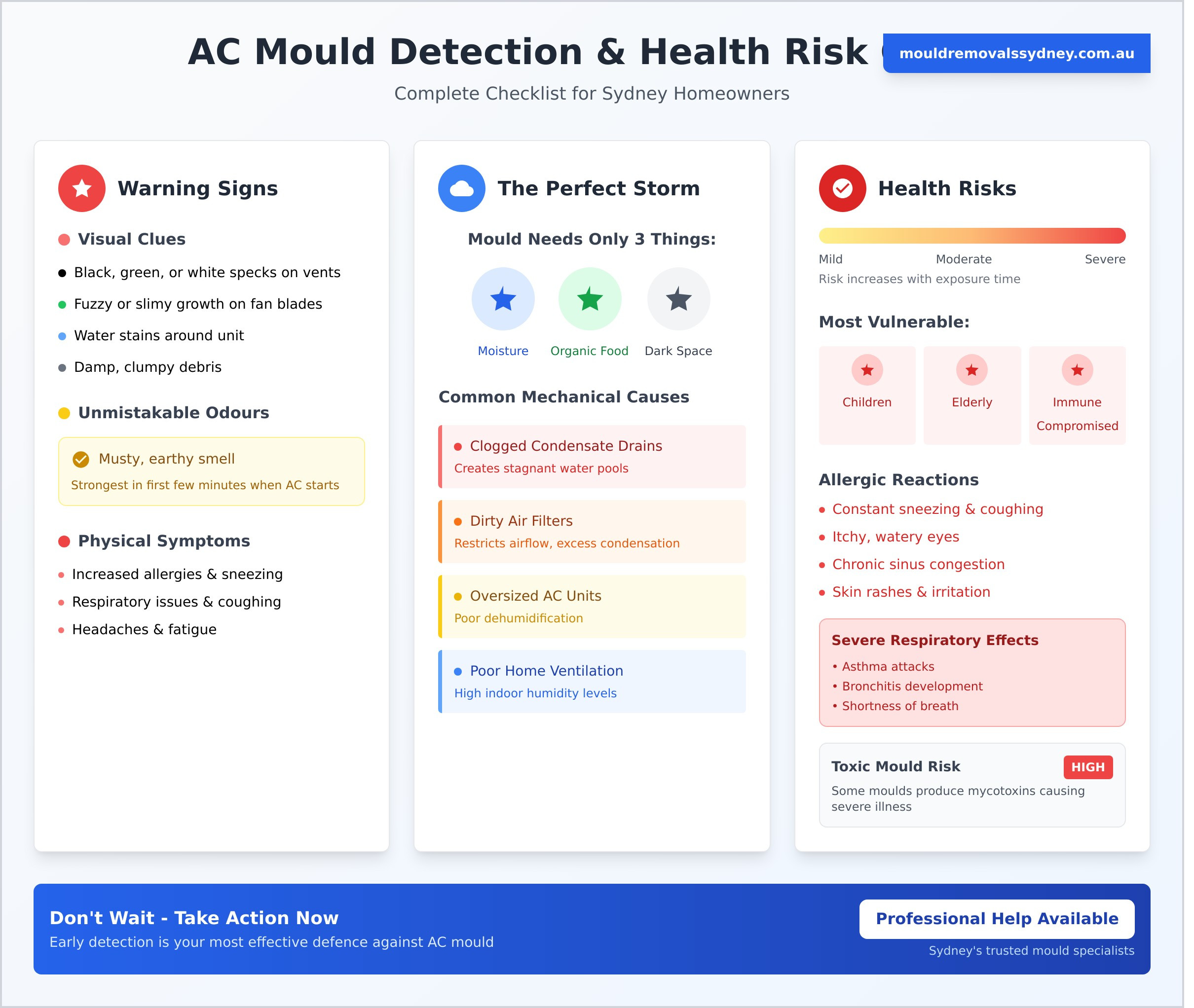
- Suspicious Spots: Look for black, green, or white specks or patches on the air vents, grilles, and surrounding surfaces.
- Fuzzy or Slimy Growth: Shine your torch inside the unit. You may see fuzzy or slimy patches on the fan blades, coils, or drain pan.
- Damp Debris: Dust and debris that looks damp, clumpy, or matted together is a red flag for excess moisture where mould can thrive.
- Water Stains: Note any discolouration or water stains on the walls, ceiling, or floor around your air conditioning unit.
Unmistakable Odours to Sniff For
Often, you will smell a mould problem before you see it. That persistent musty, earthy odour when the AC is running is a classic sign of mould hiding within the system. This smell, sometimes compared to dirty socks or a damp basement, is caused by microbial volatile organic compounds (MVOCs) released by the mould. You might notice the odour is strongest for the first few minutes after the unit turns on, as it pushes a burst of contaminated air into your room.
Physical Symptoms to Be Aware Of
The health effects of mould exposure are serious and well-documented. Airborne spores released by your AC can trigger a range of physical reactions. For a comprehensive overview of indoor mould and its potential impact, it becomes clear why immediate action is so important. Pay attention if you or your family experience:
- Increased Allergy Symptoms: A sudden increase in sneezing, a persistent runny nose, itchy eyes, or skin rashes when you are at home.
- Worsening Respiratory Issues: Unexplained coughing, wheezing, shortness of breath, or the aggravation of asthma.
- General Malaise: Chronic headaches, fatigue, or difficulty concentrating that seems to improve when you leave the house.
Why Your Air Conditioner is a Breeding Ground for Mould
Ever wondered why that musty smell appears every time you turn on the air conditioner? The answer is simple: your AC unit provides the perfect environment for mould to thrive. Understanding why this happens is the first critical step towards effective prevention and remediation. Mould requires only three things to grow: a source of moisture, organic material for food, and a dark space. Unfortunately, your air conditioner provides all three in abundance, creating a serious risk for ac mould growth, especially in Sydney’s humid climate.
The Perfect Storm: Moisture, Dust, and Darkness
Your AC unit creates a “perfect storm” for mould. As warm, humid air passes over the cold evaporator coils, condensation forms, providing a constant supply of moisture. This moisture then combines with the organic matter sucked into the unit-like dust, pollen, and skin cells-which serves as a food source. The dark, enclosed interior of the unit shields the budding colony from UV light, allowing it to flourish undisturbed. As detailed in this EPA guide to mold and moisture, controlling this moisture is the key to preventing mould growth in your home.
Common Mechanical & Environmental Causes
Beyond its basic design, several specific issues can dramatically increase the risk of an ac mould infestation. These problems often go unnoticed until the mould has already taken hold, affecting your air quality and potentially your health. Don’t wait until the problem worsens. Be aware of these common triggers:
- Clogged Condensate Drains: When the drain line that removes condensation gets blocked, water backs up inside the unit, creating stagnant pools perfect for mould growth.
- Dirty Air Filters: A clogged filter restricts airflow, causing coils to get too cold and produce excess condensation. The filter itself also traps moisture and organic debris, becoming a food source.
- Oversized AC Units: An air conditioner that is too powerful for the space will cool the room too quickly and shut off before it has a chance to properly dehumidify the air, leaving excess moisture behind.
- Poor Home Ventilation: High indoor humidity from poor ventilation gives your AC unit a constant supply of moisture-laden air to process, increasing the likelihood of condensation and mould.
The Hidden Dangers: Health Risks of Airborne AC Mould Spores
When you switch on your air conditioner, you expect clean, cool air. But if mould is hiding inside, your unit becomes a high-powered delivery system for harmful airborne spores. Every time it runs, it blasts these microscopic particles into your living room, bedroom, and kitchen, contaminating the very air you breathe. The problem of ac mould isn’t confined to the unit itself; it’s a whole-home issue.
This widespread exposure can lead to a variety of health problems, ranging from persistent irritation to severe illness. It’s a risk you can’t afford to ignore, especially for the most vulnerable members of your family, including children, the elderly, and anyone with a compromised immune system.
Allergic Reactions and Respiratory Distress
For many people, the first sign of a mould problem is a sudden increase in allergy-like symptoms. Mould is a potent allergen, and inhaling its spores can trigger an immediate immune response. This can manifest as:
- Constant sneezing and coughing
- Itchy, watery eyes
- Chronic sinus congestion or infections
- Skin rashes or irritation
For those with asthma or other respiratory conditions, airborne mould spores can be particularly dangerous, often triggering severe asthma attacks and leading to conditions like bronchitis.
Toxic Mould and Its Potential Impact
While all mould is a health concern, certain species like Stachybotrys chartarum (commonly known as black mould) can produce mycotoxins. These toxic compounds can lead to more serious health issues, including neurological symptoms like headaches, memory loss, and fatigue. It is impossible to identify a mould species by sight alone. Therefore, you must never assume a mould is non-toxic. The only safe approach is to treat all visible mould as a potential threat that requires immediate and professional removal.
Damage to Your AC Unit and Property
The danger of ac mould extends beyond your health. The organism actively feeds on organic materials, and its growth can cause significant physical damage. Mould thrives in the dark, damp conditions inside your unit, a process detailed in this EPA guide to mold growth, and can corrode sensitive components like evaporator coils and clog drain lines. This not only leads to costly repairs but also reduces your system’s efficiency, driving up your energy bills. Worse, the spores circulated by your AC can land on walls, furniture, and carpets, starting new mould colonies and spreading the infestation throughout your property.
Your Action Plan: How to Safely Address Mould in Your AC
Discovering mould in your air conditioner is alarming, and your first instinct might be to grab a spray bottle and start scrubbing. Stop. Acting without a proper plan can spread millions of harmful spores throughout your home, turning a contained issue into a widespread contamination. Don’t wait for the problem to worsen, because it will. Here is a safe and effective action plan to protect your property and your family’s health.
Immediate Safety Steps
Your family’s well-being is the top priority. Before you do anything else, take these crucial precautions to prevent further exposure to dangerous airborne spores and ensure a safe environment.
- Turn It Off Completely: Immediately switch off your air conditioning system at the thermostat. For total safety, find your home’s switchboard and turn off the corresponding circuit breaker to prevent the unit from being accidentally turned on.
- Stop All Airflow: Do not run your fan or AC unit again until the mould has been professionally remediated. Continuing to use it will act like a fan, circulating mould spores through every room in your home.
- Protect Yourself: If you plan a brief visual inspection of the vents, always wear Personal Protective Equipment (PPE). This includes an N95-rated mask, disposable gloves, and safety glasses.
The Limits and Risks of DIY Cleaning
While a small spot of surface mould on a vent cover might seem manageable, cleaning ac mould is rarely a simple DIY job. Spraying bleach is not an effective solution; it often fails to kill mould on porous surfaces and can damage sensitive AC components. Worse, improper scrubbing can disturb the colony and release a massive cloud of spores, severely degrading your indoor air quality and spreading the problem. You’re not just cleaning a stain; you are dealing with a potential health hazard that requires a professional approach.
When to Call a Professional Mould Removalist
Knowing your limits is key. A failed DIY attempt can provide a false sense of security while the hidden mould network continues to grow within the system. It’s time to call a certified Mould Removalist if:
- You can smell a persistent musty or damp odour whenever the AC is on, but you can’t see the source.
- The visible mould covers an area larger than a small patch (e.g., larger than your hand).
- Anyone in your household has asthma, allergies, a compromised immune system, or other respiratory sensitivities.
These situations demand specialised equipment and expertise to guarantee complete and safe removal. Don’t risk it. Get a professional assessment today.
The Professional Solution: How We Eradicate AC Mould for Good
A standard air conditioner service is not the same as a professional mould remediation. While a basic clean might remove visible grime, it often fails to eliminate the hidden mould colonies and airborne spores that pose a significant health risk. Simply wiping down surfaces leaves the root of the problem untouched, guaranteeing the mould will return. Don’t wait for the problem to worsen.
Our approach is different. As certified Mould Removalists, we provide a comprehensive solution that targets both the physical mould inside your unit and the invisible spores circulating through your home. We don’t just clean the problem; we solve it at its source for a lasting, healthy result.
Step 1: Specialised Air Conditioner Decontamination
Our technicians are trained to safely access and deep-clean the internal components where mould thrives, such as the evaporator coils, fan barrel, and drainage system. We use industry-approved, non-corrosive cleaning agents that are tough on mould but safe for your unit, your family, and your pets. This crucial first step ensures every trace of physical ac mould is completely removed from the unit itself.
Step 2: The Goldmorr System for Airborne Spores
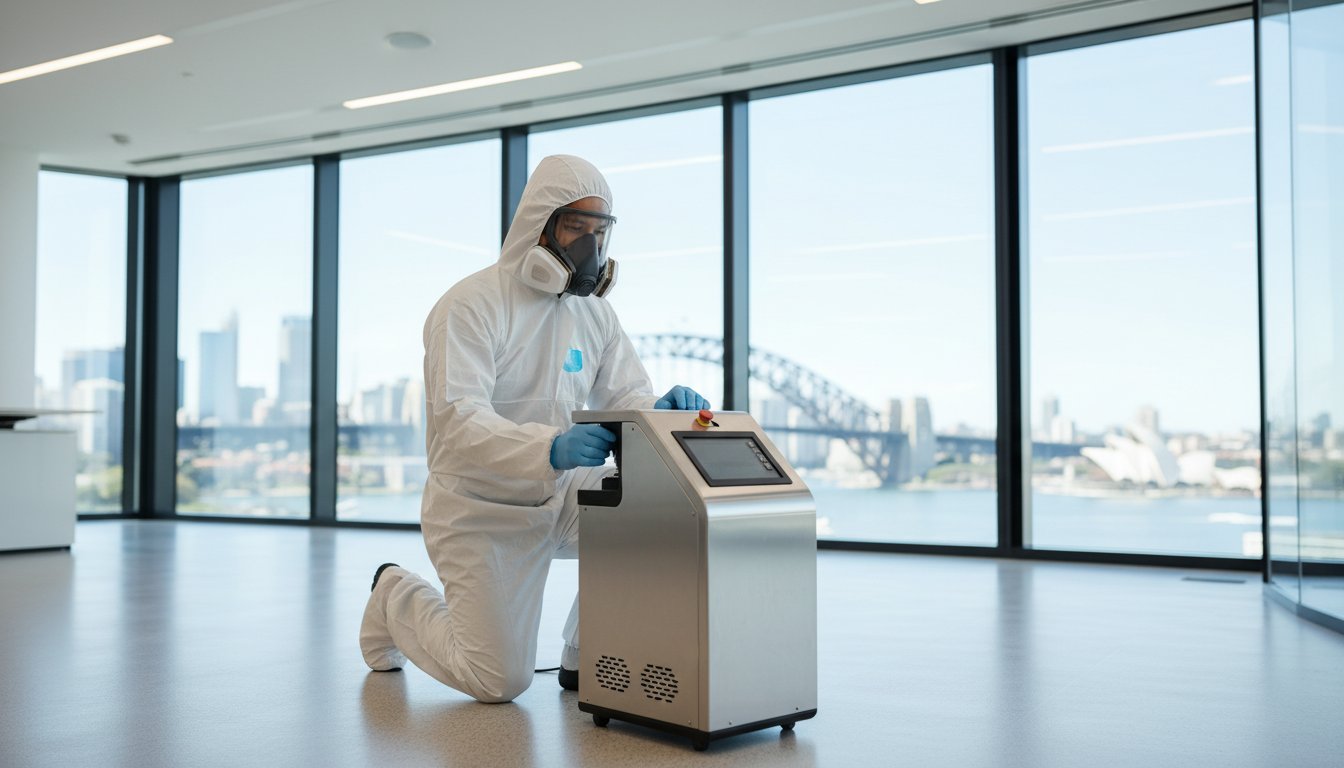
Cleaning the unit is only half the battle. Airborne mould spores are the primary cause of re-infestation and health issues. That’s why we use the revolutionary Goldmorr System. This process releases a non-toxic, biodegradable mist that acts as a “non-mechanical air scrubber.” The fogging treatment neutralises microscopic spores in the air and on surfaces throughout your home, ensuring the air you breathe is clean and safe again.
Step 3: Prevention and Final Verification
Our job isn’t finished until we’ve helped you prevent the mould from coming back. We identify the source of the moisture that allowed the mould to grow in the first place and provide clear, practical advice to fix it. For complete peace of mind, we can also arrange post-treatment air quality testing to verify the successful remediation.
We empower you with simple prevention tips, including:
- Proper filter maintenance schedules.
- Using your unit’s ‘dry’ mode to reduce humidity.
- Ensuring the condensation drain line is clear.
Don’t settle for a temporary fix. If you suspect you have an ac mould problem, contact our team of experts for a reliable, effective, and guaranteed solution. It’s that simple.
Take Control of Your Air Quality and Eliminate AC Mould for Good
Ignoring the musty smell from your air conditioner is a risk you can’t afford to take. As we’ve covered, the signs of mould can be subtle, but the health implications for your family are serious. While DIY cleaning can offer a temporary fix, completely eradicating a stubborn ac mould infestation requires professional expertise to ensure it doesn’t return, protecting both your property and your wellbeing.
You have arrived at the right place for a safe, effective, and reliable solution. As approved Goldmorr System Master Technicians servicing all of Sydney and its surrounding regions, our team has the technology to get the job done right. We provide complete peace of mind with our confident price guarantee: We Will Beat Any Written Quote By 10%. It’s that simple.
Don’t wait for the problem to worsen. Take the definitive step towards a healthier home environment today. Breathe clean air again. Schedule your free mould inspection now!
Frequently Asked Questions About AC Mould
What’s the difference between a standard AC clean and professional mould remediation?
A standard clean removes surface dust and debris from filters for better efficiency. Professional mould remediation is a specialised health and safety service. Our technicians dismantle the unit to access all internal components, using TGA-approved, non-toxic solutions to eradicate the entire mould colony, including hidden spores within the barrel fan and coils. This ensures the problem is solved, not just hidden.
Can I just spray Exit Mould or bleach into my air conditioner vents?
No, you should never spray bleach or household cleaners into your AC vents. These harsh chemicals can corrode sensitive internal parts like the evaporator coils, leading to costly damage. More importantly, turning the unit on will circulate these toxic fumes throughout your home, posing a serious health risk to your family. Professional treatment uses specialised, safe solutions that are effective without causing harm.
How much does professional AC mould removal cost in Sydney?
In Sydney, the cost for professional AC mould removal for a standard split system typically ranges from A$200 to A$400 per unit. The final price depends on the severity of the mould growth and the accessibility of the unit. For larger or more complex ducted systems, a custom on-site inspection is required to provide an accurate quote. Always ask for a detailed estimate before work begins.
How often should I have my air conditioner checked for mould?
We recommend a professional inspection and deep clean for your air conditioner at least once a year. This preventative measure is crucial for maintaining healthy air quality. If you live in a high-humidity area, have family members with allergies or asthma, or notice any musty odours, you may require more frequent checks every 6-12 months to ensure your system remains free of harmful mould growth.
Will cleaning the AC mould get rid of the musty smell immediately?
Yes, a professional clean should eliminate the musty smell almost immediately. That unpleasant odour is caused by gases released by the mould colony as it grows. Our comprehensive remediation process doesn’t just clean the visible grime; it eliminates the source of the problem. By eradicating the ac mould, we remove the cause of the smell, leaving your home’s air feeling and smelling noticeably fresher.
Is the mould in my AC the reason my allergies are so bad at home?
It’s highly likely. An air conditioner with mould continuously circulates microscopic spores throughout your home. For those with sensitivities, inhaling these airborne allergens can trigger or worsen symptoms like persistent coughing, sneezing, itchy eyes, and respiratory issues. Eliminating the mould at its source is a critical step towards improving your indoor air quality and alleviating those frustrating allergy symptoms at home.