
That dreaded email from your tenant has arrived: “There’s mould in the bathroom.” Suddenly, you’re facing a minefield of questions. Is it your responsibility? Could this escalate to an NCAT dispute? The key to a fast, fair resolution is a professional mould inspection report for landlord. But knowing what to look for-and what your legal duties are in NSW-can be overwhelming.
For Sydney landlords, getting this wrong can be costly, both in property damage and potential legal fees. A vague or incomplete report won’t protect you. It’s not just about finding mould; it’s about identifying the source, assessing the risk, and outlining a clear remediation plan that satisfies your obligations and protects your tenant’s health.
This complete 2026 guide is your definitive roadmap. We’ll break down exactly what a certified report must contain to protect your investment, provide a step-by-step plan to resolve tenant issues fast, and give you the peace of mind that comes from being a prepared, responsible landlord. Let’s get started.
Key Takeaways
- A tenant’s mould complaint is a legal trigger. Understand your obligations under the NSW Residential Tenancies Act 2010 to avoid disputes and fines.
- A professional mould inspection report for a landlord is more than a quote; it’s your key evidence, detailing moisture sources and a clear remediation plan.
- Discover why a hardware store receipt for bleach fails as evidence at NCAT, while a comprehensive mould inspection report for landlord provides the defensible proof needed to protect your investment.
- Eliminate stress with a clear, 5-step checklist that guides you from the tenant’s complaint to a final resolution, documented by a thorough mould inspection report for landlord.
Tenant Complaining of Mould? Your Legal Obligations in NSW
A tenant’s complaint about mould is not a nuisance; it’s a critical alert you must act on immediately. Under the NSW Residential Tenancies Act 2010, landlords have a legal duty to provide and maintain a property in a reasonable state of repair. This includes ensuring the premises meet the ‘fit for habitation’ minimum standards, which cover critical aspects like adequate ventilation and freedom from damp. Ignoring a mould problem is not an option-it’s a breach of your obligations that can lead to serious consequences.
Why Mould is More Than a Cleaning Issue
Unchecked mould poses a significant threat to both your tenants and your investment. Exposure can lead to a range of adverse health effects of mould, from respiratory issues to allergic reactions, creating an unsafe living environment. Beyond the health risks, mould actively deteriorates building materials, causing long-term structural damage to plasterboard, timber frames, and insulation. Fulfilling your duty of care means addressing the root cause professionally, not just cleaning the visible symptoms.
The Role of the Property Condition Report
Your first line of defence against a mould dispute is the Property Condition Report, completed at the start of the tenancy. Meticulously documenting the state of the property, including any pre-existing signs of damp or mould, is crucial. If mould appears mid-tenancy, you must investigate. This is where a professional mould inspection report for landlord becomes invaluable, as it identifies the cause and scope, protecting you from claims of negligence.
Failure to address a legitimate mould complaint can result in your tenant applying to the NSW Civil and Administrative Tribunal (NCAT). NCAT can issue orders for you to carry out repairs, compensate the tenant, or even allow them to break their lease. Acting promptly and decisively with an expert assessment is the most effective way to protect your property, your tenant’s health, and avoid costly legal disputes.
What a Legally Defensible Mould Inspection Report Must Contain
When you request a mould inspection, you’re paying for more than just a quote. A simple price estimate won’t protect you in a dispute. A professional, comprehensive report is your expert evidence-a crucial document that details the problem, its cause, and the certified solution. In a rental situation, having this level of documentation is non-negotiable, as it provides a clear, factual basis for handling mould complaints and demonstrates your due diligence. A proper mould inspection report for landlords is an investment in legal and financial protection.
Core Components of a Professional Report
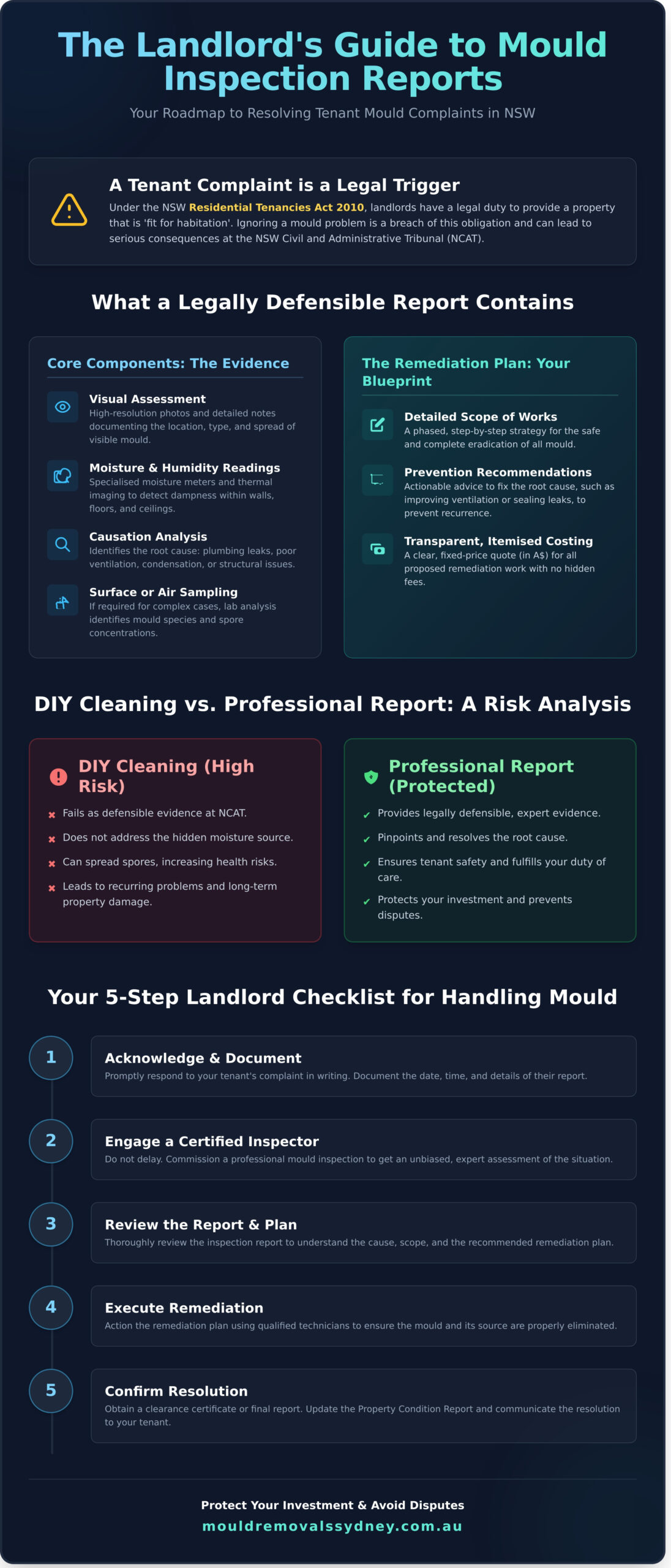
A legitimate report moves beyond guesswork and provides scientific data. Our certified technicians document every critical detail to give you a complete picture of the situation. This isn’t just about what you can see; it’s about identifying the hidden source of the problem. Key components include:
- Visual Assessment: Detailed notes and high-resolution photographic evidence documenting the precise location, type, and spread of visible mould on all affected materials.
- Moisture & Humidity Readings: We use specialised moisture meters and thermal imaging to detect and map dampness within walls, floors, and ceilings, pinpointing the water source fuelling the mould growth.
- Causation Analysis: Our experts identify the root cause of the issue, whether it’s a plumbing leak, poor subfloor ventilation, condensation, or structural failure. Fixing the source is essential for a permanent solution.
- Surface or Air Sampling: If necessary for complex cases (e.g., insurance claims or health concerns), samples can be sent to an independent laboratory to identify specific mould species and spore concentrations.
The Remediation Plan: Your Actionable Blueprint
The most critical part of the mould inspection report for landlords is the actionable plan. This section transforms findings into a clear, step-by-step strategy for complete eradication and prevention. It serves as your blueprint for restoring a safe and healthy environment for your tenants.
Your tailored plan will outline:
- A detailed, phased scope of works for safe and effective mould removal.
- Specific recommendations to prevent future outbreaks, such as improving subfloor ventilation, installing exhaust fans, or sealing leaks.
- A transparent, itemised costing (in A$) for all proposed remediation work, with no hidden fees.
You can see our full mould remediation process here to understand how our master technicians will execute this plan with precision.
DIY Cleaning vs. Professional Report: A Landlord’s Risk Analysis
It’s the first question many landlords ask when confronted with a mould issue: “Can’t I just use bleach?” While the impulse to act quickly is commendable, this approach is a high-stakes gamble with your property, your tenant relationship, and your legal obligations. The difference between a hardware store receipt and an expert report in a tribunal hearing is vast. One is a guess; the other is evidence.
Don’t make the mistake of thinking a surface clean is a real solution. It almost never is. The problem is what you can’t see: the moisture source and the airborne spores that will ensure the mould returns, often worse than before.
The Limits of a DIY Approach
A bottle of bleach might seem like a fast, A$10 fix, but it’s a dangerous illusion. Bleach often just removes the colour from the mould on the surface, leaving the underlying root structure intact and ready to regrow. Crucially, a DIY clean fails to address the root cause-the moisture. Without fixing the leak, condensation, or ventilation issue, the mould is guaranteed to return. This creates a cycle of tenant complaints and demonstrates a failure to properly address the problem, a fact that will not be viewed favourably in a tribunal.
The Value of Third-Party Expert Evidence
This is where a professional report becomes your most powerful asset. An independent mould inspection report for landlords provides undeniable proof of your due diligence to tenants and bodies like the NSW Civil and Administrative Tribunal (NCAT). It is expert, third-party evidence that moves the issue from a “he said, she said” dispute to a factual, science-backed resolution. A professional can use specialised equipment to find hidden mould behind walls or under floors and identify the precise moisture source, providing a clear, actionable remediation plan. Unsure if you need an expert? Learn more about mould testing.
DIY Cleaning (The Gamble)
- Pro: Low initial cost.
- Con: High risk of mould recurrence.
- Con: Fails to treat invisible airborne spores.
- Con: Offers no credible evidence for legal disputes.
- Con: Almost always misses the hidden moisture source.
Professional Report (The Investment)
- Pro: Provides powerful, independent evidence.
- Pro: Definitively identifies the root cause.
- Pro: Creates a clear, expert-backed action plan.
- Pro: Demonstrates your duty of care as a landlord.
- Pro: Delivers genuine, long-term peace of mind.
Ultimately, a DIY fix is a short-term patch that carries significant financial and legal risk. A professional mould inspection report for landlords is a strategic investment that protects your property, resolves tenant disputes, and safeguards you from costly tribunal orders. Act with professional certainty, not hopeful guesswork.
Your Step-by-Step Landlord Checklist for Handling Mould
Receiving a mould complaint from a tenant can be stressful, but a clear and decisive plan will give you control. Acting swiftly and professionally is the best way to protect your tenants, your property, and your legal standing under Australian tenancy laws. This simple checklist breaks the process down into manageable steps, from initial complaint to final resolution.
Follow this process to handle the situation effectively and with confidence.
Phase 1: Acknowledge and Assess
Your initial response sets the tone for the entire process. Act quickly and document everything.
- Step 1: Acknowledge the Complaint in Writing. As soon as your tenant reports the issue, respond via email. This creates a time-stamped record and reassures your tenant that you are taking their concern seriously. A simple, “Thank you for letting me know, I am looking into this,” is a perfect start.
- Step 2: Arrange a Personal Inspection. If possible, schedule a time to visit the property yourself. This demonstrates proactive management and allows you to see the scope of the problem firsthand. Always provide proper notice to your tenant before entering the property.
- Step 3: Document, Don’t Disturb. When you inspect, your job is to observe. Take clear, well-lit photos and videos of all affected areas. Do not attempt to clean or treat the mould with bleach or store-bought products. This can spread airborne spores and mask the underlying cause, making a professional assessment more difficult.
Phase 2: Engage and Resolve
With your initial assessment complete, it’s time to bring in certified experts to diagnose and fix the problem for good.
- Step 4: Engage a Certified Mould Inspector. A DIY assessment isn’t enough. A professional mould inspection report for landlords is your most important tool, providing an unbiased, scientific assessment of the mould type, the moisture source, and the exact remediation required. This official documentation is crucial for meeting your legal obligations.
- Step 5: Share the Plan with Your Tenant. Transparency is key. Once you have the report, share the key findings and the proposed remediation plan with your tenant. Explain the timeline and what they can expect. This builds trust and ensures a smoother process for everyone.
- Step 6: Complete Works and Get Clearance. Hire a professional mould remediation company to carry out the works exactly as specified in the report. Once complete, insist on a post-remediation verification or “clearance certificate.” This is your definitive proof that the property is safe and the mould has been successfully eradicated.
A comprehensive mould inspection report for landlord and property manager use is the foundation of a successful resolution. It removes guesswork and provides a clear, actionable path forward.
Need a professional report fast? Schedule your Sydney inspection today.
Choose a Sydney Mould Inspector Who Protects Your Investment
Understanding the components of a mould report is crucial, but choosing the right inspector is what truly safeguards your investment property. A generic report that only identifies visible mould leaves you vulnerable to recurring issues and potential disputes. At ABC Mould Cleaning Solutions, we provide more than just a document; we deliver a complete solution designed to protect your asset, ensure tenant safety, and give you total peace of mind.
Don’t settle for a simple checklist. A professional mould inspection report for landlords should be the first step towards a guaranteed, long-term solution.
Our Inspection Process: Thorough and Transparent
Our certified technicians go beyond the surface. We don’t just spot mould; we investigate the source to find out why it’s growing. Your detailed report is a professional document built to stand up to scrutiny, whether for insurance claims or tenancy tribunals. It will always include:
- Clear Photographs: High-resolution images documenting all affected areas and underlying structural issues.
- Scientific Data: Precise moisture and humidity readings to pinpoint the cause of the dampness fueling the mould growth.
- Actionable Recommendations: Easy-to-understand, practical steps for permanent remediation, not just a temporary fix.
From Report to Remediation: A Seamless Solution
A report is only useful if it leads to a definitive solution. We eliminate the guesswork and the stress of finding a separate, reliable contractor. Our inspection report is fully integrated with a transparent quote for our industry-leading mould remediation service.
We formulate this plan using the proven Goldmorr System, a world-leading technology that focuses on eliminating harmful airborne spores, not just wiping away stains. This process ensures a healthier, safer environment for your tenants and prevents the problem from returning. By choosing us, you get a complete solution from a single, trusted, and certified provider. Stop juggling multiple contacts and get the job done right the first time.
Don’t wait for a small problem to become a major liability. Protect your property. Get a comprehensive mould inspection report now.
Secure Your Investment and Your Peace of Mind
As a Sydney landlord, navigating a tenant’s mould complaint correctly is not just good practice-it’s essential for protecting your investment. Remember that your legal obligations in NSW are strict, and the risk of relying on DIY solutions often outweighs any initial savings. A professional, detailed report is your most powerful tool, providing a clear path to remediation and a solid defence against potential disputes.
Don’t leave your property’s health and your legal standing to chance. The right mould inspection report for landlord is your shield. Our Certified Mould Remediation Technicians produce comprehensive reports accepted as evidence at NCAT, ensuring you have the documentation you need. We are committed to providing an affordable, reliable service and will beat any written quote by 10%.
Stop the spread and eliminate the stress. Take decisive action today to safeguard your tenants and your property.
Get Your Professional Mould Inspection Report and Protect Your Property. Contact Us Today.
Frequently Asked Questions
Who is responsible for mould in a rental property in NSW, the landlord or the tenant?
In NSW, responsibility often depends on the cause. Landlords must provide a property that is fit to live in, which includes fixing structural issues like leaking roofs or pipes that lead to mould. Tenants are responsible for keeping the property reasonably clean and ventilated to prevent mould from forming due to their activities, such as not using exhaust fans or drying clothes indoors without adequate airflow. The root cause is the deciding factor in determining responsibility.
Can a tenant withhold rent because of mould in NSW?
No, a tenant in NSW cannot legally stop paying rent due to a mould problem. This would be a breach of their tenancy agreement. The correct procedure is for the tenant to notify you in writing of the issue. If you fail to act, they can apply to the NSW Civil and Administrative Tribunal (NCAT) for orders requiring you to carry out repairs, and they may be granted a rent reduction by the Tribunal.
How much does a professional mould inspection and report cost in Sydney?
A professional mould inspection in Sydney typically costs between A$350 and A$800. The final price varies based on the size of your property, the accessibility of the affected areas, and whether air and surface sampling for laboratory analysis is required. This fee generally includes a detailed report outlining the moisture source, the extent of the contamination, and a recommended remediation plan. Always get a clear quote upfront to avoid surprises.
Is the landlord required to pay for a mould inspection?
If the mould stems from a building defect, such as a water leak, rising damp, or poor drainage, the landlord is responsible for paying for the inspection and repairs. However, if the problem is determined to be caused by the tenant’s lack of ventilation or cleaning, the landlord may not be liable for the cost. An expert mould inspection report for landlords is the most effective way to professionally determine the source and assign responsibility.
What should I do if my tenant claims mould is making them sick?
You must take any health complaints related to mould seriously and act immediately. Document the tenant’s concerns in writing and promptly arrange for a professional mould inspection. This demonstrates you are meeting your duty of care as a landlord. An expert report will identify the mould species and spore count, providing a clear basis for an effective and safe remediation plan. Ignoring these claims can expose you to significant legal and financial risk.
How can I prove the mould was caused by the tenant’s lifestyle?
The most reliable evidence is a comprehensive report from a certified mould inspector. The report will document moisture readings, identify the water source, and note conditions like persistent condensation, unused exhaust fans, or indoor clothes drying. If the investigation finds no structural leaks but identifies high internal humidity, it provides strong, independent proof that the cause is related to the tenant’s habits. This documentation is crucial if a dispute arises.
Does a landlord have to disclose mould to new tenants in NSW?
Yes. Under NSW law, landlords must disclose certain “material facts” before a new tenancy agreement is signed. A history of significant mould growth, especially if caused by an underlying issue like flooding or dampness, is considered a material fact. Failing to disclose this information can give the new tenant the right to terminate their lease and seek compensation. It is always best practice to remediate the issue fully and be transparent.