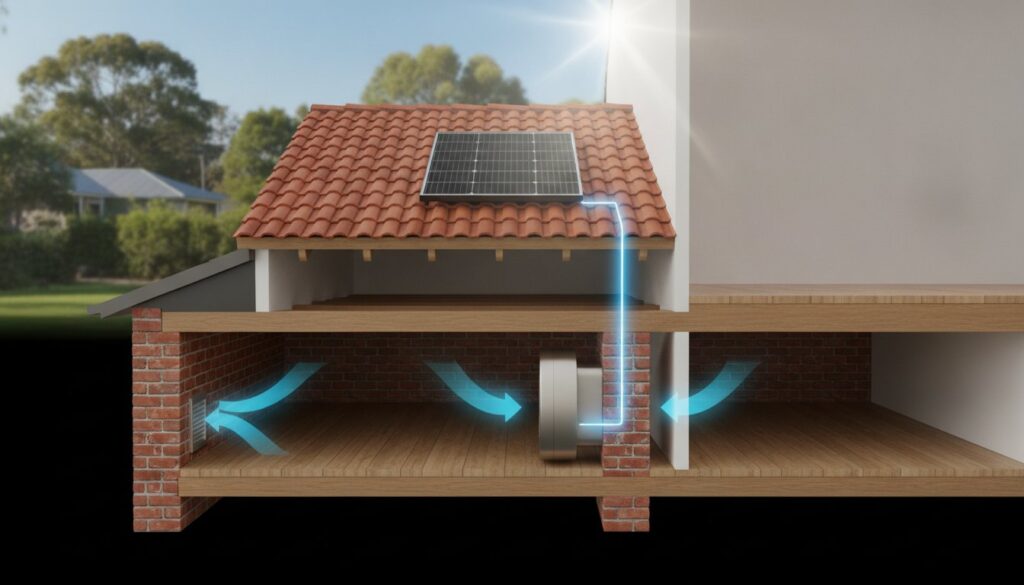
Did you know that approximately 40% of older Sydney homes suffer from inadequate subfloor airflow, leaving them vulnerable to rising damp and termite infestations? If you’ve noticed a persistent musty smell or recurring mould on your internal walls, your property is likely part of this statistic. Installing a solar powered subfloor ventilation fan is the most effective way to break this cycle. These systems harness Sydney’s abundant sunshine to extract damp air exactly when the external environment is driest, ensuring your home stays protected without adding a cent to your energy bills.
We understand the anxiety that comes with smelling “old house” odours or fearing structural rot. It’s frustrating to pay for repairs only to have the dampness return every winter. This guide will show you how to permanently eliminate subfloor moisture and protect your property value using advanced solar technology. We’ll explore why traditional mains-powered fans often fall short and how a specialized installation process creates a healthier, mould-free environment for your family.
Key Takeaways
- Identify early warning signs like musty smells and cupping floorboards to prevent costly structural damage and termite infestations.
- Understand the science behind how a solar powered subfloor ventilation fan utilizes peak sunlight to drive maximum airflow when the external air is driest.
- Evaluate the significant cost benefits and lower installation complexity of solar technology compared to traditional mains-powered systems.
- Determine whether your specific home layout requires extraction, positive pressure, or a specialized “push-pull” configuration for optimal moisture control.
- Learn why professional mould remediation using the Goldmorr System is a critical first step to ensure your subfloor is sterile before installing new equipment.
The Hidden Dangers of Subfloor Dampness in Sydney Homes
Sydney’s unique geography and humid coastal climate create a “perfect storm” for your home’s foundation. High humidity levels, combined with the city’s heavy clay-based soils, often trap moisture in the confined area beneath your floorboards. This isn’t just a minor inconvenience. It’s a structural and health crisis waiting to happen. Proper Crawl space ventilation is essential because without it, humidity levels under your home can reach 100%, especially in older brick veneer properties where weep holes are often blocked or restricted.
When subfloor air remains stagnant, it becomes a breeding ground for wood-destroying fungi and termites. Damp timber is significantly more attractive to pests, and prolonged exposure leads to rot that compromises your home’s structural integrity. Installing a solar powered subfloor ventilation fan provides a proactive shield against these hidden threats. By extracting saturated air during the warmest parts of the day, you prevent the environment that these pests and pathogens need to survive.
Signs Your Subfloor is Trapping Moisture
Don’t wait for your floorboards to fail before you take action. You can often identify a moisture problem through simple sensory checks. Does your living room have a persistent, musty “old house” smell? This is a primary indicator of fungal growth beneath your feet. Walk through your home and look for structural red flags like sticky doors or windows that suddenly don’t close properly. This often indicates timber swelling caused by rising damp. You should also inspect your external brickwork for efflorescence, which appears as white, powdery salt deposits. These salts are carried to the surface by moisture and signal a serious lack of airflow.
The Health Implications of Airborne Spores
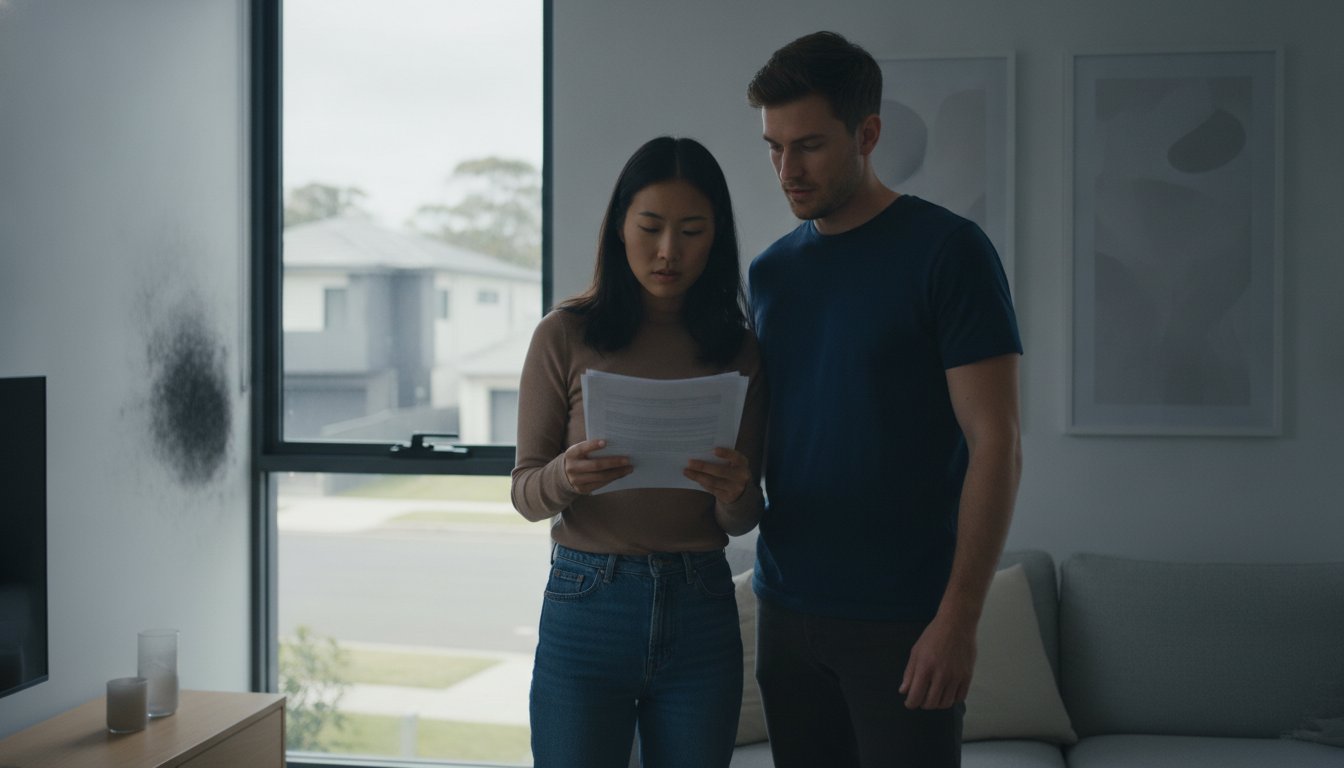
The air in your subfloor doesn’t stay there. Through a process known as the “stack effect,” air naturally migrates upward into your living areas, carrying microscopic mould spores and allergens with it. This is why recurring mould on internal walls is often a symptom of a much larger subfloor issue. If your family suffers from unexplained respiratory issues, sneezing, or skin irritation, the source might be beneath your floorboards. Simply cleaning the surface of the mould is a temporary fix that fails to address the root cause. You must eliminate the damp environment at its source. A solar powered subfloor ventilation fan ensures that the air under your home remains dry and fresh, stopping the upward migration of dangerous spores and protecting the health of everyone inside.
How Solar Powered Subfloor Ventilation Fans Work
A solar powered subfloor ventilation fan operates as a sophisticated, self-regulating engine for your home’s foundation. It converts sunlight directly into mechanical energy. This process drives high-performance fans that move thousands of litres of air per hour. Because the system is powered by the sun, its intensity naturally matches the conditions where ventilation is most effective. When the sun is at its peak, the fan runs at maximum capacity. This is exactly when the outside air is at its warmest and most capable of absorbing moisture from your subfloor.
Modern systems utilize advanced brushless motors. These components are engineered for longevity and near-silent operation. You won’t hear a disruptive hum while the system works to protect your property. This efficiency ensures a consistent flow of air that prevents the stagnant, damp conditions discussed in the previous section. If you are concerned about existing moisture levels, a professional mould inspection service can determine the current state of your subfloor before installation.
The Mechanics of Air Extraction
The primary goal of these fans is to create a pressure vacuum. By pulling stale, damp air out of the subfloor, the system forces fresh, dry air to enter through existing intake vents. This “cross-ventilation” is critical. We calculate the required air changes per hour based on your specific property size and the severity of the moisture issue. A standard installation aims to replace the entire volume of subfloor air multiple times every hour. This constant movement prevents moisture from settling into timber or masonry.
Why “Solar Only” Makes Sense for Ventilation
Many homeowners ask why they shouldn’t run fans 24/7 using mains power. The answer lies in the “Dew Point” and relative humidity. Night air in Sydney is often significantly more humid than daytime air. Pumping in cool, damp night air can actually introduce more moisture into your subfloor, worsening the problem. A high-quality solar powered subfloor ventilation fan avoids this “night air trap” entirely. It operates only when the ambient air has the highest drying potential.
- Zero ongoing running costs: The sun provides all the necessary power.
- No complex electrical wiring: Solar kits are often simpler to install than hard-wired alternatives.
- Automatic activation: The system starts and stops based on light levels without needing sensors.
- Reduced carbon footprint: You protect your home using 100% renewable energy.
By focusing operation during daylight hours, you maximize the drying effect while maintaining zero running costs. The system essentially pays for itself by preventing the structural rot and mould remediation expenses that plague untreated Sydney homes.
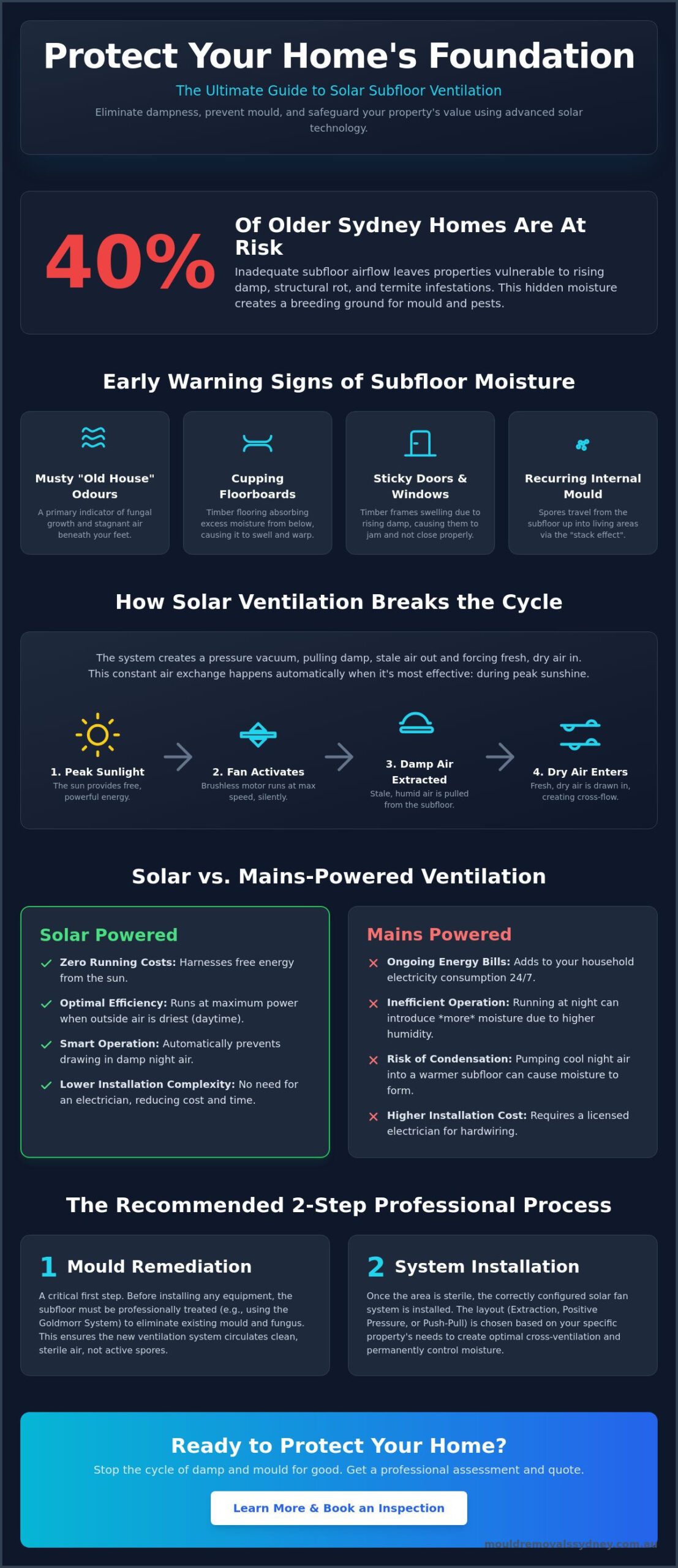
Solar vs. Mains-Powered Ventilation: Which is Better?
Choosing the right power source for your ventilation system is a decision that impacts your home’s health and your wallet for the next decade. While traditional mains-powered fans have been the standard for years, they come with hidden long-term burdens. Sydney’s coastal environment, characterized by corrosive salt air and high humidity, demands hardware that can withstand harsh conditions without constant intervention. A high-quality solar powered subfloor ventilation fan is specifically engineered for these environments, often utilizing high-grade, corrosion-resistant materials that outlast standard off-the-shelf electrical alternatives.
Reliability is paramount when protecting your foundations. Mains-powered systems rely on complex timers or sensors to avoid the “night air trap” mentioned earlier. If these sensors fail, you might unknowingly pump saturated air into your crawl space. Solar systems eliminate this risk through biological synchronization. They only operate when the sun provides the energy, which naturally coincides with the lowest relative humidity periods of the day. This inherent reliability makes solar the superior choice for Sydney homeowners seeking a “set and forget” solution.
Cost and Efficiency Breakdown
When you analyze the total cost of ownership over a 10-year period, the financial advantage of solar technology becomes undeniable. Mains-powered fans accumulate electricity costs every hour they operate. Over a decade, these small daily expenses grow into a significant financial drain. In contrast, a solar powered subfloor ventilation fan has zero ongoing running costs. The sun provides 100% of the required energy, allowing the system to pay for itself through energy savings alone.
Efficiency isn’t just about power bills; it’s about air movement volume. Solar fans often deliver a higher CFM (cubic feet per minute) per dollar invested. Because they don’t rely on the grid, they can utilize high-torque motors that move massive volumes of air during peak sunlight hours. This creates a powerful drying effect that mains-powered fans, often throttled to save on electricity, simply cannot match. You get more aggressive moisture extraction exactly when your subfloor needs it most.
Installation and Safety Considerations
Safety is a critical factor in damp, confined spaces. Subfloors are inherently prone to moisture, which creates a hazardous environment for high-voltage 240V electrical wiring. Mains-powered installations require expensive electrical certificates and heavy-duty conduits to meet safety standards. Solar systems operate on low-voltage DC power. This makes them significantly safer in damp environments and simplifies the installation process. You eliminate the risk of electrical shorts in hard-to-reach areas of your foundations.
While the power source is important, professional placement remains the deciding factor in a system’s success. Even the most powerful fan will fail if it isn’t positioned to create effective cross-ventilation. Our specialists focus on strategic extraction points that maximize airflow across the entire footprint of your home. By choosing a solar-powered solution, you reduce your home’s carbon footprint while securing a safer, more cost-effective method of moisture control.
Assessing Your Property: Choosing the Right Ventilation Method
Every Sydney property presents a unique challenge for moisture management. From the porous sandstone foundations common in the Inner West to the sloping blocks of the Northern Beaches, a generic approach to airflow will fail. You must assess the specific layout of your foundations to determine the most effective configuration for your solar powered subfloor ventilation fan. Stagnant air pockets often hide behind internal dwarf walls or in areas with extremely low clearance. These “dead zones” require a tailored engineering strategy to ensure moisture doesn’t accumulate in hard-to-reach corners.
Sydney’s varied topography often leads to drainage issues. If your home sits on a sloping block, water runoff can pool against the uphill foundations, keeping the soil perpetually damp. In these scenarios, a single fan might not be enough. We frequently utilize the “Push-Pull” method for complex or large layouts. This involves installing intake fans on one side of the house and extraction fans on the opposite side. This configuration creates a continuous, high-velocity stream of air that leaves no room for humidity to settle. It’s a proactive way to protect your structural integrity before rot begins.
When to Use Air Extraction
Extraction is the most effective method for homes already suffering from high moisture levels or those persistent, musty “old house” smells. By pulling damp air out of the cavity, you create a pressure vacuum that naturally draws fresh air in through existing air bricks. You must position extraction fans strategically. We ensure they aren’t placed near floor gaps or internal stairs, which could accidentally pull conditioned air from your living spaces. This focus ensures your solar powered subfloor ventilation fan is working exclusively on the subfloor environment.
The Benefits of Positive Pressure (Input)
Positive pressure, or input ventilation, works by forcing dry, external air into the subfloor. This is an ideal solution for Sydney renovations where external wall space for extraction is limited. By pumping in dry air, you “push” the damp, heavy air out through any available opening. This method is particularly useful for targeting specific damp spots caused by poor drainage or leaking pipes. Combining both extraction and input methods provides the ultimate level of moisture control for high-risk properties.
Don’t guess when it comes to your home’s foundations. Book a professional subfloor ventilation system installation assessment to determine the exact configuration your property needs for permanent moisture relief.
Professional Installation: Integrating Ventilation with Remediation
A solar powered subfloor ventilation fan is a high-performance engineering tool, but it’s not a magic wand for an active mould infestation. If your crawl space already has visible growth or heavy spore concentrations, simply turning on a fan can be counterproductive. Stagnant air often holds millions of microscopic spores. Without proper remediation, increased airflow can inadvertently spread these particles throughout the structure. You must treat the existing infection before establishing a long-term ventilation strategy to ensure the problem doesn’t return.
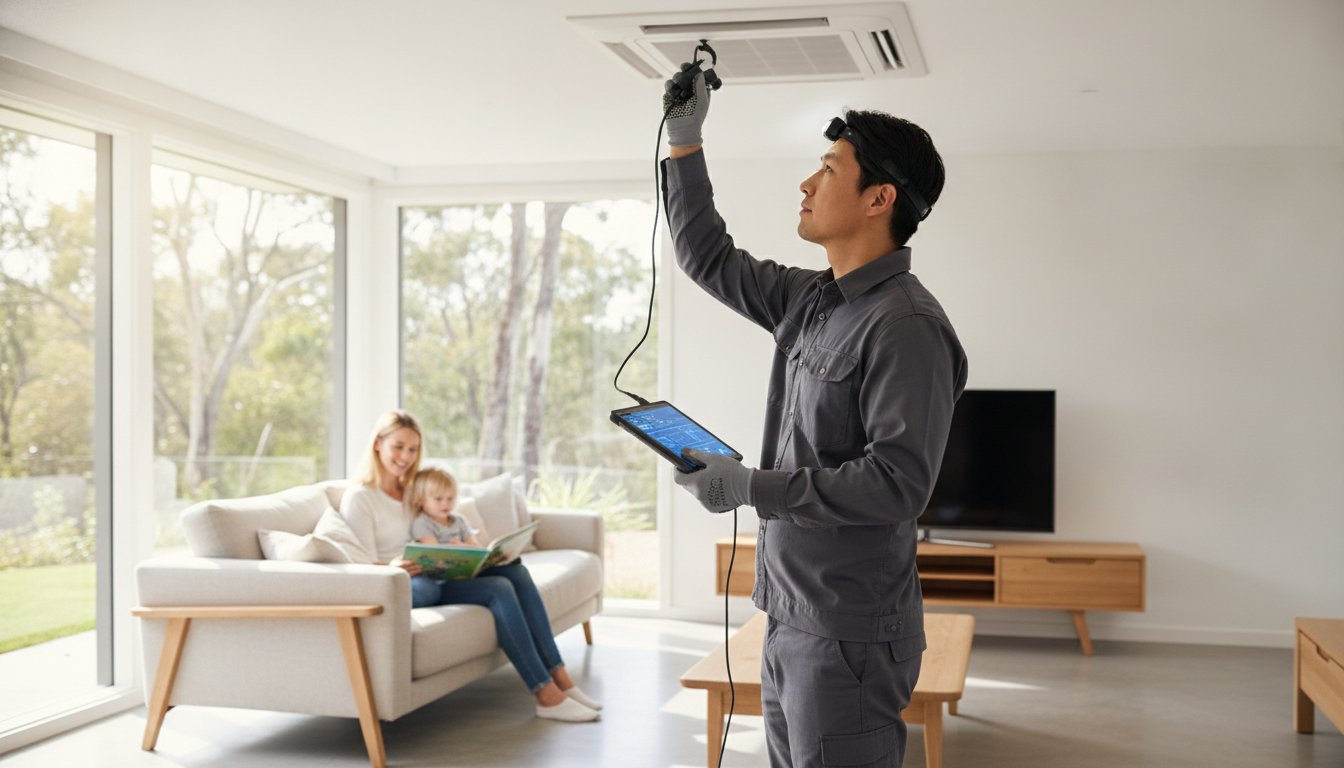
Professional placement is the difference between a dry home and a wasted investment. DIY “best guess” installations often fail to account for complex air pressure dynamics or stagnant pockets behind internal dwarf walls. Our specialists use precision tools to map airflow and identify exactly where moisture is trapped. We also provide guidance on ongoing maintenance. Ensuring your external vents remain clear of garden mulch, debris, or spider webs—tasks often handled by exterior specialists like House Washing Heroes—is essential for the system to operate at peak efficiency. This professional oversight guarantees that your foundations remain protected for decades.
The ABC Mould Cleaning Solutions Approach
We don’t just install hardware; we provide a systematic, evidence-based solution to restore your home’s health. Our process begins with a professional inspection to map subfloor moisture and identify the root cause of the dampness. We often integrate air purification with structural drying to ensure your indoor air quality improves immediately. A cornerstone of our specialized methodology is the Goldmorr System. This proprietary process uses a biodegradable fogging agent to eliminate airborne and surface spores. It’s a safe, non-toxic way to reset your subfloor environment before the ventilation system takes over.
Your Path to a Mould-Free Home
Resolving subfloor issues requires a logical, step-by-step path. We’ve simplified the process to move you from a state of concern to a state of resolution quickly. Our specialists follow a strict protocol:
- Step 1: Professional subfloor inspection and high-precision moisture mapping.
- Step 2: Source identification to locate leaks, rising damp, or drainage failures.
- Step 3: Professional installation of a high-performance solar powered subfloor ventilation fan tailored to your property’s layout.
Don’t let hidden dampness compromise your family’s health or your property’s structural integrity. Taking action now prevents escalating repair costs and protects your property value. Ready to dry out your home? Contact Sydney’s mould experts today to secure a permanent, cost-effective solution for your subfloor.
Secure Your Home’s Future with Advanced Solar Ventilation
Sydney’s humid climate doesn’t have to dictate the health of your home or the integrity of your foundations. By choosing a solar powered subfloor ventilation fan, you address the root cause of dampness without ever incurring ongoing energy costs. We’ve explored how integrating this sustainable technology with our specialized Goldmorr System provides a permanent shield against structural rot and dangerous respiratory hazards. Our team of Certified Goldmorr System Technicians provides expert Sydney-wide service to ensure your property remains a safe, dry environment for your family.
Don’t let hidden moisture devalue your property or threaten your family’s well-being. We offer comprehensive mould inspection and removal services to prepare your foundations for long-term success. It’s time to transition from reactive repairs to a proactive, results-driven strategy. Get a Professional Subfloor Ventilation Quote and take the first step toward a healthier home today.
You deserve the peace of mind that comes with a professionally protected subfloor. We’re ready to help you restore and maintain a healthy living space for years to come.
Frequently Asked Questions
Do solar subfloor fans work on cloudy or rainy days?
Yes, these systems continue to operate during overcast conditions, though at a reduced speed. Modern photovoltaic panels are sensitive enough to capture ambient light even on grey Sydney days. This reduced output is actually a technical advantage. You don’t want high-volume air exchange when the external humidity is at 100% during heavy rain. The system naturally scales its performance to match the drying potential of the outside air.
How many solar fans do I need for a standard Sydney home?
Most standard three-bedroom brick veneer homes require between one and three units for effective moisture control. We determine the exact number by calculating the total cubic volume of your subfloor and identifying internal obstructions like sandstone footings or dwarf walls. A single fan might suffice for a small area, but larger footprints often need multiple extraction points to eliminate stagnant air pockets completely.
Are solar powered subfloor ventilation fans noisy for neighbors?
No, these fans are engineered for near-silent operation using advanced brushless DC motors. Unlike older AC-powered models that can vibrate or produce a loud hum, a high-quality solar powered subfloor ventilation fan is barely audible from just a few metres away. Because they only run during daylight hours when ambient neighborhood noise is higher, they are virtually undetectable to your neighbors.
Can I install a solar subfloor fan myself?
While DIY kits are available, we strongly recommend professional installation to ensure the system actually solves your moisture problem. Incorrect placement often leads to “short-circuiting,” where the fan simply pulls air from a nearby vent rather than drawing it across the entire subfloor. Our specialists ensure the solar powered subfloor ventilation fan and its panel are positioned at the optimal angle for Sydney’s latitude to maximize daily run times.
How long do solar-powered ventilation systems typically last?
You can expect a professionally installed, high-quality system to last between 10 and 15 years. The solar panels themselves often carry performance warranties exceeding 20 years, while the brushless motors are rated for long-term continuous use. We use corrosion-resistant materials that are essential for Sydney’s coastal air to prevent the housing or fan blades from degrading prematurely.
Will a solar fan stop termites from entering my subfloor?
A fan isn’t a physical barrier, but it removes the damp, stagnant conditions that termites crave. These pests are highly attracted to high-moisture environments and decaying timber. By maintaining a dry, well-ventilated subfloor, you make your home a significantly less attractive target for infestation. It’s a vital part of a proactive property maintenance strategy, though it doesn’t replace the need for regular professional termite inspections.
Do I need to clean or service the solar panel and fan?
Can these fans be used in apartments or just houses?
These systems are primarily designed for detached or semi-detached houses with a crawl space foundation. If a ground-floor apartment has its own dedicated subfloor cavity and access to a sunlit external wall for the solar panel, installation may be possible. However, most modern high-rise apartments lack the necessary subfloor clearance and require different mechanical ventilation solutions that don’t rely on external solar mounting.