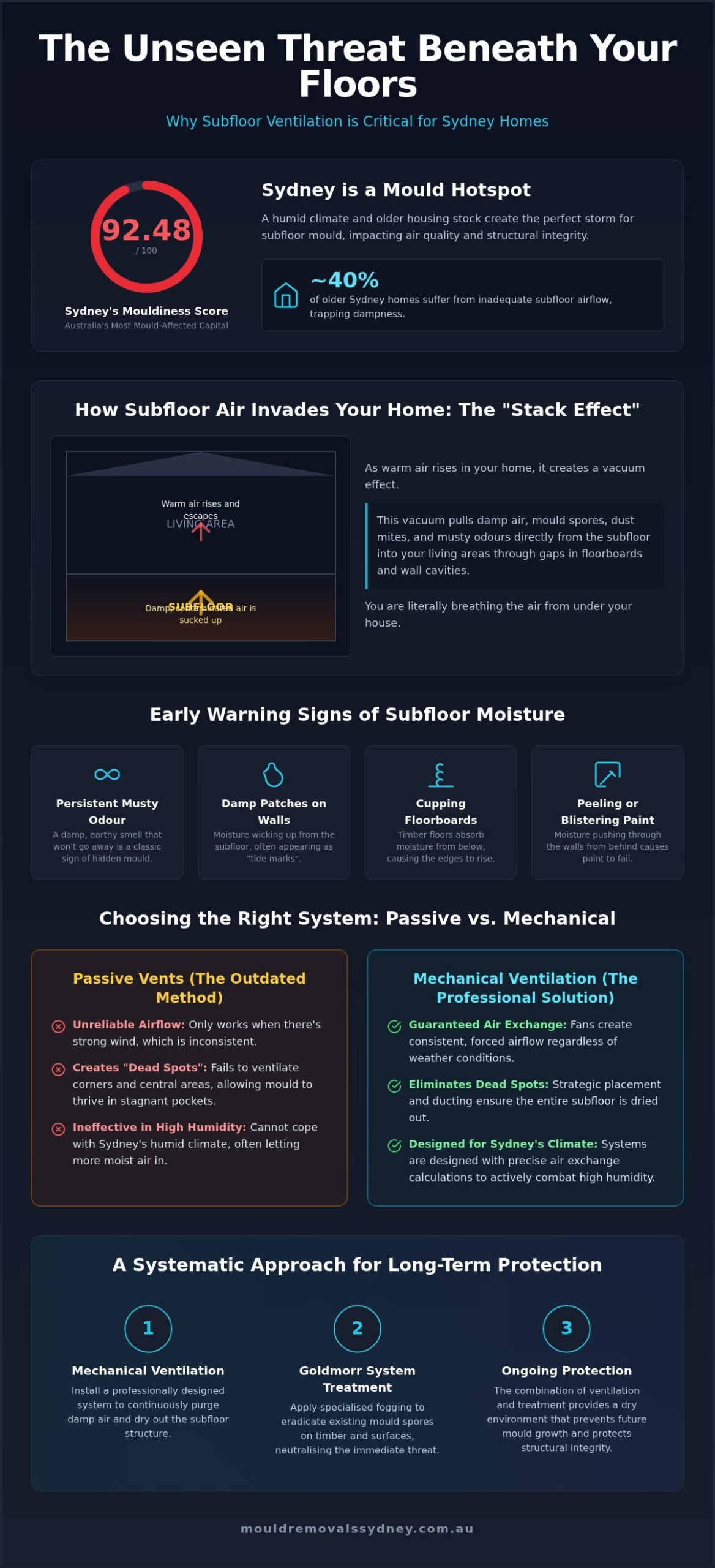
Did you know that Sydney is officially ranked as the most mould-affected capital city in Australia, with a staggering “mouldiness score” of 92.48 out of 100? If you’ve noticed a persistent musty odour or damp patches on your internal walls, you’re facing a common but serious problem. Nearly 40% of older Sydney homes suffer from inadequate airflow, making subfloor ventilation for mould prevention a critical necessity rather than an optional upgrade. It’s natural to feel anxious about airborne spores affecting your family’s health or the threat of termites attracted to damp foundations.
You deserve a home that feels fresh and safe. This guide reveals how professional subfloor ventilation stops mould at the source, protects your home’s structural integrity, and secures your family’s health. We’ll explore the latest mechanical extraction technologies, the role of the Goldmorr System in spore eradication, and the specific steps required to achieve a dry, mould-free subfloor that stands up to Sydney’s humid climate. It’s time to stop the cycle of rising damp and reclaim your indoor air quality with a systematic, evidence-based approach that delivers long-term protection.
Key Takeaways
- Understand how the “Stack Effect” draws damp, contaminated air from your foundations into your living areas and how to break the cycle.
- Discover why mechanical subfloor ventilation for mould prevention is essential for eliminating stagnant “dead spots” where passive vents often fail.
- Learn to identify early warning signs like cupping floorboards and peeling paint before subfloor mould migrates into your wall cavities.
- Explore how professional installation uses precise air exchange calculations and strategic vent placement to combat Sydney’s unique humidity levels.
- Find out why combining ventilation with the Goldmorr System is the only way to neutralise existing spores while providing long-term structural protection.
The Science of Subfloor Moisture: Why Ventilation is Non-Negotiable
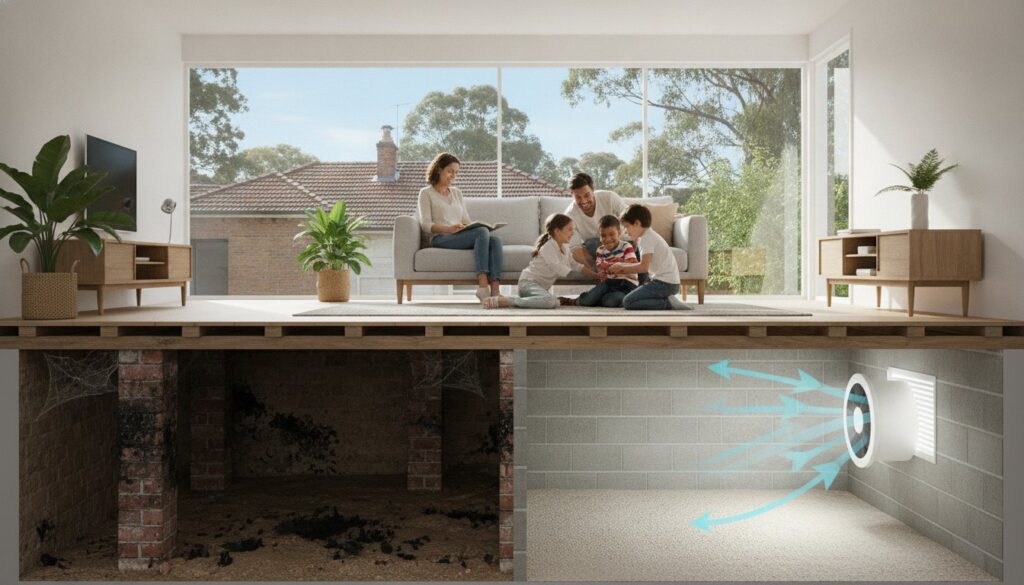
Subfloor ventilation isn’t just a series of holes in your brickwork; it’s the active, continuous exchange of heavy, moisture-laden air with fresh, dry outdoor air. For many Sydney homeowners, the space beneath their feet is an afterthought. However, this dark, enclosed environment is the primary engine for your home’s air quality. Without a functional system, moisture becomes trapped, creating a stagnant microclimate where fungal colonies thrive. Implementing professional subfloor ventilation for mould prevention ensures that this damp air is purged before it can settle and cause structural damage.
You might think the air under your house stays there, but the “Stack Effect” proves otherwise. As you heat your home or as the sun warms the roof, warm air naturally rises and escapes through the upper levels. This creates a powerful vacuum that sucks air from the lowest point of the structure, the subfloor, directly into your living areas through gaps in floorboards and wall cavities. If your subfloor is damp, you’re breathing in microscopic spores, dust mites, and earthy odours every single day. Understanding The Science of Indoor Air Quality is vital because it highlights how your foundation’s health directly dictates your family’s respiratory health.
Sydney’s traditional double-brick homes are particularly vulnerable. These structures often sit on clay-heavy soil that retains water long after the rain stops. When moisture is trapped between two layers of brickwork without adequate airflow, it creates a “ticking time bomb” for your floor joists. Standing water or high humidity levels under the house don’t just stay in the soil; they evaporate and saturate the timber, leading to rot and attracting wood-destroying pests.
The Role of Relative Humidity Under Your Floor
Mould doesn’t need a flood to grow; it only needs humidity. Once relative humidity levels in your subfloor exceed 60%, mould spores begin to germinate rapidly. Sydney’s coastal climate frequently pushes humidity levels well above this threshold, especially during the sweltering summer months. Passive terracotta vents often fail because they rely entirely on external wind pressure to move air. When the air is still, moisture settles on timber joists and bearers as condensation. This creates a consistent moisture source that sustains fungal growth even during dry spells.
Rising Damp vs. Condensation: Knowing the Difference
It’s crucial to distinguish between different moisture threats to apply the right solution. Rising damp occurs when ground water travels upward through porous masonry like a wick, often leaving “tide marks” or salt crusting on internal walls. This happens when subfloor moisture effectively bypasses your home’s original damp-proof course. In contrast, condensation forms when warm, moist air hits cold surfaces. If you have foundation leaks or drainage issues, immediate water damage repair is necessary to stop the influx of liquid water before any ventilation system can be expected to perform effectively.
Passive vs. Mechanical Ventilation: Choosing the Right System
Choosing between passive and mechanical systems is the difference between hoping for a breeze and guaranteed airflow. Traditional terracotta vents are common in Sydney, but they’re often relics of a bygone era. These passive systems rely entirely on natural wind pressure to move air. If there’s no wind, or if your home is nestled in a valley or surrounded by close neighbours, the air under your house stays stagnant. For reliable subfloor ventilation for mould prevention, modern mechanical fans are the professional standard. They provide a high-flow, forced air exchange that doesn’t wait for the weather to cooperate.
One of the biggest failures of passive systems is the “Dead Spot” problem. Air is lazy; it follows the path of least resistance. In a subfloor with only passive vents, the air usually moves in a straight line between the two closest openings. This leaves the corners and the centre of the subfloor completely untouched. These stagnant pockets remain damp, providing a perfect nursery for fungal growth. According to the National Center for Healthy Housing, controlling moisture in these hidden spaces is vital for a healthy home environment. Mechanical systems solve this by strategically placing fans and ducting to pull air from the most remote corners, ensuring every square inch of your foundation is dry.
Many Sydney properties, particularly terrace houses or homes on sloped blocks, have limited external wall access. You might only have vents on the front and back, with no way to get airflow to the middle. Mechanical extraction is essential here. Without it, moisture builds up against internal foundation walls, leading to structural timber rot. If you’re unsure if your current setup is working, booking a professional mould inspection can identify these hidden moisture traps before they cause permanent damage.
When Passive Vents Aren’t Enough
You might have clear vents but still smell that tell-tale musty odour. This often happens because Sydney’s urban density blocks natural airflow. High fences, new garden beds, or concrete patios often choke off the air supply to original terracotta vents. Sydney’s porous sandstone foundations act like a sponge. They require a much higher air exchange rate than standard passive vents can provide, especially during humid coastal summers when the air is thick with moisture.
The Advantage of Mechanical Extraction Fans
Mechanical fans offer a consistent cross-flow that purges moisture-laden air around the clock. Modern DC motors have replaced the loud, vibrating fans of the past. These units operate with a quiet hum; they’re barely noticeable to residents. The most effective systems use automated sensors. These sensors trigger the fans only when humidity levels rise. This ensures maximum efficiency. You can choose between mains-powered systems for constant reliability or solar-powered options to reduce your carbon footprint. Mains-powered units are generally preferred for their ability to run during damp, rainy nights when ventilation is needed most.
Identifying Subfloor Mould Before It Spreads
That persistent, earthy scent in your hallway isn’t just “old house” character; it’s often the first warning sign of a thriving fungal colony beneath your feet. While you might not see the growth immediately, your home’s structure and your family’s health are already under threat. Identifying these issues early is the only way to prevent a minor moisture problem from becoming a full-scale remediation project. Effective subfloor ventilation for mould prevention acts as your primary defence, but you must first recognise when the battle has already begun.
Mould is an opportunistic invader. It doesn’t stay confined to the soil or the brickwork. One of the most significant dangers for Sydney homeowners is the risk of black mould migrating from the subfloor into your wall cavities. Once it enters these voids, it can spread throughout the entire building frame, damaging insulation and internal plasterboard. This hidden migration makes the problem significantly harder and more expensive to treat if left unchecked. If you suspect growth, a professional mould inspection is vital for identifying these hidden infestations before they compromise your home’s structural integrity.
The health implications are equally urgent. As damp air is drawn upward, it carries airborne spores that trigger allergies, persistent coughing, and asthma attacks. For children or the elderly, these respiratory irritants are particularly hazardous. Don’t wait for visible spots to appear on your walls; by that stage, the spore count in your home is likely already at dangerous levels.
Physical Signs in the Living Space
Your floorboards often tell the story of what’s happening underneath. Walk through your home and check for any “bounce” or unusual softness in timber floors, as this often indicates advanced wood rot. You should also inspect internal brickwork for white efflorescence, a salty crust left behind by evaporating moisture. Don’t forget to peel back the corners of carpets or rugs; mould frequently colonises the underside of floor coverings where air circulation is poorest.
The Airborne Threat: Spores You Can’t See
Visible mould represents only about 10% of the total fungal biomass in an infested home. The real risk lies in the 90% you can’t see: the billions of microscopic spores suspended in the air. Microscopic spores travel through tiny gaps in floorboards and service penetrations, riding the Stack Effect directly into your breathing zone. Specialized mould removal sydney experts use advanced air sampling to test for subfloor spore counts, providing a scientific baseline that visual inspections simply cannot match. This data-driven approach ensures that your ventilation system is designed to handle the actual biological load of your specific property.
Professional Installation: Designing for Sydney’s Climate
Professional installation of subfloor ventilation for mould prevention is a precise engineering task, not a simple weekend project. We begin by calculating the total cubic volume (m³) of your subfloor space to determine the exact fan capacity required. While the National Construction Code (NCC) 2022 currently governs New South Wales, the transition to NCC 2025 has already begun. These updated standards place a heavier emphasis on condensation management, particularly in humid coastal zones like Sydney. A system that doesn’t meet these specific air exchange requirements will fail to keep your foundations dry during a typical Sydney summer.
Strategic vent placement is the secret to a successful system. If fans are placed incorrectly, you risk “short-circuiting” the airflow. This happens when the system draws fresh air from a nearby vent and exhausts it immediately, leaving the dampest areas in the centre of the subfloor completely stagnant. We use advanced airflow modelling to ensure there are no “dead zones” where moisture can accumulate. DIY installations often overlook these dynamics, resulting in ineffective systems that consume electricity without actually solving the mould problem. Professional installers also ensure all electrical work is performed by licensed specialists, as even small DC fans require safe, compliant wiring to avoid fire risks in confined spaces.
Sydney’s geography presents unique challenges, particularly in suburbs with high water tables or clay-heavy soils. In areas like the Inner West or Northern Beaches, ventilation alone might not be enough if liquid water is actively seeping into the subfloor. We identify these issues during our initial assessment. If your home has poor site drainage, we may recommend installing a 200-micron polythene ground moisture barrier. This can reduce soil evaporation by up to 80%, allowing the ventilation system to focus on air exchange rather than fighting constant ground moisture. To ensure your home is protected by a system designed for these local conditions, book a professional subfloor ventilation installation with our expert team.
Sizing Your System Correctly
Determining fan capacity starts with the cubic area of the void. We also factor in “make-up air” requirements. For every litre of damp air we extract, a litre of fresh, dry air must enter the space. Without this balance, the system creates negative pressure that can actually pull more moisture or dust into the subfloor. We often find that installing multiple smaller, high-efficiency fans is more effective than one large unit. This approach allows us to create a sophisticated cross-flow that reaches every corner of the foundation.
Sydney Architectural Challenges
Heritage federation homes and terrace houses often feature internal “dwarf walls” that act as barriers to airflow. We must navigate these structural obstacles by using specialized ducting or through-wall fans to ensure air isn’t trapped in mid-sections. Split-level homes on sloping blocks also require custom strategies, as moisture naturally pools at the lowest points. If stagnant subfloor air has already been drawn into your home’s cooling systems via the “Stack Effect,” you may also need professional air duct cleaning to remove spores that have migrated into your HVAC network.
The ABC Solution: Combining Goldmorr Fogging with Ventilation
Installing a high-quality fan system is a brilliant move for the future of your home, but it isn’t a magic wand for existing problems. While subfloor ventilation for mould prevention is the industry standard for keeping foundations dry, it cannot kill fungal colonies that have already taken root. If your floor joists are currently covered in spores, simply turning on a fan can actually backfire. High-flow extraction may disturb these colonies, pulling even more contaminants into your breathing zone via the Stack Effect. To truly secure your home, you need a dual-action strategy that eliminates the current threat before establishing long-term protection.
ABC Mould Cleaning Solutions provides a systematic, three-step methodology to restore your home’s health. We don’t just treat symptoms; we solve the underlying environmental crisis. Our process is designed for maximum efficiency and total transparency:
- Step 1: Forensic Inspection. We identify the specific moisture sources and map out “dead zones” where air has stagnated.
- Step 2: Goldmorr Remediation. We deploy our proprietary fogging system to neutralise every active spore in the subfloor cavity.
- Step 3: Mechanical Prevention. We install a custom-engineered ventilation system to ensure humidity never again reaches the 60% germination threshold.
We stand behind our work with a no-nonsense commitment to value. Our team offers a price-match guarantee where we will beat any written competitor quote by 10%. You get the highest level of technical expertise and the most advanced remediation technology without the premium price tag. It’s a professional, affordable, and effective way to protect your property investment.
The Goldmorr Advantage
In the tight, confined spaces of a Sydney subfloor, traditional scrubbing is often impossible and rarely thorough. The Goldmorr System solves this by using a biodegradable, non-toxic fog that reaches every hidden crevice. This specialized fogging agent neutralises airborne spores and surface colonies on contact, including those tucked behind dwarf walls or inside porous brickwork. Because the product is biodegradable, it’s completely safe for your family, your pets, and the surrounding environment. It eliminates the need for invasive structural work, saving you time and money while delivering a scientifically clean result.
Long-Term Maintenance and Peace of Mind
A dry subfloor requires consistent performance. We recommend annual check-ups to ensure your mechanical fans remain clear of dust, spider webs, and garden debris. During these visits, we monitor humidity levels to confirm the system is performing exactly as designed. This proactive maintenance prevents small issues from escalating into major structural threats. Don’t let hidden moisture undermine your home’s foundation or your family’s health. Take the first step toward a permanently dry home and request a professional subfloor inspection today.
Take Control of Your Home’s Health Today
Your home’s foundation shouldn’t be a source of anxiety or respiratory illness. We have explored how stagnant air and the “Stack Effect” compromise your living space, but you now have the knowledge to stop this cycle. Remember that effective subfloor ventilation for mould prevention requires a dual approach. You must first neutralise existing colonies with our specialised Goldmorr System and then install a precisely engineered mechanical system to keep moisture at bay. Our expert Sydney-based installation team understands the unique challenges of local sandstone foundations and high water tables. We provide a comprehensive structural and health solution that retail DIY kits simply cannot match.
Don’t let musty odours and timber rot devalue your property or threaten your family’s wellbeing. Our streamlined process makes restoration straightforward and stress-free. We offer a pragmatic, results-driven service that transitions your home from a state of concern to total resolution. Take the first step toward permanent protection now.
Book Your Sydney Subfloor Inspection & Get a Free Quote
You can finally enjoy the peace of mind that comes with a dry, healthy, and protected home.
Frequently Asked Questions
Is subfloor ventilation noisy during the night?
Modern systems are designed for whisper-quiet operation and are barely audible from within the living areas of your home. High-quality DC motors produce a very low-frequency hum that doesn’t disrupt sleep or daily activities. We can also install smart timers or humidity sensors to ensure fans only operate during optimal daylight hours or when moisture levels actually require extraction.
How much does it cost to run a subfloor ventilation system?
Running costs are exceptionally low for modern, energy-efficient systems. Some low-voltage fans can operate for as little as $4 per year in electricity costs. These units are designed for long-term, continuous use without significantly impacting your household utility bills. Choosing a high-efficiency system ensures you protect your home’s structure while maintaining a minimal environmental footprint.
Can subfloor ventilation help with termite prevention?
Yes, subfloor ventilation for mould prevention is a powerful secondary defence against termite infestations. Termites are naturally attracted to damp, decaying timber and high-humidity environments. By actively removing stagnant, moist air and keeping your floor joists dry, you create an inhospitable environment for these wood-destroying pests, supporting your primary termite management plan. If you are located in other regions and need expert assistance with structural pests, you can check out Northern Tas Pest Control for professional guidance.
Will subfloor fans stop rising damp completely?
Ventilation manages the symptoms of moisture but won’t repair a physically compromised damp-proof course. It works by rapidly evaporating moisture from brickwork and soil before it can migrate into your living spaces. In severe cases, we recommend a holistic approach that combines mechanical extraction with improved site drainage or a 200-micron polythene ground moisture barrier for total protection.
How long does a professional subfloor ventilation installation take?
Most professional installations for standard Sydney homes are completed within four to eight hours. The exact timeframe depends on your home’s footprint and the complexity of the subfloor layout, such as the presence of internal dwarf walls. Our specialists aim for a “same-day” resolution to ensure your home’s moisture management is restored with minimal disruption to your schedule.
Do I need to clear my garden beds before installing new vents?
Yes, you must ensure that all external vent openings are clear of soil, mulch, and dense foliage. Obstructed vents choke the air supply and prevent the system from achieving the necessary air exchange rates. We recommend maintaining a clear space of at least 150mm around each vent to allow for unrestricted intake and exhaust of subfloor air.
Can I install a subfloor fan myself?
No, you shouldn’t attempt a DIY installation because Australian law requires all fixed electrical components to be installed by a licensed electrician. Furthermore, DIY kits often result in “short-circuiting” where air is drawn from the nearest opening rather than the dampest corners. Professional subfloor ventilation for mould prevention ensures that fans are strategically placed to eliminate stagnant “dead zones” effectively.
How often should I have my subfloor ventilation system serviced?
We recommend a professional service every 12 to 24 months to maintain peak performance. During these check-ups, we clear debris from grilles, inspect fan bearings for wear, and verify that humidity sensors are calibrated correctly. Regular maintenance ensures the system continues to purge moisture-laden air effectively, preventing the return of musty odours and fungal growth.