
What if the “sudden” storm damage that soaked your carpets leads to a A$5,000 mould bill your insurer refuses to pay? It’s a common nightmare for Sydney homeowners. You’ve already dealt with the stress of water ingress; now you’re facing toxic spores and the fear of a claim denial. You likely feel that if you pay your premiums on time, your property should be protected from every angle. Unfortunately, the question of does insurance cover mould removal Sydney residents often ask doesn’t have a simple answer. Most insurers view mould as a maintenance issue unless you can prove it resulted from a specific, covered event like a burst pipe or flash flooding.
This guide cuts through the fine print to show you exactly how to secure a successful claim. You’ll learn the “yes/no” framework insurers use to evaluate damage and the critical steps you must take to document evidence before the cleanup begins. We’ll also explain why professional remediation using the Goldmorr System is often the only way to satisfy an insurer’s requirement for a permanent, safe solution. By the end of this article, you’ll have a clear roadmap to protect your health, your tenants, and your bank account from the high costs of remediation.
Key Takeaways
- Identify the critical difference between “primary” maintenance issues and “secondary” damage to understand when your policy triggers coverage.
- Discover the specific “sudden and accidental” scenarios where does insurance cover mould removal Sydney homeowners need after burst pipes or flash flooding.
- Master a professional five-step documentation process to capture the evidence required to prevent claim denial and secure your payout.
- Learn why professional air scrubbing and specialized remediation are mandatory for insurance compliance rather than DIY cleaning methods.
- Understand how Sydney’s unique humidity factors accelerate damage and why immediate action is vital for both health safety and claim success.
Understanding Mould Coverage in Australian Home Insurance
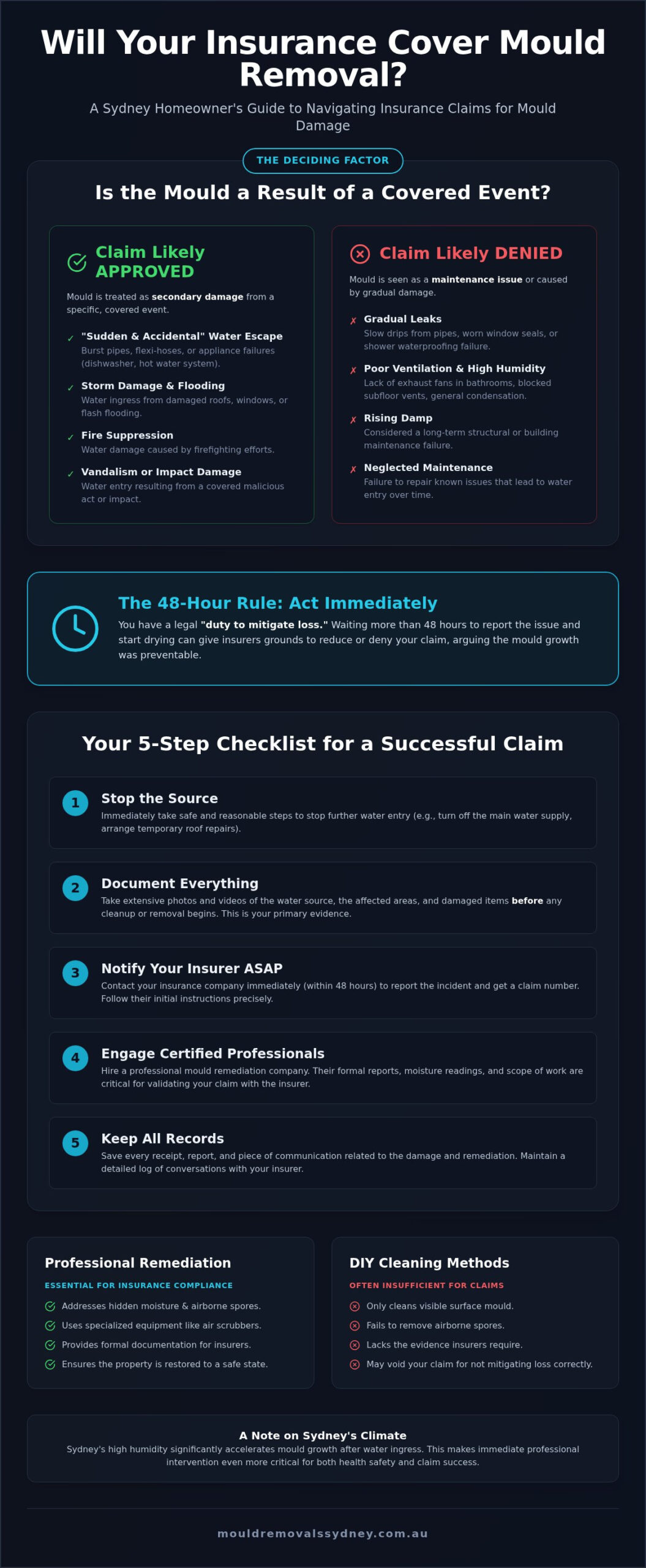
Your Product Disclosure Statement (PDS) is the final word on your coverage. In Australia, most policies treat mould with suspicion. It is rarely covered as a standalone “primary” issue. Instead, insurers categorize mould as a maintenance problem that homeowners are responsible for managing. This creates a high hurdle for many. To determine if your claim stands a chance, you must distinguish between gradual damage and sudden, accidental events. The insurer’s primary duty is to restore your property to its pre-loss condition, but they will only do so if the root cause is a listed “insured event.” This means the mould removal isn’t the claim itself; it’s a necessary part of fixing the damage caused by something else.
The “Preventable” Argument: Why Claims Get Denied
Insurers frequently deny claims by labeling the damage as preventable. If your bathroom lacks adequate exhaust fans or your subfloor ventilation is blocked, the resulting growth is seen as your responsibility. They expect you to maintain the property to a reasonable standard. A small window seal leak that you ignore for months will be classified as “gradual damage.” This is the death knell for a claim. Similarly, rising damp is viewed as a long-term structural failure rather than a sudden accident. Because these issues develop over time, they fall outside the scope of standard home and contents insurance. If the insurer can prove you had the opportunity to stop the moisture and didn’t, they’ll likely walk away.
Mould as a Result of an Insured Event
The landscape changes completely when mould is a “secondary” result of a covered catastrophe. Insured events typically include fire, storms, or the “sudden and accidental” escape of liquid from plumbing systems. If a pipe bursts behind your kitchen wall and mould develops within days, you have a strong case for a payout. The question of does insurance cover mould removal Sydney property owners face is usually answered “yes” when the growth is a direct consequence of the water damage. The insurer’s legal obligation is to restore your home to its pre-loss condition. This means they must address the moisture and the resulting biological growth to ensure the environment is safe for occupants. You cannot effectively restore a water-damaged room without removing the airborne spores that have settled on surrounding surfaces. Collateral mould damage is defined as a claimable secondary loss when it arises directly from an insured event such as a sudden pipe failure or storm-driven water ingress.
The “Sudden and Accidental” Rule: When Claims Get Approved
The “sudden and accidental” rule is the pivot point for most successful insurance claims in New South Wales. If you’re asking does insurance cover mould removal Sydney insurers will look for a definitive, time-stamped event. Burst flexi-hoses under kitchen sinks are the primary culprit. These failures happen instantly, releasing hundreds of litres of water into cabinetry and floorboards. Because the event is sudden, the resulting mould is usually covered under standard home and contents policies.
Flash flooding and severe Sydney storms also trigger coverage. When a hailstone smashes a roof tile or high winds lift flashing, water enters the ceiling cavity. Mould follows within days. Similarly, appliance failures like a dishwasher pump blowing or a hot water system tank splitting while you’re at work are classic examples of accidental damage. Even rare events like vandalism or the water used by Fire and Rescue NSW to extinguish a blaze count as insured events that lead to claimable mould remediation.
The Importance of Prompt Action
Speed is your greatest ally in a claim. You have a legal “duty to mitigate loss,” which means you must take reasonable steps to stop the damage from worsening. Waiting more than 48 hours to report an issue or start drying can give insurers a reason to reduce your payout. They may argue the mould growth was preventable if you had acted sooner. Engaging professional mould removal specialists immediately demonstrates your commitment to minimizing the loss. This proactive approach creates a paper trail that supports your claim and protects your health.
Identifying the Source of Moisture
You cannot fix what you cannot see. A professional mould inspection provides the technical evidence required to satisfy a claims adjuster. Hidden leaks behind gyprock or under subfloors are common in older Sydney terraces and bungalows. When determining does insurance cover mould removal Sydney adjusters focus on the timeline of the moisture event. We use advanced thermal imaging and moisture meters to map the exact path of water ingress. This data proves the mould is a direct result of the sudden event rather than a long-term maintenance failure. If you suspect a hidden leak, getting an expert mould remediation report is the best way to secure your financial recovery.
Sydney Storms and Water Damage: Navigating Local Claims
Sydney’s environment is uniquely hostile to property preservation during the storm season. The “Sydney Humidity Factor” acts as a biological accelerant. Once water enters a building envelope, the relative humidity often exceeds 70%. This is the critical threshold where dormant spores activate and multiply. In 2026, we’ve seen a measurable spike in moisture-related claims following a series of intense East Coast Lows that battered the basin. These weather patterns don’t just cause immediate leaks; they create a lingering dampness that traditional drying methods fail to address.
Geography plays a massive role in your risk profile. Coastal residents in the Northern Beaches deal with wind-driven rain that forces moisture through weep holes and window flashings. Conversely, Western Suburbs like Blacktown or Penrith experience intense heat immediately following rain. This creates a “greenhouse effect” inside wall cavities. When asking does insurance cover mould removal Sydney homeowners must realize that insurers track these local weather events. If your suburb was in the direct path of a declared storm, your chances of an approved claim increase significantly. Landmarks near flood-prone areas like the Hawkesbury-Nepean Valley or the Georges River face even stricter scrutiny regarding “gradual” vs “sudden” ingress.
Storm-Related Water Ingress
Most approvals hinge on the exact point of entry. A cracked tile from a fallen branch is a clear, sudden insured event. However, if your gutters were choked with organic debris, the insurer may argue the overflow was a maintenance failure. Consider a typical 2026 case study: a storm in Surry Hills caused a flash flood that overwhelmed a balcony drain. Because the drain was clear but the volume of water was “unprecedented,” the resulting ceiling mould was fully covered. You must document the intensity of the local weather to prove the event was beyond your control.
The Subfloor Ventilation Connection
Older Sydney terraces and bungalows often rely on passive vents. These are frequently blocked by modern landscaping or years of debris. This lack of airflow creates a damp microclimate under your home. Insurers often view subfloor growth as a long-term, “preventable” issue rather than a sudden accident. To protect your property, many owners are now installing active subfloor ventilation systems. These systems ensure consistent air exchange. They remove the stagnant moisture that leads to claim denials and structural rot. Proactive moisture management is the best way to ensure your property remains a low-risk asset in the eyes of your provider.
5 Steps to Take Before Filing Your Mould Insurance Claim
Preparing a claim requires a systematic approach to avoid the “maintenance” trap set by many Australian insurers. When asking does insurance cover mould removal Sydney residents must realize that the burden of proof rests entirely on the policyholder. You need to prove that the growth is a direct result of a sudden event rather than neglect. Follow these five steps to build a bulletproof case before you pick up the phone to call your provider.
- Safety first: Do not touch or disturb the mould. This releases spores into the air, worsening the contamination. Immediately stop the water source if it is safe to do so, such as turning off the mains for a burst pipe.
- Document everything: Capture high-resolution visual evidence before any cleanup begins. This is your most valuable asset during the claims process.
- Call for a professional inspection: An expert report identifies the moisture source with technical precision. This prevents the insurer from claiming the issue was pre-existing.
- Review your PDS: Look specifically for “Flood,” “Storm,” and “Escape of Liquid” clauses. These are the triggers that typically override the standard mould exclusion.
- Contact your insurer immediately: Lodge your intent to claim as soon as the damage is discovered. Delays can be interpreted as a failure to mitigate loss.
Documenting the Damage Correctly
Visual evidence must be comprehensive to satisfy a claims adjuster. Take wide shots of the affected rooms to show the total scale of the damage. Follow these with close-up photos of the moisture source, such as the specific burst flexi-hose or the water line on the skirting boards. Record the exact date and time of discovery to establish a clear timeline. Keep a detailed log of any respiratory issues, headaches, or allergic reactions experienced by occupants since the moisture event began. This health data adds weight to the urgency of the remediation request.
The Professional Inspection Report
An expert opinion carries significantly more weight than a DIY assessment. While you might see “black spots,” a specialist uses moisture meters and thermal imaging to prove the link between a burst pipe and the resulting fungal growth. ABC Mould Cleaning Solutions assists property owners by providing detailed documentation that maps the moisture profile of the home. This technical data is essential for proving the mould is a “secondary loss” from an insured event. Our reports provide the evidence needed to challenge a denial and ensure your home is restored to a safe, pre-loss condition. If you need a professional assessment to support your claim, book our mould inspection services today to get the evidence you need.
Why Professional Remediation is Essential for Insurance Compliance
Insurers don’t just want the mould gone; they want proof that the property is safe for habitation. Many homeowners attempt DIY fixes with bleach or vinegar, but these retail products only treat surface stains. They don’t kill the root system of the fungus or address the airborne spores. In the context of does insurance cover mould removal Sydney, providers look for professional remediation that meets industry standards for airborne spore reduction. If you simply wipe a wall, the insurer may argue you haven’t addressed the underlying risk, potentially complicating future claims.
True remediation involves a “Make Safe” phase followed by deep cleaning and air purification. Insurers require a final sign-off that confirms the indoor environment has returned to a healthy state. This is often verified through independent air quality testing. We focus on lowering airborne spore counts to levels that match or beat the outdoor environment, ensuring the home is safe for families or tenants.
The Goldmorr Fogging Advantage
Our specialized Goldmorr System uses biodegradable fogging to penetrate areas manual cleaning cannot reach. This includes wall cavities, ceiling voids, and subfloor spaces where moisture often lingers. This method is significantly faster than traditional scrubbing, which helps contain the total cost of the insurance payout. Beyond the visible growth, fogging eliminates the persistent musty smell that signals lingering contaminants. It provides a comprehensive solution that satisfies the insurer’s requirement for permanent restoration.
Water Damage Restoration and Air Scrubbing
Mould is rarely a standalone issue. It is almost always the result of a moisture event that requires professional water damage repair. We use industrial-grade air scrubbing machines equipped with HEPA filters to capture microscopic spores during the remediation process. This step is vital for occupant health, as it prevents cross-contamination to unaffected areas of the home. Once the structural drying and air purification are complete, you’ll receive the documentation needed to close your claim with confidence. We ensure your Sydney property is fully restored to its pre-loss condition, providing the emotional relief and security you deserve.
Secure Your Property and Your Payout Today
Navigating the complexities of home insurance doesn’t have to be a solo struggle. Remember that while standard policies often exclude general maintenance, they do support you when mould follows a sudden, accidental event like a burst pipe or a severe Sydney storm. The question of does insurance cover mould removal Sydney residents often ask depends entirely on the quality of your evidence and the speed of your response. By documenting the damage immediately and identifying the exact moisture source, you shift the narrative from preventable neglect to a legitimate insured loss.
Don’t let toxic spores compromise your family’s health while you wait for a claims adjuster. Our expert Goldmorr System technicians provide the professional surface and air purification required to meet strict insurance restoration standards. We deliver comprehensive, insurance-ready reports that give your provider the technical proof they demand. With our 24/7 emergency water damage response, we stop the growth before it escalates into a structural nightmare.
Get a Professional Mould Inspection & Insurance Report Today to protect your investment. You deserve a home that’s safe, dry, and fully restored.
Frequently Asked Questions
Is black mould covered by home insurance in Sydney?
Black mould is covered when it is a secondary loss resulting from a sudden, insured event. If a pipe bursts or a storm damages your roof, the subsequent mould growth is typically included in the restoration. However, insurers won’t pay if the growth stems from high humidity or poor bathroom ventilation. The question of does insurance cover mould removal Sydney residents ask is always tied to the root cause of the moisture.
Can I claim mould removal if it was caused by a leaking roof?
You can claim if the leak was caused by a sudden event like a fallen tree or hail damage during a storm. Insurers distinguish between “sudden” and “gradual” damage. If your roof has been leaking for months due to old tiles or rusted gutters, the claim will likely be denied under the maintenance exclusion. Professional documentation of the storm event is essential for a successful payout in these scenarios.
What is the “Escape of Liquid” clause in my insurance policy?
The “Escape of Liquid” clause covers sudden and accidental leaks from fixed plumbing systems or appliances. This includes burst flexi-hoses, split hot water tanks, or overflowing dishwashers. If these events lead to fungal growth, the remediation is usually covered. This clause is the most common trigger for approved claims because it involves an identifiable, sudden event that a homeowner couldn’t have reasonably prevented through routine maintenance.
How long do I have to report mould damage to my insurer?
Report the damage as soon as you discover it. Most New South Wales policies require you to notify the insurer immediately to satisfy your “duty to mitigate loss.” If you wait weeks to report a leak, the insurer may argue that the mould growth became worse because of your delay. Fast action and professional evidence gathering are your best strategies for ensuring the claim is accepted without complications.
Will insurance pay for a hotel if my house has a severe mould infestation?
Insurance may pay for temporary accommodation if a covered event makes your home unsafe to live in. Severe mould infestations often trigger health risks that make a property uninhabitable. If the mould is a direct result of a burst pipe or storm, your “Additional Living Expenses” clause should cover hotel costs. You must provide a professional remediation report confirming that the airborne spore levels are hazardous to occupants.
Does insurance cover mould in a rental property in NSW?
Coverage depends on who owns the policy and what caused the damage. Landlord insurance typically covers mould remediation if it results from a sudden plumbing failure or storm. Tenants usually need their own contents insurance to cover mould damage to furniture or clothing. In NSW, the landlord is generally responsible for the structural cleanup if the moisture source is a building defect or a covered insured event.
Why did my insurer deny my mould claim for “lack of maintenance”?
Claims are often denied because the insurer believes the damage was preventable. If you ignored a damp patch for months or failed to clear your gutters, they will classify the mould as “gradual damage.” They expect property owners to perform regular inspections and repairs. Providing a professional report that proves the moisture was sudden and hidden is the only way to challenge a “lack of maintenance” denial effectively.
What should I do if my insurer refuses to pay for professional remediation?
Lodge a formal dispute through your insurer’s internal dispute resolution process. You should provide a detailed report from a specialist remediation expert that identifies the “sudden” moisture source. If the internal review fails, you can take your case to the Australian Financial Complaints Authority. Having technical evidence from a professional inspection is the most powerful tool you have to prove does insurance cover mould removal Sydney for your specific case.