In Sydney’s high-humidity coastal environment, traditional passive vents are often little more than decorative holes in your brickwork. They simply cannot move enough air to combat the stagnant moisture that a modern smart subfloor ventilation system is designed to extract.
You’ve likely felt the anxiety of a recurring musty odor or noticed your floorboards starting to cup, signaling that dampness is trapped and active. It’s exhausting to worry about the health risks of airborne spores when standard solutions fail to keep your foundations dry. We understand that your home’s structural integrity and your family’s well-being are non-negotiable.
This guide explains how automated moisture-management technology transforms your home into a self-regulating environment that eliminates dampness permanently. We will break down the 2026 National Construction Code updates and show how intelligent sensors work alongside the Goldmorr System to guarantee a healthy subfloor. You’ll learn how to protect your property with a professional solution that requires zero manual adjustment.
Key Takeaways
- Understand the evolution from passive bricks to the modern smart subfloor ventilation system that uses automated sensors to manage moisture levels in real-time.
- Learn why sensor-driven technology is essential to prevent the intake of humid external air, ensuring your subfloor stays dry even during Sydney’s wettest months.
- Discover the critical differences between exhaust, inflow, and crossflow configurations to determine the most effective setup for your home’s specific layout.
- Identify why professional placement is vital to avoid short-circuiting airflow and ensure every damp corner of your property is properly ventilated.
- See how integrating active ventilation with the Goldmorr System creates a permanent barrier against mould regrowth after professional remediation.
What is a Smart Subfloor Ventilation System?
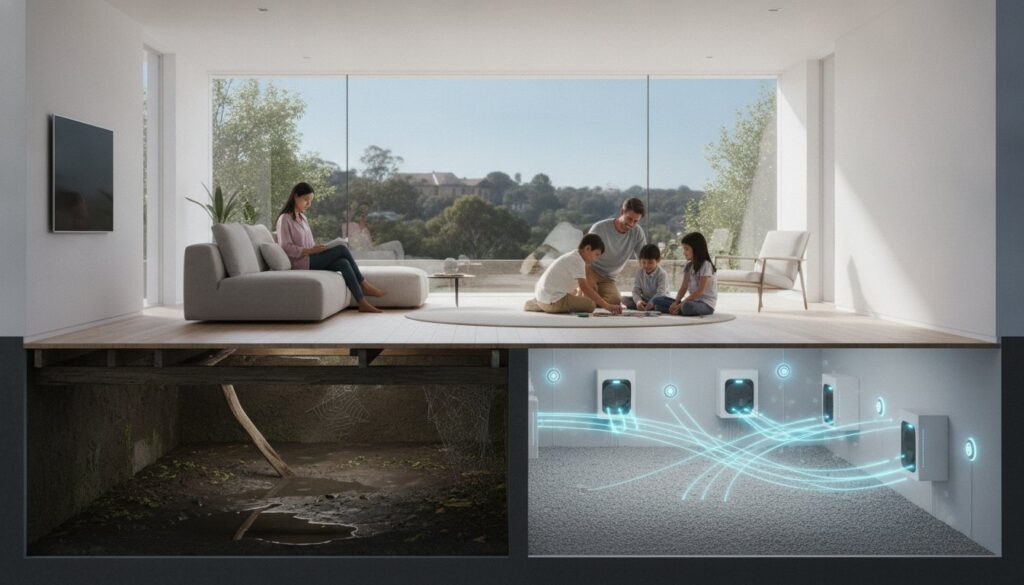
A smart subfloor ventilation system is an automated moisture-management solution that uses precision sensors to maintain a dry environment beneath your home. It’s a responsive ecosystem. Unlike older methods, it doesn’t just run on a timer. It monitors real-time environmental data to decide exactly when to move air. This is a critical upgrade for Sydney properties. Our local sandstone foundations and timber joists are constantly under threat from high coastal humidity and rising damp.
Effective moisture control relies on the same fundamental principles as Underfloor Air Distribution (UFAD). It utilizes the subfloor plenum to circulate air and prevent stagnation. By treating the space under your home as a managed zone rather than a forgotten cavity, you protect your home’s structural integrity from rot. Without this active management, moisture builds up, leading to cupped floorboards and musty odors that permeate your living spaces.
The Core Components of a Smart System
Modern systems rely on three primary pillars of technology to ensure total effectiveness. High-efficiency EC (Electronically Commutated) fans provide powerful airflow with minimal noise. These aren’t your standard loud hardware-store fans. They’re engineered for continuous, quiet operation and consume about as much power as a single LED light bulb. Digital hygrostats and thermostats act as the system’s brain, measuring both temperature and relative humidity with surgical precision. Finally, smart controllers with WiFi integration allow you to monitor your subfloor’s health directly from your smartphone. You’ll see real-time data on moisture levels, proving the system is working before you ever smell a problem.
Passive vs. Mechanical vs. Smart: The Evolution
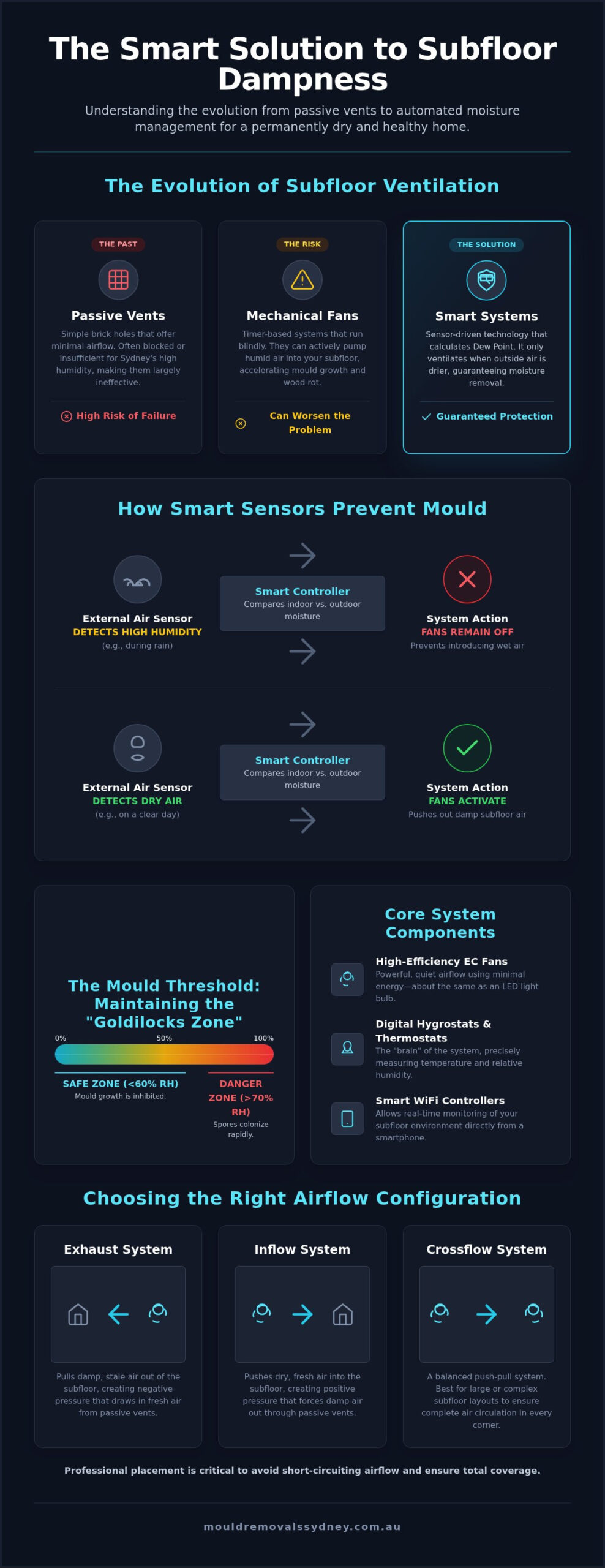
For decades, Sydney builders relied on terracotta passive vents. In high-density suburbs like the Inner West or Northern Beaches, these vents are often blocked, shadowed, or simply insufficient. They can’t move enough air to dry out damp soil. Standard mechanical fans were the next step, but they carry a massive risk. If it’s raining or humid outside, a basic fan blindly pumps “wet” air into your subfloor. This actually accelerates mould growth and wood decay.
Smart systems eliminate this risk by calculating the “Dew Point.” They only activate when the external air is demonstrably drier than the air trapped under your house. This precision prevents the accidental introduction of moisture. It ensures your foundations remain well below the 14% moisture threshold required by Australian Standards (AS 1884). It’s the difference between guessing and guaranteed protection for your property.
How Smart Sensors Prevent Mould Growth
A smart subfloor ventilation system operates on the principles of psychrometrics. This is the science of how temperature and humidity interact within a given space. Traditional fans are “dumb” because they run regardless of external conditions. If it is raining in Sydney and the humidity is 90% outside, a standard fan will pump that moisture directly into your foundations. Smart sensors prevent this by comparing the moisture content of the external air with the internal subfloor environment. The system only activates when the outside air is demonstrably drier, ensuring you never accidentally import dampness.
We aim to maintain what specialists call the “Goldilocks Zone.” This is a balanced environment where moisture levels are too low for fungal life to survive. As established in the EPA guide to mold and moisture, controlling indoor dampness is the primary strategy for preventing mould colonization. By using automated speed adjustments, the system responds to environmental threats in real-time, throttling up during high-risk periods and slowing down when conditions are stable to save energy.
Relative Humidity and the Mould Threshold
Mould spores are opportunistic and remain dormant until environmental conditions are perfect. Once subfloor humidity exceeds 70%, these spores colonize timber joists and insulation with alarming speed. The mould threshold is strictly defined as maintaining a target relative humidity of 60% or lower to inhibit fungal activity. A smart system provides 24/7 monitoring that no manual check can replicate. It catches moisture spikes before they become a health hazard, providing a level of security that passive vents simply cannot offer.
Temperature Sensing and Condensation Control
Temperature differentials are a major cause of hidden dampness. During Sydney’s cool winters, the temperature gap between your heated living spaces and the cold subfloor creates condensation on the underside of floorboards. Sensors identify these thermal shifts and detect “dead zones” where air remains stagnant. By using this thermal data, the system optimizes airflow patterns across the entire footprint of your home. This targeted approach eliminates localized damp spots that often lead to cupped timber and structural decay. If you already notice musty odors, a professional mould inspection is a necessary first step to ensure your subfloor is clean before the ventilation system begins its work.
Choosing the Right Configuration: Exhaust vs. Inflow vs. Crossflow
Selecting the correct configuration for your smart subfloor ventilation system is a matter of physics. Every Sydney home has a unique footprint. Factors like foundation depth, soil type, and prevailing winds dictate how air moves through the subfloor plenum. If your property sits on heavy clay, moisture retention is naturally higher. Conversely, homes on sandy soil face different challenges with rising damp. A professional assessment identifies these variables to ensure the mechanical solution matches the environmental reality of your site.
- Exhaust Ventilation: This setup focuses on pulling damp, stagnant air out of the subfloor. It creates negative pressure, which naturally draws fresh air in through existing passive vents.
- Inflow Ventilation: This approach pushes fresh, dry air into the cavity. It works by displacing heavy, moisture-laden air and forcing it out through relief vents.
- Crossflow Systems: This is the gold standard for complex layouts. It uses a synchronized pair of intake and exhaust fans to create a high-velocity air current that leaves nowhere for moisture to hide.
When to Use Exhaust-Only Systems
Exhaust-only systems are highly effective for homes with plenty of existing, unobstructed terracotta vents. If your passive vents are clear, the fans can efficiently create the pressure differential needed for consistent airflow. This configuration is specifically designed to handle concentrated damp spots and heavy musty odors. By maintaining negative air pressure, these systems prevent contaminated air from rising through gaps in floorboards and into your living areas. It’s a proactive way to keep airborne spores away from your family’s breathing zone.
The Power of Crossflow Ventilation
Large or multi-level Sydney floorplans often have “dead air” pockets where traditional fans can’t reach. Crossflow ventilation solves this by pairing intake and exhaust units. This combination achieves the highest possible air exchange rates. Strategic fan placement is vital here. We position units to ensure air travels across the entire subfloor area, leaving no corner unventilated. Professional installation is mandatory for these setups. Improperly balanced systems can lead to pressure imbalances or “short-circuiting,” where air moves between fans without actually drying the soil. Our specialists calculate the exact cubic meters of air required to maintain a dry, healthy environment for your specific property.
Professional Installation: Why Placement is Critical
A smart subfloor ventilation system is only as effective as its physical placement. Many Sydney homeowners attempt a DIY approach, assuming that bolting a fan to an existing vent hole is sufficient. This is a dangerous oversimplification. Without a professional understanding of airflow dynamics, you risk short-circuiting the system. Your home’s location also dictates specific hardware requirements. A terrace in the Inner West with porous sandstone foundations requires a different moisture-management strategy than a Northern Beaches home exposed to corrosive, salty coastal air. We ensure all hardware is IP-rated to withstand these harsh environments and prevent premature motor failure.
The ABC Mould Cleaning Solutions Assessment Process
We don’t guess; we measure. Our specialists begin by moisture mapping your subfloor to identify the exact source of dampness. This may be groundwater seepage, poor external drainage, or a lingering issue requiring professional water damage repair. We also inspect for structural impediments like internal sleeper walls. These brick barriers often block natural airflow, creating stagnant “dead zones” where mould thrives undetected. Our assessment verifies electrical safety and ensures that fan units are positioned to minimize noise disruption for residents while maximizing air exchange rates across the entire footprint of the property.
Avoiding Common Installation Failures
The most frequent error in amateur installations is failing to account for the plenum’s pressure. If fans are installed too close to an air intake point, they fail to exchange air deep within the subfloor cavity. We focus on sealing secondary air leaks to maintain the necessary pressure differential for a true whole-of-house solution. Short-cycling air is the #1 mistake in DIY ventilation because it creates a feedback loop of fresh air near the vent while leaving the core of your subfloor trapped with moisture and active mould spores. To avoid these costly errors and ensure your home is protected by a high-performance system, contact us for a professional subfloor ventilation installation quote today.
Integrating Ventilation with Professional Mould Remediation
Mould is a biological organism. Once it establishes a colony on your timber joists, simply increasing airflow will not remove the established root structures or the toxic spores already present in the soil. A smart subfloor ventilation system is a preventative tool, not a curative one. If you have active growth, installing a fan without prior treatment simply risks spreading spores into other areas of your home. We follow a strict “Clean, Then Ventilate” protocol to ensure your foundations are sterile before the automated maintenance cycle begins.
This integrated approach serves as a long-term insurance policy for your mould removal Sydney investment. By remediating the existing threat first, you ensure the smart system is maintaining a healthy environment rather than struggling against an active infestation. This creates a “Healthy Home” ecosystem that manages air quality from the ground up, protecting both your property and your family’s respiratory health.
The Goldmorr System Advantage
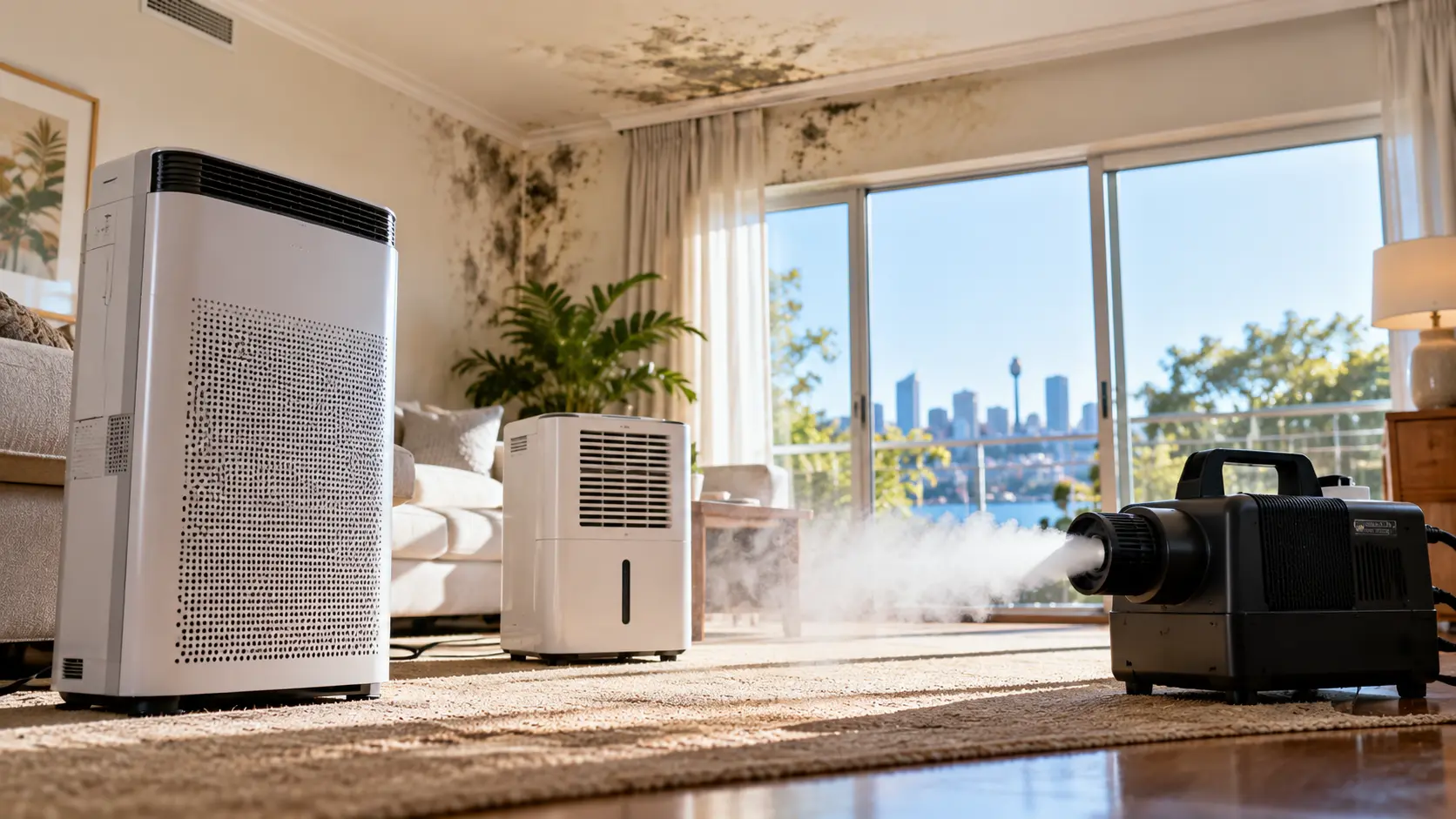
We utilize the specialized Goldmorr System to eliminate surface mould and airborne spores before activating new ventilation. This proprietary methodology is far superior to retail cleaning products. It involves professional fogging, which is essential to reach inaccessible subfloor corners and deep into the porous surfaces of sandstone foundations. This process neutralizes the mould at a cellular level. Once the subfloor is verified as sterile, the smart subfloor ventilation system takes over. It monitors the environment 24/7 to ensure the conditions that allowed the mould to grow never return. This systematic, evidence-based approach is the only way to guarantee a permanent resolution to dampness issues.
Long-Term Benefits: Health, Value, and Peace of Mind
The primary benefit of this dual-action strategy is the immediate reduction in health risks. Controlling subfloor moisture is the most effective way to prevent the development of black mould, which is linked to chronic respiratory issues and allergic reactions. Beyond health, a documented moisture-management system significantly increases your property value. Potential buyers in Sydney are increasingly wary of dampness and mould. Providing proof of a professional, automated system offers them the same peace of mind it offers you. Don’t wait for structural rot to set in. Request a professional subfloor ventilation assessment from the ABC experts today and secure your home’s future.
Secure Your Home’s Future Against Dampness
Your property is likely your most significant investment. Don’t allow trapped moisture and toxic mould spores to compromise its structural integrity or your family’s health. We’ve shown that a smart subfloor ventilation system is the only way to achieve a truly self-regulating, dry environment in Sydney’s coastal climate. Traditional methods fail because they lack the sensor-driven intelligence required to outsmart humidity.
It’s clear that success depends on the “Clean, Then Ventilate” protocol. As Sydney’s leading experts in Goldmorr remediation, we provide professional installation by trained mould specialists who understand the physics of airflow. Our comprehensive inspections include detailed moisture-mapping to pinpoint exact problem areas before they lead to cupped floorboards or black mould growth. This systematic approach ensures your foundations remain sterile and protected for the long term.
Secure your home’s health with a professional smart ventilation assessment today. Our team is ready to help you transition from a state of concern to a state of total resolution. You deserve a home that breathes as well as you do.
Frequently Asked Questions
How much electricity does a smart subfloor ventilation system use?
A high-efficiency smart subfloor ventilation system typically costs between $50 and $80 per year to operate. This is roughly equivalent to running a single LED light bulb. These systems use EC motors that are up to 30% more efficient than traditional AC fans. Because the smart sensors only activate the fans when environmental conditions are optimal, the system isn’t running 24/7, which further reduces your total annual energy consumption.
Are smart subfloor fans noisy for the people living in the house?
No, modern systems are designed for whisper-quiet operation. We utilize high-efficiency fans specifically engineered to move large volumes of air at low decibel levels. When professionally installed, these fans are mounted with vibration-dampening brackets to prevent sound from traveling through the floor joists. You’ll barely notice the system is running. This is a significant improvement over older, industrial-style mechanical fans that often caused disruptive humming throughout Sydney homes.
Can I install a smart ventilation system myself to save money?
We strongly advise against DIY installation. Proper placement is the most critical factor for moisture removal. Amateur setups often suffer from short-cycling, where air only moves between the fan and the nearest vent without drying the soil. Our specialists conduct comprehensive moisture mapping to identify dampness sources and structural impediments like sleeper walls. A professional installation ensures the system meets National Construction Code standards and provides a documented moisture-management solution.
How long do these smart ventilation systems typically last in Sydney?
A high-quality system should last 10 to 15 years with basic maintenance. In Sydney, the salty coastal air can be corrosive to standard hardware. That’s why we only install IP-rated, marine-grade fans that resist salt spray and high humidity. Choosing durable, professional-grade components prevents premature motor failure. Regular inspections ensure the sensors remain calibrated and the fan blades stay clear of debris, maximizing the lifespan of your property investment.
Will a smart fan work if my subfloor is made of sandstone?
Yes, smart ventilation is essential for sandstone foundations. Sandstone is highly porous and acts like a sponge, drawing moisture from the soil into your home’s structure. A smart system identifies when external air is dry enough to help bake out this trapped moisture. By maintaining a consistent crossflow of dry air, the system prevents the sandstone from reaching the saturation point that leads to rising damp and structural decay.
Does a smart ventilation system help with rising damp?
It is a vital part of the solution but not a standalone cure. Rising damp often stems from failed damp-proof courses or poor external drainage. While a ventilation system effectively manages the symptoms by drying the masonry and soil, you must address the water source first. We integrate our ventilation setups with professional remediation and water damage protocols to ensure a holistic fix. This prevents moisture from migrating up into your living areas.
What happens to the system when it rains outside?
The smart sensors automatically pause the system during rain. Standard fans blindly pump wet air into your home during storms, which actually accelerates mould growth. A smart subfloor ventilation system calculates the dew point and relative humidity of the outside air. It will only activate when the external air is drier than the air trapped in your subfloor. This precision prevents the accidental introduction of moisture, ensuring your foundations stay dry.
Do I need to clean or maintain the fans once they are installed?
Minimal maintenance is required to keep the system at peak performance. You should inspect the external vent covers every six months to ensure they aren’t blocked by leaves or debris. Our team offers annual service checks to calibrate the smart sensors and clean the fan blades. This ensures the airflow remains at the maximum capacity of 734 m³/hr. Keeping the system clean prevents motor strain and guarantees your subfloor stays dry.