
Scrubbing the black spots in your bedroom corner with bleach isn’t solving the problem; it’s just hitting the snooze button on a persistent health hazard. You’ve likely spent hours cleaning those stubborn patches, only to have them reappear weeks later alongside that unmistakable musty smell. It’s exhausting to feel like you’re losing a battle in your own home, especially when you’re anxious about the respiratory risks for your children or pets. Learning how to stop mould growing in corners of room requires moving beyond surface treatments to address the invisible micro-climate of the corner itself.
We understand that recurring growth creates a sense of defeat, but professional remediation focuses on the root cause rather than the symptoms. This guide provides the science-backed methods you need to eliminate corner mould and prevent it from returning to your Sydney home. We will explain the critical differences between surface condensation and structural leaks. You will also discover practical, actionable steps to break the cycle of “dead air” zones and improve ventilation. By the end of this article, you’ll have a clear, professional strategy to restore a safe, mould-free environment for your family.
Key Takeaways
- Identify why “Dead Air Zones” and thermal bridging create the perfect micro-climate for fungal growth in tight spaces.
- Discover how to stop mould growing in corners of room by maintaining a minimum 50mm gap between heavy furniture and external walls.
- Learn to differentiate between simple surface condensation and serious structural issues like rising damp or subfloor moisture.
- Understand why professional remediation using the Goldmorr System is necessary to eliminate airborne spores that DIY cleaning leaves behind.
- Implement immediate airflow strategies using pedestal fans to disrupt stagnant air and lower localized humidity levels effectively.
The Science of “Corner Mould”: Why It Grows in Tight Spaces
Corner mould isn’t just an eyesore; it’s a structural red flag. It indicates a specific failure in your home’s thermal envelope and ventilation. Understanding how to stop mould growing in corners of room starts with recognizing that these areas are unique micro-climates. Unlike flat wall surfaces, corners suffer from a combination of stagnant air and plummeting temperatures. When these two factors collide, fungal growth becomes inevitable.
Understanding Thermal Bridging in Sydney Homes
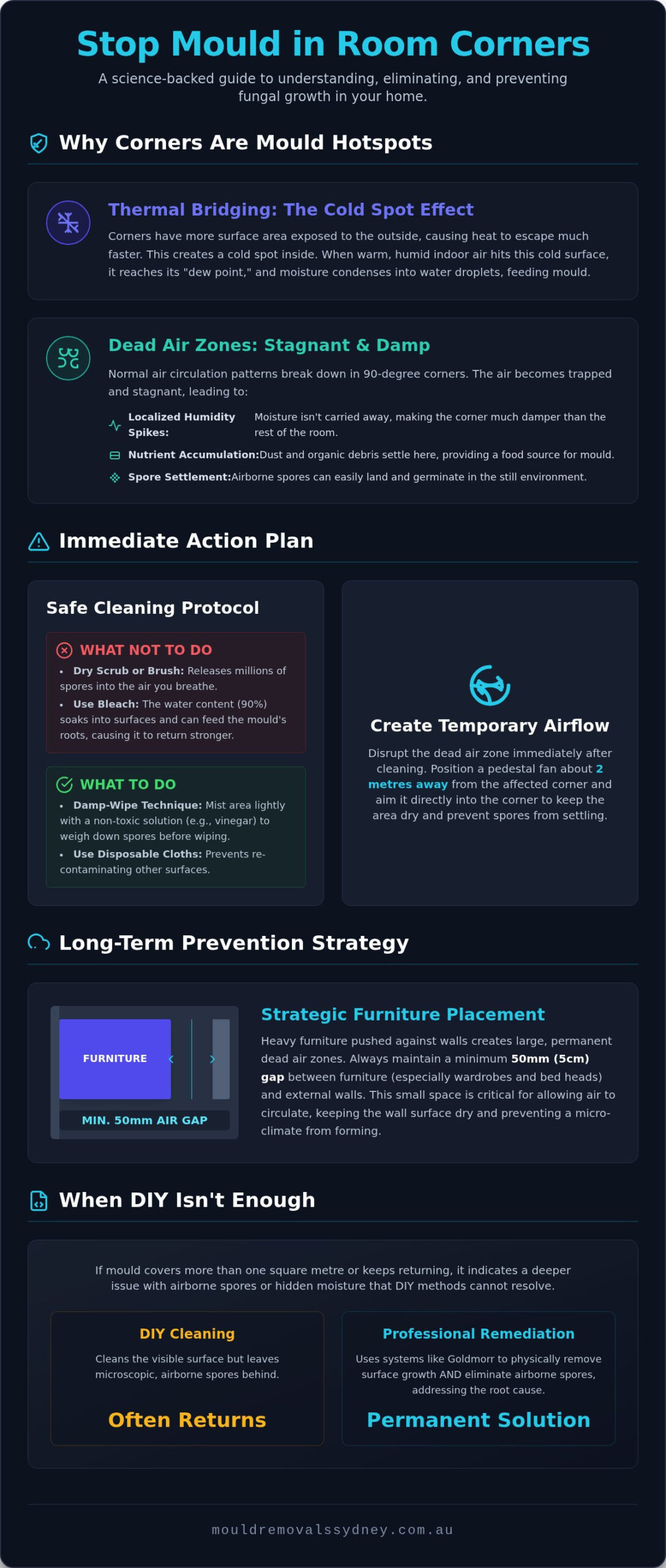
Sydney’s climate and building styles create specific vulnerabilities. Many local homes utilize solid brick or brick veneer construction. In these structures, corners act as “thermal bridges.” This means heat escapes through the corner much faster than through a flat wall because the corner has more surface area exposed to the outside air. It’s a simple matter of physics. The corner is chilled from two sides simultaneously, making it the coldest part of your room.
Why does this temperature drop matter? It all relates to the “dew point.” As warm, humid indoor air comes into contact with a chilled corner, it loses its ability to hold moisture. That moisture turns into liquid droplets on your wall. Porous materials like plasterboard and paint soak up this condensation, providing the damp environment spores need to thrive. External corners are particularly high-risk because they are exposed to the elements on two sides, while internal corners often suffer more from restricted airflow.
The Role of Dead Air Zones
Why does mould love a 90-degree angle? It’s caused by the “Dead Air Zone.” In a standard room, air circulates in a circular or elliptical pattern. However, this movement breaks down when it hits a corner. The air slows down, becomes trapped, and eventually stagnates. This lack of kinetic energy allows the micro-climate to remain damp and undisturbed for days at a time.
Stagnant air leads to several critical problems:
- Localized Humidity Spikes: Without a breeze to carry moisture away, the relative humidity in a corner can be significantly higher than in the centre of the room.
- Nutrient Accumulation: Dust, pet dander, and organic debris settle in corners due to the lack of movement, providing a constant food source for fungi.
- Spore Settlement: Airborne spores find a still environment to land and take root without being disturbed by natural ventilation.
Contrast this with the middle of a well-ventilated wall. Even minor air currents from a doorway or window keep that surface drier and cleaner. In a corner, the air is effectively “dead,” which is why you might see a clean wall but a black, fuzzy corner only centimetres away. Identifying these zones is the first step toward a permanent solution.
Immediate Steps to Stop Mould Growth in Room Corners Today
When you spot dark clusters forming in the corner of your bedroom or lounge, you must act quickly to prevent a localized issue from becoming a whole-house contamination. Immediate action stops spores from maturing and spreading through your HVAC system or natural drafts. However, speed shouldn’t lead to recklessness. Using the wrong cleaning methods often makes the problem worse by aerosolizing fungal particles that you then inhale.
Safe Cleaning Without Spreading Spores
The biggest mistake property owners make is dry brushing or scrubbing mould. This releases millions of microscopic spores into your breathing zone. You should also avoid standard household bleach. While it whitens the surface, bleach contains approximately 90% water. On porous surfaces like plasterboard, the chlorine stays on top while the water soaks in, effectively feeding the mould roots you can’t see. This is why the growth often returns even darker a week later.
Instead, use a damp-wiping technique. Mist the area lightly with a non-toxic solution, such as fermented vinegar or a professional botanical disinfectant, to weigh down the spores. Wipe the area using disposable microfibre cloths, folding the cloth after every stroke to ensure you aren’t just moving the fungus around. If the growth covers more than one square metre, attempting a DIY fix is risky. In these cases, contacting mould removal sydney specialists is the only way to ensure the spores are physically removed rather than just bleached.
Creating Temporary Airflow
Once the surface is clean, you must disrupt the “dead air zone” discussed previously. Position a pedestal fan about two metres away from the affected corner. Point it directly into the 90-degree angle on a high setting. This “scrubs” the stagnant air out of the corner and encourages evaporation. While this isn’t a permanent fix, it prevents the immediate return of moisture.
You must also change your daily habits to manage the indoor environment:
- Open Windows Daily: Even in winter, a ten-minute “cross-flush” of air reduces internal humidity.
- Extract at the Source: Always run bathroom and kitchen exhaust fans during and for 20 minutes after high-evaporation activities.
- Use Moisture Absorbers: Place calcium chloride tubs in corners as a short-term stopgap, though these cannot replace proper ventilation.
To truly understand how to stop mould growing in corners of room, you need data. Purchase a digital hygrometer to monitor your indoor climate. Your goal is to keep relative humidity between 30% and 50%. If your levels consistently sit above 60%, even the most thorough cleaning won’t stop the regrowth. If your humidity is low but the corner remains wet, you likely have a structural issue. You can request a professional moisture inspection to determine if a hidden leak is the true culprit.
Solving the Root Cause: Ventilation and Structural Fixes
While cleaning and temporary fans offer immediate relief, they don’t address the structural vulnerabilities of your property. If you want to know how to stop mould growing in corners of room permanently, you must investigate the moisture sources beneath and behind your walls. Often, what looks like a simple condensation issue is actually a symptom of rising damp or poor subfloor drainage. When moisture enters the building fabric itself, no amount of surface scrubbing will prevent the fungus from returning.
The Importance of Subfloor Ventilation
Sydney’s coastal geography means many homes are built on high water tables or reactive clay soils. In regions like the Inner West, the Eastern Suburbs, or the Northern Beaches, moisture often traps itself in the subfloor void. This creates a “chimney effect” where damp, heavy air rises through wall cavities and into your living spaces. Because corners are typically the least ventilated part of the wall cavity, they become the primary exit point for this rising moisture.
Installing a professional mechanical subfloor ventilation system is often the most effective solution for Sydney property owners. These systems utilize specialized fans to pull fresh air through the subfloor void, pushing damp air out before it can migrate into your internal corners. This process actively lowers the relative humidity of the entire structure. By drying the “foundational air,” you remove the fuel source that corner mould relies on to survive.
Insulation and Wall Treatments
Thermal bridging can be mitigated by improving the thermal performance of your external walls. If your home has a cavity wall, you must ensure that insulation hasn’t slumped into the corners. Slumped or missing insulation creates localized “cold spots” that attract condensation even when the rest of the room feels warm. Correcting these gaps ensures the surface temperature of the corner stays above the dew point.
You should also inspect your external brickwork for these common structural failures:
- Blocked Weep Holes: These small gaps in the mortar allow moisture to escape the wall cavity. If they’re blocked by garden beds or debris, moisture builds up and leeches into your internal corners.
- Poor External Drainage: Ensure downpipes aren’t leaking directly onto the base of the corner wall, as this saturates the masonry.
- Anti-Mould Paints: These contain antimicrobial agents that provide a secondary line of defence. However, they aren’t a “magic bullet.” If the wall behind the paint is wet due to a structural leak, the mould will eventually push through or grow on top of the paint film.
Addressing these structural factors moves you from a cycle of constant cleaning to a state of long-term property security. Professional inspection remains the only certain way to differentiate between simple condensation and these more serious structural threats.
Strategic Furniture Placement and Humidity Management
Your room’s layout plays a massive role in whether fungal spores take root. Even if you’ve fixed structural leaks, poor furniture arrangement can recreate the stagnant micro-climates that allow growth to persist. Learning how to stop mould growing in corners of room involves more than just cleaning; it requires a strategic reorganization of your living space to ensure air reaches every centimetre of your walls.
Furniture Placement Rules for Healthy Walls
The most critical rule for any Sydney property owner is the “50mm Rule.” You must maintain a minimum 50mm gap between your furniture and any external wall. This space allows air to circulate behind heavy items, preventing moisture from becoming trapped against cold surfaces. Heavy wardrobes, solid-backed beds, and floor-to-ceiling curtains are the most common culprits. They act as “thermal blankets” that keep the wall behind them chilled and damp.
- Choose Breathable Furniture: Opt for bed frames with slatted headboards and wardrobes with ventilated backs. These designs prevent air from stagnating.
- Use Furniture Risers: Raising your bed or sofa off the floor by just a few centimetres allows air to flow underneath, drying out the base of the corner.
- Eliminate Cardboard: Never store cardboard boxes in corners. Cardboard is made of cellulose, which is the primary food source for black mould. When a damp corner meets a cardboard box, you create a fungal “buffet.”
Active Humidity Control in Sydney
Sydney’s coastal humidity frequently exceeds 70% during the summer months, which is well above the safe threshold for mould prevention. You should aim to keep your indoor relative humidity between 40% and 60%. If your home consistently feels “sticky” or your windows are fogging up, a mechanical dehumidifier is a mandatory investment. Use a compressor dehumidifier for Sydney’s humid summers, as they are highly efficient at stripping moisture from warm air. In cooler months, a desiccant model might be more effective at lower temperatures.
Your air conditioning system is also a powerful tool for humidity management, but it can become a liability if neglected. A dirty unit can actually blow spores into the very corners you are trying to protect. Regular air conditioner cleaning ensures your system removes moisture effectively without compromising your air quality. If you’ve rearranged your furniture but still notice a musty smell, you should book a professional mould inspection to identify hidden reservoirs of growth behind your built-in fixtures.
Professional Mould Remediation: When DIY Isn’t Enough
If you have followed every ventilation tip and rearranged your furniture but still see black spots returning, you are likely dealing with an established spore reservoir. DIY cleaning only targets the visible growth. It ignores the millions of microscopic spores suspended in your room’s air. These spores act like seeds, waiting for the next humid Sydney day to land and restart the colony. This is why understanding how to stop mould growing in corners of room often requires moving beyond retail sprays toward professional-grade remediation.
General household cleaners and bleach are often insufficient for established infestations. They fail to penetrate the porous surfaces of plasterboard and timber. When you only clean the surface, the “roots” of the fungus remain active inside the wall. A professional approach uses a systematic, evidence-based methodology to ensure the fungus is physically removed and the air is purified.
The Goldmorr Advantage: Biodegradable Fogging
We utilize the Goldmorr System, a specialized methodology that focuses on total elimination rather than just surface whitening. The cornerstone of this process is biodegradable fogging. Unlike harsh, toxic chemicals used by some general cleaners, this fogging agent is safe for your family and the surrounding environment. The fine mist penetrates deep into the 90-degree angles of your corners and even into wall cavities where manual wiping cannot reach. It physically neutralizes spores on contact, ensuring they cannot regenerate.
This process is highly efficient and non-invasive. It addresses the “dead air zones” discussed earlier by saturating the stagnant air with a neutralizing agent. Because the formula is biodegradable, it doesn’t leave behind toxic residues, making it an ideal choice for bedrooms and nurseries where health risks are a primary concern.
Comprehensive Air Purification
Eliminating the visible growth is only half the battle. During a professional mould inspection, we use advanced moisture mapping technology to identify the exact source of dampness behind your walls. This is far superior to a simple visual check, as it can detect rising damp or subfloor leaks that haven’t yet reached the surface. Once the source is identified, we deploy industrial HEPA air scrubbers to filter the room’s atmosphere.
These machines cycle the entire volume of air in your room several times per hour, trapping 99.97% of airborne particles, including microscopic spores and dust. This process removes the “food source” for future outbreaks and provides a clean, safe environment for your family. Don’t wait for a musty smell to impact your respiratory health. Get a free quote for professional mould removal in Sydney and secure your property with a permanent solution.
Secure a Mould-Free Future for Your Sydney Home
Stopping fungal regrowth in corners requires a shift from superficial cleaning to proactive structural management. You now understand that “dead air zones” and thermal bridging are the true culprits behind those persistent black spots. By implementing the 50mm furniture rule and actively managing indoor humidity, you can disrupt the micro-climate that allows spores to thrive. If these environmental changes don’t yield immediate results, it’s likely you have a hidden moisture source or an established airborne spore reservoir that requires specialist intervention.
Our team provides specialized subfloor ventilation and comprehensive water damage restoration to address the root causes of dampness. We utilize the exclusive Goldmorr System to neutralize airborne spores and offer a 24/7 emergency water damage response for urgent structural issues. Mastering how to stop mould growing in corners of room is the first step toward a healthier living environment. Professional verification ensures your family’s safety is restored permanently. Book Your Expert Mould Inspection Today and breathe easier in a clean, protected home.
Frequently Asked Questions
Why does mould always grow in the corners of my bedroom first?
Mould prioritizes corners because they act as thermal bridges where heat escapes faster than through flat walls. This drop in temperature causes indoor air to reach its dew point, resulting in liquid condensation. Since these areas also suffer from restricted airflow or “dead air zones,” the moisture cannot evaporate. The combination of a damp surface and stagnant air creates an ideal micro-climate for spores to settle and thrive before spreading elsewhere.
Can I just paint over the mould in the corner of the room?
Painting over fungal growth is a temporary cosmetic fix that often leads to more significant structural damage. Standard paint doesn’t kill the roots of the organism. Instead, it provides a fresh layer of organic material for the fungus to consume. Eventually, the growth will bubble through the new paint or continue rotting the plasterboard underneath. You must physically remove the spores and address the underlying moisture issue before applying any specialized anti-mould coatings.
How much gap should I leave between the wall and furniture to prevent mould?
You should maintain a minimum gap of 50mm between your furniture and any external walls. This specific distance allows for sufficient air circulation to disrupt the stagnant micro-climate in the corner. For large items like wardrobes or heavy beds, increasing this gap to 100mm provides even better protection. This simple adjustment prevents the furniture from acting as an insulator that keeps the wall surface chilled and prone to condensation.
Is corner mould dangerous to my health?
Persistent growth in corners poses a significant risk to your respiratory health because it releases microscopic spores and mycotoxins into your breathing zone. Exposure can lead to chronic coughing, nasal congestion, and skin irritation. Children, pets, and individuals with pre-existing asthma are particularly vulnerable to these airborne triggers. If you notice a musty smell that won’t go away, the high concentration of spores could be impacting your family’s long-term well-being and safety.
Does vinegar or bleach work better for stopping mould in corners?
Fermented vinegar is significantly more effective than bleach for long-term remediation. While bleach whitens the surface, its high water content actually feeds the roots of the fungus on porous surfaces like plaster. Vinegar contains acetic acid which penetrates the material to kill the organism at its source. Learning how to stop mould growing in corners of room requires skipping the bleach and using a 4:1 vinegar-to-water solution to weigh down and neutralize spores.
What is the best dehumidifier setting to prevent mould growth?
You should set your dehumidifier to maintain a relative humidity level between 30% and 50%. Keeping the atmosphere within this target range is a key part of how to stop mould growing in corners of room. This ensures the air is dry enough to prevent condensation on cold corner surfaces without making the room uncomfortably dry. Monitoring these levels with a digital hygrometer is the most reliable way to prevent regrowth during Sydney’s humid summer.
How do I know if corner mould is caused by a leak or condensation?
Condensation usually appears as small, scattered black dots on the surface and correlates with cold weather or high indoor humidity. If the wall feels damp even when the room is well-ventilated, or if the staining is localized to a specific patch that grows regardless of the season, you likely have a structural leak. Professional moisture mapping is the only definitive way to differentiate between these two causes and identify hidden issues like rising damp or leaking pipes.
When should I call a professional mould removal service in Sydney?
You should contact a specialist if the affected area exceeds one square metre or if the growth returns within weeks of a thorough cleaning. Professional intervention is also necessary if residents are experiencing unexplained respiratory symptoms or if you detect a persistent musty odour. Our specialists use the Goldmorr System to eliminate airborne spores and can install subfloor ventilation systems to address the root cause of moisture, providing a level of security that DIY methods cannot match.