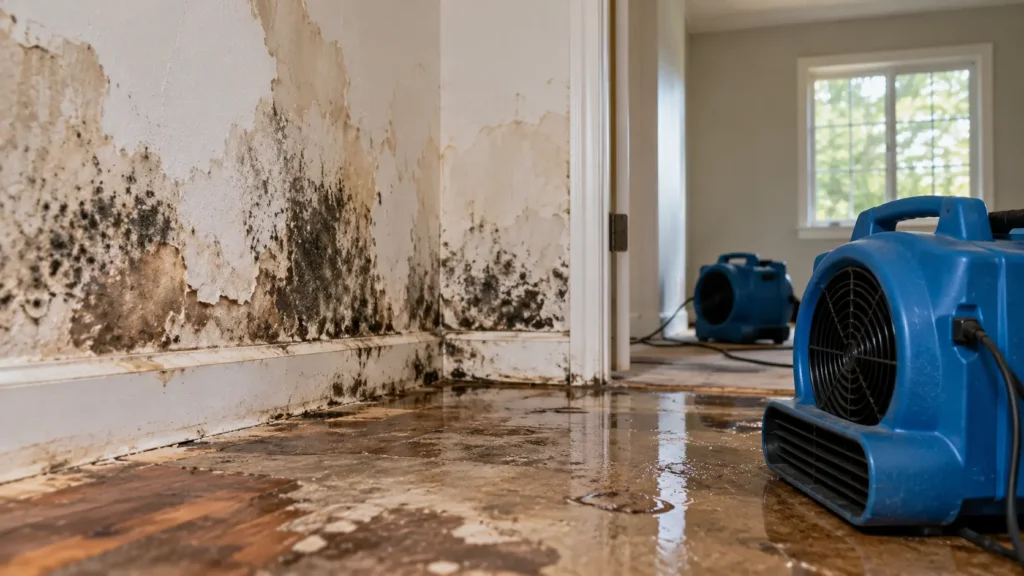
Water damage and mould are different problems, but they can be closely connected. When excess moisture remains in a property, it creates conditions where mould can develop or return. Treating visible mould without identifying the moisture source can leave the underlying problem unresolved.
Whether you’re dealing with a house, apartment, strata property, or commercial building, the right approach starts with understanding where the moisture is coming from and which areas have actually been affected.
Key Takeaways
- Water damage and mould remediation are separate processes. If ongoing moisture is contributing to mould growth, both issues need to be addressed appropriately.
- Cleaning visible mould doesn’t necessarily address contamination in difficult-to-access areas or the underlying moisture problem.
- Rising damp, subfloor moisture, leaks, condensation, and inadequate ventilation can all contribute to recurring mould problems depending on the property.
- ABC Mould Cleaning Solutions uses the Goldmorr System, a non-mechanical fogging approach designed to treat mould contamination beyond what standard surface cleaning can reach.
- ABC Mould Cleaning Solutions are approved master technicians for the Goldmorr product range.
- For bathroom mould, ABC Mould Cleaning Solutions concentrates on ceilings and walls rather than bathroom tiles.
- Most jobs can initially be quoted from photos. Send images to abcmouldcleaningsolutions@gmail.com to get started.
What’s the Real Difference Between Water Damage and Mould Removal?
They can occur together, but they’re not the same problem.
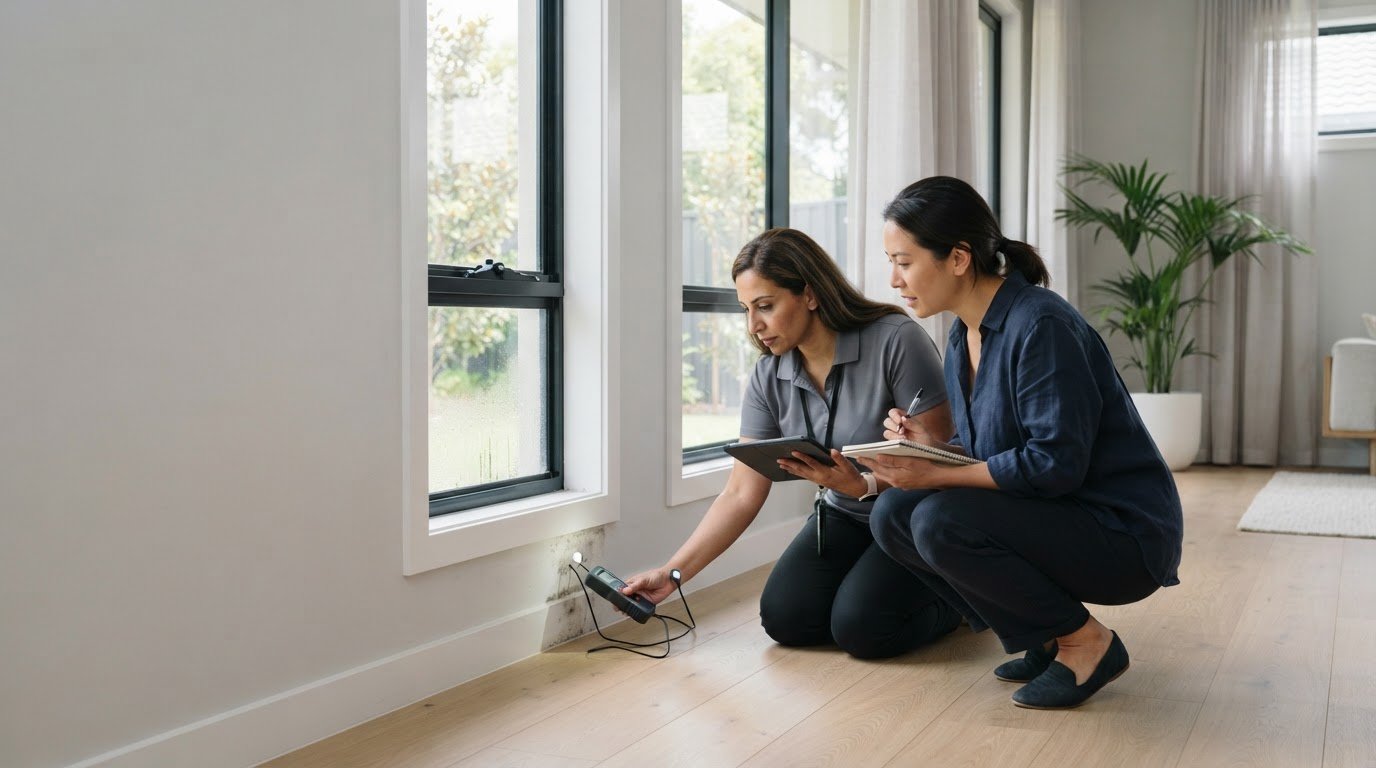
Water damage work focuses on identifying the source of unwanted moisture and dealing with affected building materials. Depending on the situation, that may involve stopping a leak, assessing moisture penetration, drying affected materials, or addressing a structural moisture problem.
Mould treatment focuses on biological contamination that has developed because suitable moisture conditions were present.
The two become connected when water remains in building materials long enough to support mould growth.
For example, a leaking roof, plumbing failure, bathroom leak, rising damp, or moisture beneath a floor can create conditions for mould. Treating the mould without correcting an active moisture source can allow the problem to return.
Likewise, fixing a leak doesn’t automatically remove mould that has already developed.
That’s why complete mould remediation in Sydney starts by looking at both the contamination and the conditions that allowed it to develop.
Why Does Mould Keep Coming Back Even After Cleaning?
Recurring mould can indicate that something beyond the visible surface needs attention.
You might clean mould from a wall or ceiling and see a significant improvement, only for it to return weeks or months later. In those situations, it’s important to investigate why that surface continues to experience enough moisture for mould to grow.
Potential causes include:
- Leaks or previous water intrusion
- Condensation
- Inadequate ventilation
- Rising damp
- Subfloor moisture
- Moisture trapped in building materials
- Other property-specific moisture conditions
Rising damp and subfloor moisture aren’t limited to one particular type of property. Whether either problem can occur depends on the building’s construction, its relationship with the ground, drainage, ventilation, moisture barriers, and other site conditions.
Mould that repeatedly appears on lower walls or around skirting boards may justify further investigation for a moisture problem, but its location alone shouldn’t be used to diagnose the cause.
Understanding why mould returns after professional cleaning can help property owners understand why identifying the source is so important.
What About Bathroom Mould?
Bathroom mould deserves separate consideration because bathrooms naturally experience higher humidity and condensation.
ABC Mould Cleaning Solutions concentrates its bathroom mould treatment on ceilings and walls, not bathroom tiles.
If mould keeps returning to a bathroom ceiling or wall, the cause may involve condensation, inadequate ventilation, a leak, or another moisture problem.
Repeatedly wiping the visible mould may improve its appearance without resolving the conditions allowing it to return.
That’s why the first question shouldn’t simply be, “How do I clean this?”
It should also be, “Why does this ceiling or wall keep getting damp enough for mould to grow?”
Once the moisture conditions are understood, an appropriate treatment approach can be determined.
How Does Non-Mechanical Fogging Work?
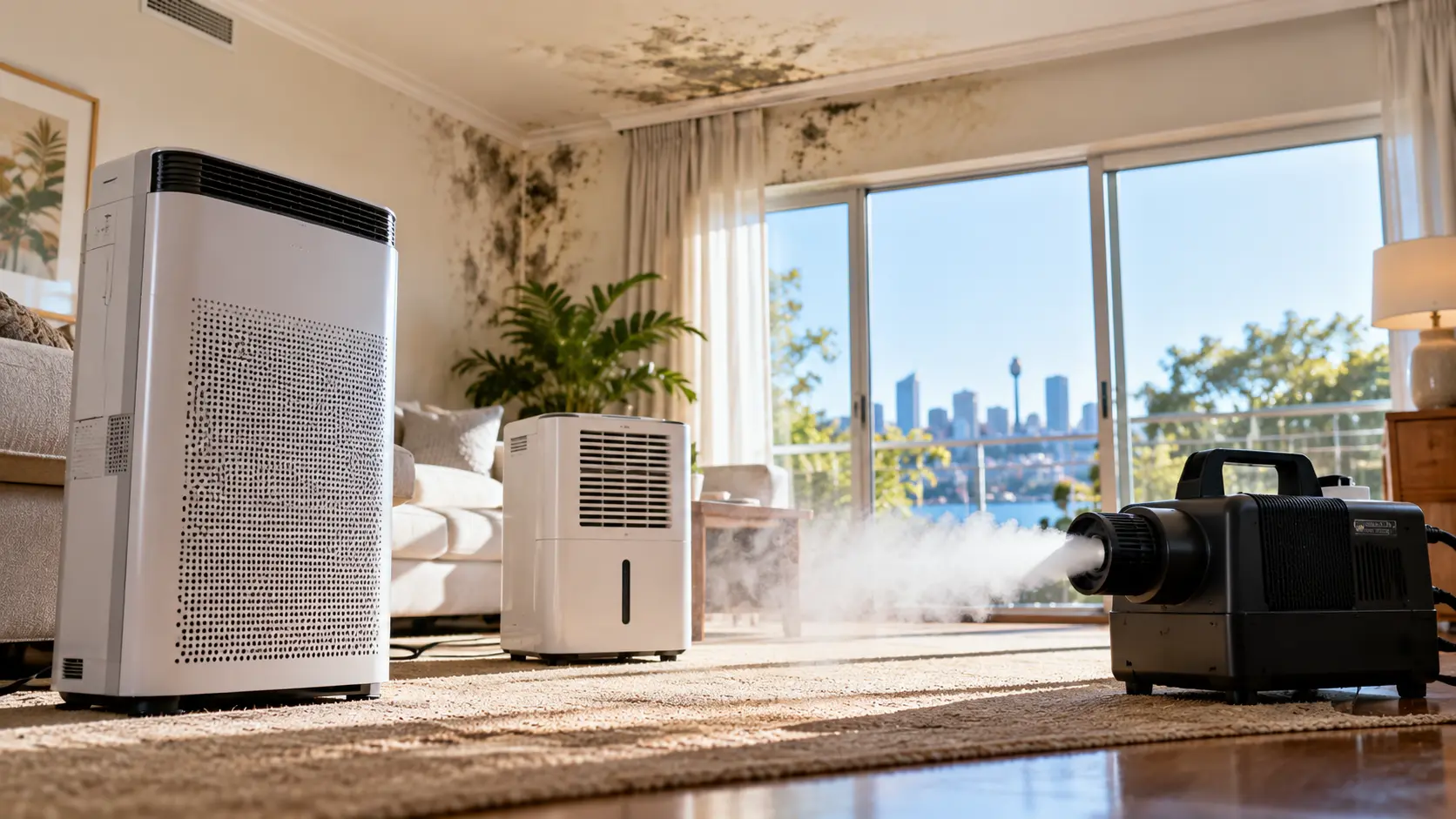
Non-mechanical fogging disperses treatment throughout the area being treated rather than relying exclusively on manually wiping accessible surfaces.
This can be useful because mould contamination isn’t always confined to the most obvious visible patch. Depending on the property and extent of the problem, affected areas can include spaces that are difficult to reach using conventional surface-cleaning methods.
ABC Mould Cleaning Solutions uses the Goldmorr System as part of its mould treatment process. ABC are approved master technicians for the Goldmorr product range.
Rather than assuming the same method is appropriate for every property, the treatment should be based on the actual areas affected and the underlying moisture conditions.
For more information about treating wall mould, see the professional guide to mould removal from walls.
What Does a Proper Remediation Sequence Look Like?
Consider a property where water has entered through a plumbing problem, roof leak, bathroom leak, or another source.
You may notice ceiling staining, discolouration, a damp smell, or eventually visible mould.
The appropriate process starts by identifying what caused the moisture.
From there, the affected materials and extent of moisture need to be assessed. If the source is still active, it needs to be stopped. Wet materials may need to dry properly before finishing work such as painting or sealing is considered.
Where mould contamination has developed, that needs to be treated as its own part of the process.
A practical sequence may therefore involve:
- Identify the moisture source.
- Stop active water intrusion where applicable.
- Determine which materials and areas have been affected.
- Address excess moisture and allow appropriate drying.
- Treat mould contamination.
- Address any building condition contributing to recurrence.
- Complete repairs, painting, or finishing work once the underlying problem has been dealt with.
The exact sequence can vary because a plumbing leak, rising damp problem, subfloor moisture issue, and bathroom condensation problem aren’t identical situations.
For black mould specifically, professional assessment can help determine the extent of the affected area and the appropriate remediation approach.
Water Damage and Mould: Choosing the Appropriate Response
| Situation | What Needs to Be Considered | Appropriate Next Step |
|---|---|---|
| Bathroom ceiling or wall mould | Condensation, ventilation, leaks, recurring moisture | Assess the moisture source and treat affected ceiling/wall areas |
| One-off leak that has been repaired | Whether affected materials have fully dried and whether mould developed | Assess remaining moisture and contamination |
| Rising damp | Ground moisture moving through susceptible building materials | Assess the damp problem and any associated mould separately |
| Subfloor moisture | Ventilation, drainage, ground moisture and existing contamination | Investigate both moisture conditions and mould |
| Burst pipe or roof leak | Extent of water penetration and affected materials | Stop the water source, assess damage, dry appropriately and treat mould if present |
| Persistent mould with no obvious source | Hidden or unidentified moisture conditions | Professional assessment may be appropriate before further treatment |
The important distinction is that visible mould doesn’t tell you everything about why the problem developed.
The treatment needs to match the source.
When Is Mould Treatment Alone Not Enough?
If an active moisture problem is still present, mould treatment alone may not provide a lasting solution.
For example, if a roof is still leaking, plumbing is continuing to release water, a subfloor remains excessively damp, or rising damp is affecting building materials, the moisture problem needs attention as well.
ABC Mould Cleaning Solutions focuses on identifying the mould issue and determining an appropriate treatment approach. Where another trade or structural solution is required to correct the source of water, that work may need to occur alongside or before mould treatment.
If you’re not sure what’s driving the problem, photos are a practical starting point.
ABC Mould Cleaning Solutions can quote many jobs using photos without requiring an initial site visit. If Warren needs to inspect the property in person to properly assess the situation, the on-site inspection fee is $275.
Getting a second opinion on mould remediation can also be worthwhile when the source of recurring mould hasn’t been clearly identified.
ABC Mould Cleaning Solutions services Sydney Metro, the Blue Mountains, and Wollongong.
Call 0488 866 853 or email photos to abcmouldcleaningsolutions@gmail.com to get started.
Frequently Asked Questions
How do I know if I need water damage work or mould treatment?
Start with the moisture source. If water is still entering the property or building materials remain wet, the moisture problem needs to be addressed. If mould has developed, mould treatment may also be required. Depending on the property, both issues may need attention.
Can houses and apartments both develop these problems?
Yes. Houses, apartments, strata properties, and other buildings can experience water damage and mould. The cause depends on the individual property’s construction, moisture source, ventilation, drainage, and other building conditions.
Does ABC Mould Cleaning Solutions treat mould on bathroom tiles?
ABC Mould Cleaning Solutions concentrates its bathroom mould treatment on ceilings and walls rather than bathroom tiles.
Can I get a quote without someone coming to my property?
Yes. Many jobs can initially be quoted using photos. Send clear images of the affected areas to abcmouldcleaningsolutions@gmail.com. If an on-site assessment is required, Warren’s inspection fee is $275.
Why does mould keep coming back after I clean it?
Recurring mould can indicate that the conditions supporting its growth haven’t been fully resolved. Possible causes include condensation, inadequate ventilation, leaks, rising damp, subfloor moisture, or moisture remaining in building materials. Identifying the cause is an important part of choosing the right treatment.
What makes the Goldmorr System different from ordinary surface cleaning?
The Goldmorr System uses a fogging-based treatment approach rather than relying only on wiping visible surfaces. ABC Mould Cleaning Solutions are approved master technicians for the Goldmorr product range and can determine how the treatment should be applied based on the affected property.
Does treating one room fix mould throughout the property?
Not necessarily. Treatment should be based on the areas that are actually affected. If mould or moisture problems are present elsewhere, those areas may need to be assessed separately.
Can rising damp affect apartments as well as houses?
Whether rising damp can occur depends on the building’s construction and exposure to ground moisture rather than simply whether the property is described as a house or apartment. The cause should be properly assessed rather than assumed from the property type.
Is subfloor mould only a problem in apartments?
No. Houses and apartment buildings can both have subfloor moisture and mould problems where the building has an affected subfloor area. Ventilation, drainage, ground moisture, access, and construction all influence the problem.
How quickly can I get service?
ABC Mould Cleaning Solutions provides service across Sydney Metro, the Blue Mountains, and Wollongong. For urgent enquiries, call 0488 866 853 or email abcmouldcleaningsolutions@gmail.com with photos and details of the affected area.
About the Author
Warren Bailey is the principal technician at ABC Mould Cleaning Solutions and an approved master technician for the Goldmorr System. He works across mould removal, rising damp treatment, subfloor ventilation in Sydney’s Eastern Suburbs, and air conditioning cleaning throughout Sydney Metro, the Blue Mountains, and Wollongong.
ABC Mould Cleaning Solutions provides professional mould treatment for houses, apartments, strata properties, and commercial buildings, with an approach focused on identifying the moisture conditions contributing to the problem and treating the affected areas appropriately.