Did you know that a technician’s personal training qualification is not the same thing as a legal clearance for your building? Many Sydney property owners mistakenly believe that hiring anyone with a “certified” badge protects them; yet without a specific mould inspection certificate for the premises, you remain legally vulnerable under the NSW Residential Tenancies Act 2010. It’s a frustrating reality that can leave landlords facing heavy liabilities and tenants worried about their health. No one wants to deal with “cowboy” operators who offer vague promises instead of concrete, scientific proof of safety.
We understand that you want more than just a surface scrub. You need the peace of mind that comes from a professional assessment of your indoor air quality. This guide will teach you exactly what a mould inspection certificate entails, why it’s the only way to prove your property is safe, and how to secure a professional clearance report that stands up in court. We’ll look at the essential requirements for Sydney homes and how our master technicians use the industry leading Goldmorr System to ensure your property is fully compliant and mould free. It’s that simple and that easy to protect your investment.
Key Takeaways
- Understand the critical difference between technician credentials and a Post-Remediation Verification (PRV) report to ensure your property is legally compliant.
- Learn why Sydney’s high humidity levels require professional moisture mapping to identify “hidden mould” that DIY inspections consistently miss.
- Discover the comprehensive 5-step scientific process required to secure a valid mould inspection certificate that guarantees the safety of your home or office.
- Identify why the IICRC S520 and the Goldmorr System are the industry-leading standards for eliminating airborne spores and structural risks.
- Find out how to obtain a professional clearance report today while benefiting from our “Beat Any Written Quote by 10%” local price guarantee.
What is a Mould Inspection Certificate?
A mould inspection certificate serves as your property’s clean bill of health. It provides scientific proof that your living environment is safe, dry, and free from dangerous fungal growth. In Sydney’s humid climate, these documents are vital for homeowners, buyers, and property managers. They move beyond simple visual checks, relying on data to confirm that a structure is habitable. If you are dealing with a recurring musty smell or visible growth, this document is your primary tool for resolution. You can review this comprehensive guide to indoor mould to understand the various species that professional reports identify. A valid mould inspection certificate must include moisture readings, particle counts, and a clear pass or fail result based on established safety thresholds.
Technician Qualifications vs. Property Clearance
Don’t confuse a technician’s personal training credentials with a property clearance certificate. A technician might hold a certification from the IICRC (Institute of Inspection Cleaning and Restoration Certification), specifically the S520 standard. This means the individual is trained in professional remediation. However, the property certificate is the final report they issue after the work is done. Our Master Technicians use the Goldmorr System to ensure every mould inspection certificate we provide meets these rigorous standards. Training through organizations like ACES or Decon provides the technical foundation needed to validate these results. Hiring a certified expert ensures that the testing methods, such as air sampling and surface swabbing, are scientifically sound and legally defensible.
The Legal Weight of a Mould Report in NSW
In New South Wales, property standards are strictly regulated. Landlords have a legal obligation under the Residential Tenancies Act 2010 to provide a premises that is fit for habitation. A professional report acts as a shield against “failure to maintain” claims. It provides a clear paper trail showing that you’ve taken proactive steps to manage moisture and fungal issues. A clearance certificate is a formal document issued by a qualified professional confirming mould levels are back to normal. For tenants, this document offers peace of mind before signing a lease. For insurance claims, it serves as the necessary evidence to prove that remediation was successful and the claim can be closed. Whether you are selling a home in the Inner West or managing a rental in Parramatta, this report is your definitive proof of safety. It’s that simple. It’s that easy to protect your investment.
Why Sydney Property Owners Need Professional Certification
Sydney’s coastal climate creates a perfect storm for fungal growth. With humidity levels in the Harbour City frequently hitting 70% or higher during the humid summer months, moisture trapped in building cavities becomes an invisible threat. A professional mould inspection certificate is the only way to prove a property is truly safe. Surface cleaning with supermarket sprays doesn’t address the root cause. It often leaves hidden mould behind walls or under floorboards where it continues to eat away at the building’s framework. You can’t fix what you can’t see, and DIY checks simply don’t have the technology to find moisture pockets deep within a structure.
For commercial property managers and body corporates, this documentation is about liability protection. In NSW, property owners have a legal duty of care to provide a healthy environment for occupants. A certified report from a master technician documents the structural integrity of the building. It provides a clear paper trail that can be used in court or during audits to show that all reasonable steps were taken to manage moisture risks. It turns a subjective “looks clean” into an objective “is safe.”
Health Risks and Airborne Spore Validation
Wiping away a dark patch on a ceiling doesn’t make a room healthy. Real safety comes from validating that airborne spore counts have returned to normal levels. Our process involves professional air scrubbing and non-mechanical purification to meet rigorous clearance standards. This is vital because many respiratory issues are caused by what you breathe, not just what you touch. You can learn more about the specific dangers in our guide on what is black mould. We follow the NSW Health guidelines on mould to ensure every remediation project meets state safety benchmarks. This isn’t just about aesthetics; it’s about making sure your family or staff aren’t inhaling microscopic toxins every day.
Insurance and Real Estate Requirements
The Sydney real estate market moves fast, and nothing kills a deal quicker than a building inspection that finds dampness. A mould inspection certificate gives buyers confidence and prevents sales from falling through at the eleventh hour. It’s also a powerful tool for resolving tenant-landlord disputes at the NSW Civil and Administrative Tribunal (NCAT). Without professional documentation, property owners often find themselves in a “he-said, she-said” battle over bond returns or rent reductions.
- Insurance Claims: Many Australian insurers won’t process water damage claims without a professional assessment.
- Property Value: Documented remediation preserves the long-term value of your asset.
- Compliance: Meets the requirements for habitable premises under the Residential Tenancies Act.
Don’t leave your property’s health to chance. You can contact our experts to discuss how we can secure your building’s future and give you total peace of mind.
The 5-Step Process to Securing a Clearance Certificate
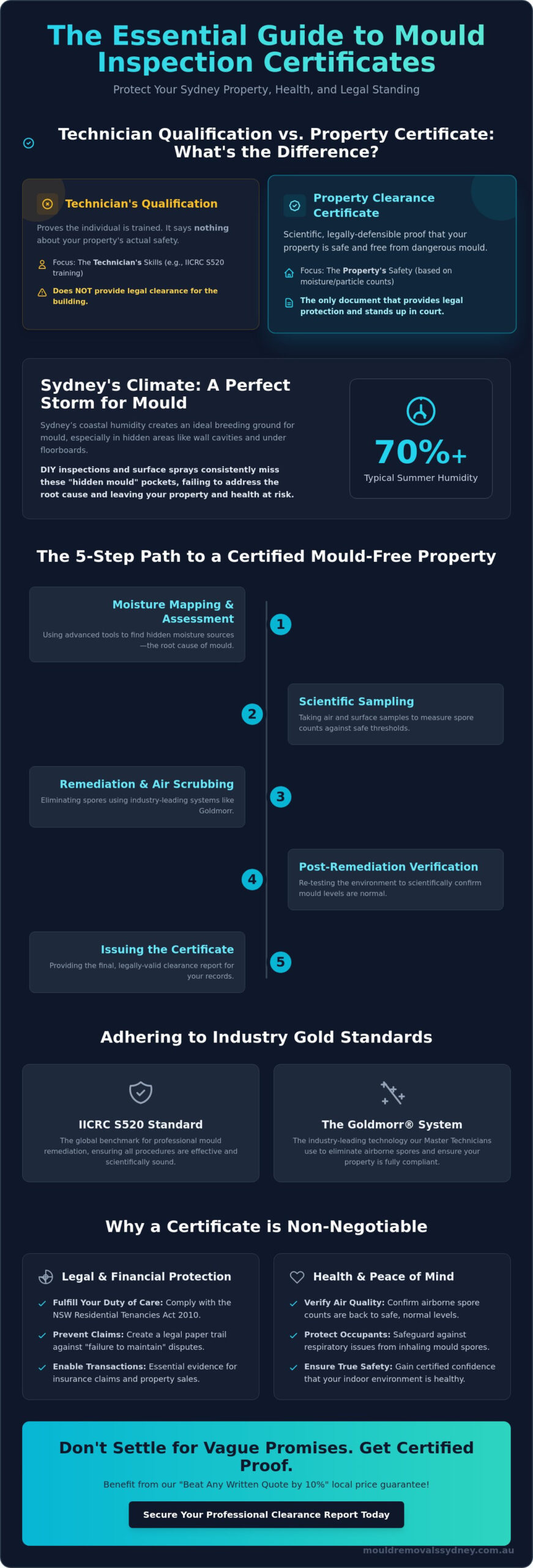
Securing a mould inspection certificate requires more than a simple surface wipe. It is a rigorous, scientific process designed to ensure your property meets Australian health standards. Our master technicians follow a strict protocol to move your building from a contaminated state to a verified safe environment. Don’t risk your health or your property’s value on guesswork. Follow this proven path to compliance.
Step 1: The Initial Professional Inspection
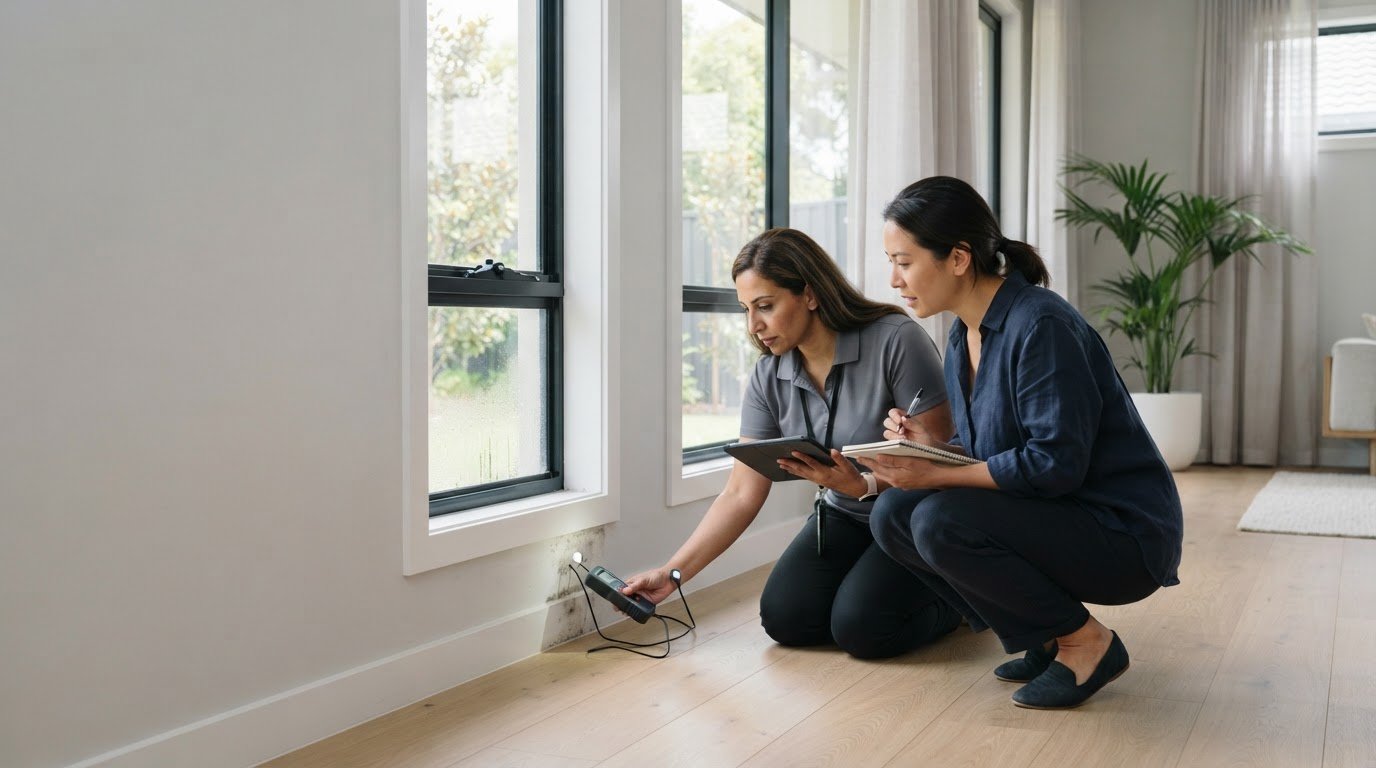
We begin by identifying exactly where the moisture is hiding. Our team uses advanced thermal imaging cameras and precision moisture meters to track water ingress behind walls and under floorboards. This step is critical because you can’t fix what you can’t see. We differentiate between simple surface mildew and deep-seated structural mould that threatens the building’s integrity. If you suspect an issue, contact Sydney’s #1 Mould Removal Service for a definitive assessment. We find the source of the dampness to ensure the problem doesn’t return after we leave.
Step 2 & 3: Remediation and Air Scrubbing
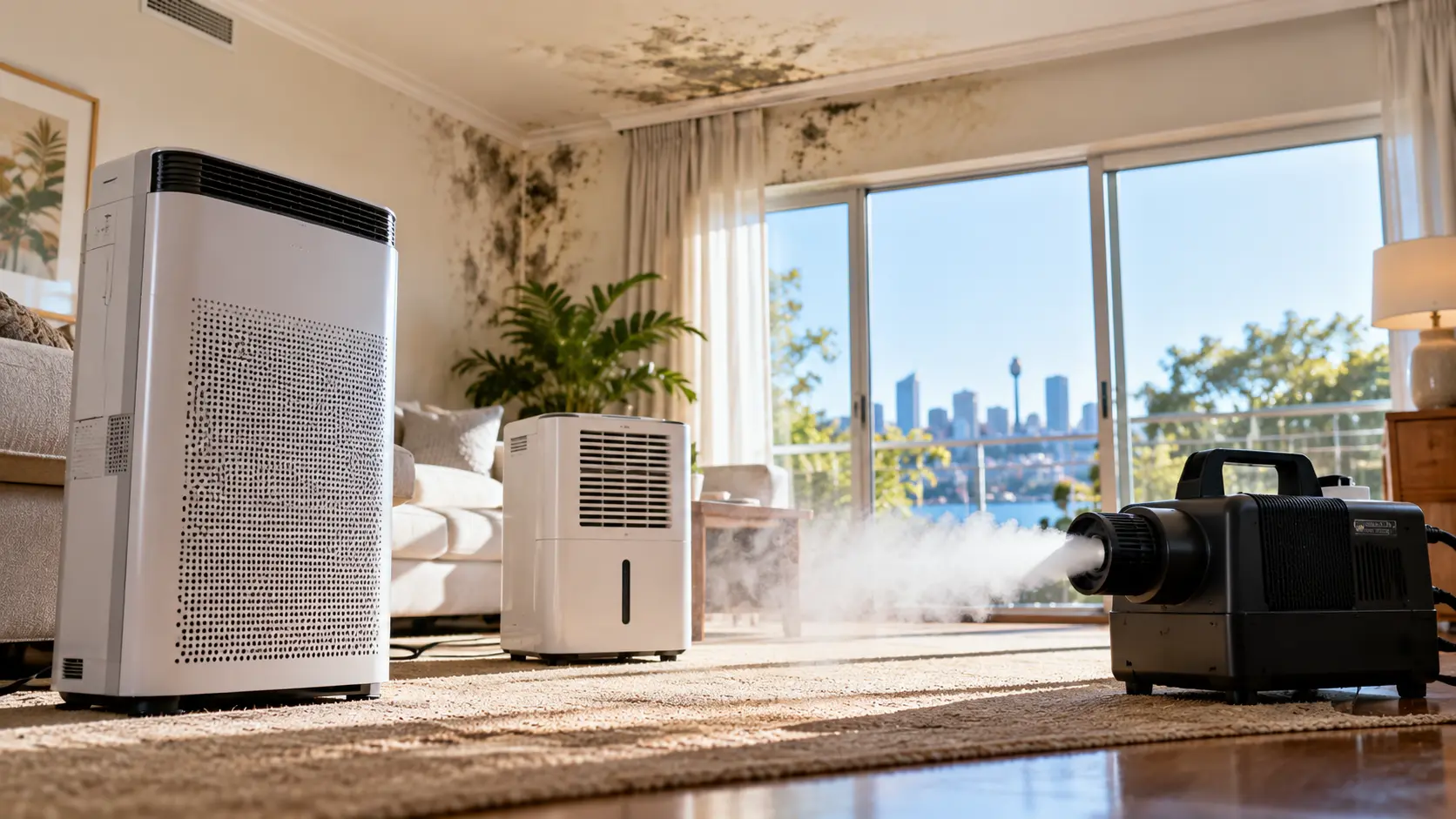
Once we identify the scope, we deploy the Goldmorr System. This industry-leading solution uses a biodegradable fogging process to eliminate airborne spores instantly. It’s fast, effective, and safe for your family or employees. While surface cleaning is part of the job, the real work happens in the air. We use HEPA air scrubbing units to achieve “Condition 1” status, which refers to a normal fungal ecology. DIY attempts almost always fail at this stage because household chemicals don’t kill airborne spores. Without professional-grade air filtration, your mould inspection certificate will remain out of reach.
- Goldmorr Fogging: Targets spores in hard-to-reach crevices and ceiling voids.
- HEPA Filtration: Captures 99.97% of particles as small as 0.3 microns.
- Containment: Prevents cross-contamination to clean areas of the property.
Step 4 & 5: Testing and Final Reporting
The final stage involves rigorous validation. We collect indoor air and surface samples to compare them against outdoor control samples. A “Pass” on a professional lab report means the indoor spore count is lower than or equal to the natural outdoor environment. We send these samples to independent laboratories to ensure total transparency. Once the lab confirms the remediation was successful, ABC Mould Cleaning Solutions issues your official mould inspection certificate. This document provides the legal and functional proof you need for landlords, insurers, or potential buyers. It’s that simple. It’s that easy. You get total peace of mind and a property that’s guaranteed safe.
Understanding Standards: IICRC, Goldmorr, and Australian Guidelines
Professional remediation isn’t just about scrubbing away visible spots; it’s about following a strict scientific framework. The IICRC S520 is the internationally recognized “bible” of the industry. This standard dictates how technicians must contain a site, remove contaminated materials, and verify that the air is safe. Following these rules ensures your mould inspection certificate is valid and scientifically backed. If a contractor isn’t familiar with S520 protocols, they aren’t experts, and their documentation likely won’t hold up under legal scrutiny.
The Goldmorr Advantage for Certification
Our team utilizes the Goldmorr System because it’s the most effective method for Sydney’s unique humid climate. This system relies on biodegradable fogging that’s completely safe for your family, pets, and the environment. This process targets microscopic airborne spores that traditional cleaning methods often miss. By using non-mechanical air scrubbing, we often achieve a significantly faster path to a clearance certificate than companies using outdated, laborious techniques. It’s a scientific approach that provides immediate results without leaving toxic chemical residues behind.
NSW Fair Trading and Rental Laws
Landlords in NSW have strict legal obligations that are becoming even more rigorous. Under the Residential Tenancies Act, owners must provide a property that is in a reasonable state of repair and fit for habitation. This includes managing dampness and mould issues promptly. The NSW Government is currently finalizing updates to rental safety standards scheduled for 2026, which will likely mandate specific ventilation and moisture controls for all managed properties. A professional mould inspection certificate serves as vital legal evidence. It proves you’ve met your duty of care and complied with NSW Fair Trading requirements, protecting you from potential tribunal disputes.
Spotting Fake or Invalid Certificates
Don’t be fooled by cheap, generic printouts. An invalid certificate puts your health and your legal standing at risk. Look for these specific red flags when reviewing your documentation:
- Lack of a technician’s individual certification number or IICRC affiliation.
- No recorded moisture readings or humidity levels from the initial inspection.
- Missing details regarding the specific remediation chemicals or methods used.
- A “pass” issued without a post-remediation air quality test or laboratory analysis.
If the document looks like a basic Word template without technical data, it won’t hold up in court or during a property sale. Legitimate certificates must include data-driven proof that the environment has returned to “Condition 1” (normal fungal ecology) status.
Get Your Sydney Property Certified Today
Securing a mould inspection certificate isn’t just a paperwork exercise. It’s about protecting your health and your long-term property investment. At ABC Mould Cleaning Solutions, we’ve helped over 5,000 Sydney residents restore their homes to a safe, breathable state. We understand the local climate and how the humid coastal air contributes to rapid fungal growth. You shouldn’t settle for a surface-level wipe down when professional remediation is required to stop the spores from returning.
Our commitment to Sydney property owners is simple. We provide a professional, scientific approach that actually works. We’re so confident in our pricing that we offer a bold guarantee. We will beat any written quote by 10% for the same professional services. You get the industry-leading Goldmorr System and the expertise of master technicians without overpaying. We focus on results that last, ensuring your property meets all safety standards.
Our team follows a proven 3-step process to get your space back to normal:
- Inspect: We perform a detailed assessment to find the moisture source and the extent of the infestation.
- Clean: Using our specialized, biodegradable fogging process, we eliminate mould at the root.
- Certify: Once the property is clear, we issue your mould inspection certificate to prove the space is safe.
Our Master Technicians and Expertise
The team consists of master technicians with years of hands-on experience across Sydney suburbs. These experts have seen everything from minor bathroom mildew to severe structural infestations. We use non-mechanical air scrubbing and the latest technology to ensure your air quality is restored. If your mould issues stem from a burst pipe or flooding, we also provide specialized Water Damage Repair to stop the rot before it spreads. This ensures you get an affordable, effective solution that gives you total peace of mind.
Contact Us for an Inspection Certificate
Don’t let a mould problem linger until it causes permanent damage or health issues. Call us right now to speak with an expert. Sending images of the affected areas allows us to provide a fast, affordable quote. Our 24/7 emergency response is available for water-damaged properties, so we’re ready when you need us most. Trust us to handle the hard work so you can get back to living in a healthy home. It’s that simple. It’s that easy.
Secure Your Sydney Property and Protect Your Health Today
Don’t let hidden spores compromise your health or devalue your investment. Securing a mould inspection certificate is the only way to prove your Sydney home or office is truly safe and compliant with IICRC and Australian guidelines. Our IICRC Certified Master Technicians use the industry leading Goldmorr System to identify issues that the naked eye misses. Whether you’re a landlord meeting legal obligations or a homeowner concerned about musty smells, professional certification provides the definitive proof you need. We’re so confident in our expert service that we’ll beat any written quote by 10%. It’s that simple. You get the highest standard of care at the best price in New South Wales. Protecting your family shouldn’t be a guessing game. Get the facts, get the certificate, and breathe easier knowing your environment is restored to a healthy state.
Get Your Professional Mould Inspection Certificate – Call ABC Mould Cleaning Solutions Today
Your property deserves the best protection available in Sydney. Our team is ready to help you reclaim your space and your peace of mind.
Frequently Asked Questions
Is a mould inspection certificate legally required in NSW?
No, there’s no specific law in NSW that mandates a mould inspection certificate for every property sale or lease. However, the Residential Tenancies Act 2010 requires landlords to provide a premises that’s fit for habitation. If a tenant reports dampness or respiratory issues, this certificate serves as vital legal evidence that you’ve met your duty of care. It protects owners from costly Fair Trading disputes and compensation claims.
How long is a mould clearance certificate valid for?
A mould clearance certificate is a point-in-time document, though most Sydney insurers and relocation agents consider it valid for 12 months. It confirms the property was safe and within healthy spore limits on the specific day of testing. If a new plumbing leak occurs or indoor humidity stays above 60% for several days, the certificate’s findings are no longer accurate. We recommend annual checks for high-risk properties to maintain safety.
Can I get a certificate if I cleaned the mould myself?
You can’t issue your own certificate after a DIY clean because it lacks independent professional verification. A valid mould inspection certificate requires a master technician to verify the air quality using specialised equipment. DIY scrubbing often leaves microscopic spores behind that regrow within 14 days. To get certified, you need a professional assessment to prove the environment meets Australian health standards and is safe for occupants.
What is the difference between a mould report and a clearance certificate?
A mould report identifies the current problem, while a clearance certificate confirms the problem is solved. The report is your diagnostic tool that lists moisture levels and fungal species found in the home. The certificate is the final document issued after the Goldmorr System or remediation process is complete. It’s the proof you need for tenants or buyers that the property is officially decontaminated and safe to enter.
How much does a professional mould inspection cost in Sydney?
Professional mould inspections in Sydney typically cost between A$250 and A$600 depending on the size of the building. This price range covers a standard residential home and includes moisture mapping and a detailed findings report. If you require laboratory air sampling or surface swabs, costs can increase based on the number of samples needed. We’re committed to being competitive and will beat any written quote by 10% for the same service.
Will a mould certificate help me sell my house?
Yes, a mould inspection certificate is a powerful tool for building buyer confidence during a property campaign. In the competitive Sydney market, transparency about property health prevents buyers from using “suspected damp” as a reason to lower their offer. Providing this documentation upfront shows you’re a responsible owner. It removes the fear of hidden structural damage and can significantly speed up the exchange of contracts.
What happens if my property fails the initial inspection?
If your property fails the initial inspection, we’ll provide a direct remediation plan to fix the specific issues found. Failure usually occurs when airborne spore counts are significantly higher than outdoor levels or hidden moisture is detected in walls. You’ll need to address the water source and have a professional cleaning performed. Once the remediation is finished, we’ll conduct a final re-test to issue your certificate and restore your peace of mind.
Do I need a certificate for a small amount of bathroom mould?
You don’t typically need a formal certificate for minor surface mould on bathroom grout that’s smaller than 1 square metre. These small patches can usually be managed with proper ventilation and regular cleaning. However, if the mould returns every few weeks, it’s a sign of a deeper structural issue. In these cases, a professional inspection is the only way to ensure a small problem doesn’t turn into a major health risk for your family.