Scrubbing visible mould off your walls might make your home look cleaner, but it often leaves the most dangerous part of the infestation floating in the air you breathe. You’re likely asking, is fogging effective for mould removal? It’s a common question for homeowners who are tired of recurring growth and worried about the health risks of airborne spores. You want a home that’s truly safe for your family, not just one that looks tidy on the surface.
You deserve to know the facts about modern remediation technology. This guide will reveal the truth about mould fogging, when it works, and how it fits into a professional remediation plan. We’ll explore the latest industry standards, such as the AS-IICRC S520:2025, and explain how our specialized Goldmorr System provides a non-toxic solution for long-term protection. Discover how to eliminate invisible spores and reclaim your peace of mind with a strategy that targets the source of the problem.
Key Takeaways
- Learn how aerosolized antimicrobial mists reach hidden areas like wall cavities and roof voids that manual cleaning cannot access.
- Discover the scientific evidence behind the question, Is Fogging Effective for Mould Removal?, and why it’s critical for neutralizing airborne spores.
- Understand why fogging is not a shortcut; it must be paired with physical source removal to eliminate health risks from dead biomass.
- Identify specific scenarios, such as post-flood restoration, where fogging is a vital part of a professional, long-term prevention strategy.
- Explore how the Goldmorr System integrates biodegradable fogging into a certified remediation process to restore safety to your home.
What is Mould Fogging and Why is it Used?
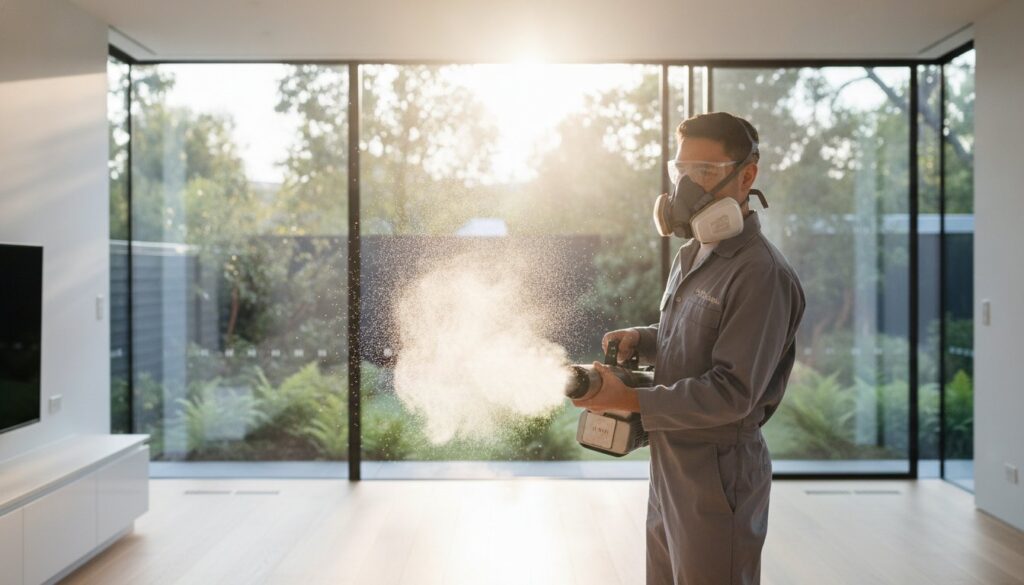
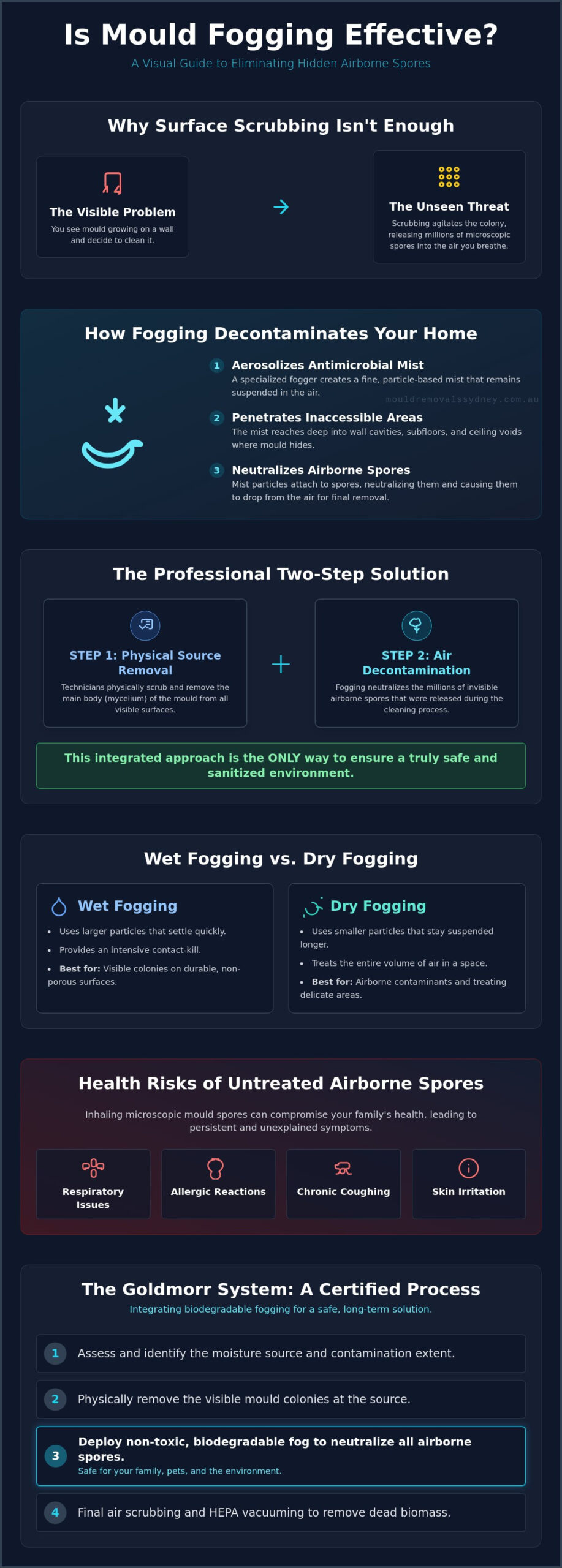
Fogging is a specialized remediation technique that involves aerosolizing a professional-grade antimicrobial solution into a fine mist. This process creates a cloud of microscopic particles that penetrate every corner of a room, including spaces that are physically impossible to reach by hand. Homeowners often ask, is fogging effective for mould removal? The answer lies in its ability to address both visible colonies and the invisible threat of airborne spores. It’s a scientific approach to a biological problem that requires more than just a surface-level wipe down.
Sydney properties face unique environmental challenges that make many ask, is fogging effective for mould removal? in our specific climate. Our coastal humidity and high moisture levels often trap spores in stagnant air pockets within wall cavities, subfloors, and ceiling voids. Without fogging, these areas remain untreated. This allows the infestation to return the moment conditions are right. Professional fogging ensures that the treatment reaches deep into structural gaps to neutralize the problem at its source, providing a level of security that DIY methods can’t provide.
Understanding the biology of the intruder is essential for effective treatment. As noted in this comprehensive guide to indoor mould, spores are the primary vehicle for reproduction and spread. While manual cleaning might remove the visible “body” of the mould, it often fails to stop these “seeds” from floating through your home. Fogging provides a comprehensive blanket of protection that manual methods simply cannot match. It’s about restoring the air quality of your home, not just the appearance of your walls.
The Difference Between Wet and Dry Fogging
Professional remediation typically utilizes two distinct types of fogging depending on the severity and location of the contamination. Wet fogging uses larger particles that are designed to settle quickly on surfaces. This provides an intensive contact-kill for visible colonies on durable materials. Dry fogging, on the other hand, creates much smaller particles that remain suspended in the air for extended periods. This is the preferred method for targeting airborne contaminants and treating delicate areas where moisture buildup must be avoided. Our certified Goldmorr System utilizes specialized biodegradable agents to ensure these treatments are safe for your family and pets.
Fogging vs. Traditional Scrubbing
It’s a mistake to view these as competing methods. Traditional scrubbing is necessary to remove the mycelium, or the main body of the mould, from surfaces. However, the physical act of scrubbing can agitate the colony and release thousands of spores into the air. Fogging acts as the secondary, vital layer of defense. It neutralizes the spores that scrubbing disperses, preventing them from settling elsewhere to start new colonies. Don’t settle for a halfway solution. A professional remediation plan always integrates both steps to ensure the environment is truly safe and sanitized for all occupants.
The Science of Airborne Spores: Why Fogging is Critical
Visible mould is only the tip of the iceberg. The real danger often lies in what you can’t see. Mould spores are microscopic reproductive units that act like seeds. They’re so light that they can remain suspended in your home’s air for days at a time. When you attempt to clean a colony by hand, you’re inevitably agitating the surface. This physical contact releases millions of these spores into the atmosphere, significantly increasing their concentration in the air you breathe. When homeowners ask, is fogging effective for mould removal?, they’re often looking for a solution to this invisible threat.
Professional fogging addresses this by treating the air itself. The antimicrobial particles in the fogging mist attach to individual spores to encapsulate them and neutralize their ability to grow or cause irritation. This process adds weight to the spores, causing them to drop out of the air where they can be safely removed during the final stages of a professional remediation plan. Without this step, you’re simply moving the problem around your home rather than eliminating it.
Air Quality and Your Health
Airborne spores are more than just a nuisance; they’re a significant health risk. Inhaling these microscopic particles can trigger persistent respiratory issues, chronic coughing, and severe allergic reactions. If you’ve noticed family members suffering from unexplained congestion or skin irritation, the air quality in your home may be compromised. You can refer to our guide on black mould for a detailed breakdown of symptoms and risks. Integrating air purification and scrubbing alongside fogging ensures your indoor environment is restored to a safe, breathable state. It’s about protecting your family’s health with a systematic, evidence-based approach.
Reaching Hidden Mould Cavities
Traditional cleaning methods usually only address about 20% of the total contamination. In older Sydney terraces and poorly ventilated modern apartments, mould thrives in the dark, stagnant spaces you cannot see. Spores settle behind skirting boards, inside wall cavities, and deep within ceiling voids. Manual scrubbing can’t reach these areas. This is why homeowners often ask, is fogging effective for mould removal? when dealing with persistent, musty odors that won’t go away. According to the EPA guidelines on mould remediation, effective treatment must address both the visible growth and the underlying moisture that allows it to spread. Fogging provides the necessary reach to penetrate these structural gaps, ensuring that hidden colonies are neutralized before they can recolonize your living space. If you suspect your home has hidden growth, a comprehensive mould removal Sydney inspection is your first step toward a permanent solution.
Is Fogging Effective? Pros, Cons, and the “Source Removal” Debate
Property owners often look for a quick fix when they discover an infestation. They ask, Is Fogging Effective for Mould Removal? The short answer is yes, but with a critical caveat. Professional remediation isn’t just about killing the fungus; it’s about removing it entirely. Some property owners assume that once a room is fogged, the problem is solved. This is a dangerous misconception. If you leave the dead biomass behind, you’re still living with biological material that can trigger the health effects of mould exposure. Dead mould can be just as allergenic as live mould. This is why we treat fogging as a vital tool in a broader strategy, not a magic wand that replaces manual cleaning.
Don’t confuse professional fogging with the aerosol “bombs” found at local hardware stores. These retail products often lack the pressure and particle size control required to penetrate deep into structural materials. They typically provide a surface-level coating that masks the issue without addressing the microscopic spores in the air or the colonies hidden in your subfloors. Our certified Goldmorr System uses specific particle distribution to ensure every cubic centimeter of air is treated. It’s a systematic process that prioritizes tangible results over temporary fixes. Fogging is highly effective only when it’s paired with physical source removal.
The Pros of Professional Fogging
One of the greatest advantages of this method is its sheer speed and coverage. We can treat entire rooms, large subfloor areas, or complex roof voids in a fraction of the time it would take to physically scrub every surface. It provides immediate relief by neutralizing airborne contaminants that would otherwise settle and recolonize. Because it’s a non-destructive process, it often minimizes the need for expensive strip-outs of structural materials. This makes it a cost-effective and efficient way to restore safety to your property. When people ask Is Fogging Effective for Mould Removal?, these rapid results are often what they’re looking for.
The Limitations to Consider
Despite its power, fogging has clear boundaries. It won’t fix a leaking pipe or solve rising damp. If the underlying moisture source isn’t addressed through professional water damage restoration or subfloor ventilation, the mould will return regardless of how well the room was fogged. Additionally, if mould has grown deep inside porous materials like thick drywall or insulation, fogging alone cannot reach the internal core. In these cases, the contaminated material must be removed and replaced. Success depends on a correct diagnosis and a professional-grade application of the antimicrobial mist.
When Should You Choose Fogging for Your Sydney Property?
Sydney’s unique geography, with its high coastal humidity and frequent storm events, creates a perfect breeding ground for persistent infestations. Homeowners often ask, Is Fogging Effective for Mould Removal?, when traditional cleaning fails to stop the cycle of regrowth. While it isn’t required for every minor bathroom patch, there are specific situations where professional fogging is the only way to ensure a safe environment. To answer the question, Is Fogging Effective for Mould Removal?, we must look at the complexity of the environment and the depth of the moisture penetration.
Professional fogging is most critical in the following scenarios:
- Post-flood restoration: After major water ingress, moisture penetrates structural cavities that manual scrubbing cannot reach. Fogging is essential here to prevent deep-seated growth within the framework of your home.
- Extensive ceiling mould: If you see spots on your ceiling, spores have likely already colonized the roof cavity. Fogging treats the entire void, neutralizing spores before they settle into insulation.
- Persistent musty smells: If your home smells heavy or damp but you can’t see the colony, it’s a sign of high airborne spore concentrations. Fogging clears the air and reaches hidden pockets behind furniture.
- Pre-settlement cleaning: For those buying or selling, fogging provides a certified “clean slate.” It’s a proactive step for health-conscious buyers who want to avoid the respiratory issues discussed earlier.
Safe for Families and Pets
Anxiety about chemical residues is a common concern for property owners. We address this by using the Goldmorr System, which relies on biodegradable, family-safe agents. Unlike harsh retail alternatives, these professional-grade solutions are designed to break down safely without leaving toxic films on your furniture or flooring. Typically, families and pets can reenter the property within a few hours once the mist has settled and the area is ventilated. We prioritize these eco-friendly Goldmorr agents to ensure that while we’re neutralizing the mould, we aren’t introducing new risks to your living space.
Addressing the Root Cause
Fogging is a powerful treatment, but it must be part of a holistic plan. You cannot fog your way out of a structural problem. This is why we often link remediation with subfloor ventilation to address the rising damp and stagnant air that fuels growth. If your property has suffered a leak or storm ingress, you must fix the water damage before the final fogging application. Combining these steps ensures the mould doesn’t just die; it stays gone. If you suspect hidden growth in your home, request a professional Sydney mould inspection to determine the best course of action.
The Goldmorr System: Our Proven Approach to Mould Removal
Effective remediation requires more than just a single tool. It demands a systematic, evidence-based methodology that addresses the biological reality of fungal growth. At ABC Mould Cleaning Solutions, we utilize the Goldmorr System. This proprietary process ensures that every stage of the infestation is neutralized, from the visible root systems to the microscopic spores in the air. When you ask, is fogging effective for mould removal?, the Goldmorr System provides the definitive answer by integrating it into a comprehensive four-step plan.
- Step 1: Comprehensive Inspection. Our specialists conduct a detailed mould removal Sydney inspection. We identify the moisture source and map the extent of the contamination.
- Step 2: Physical Source Removal. We physically eliminate all visible colonies using specialized antimicrobial agents. This removes the biomass and prevents the release of further spores.
- Step 3: Goldmorr Fogging. We apply our trademarked fogging process to reach every hidden surface and neutralize residual airborne spores. This is where the question, is fogging effective for mould removal?, becomes a reality for your home’s safety.
- Step 4: Air Scrubbing and Purification. We deploy industrial-grade air scrubbers to filter out neutralized particles. This final stage restores hospital-grade air quality to your living environment.
Why the Goldmorr System is Different
Most traditional methods rely on aggressive chemicals or destructive techniques. The Goldmorr System is different because it targets mould at a cellular level using biodegradable products. These agents are completely safe for children and pets, allowing for a faster return to your home. Because our specialized solutions are so effective at penetrating surfaces, our system eliminates the need for aggressive sanding or structural demolition in many residential cases. This preserves the integrity of your property while ensuring a deep, lasting clean.
Get Your Sydney Property Healthy Again
Mould is a progressive problem. If you delay treatment, spores will continue to spread through your HVAC system and subfloor voids, contaminating your entire property. Act now to protect your family’s health and your home’s value. We are committed to providing the best value in the industry. We offer a bold price-matching guarantee for any comparable professional remediation service in the Sydney area. Don’t settle for amateur results when you can have certified expertise. Contact us today for a free assessment of your mould situation and let us restore your home to a safe, non-toxic environment.
Secure Your Home Against Invisible Spores
Protecting your property requires a move beyond surface-level cleaning. You now understand that fogging is a critical scientific tool for neutralizing the airborne spores that manual scrubbing simply cannot reach. By choosing a methodology that prioritizes source removal alongside aerosolized treatment, you ensure that your living space is truly sanitized. When homeowners ask, is fogging effective for mould removal?, the answer depends entirely on the expertise of the application and the quality of the system used.
Don’t let hidden colonies compromise your family’s health. Our Goldmorr System certified specialists use biodegradable and family-safe agents to restore your environment without introducing toxic residues. Whether you’re dealing with a persistent musty odor or recovering from a storm event, our team provides a 24/7 emergency response for water damage to stop the spread before it escalates. Take the first step toward a breathable, healthy home today.
Get a Professional Mould Assessment & Quote Today
Your peace of mind is our priority. We look forward to helping you reclaim a safe and comfortable living space for years to come.
Frequently Asked Questions
Is fogging safe for my family and pets?
Yes, professional fogging is safe for all occupants when performed by specialists. We utilize the Goldmorr System, which relies on biodegradable, family-safe agents that break down without leaving toxic residues. These solutions are designed to neutralize biological threats while prioritizing the safety of children and pets in the home.
How long do I have to stay out of the house after mould fogging?
You can typically reenter your property within two to four hours after the treatment is complete. This timeframe allows the antimicrobial mist to settle and the specialists to ventilate the living spaces thoroughly. We provide a precise schedule during your initial assessment so you can plan your day with minimal disruption.
Does fogging kill black mould permanently?
Fogging neutralizes existing spores, but it isn’t a permanent shield against future growth. To stop mould forever, you must address the underlying moisture source, such as a leaking pipe or poor subfloor ventilation. When people ask, is fogging effective for mould removal?, we emphasize that it’s a vital part of a broader strategy that includes long-term moisture control.
Can I use a DIY mould fogger from a hardware store?
What is the difference between air scrubbing and fogging?
Fogging and air scrubbing perform two distinct but complementary roles. Fogging uses a fine mist to neutralize spores on contact throughout the room. Air scrubbing uses high-efficiency particulate air (HEPA) filters to physically pull those neutralized particles out of your home’s atmosphere. We use both steps to achieve hospital-grade air quality.
How much does professional mould fogging cost in Sydney?
The cost of professional remediation in Sydney depends on the size of your property and the severity of the contamination. A single room treatment is priced differently than a whole-house subfloor remediation. We offer a competitive price-matching guarantee to ensure you receive the best value for certified, expert-led services.
Will fogging damage my furniture or electronics?
Professional fogging is a non-destructive process that won’t harm your household items. The microscopic mist is fine enough to treat your environment without saturating electronics or damaging delicate furniture finishes. It’s a much safer, less invasive alternative to aggressive sanding or structural demolition.
Do I need to clean everything after the fogging is finished?
You don’t need to perform any heavy cleaning once our team finishes the remediation. Our systematic approach includes the removal of neutralized biological material and final air purification. When asking, is fogging effective for mould removal?, homeowners are often relieved to learn that our professional process is designed to be a comprehensive, hassle-free solution.