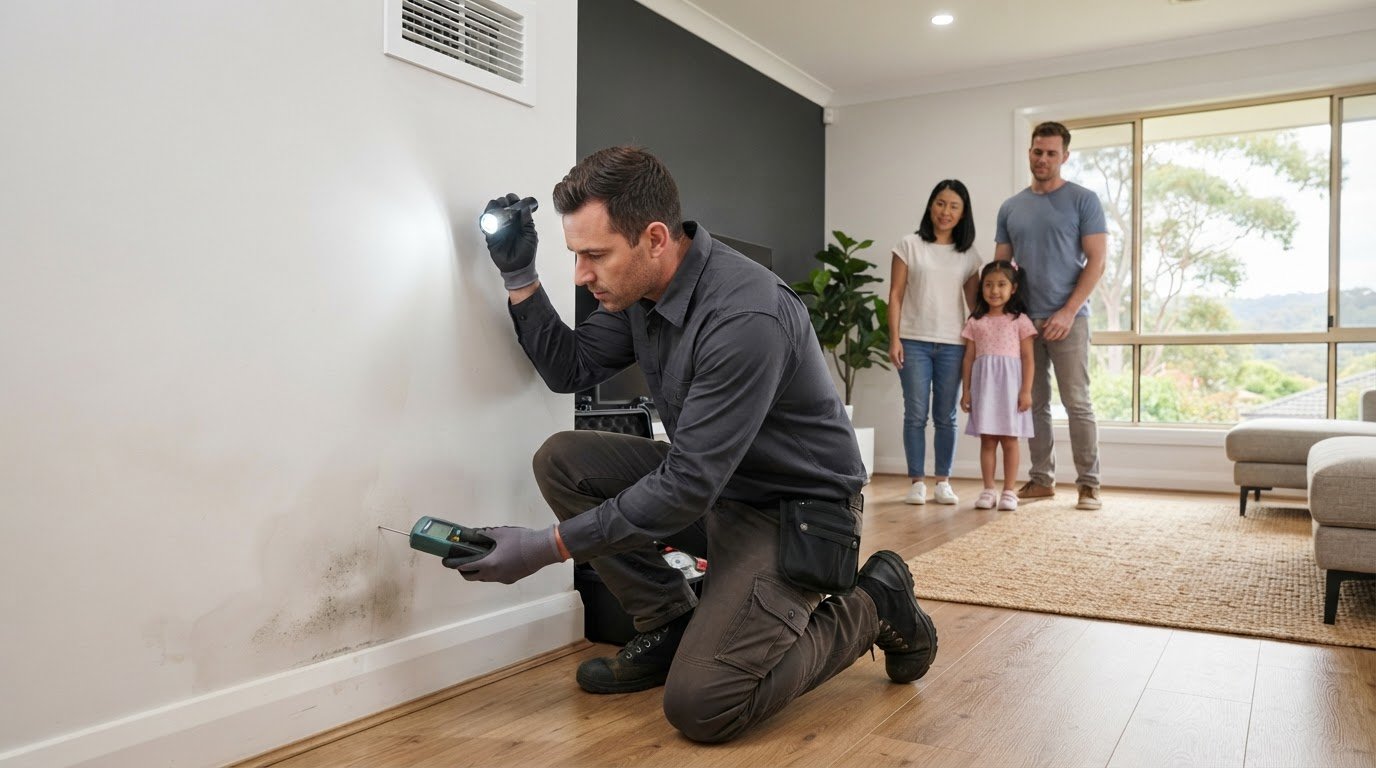
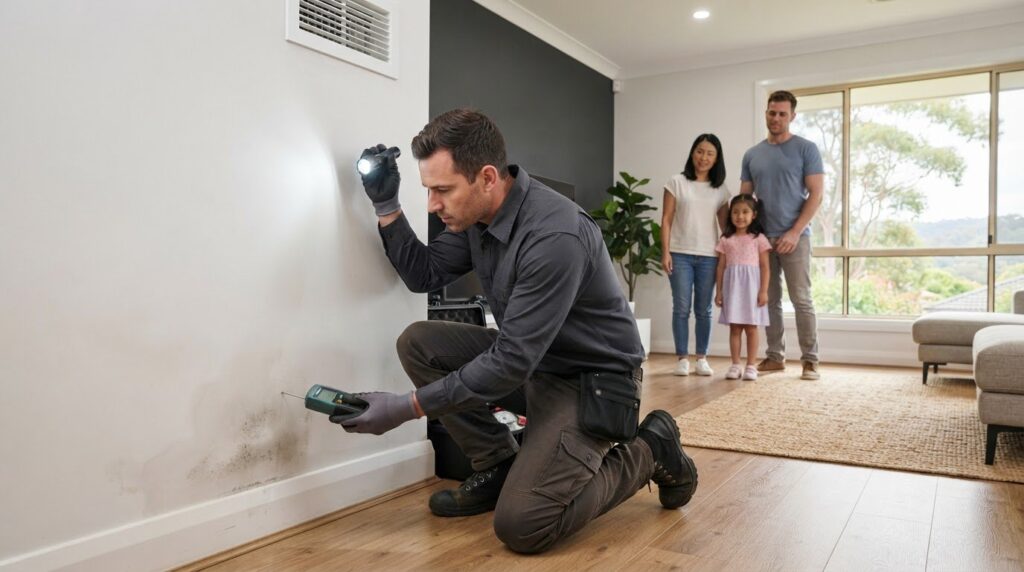
Visible mould can be a clue to a wider moisture problem. A mould inspection Hornsby homeowners arrange can look beyond marks on a wall to assess air quality, humidity, ventilation, structural dampness and possible hidden moisture. Understanding these conditions helps you focus on the cause, not just the surface.
A photo assessment can provide an initial review and quote. If deeper contamination is suspected, an on-site inspection with specialised equipment can assess the property more closely. The right starting point depends on the signs you’ve noticed and what you need to understand.
This guide explains what an inspection assesses, how to prepare and how to use the findings. You’ll learn what photos and details can help with a photo assessment, what to expect during an on-site visit and how a written report can guide practical next steps.
Key Takeaways
- A mould inspection Hornsby assessment can help connect visible mould or musty odours with dampness and possible hidden moisture.
- An inspection assesses factors including air quality, humidity, ventilation and structural dampness.
- Record the signs, when they appeared and any known leak or water damage to help prepare for an assessment.
- A photo assessment can help with an initial review and quote. Suspected deeper contamination calls for an on-site inspection.
- ABC’s Call, Quote, Results process includes written findings; same-day quotes are available for many photo assessments.
Mould Inspection Hornsby: When Is a Professional Assessment Worthwhile?
A dark patch on a wall is easy to spot. The moisture behind it may not be. A mould inspection Hornsby assessment reviews visible mould, dampness and potential moisture sources to clarify the likely extent of the issue and inform suitable next steps. It helps establish what’s happening before you decide on treatment.
Cleaning a visible mark may improve its appearance, but if it returns, the conditions contributing to it may still need attention. An inspection considers the signs and property conditions together, helping you make a decision based on more than appearance alone.
Which signs in a Hornsby property may warrant an inspection?
Consider an assessment if mould keeps returning after cleaning, appears in several rooms or accompanies a persistent musty odour. Visible dampness or mould following a leak, flooding or other water damage can also warrant a closer look. These signs are useful clues, but they don’t show where moisture is entering, how far it has travelled or whether mould is present out of sight.
- Recurring patches: Note where mould returns and how soon it reappears after cleaning.
- Multiple affected areas: Record whether marks occur in separate rooms or on different surfaces.
- Musty odours or dampness: Include areas where you notice a smell or moisture, even if no mould is visible.
- Water damage history: Mention known leaks or water damage and the areas they affected.
When is an inspection more useful than relying on appearance?
Appearance shows what’s on the surface, not necessarily the full moisture pattern. Mould on a wall, for example, doesn’t reveal whether dampness is limited to that spot or connected to another moisture source. A professional assessment considers visible signs alongside humidity, ventilation, structural dampness and possible hidden moisture.
A closer assessment is particularly useful when mould repeatedly returns or you suspect contamination beyond the visible area. ABC provides on-site inspections with specialised equipment when deeper contamination is suspected. The findings help distinguish observed conditions from possible causes and guide appropriate next steps.
Mould concerns can also raise questions about indoor air and occupant wellbeing. For general background on possible effects, see Mold health issues. This information shouldn’t be used to diagnose a health condition or determine the source of mould in a property. An inspection focuses on the building conditions and signs that can be assessed, giving you a practical basis for deciding what to do next.
What a Hornsby Mould Inspection Assesses: Air, Moisture, and Ventilation
A useful inspection looks beyond the visible patch. ABC assesses air quality, humidity, ventilation, structural dampness and possible hidden moisture in relation to the mould or dampness observed in your property. Together, these factors help build a clearer picture of the conditions and inform practical next steps.
A mould inspection evaluates visible signs alongside air quality, humidity, ventilation, structural dampness and potential hidden moisture.
How air quality and humidity fit into the assessment
Visible growth is one part of the picture. Air quality and humidity checks add context about the indoor environment around the affected area. For example, a damp room and mould on a surface are observations to consider together, not proof of a particular cause. The findings are explained in plain language, with the overall conditions considered rather than relying on a single reading.
An air-quality assessment is distinct from mycotoxin testing. Optional mycotoxin testing referrals are available if further testing is relevant; ABC refers clients for this testing rather than performing it. The EPA Mold Resources also offers general background on mould and moisture management, though it isn’t a substitute for assessing conditions in a Hornsby property.
How inspectors look for ventilation and structural dampness
Ventilation is assessed because how air moves through a space adds useful context to dampness. Structural dampness is another key area. The inspection considers whether moisture could be associated with a known leak, plumbing issue or previous water damage, using the property’s conditions and history to inform the assessment.
Where water damage is part of the history, its location and timing can help identify areas that may need attention. ABC’s Sydney water damage repair guidance provides related information for Sydney homes.
For suspected deeper contamination, an on-site inspection with specialised equipment supports a closer assessment of affected conditions. The findings relate to the areas assessed and help guide suitable next steps, including whether further investigation or mould remediation may be appropriate.
If you’re weighing up whether your concerns need a closer look, a professional mould inspection can help turn observations about air, moisture and ventilation into a more informed plan.
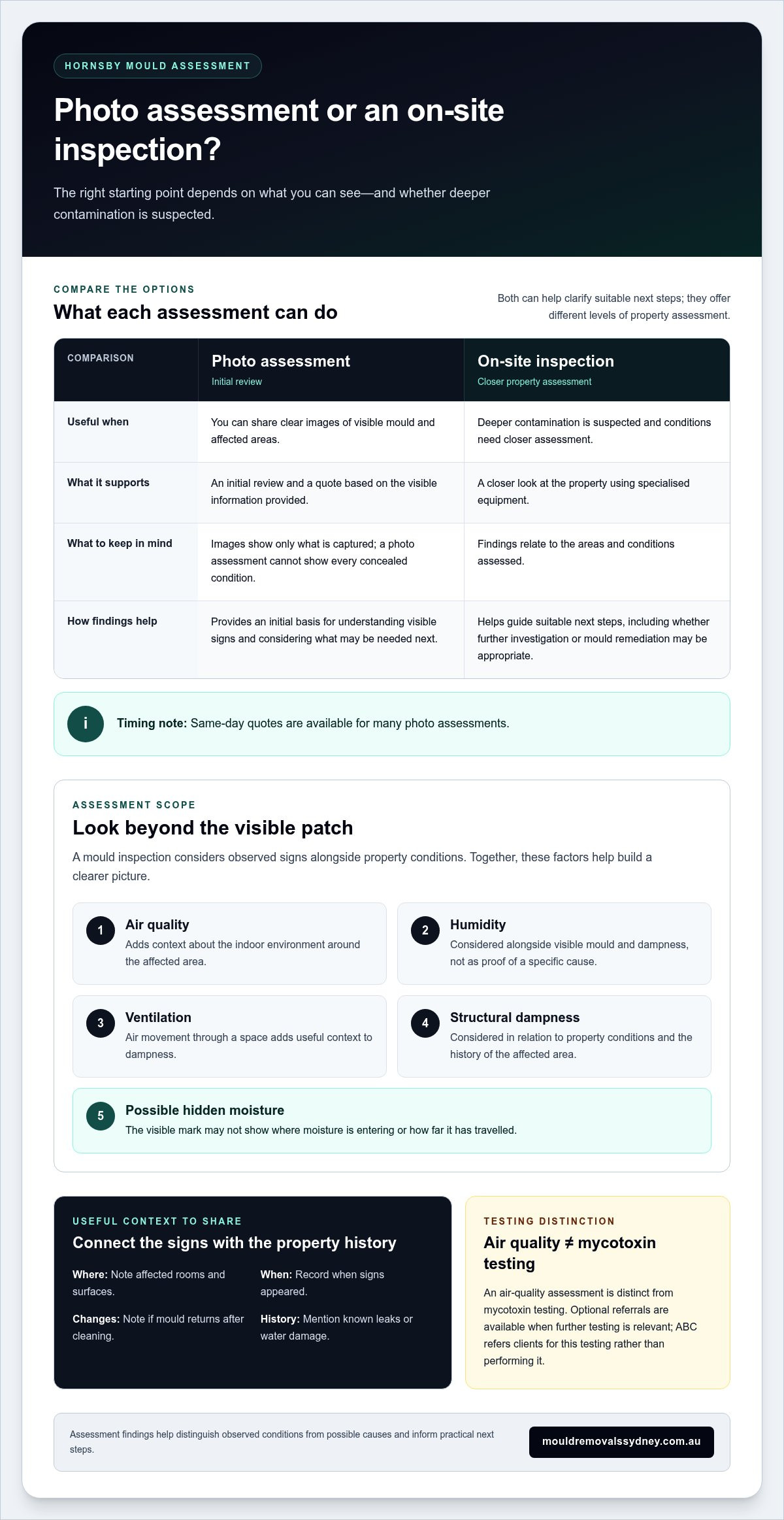
Photo Assessment or On-Site Mould Inspection in Hornsby?
Choosing between a photo assessment and an on-site visit depends on what you can see and what you need to understand. Clear images help ABC review visible mould and provide a quote. If deeper contamination is suspected, an on-site inspection with specialised equipment can assess the property more closely. A photo assessment is a useful starting point, but it can’t show every concealed condition.
| Assessment option | Useful for | What to keep in mind |
|---|---|---|
| Photo assessment | Sharing visible mould and affected areas for an initial review and quote. | Images show only what’s captured; they can’t confirm hidden contamination. |
| On-site inspection | Closer assessment when deeper contamination is suspected. | Specialised equipment supports assessment of conditions at the property. |
What photos can help ABC assess before quoting
Photos communicate the visible signs before you decide on next steps. Capture the affected area clearly, then include a wider view showing where it is in the room. If mould appears in more than one place, photograph each area. Add relevant context, such as when you first noticed it or whether there has been water damage.
ABC’s photo-assessment system provides a same-day quote for many cases. The quote is based on the information provided. A photo can’t reveal what’s behind a surface, establish the full extent of contamination or determine every moisture source. If the images or property history suggest a more involved issue, an on-site inspection may be more appropriate.
When an on-site inspection with specialised equipment is appropriate
ABC provides on-site inspections when deeper contamination is suspected. A visit allows the assessor to consider the property directly, with specialised equipment supporting a closer examination of relevant conditions. This is useful when visible mould is only part of the concern or when the signs and history point to areas that photographs can’t show.
The findings relate to the areas examined and the information available. The aim is to clarify the appropriate next step, not to treat a photo assessment as proof that hidden mould is present or absent.
For a straightforward quoting enquiry, photos can help start the process. If the concern suggests deeper contamination, an on-site assessment offers a closer look. If findings point towards removal, ABC’s professional mould removal guidance provides context on what may follow an inspection. This keeps assessment and remediation distinct, so the path forward reflects the property’s circumstances.
How to Prepare for a Mould Inspection in Hornsby and Use the Findings
A little preparation can make an inspection more useful. Record what you’ve noticed, when it began and any known water damage to put the visible signs into context. You don’t need to identify the cause yourself. Focus on what you’ve observed and let the inspection assess possible sources.
Use this four-step sequence to prepare for a mould inspection Hornsby property owners can act on:
- Record the signs. Note the affected rooms, visible changes, musty odours and damp areas. Write down when you first noticed the issue and whether it has returned.
- Gather relevant history. Make a note of known leaks, water damage or earlier mould problems. Include approximate timing and the areas affected, if you know them.
- Arrange the assessment. Share the information you’ve gathered and provide clear photos if you’re starting with a photo assessment. These details help communicate your concerns without requiring you to diagnose the cause.
- Review the findings. Read the written report and recommendations, noting what was assessed, which moisture factors were observed and what actions are suggested.
What to note before the inspection
Keep your notes factual. For example, record that a patch appeared near a window after water entered the room, rather than concluding that the window is the source. If mould returned after cleaning, note when it reappeared. Avoid disturbing suspected hidden contamination or trying to diagnose what may be behind a surface. Your observations give the assessor useful context.
How written findings can guide your next decision
ABC provides a full written report. It explains the mould or dampness observed, possible moisture sources and relevant conditions such as ventilation or humidity. Recommendations are tailored to the conditions assessed, rather than assuming every case needs the same response. Review what was observed and which next steps relate directly to those findings.
If moisture or ventilation is part of the assessment, use the recommendations to focus on the conditions identified. For example, a ventilation suggestion should relate to observed airflow or dampness concerns, while a water-damage recommendation should connect to the affected area and its history. General background in this complete mould guide for Australian homeowners can add context, but the property’s assessment findings should guide decisions about its specific conditions.
Keep the report and your original notes together. They can help you track changes and understand the reasoning behind recommended action. For clear, property-specific next steps, arrange a mould inspection with ABC.
ABC Mould Inspection Hornsby: From Same-Day Quote to Clear Next Steps
Knowing what happens next makes a mould concern easier to manage. ABC’s process follows three clear stages: Call, Quote, Results. Share what you’ve observed by phone or submit photos for assessment. ABC provides free estimates by phone or photo, with same-day quotes available for many photo assessments.
The assessment clarifies the mould or dampness observed and possible contributing conditions. ABC provides a full written report with findings to review before deciding on appropriate action. Inspection and treatment are separate steps: the assessment informs recommendations, and any further work should reflect the property’s findings and needs.
What happens after the assessment?
Recommendations are tailored to the conditions observed. If water damage is relevant, the report connects that history with the areas assessed. Where subfloor dampness or ventilation is a concern, those factors can also inform suitable next steps. The aim is to move from observations to a practical plan, rather than assume every property needs the same treatment.
Optional mycotoxin testing referrals are available when relevant. ABC can refer you for this testing, which is separate from the mould inspection. The inspection assesses property conditions and provides findings to guide decisions.
Why Hornsby customers choose ABC’s inspection and removal pathway
ABC serves Sydney and surrounding areas, including Hornsby, with mould inspection and remediation services. If treatment is recommended, Goldmorr products are applied only by Goldmorr-approved and trained master technicians using the Goldmorr System. Goldmorr Group has supplied mould-removal solutions since 1998. The system uses a biodegradable, non-mechanical fogging technique.
All treatments are safe for pets, people, and the environment. Review the assessment findings and recommendations to understand the work proposed and decide on a suitable next step. The written report keeps that decision connected to the conditions observed, rather than making removal an automatic assumption.
For a clear starting point, call ABC on 0488 866 853 or share photos for assessment. Many photo assessments receive a same-day quote. ABC also offers this written quote commitment: We Will Beat Any Written Quote By 10%. The Call, Quote, Results process helps move a Hornsby mould concern from initial review to informed action.
Take the Next Step Towards a Clearer Plan
You don’t need to work out the cause of mould before arranging an assessment. Start with what you’ve noticed and what remains uncertain. A focused mould inspection Hornsby assessment can give you a clearer basis for deciding what needs attention next.
If the affected areas are visible, share photos to request an estimate. If you suspect a deeper issue, explain what you’ve observed so the assessment can address your concern. The goal is practical clarity and recommendations grounded in the property’s conditions.
Request a free mould inspection estimate, or call 0488 866 853 to discuss your property.
Frequently Asked Questions
Can a photo provide a same-day mould inspection quote in Hornsby?
Yes. ABC’s photo-assessment system provides same-day quotes for many cases. Send clear images showing the mould and surrounding area, and include relevant context, such as when you noticed it. A photo helps ABC review visible conditions for a quote, but it can’t show what may be concealed behind a wall or ceiling. If the images suggest a more complex issue, an on-site assessment may be appropriate.
When should I request an on-site mould inspection instead of a photo assessment?
Request an on-site inspection if you suspect deeper contamination or if the visible signs don’t explain the full concern. For example, mould in one area combined with dampness elsewhere may need a closer assessment at the property. ABC uses specialised equipment to support on-site inspections, helping assess conditions that a photograph can’t show.
Can a mould inspection identify moisture hidden behind a wall?
An inspection can assess possible hidden moisture, but it may not identify every concealed issue. The assessor considers the signs and property conditions available, which can help indicate areas needing closer attention. Share relevant history, such as a past leak near the wall, and point out nearby dampness or recurring mould. This context supports the assessment but doesn’t establish what is inside the wall.
What information should I provide when requesting a mould inspection?
Describe which rooms are affected, when you first noticed the mould and whether it has returned. Mention musty odours, visible dampness, known leaks or water damage, and any areas where signs have changed. If you’re requesting a photo assessment, send clear images of both the affected surface and its wider surroundings. These details help ABC understand your concerns and assess the most useful next step.
Does ABC Mould Cleaning Solutions perform mycotoxin testing?
No. ABC doesn’t perform mycotoxin testing, but optional referrals are available if further testing is relevant. A mould inspection assesses property conditions and helps inform next steps; mycotoxin testing is a separate process. Referrals can be considered alongside the inspection findings rather than assumed to be necessary.
Are ABC’s mould treatments safe for pets, people, and the environment?
Yes. All treatments are safe for pets, people, and the environment. If mould remediation is recommended, Goldmorr products are applied only by Goldmorr-approved and trained master technicians using the Goldmorr System. Discuss household considerations, including pets or people who need particular care, before treatment so you understand the recommended approach for your property.
What happens after ABC completes a mould inspection?
ABC provides a full written report with findings to help you understand the assessment and consider recommended next steps. Recommendations are based on the property conditions observed, rather than being an automatic instruction to proceed with removal. Depending on the findings, you can review whether mould remediation or attention to relevant moisture conditions may be appropriate. Keep the report with your property records for future reference.