Why do so many Sydney homeowners face immediate claim denials the moment they discover black mould? Most insurers default to blaming “gradual damage” or “lack of maintenance,” leaving you to manage health risks and property restoration on your own. To secure your payout, you need a technical, evidence-based mould report for insurance claim that proves the infestation resulted from a sudden, insured event like a burst pipe or storm flash flooding.
We know how stressful it is to watch spores colonise your property within 48 hours while you’re stuck deciphering complex policy wording. This guide explains exactly what a professional assessment must include to meet the rigorous AS-IICRC S520:2025 standards. You’ll learn how to present the expert evidence needed to counter insurer arguments and ensure your home is safely restored. We’ll preview the specific moisture mapping and causation data required to make your claim bulletproof from the start.
Key Takeaways
- Understand how a technical mould report for insurance claim differentiates between sudden water damage and excluded maintenance issues.
- Discover why moisture mapping and thermal imaging are essential for proving the source of infestation to your insurer.
- Identify common “maintenance traps” like rising damp or poor ventilation that insurers use to deny coverage.
- Learn the critical documentation steps to take immediately after water damage to protect your claim’s validity.
- See how IICRC-compliant inspections and the specialised Goldmorr System provide the evidence needed for a successful payout.
Why You Need a Professional Mould Report for an Insurance Claim
A professional mould report for insurance claim is not just a PDF with a few photos. It is a forensic technical document that details the precise extent of fungal contamination, identifies the species involved, and scientifically determines the underlying moisture source. While you might see black spots on a skirting board, an insurance adjuster sees a potential liability they can potentially deny. Without a formal report, your claim is merely an opinion. With one, it becomes a documented fact backed by industry standards.
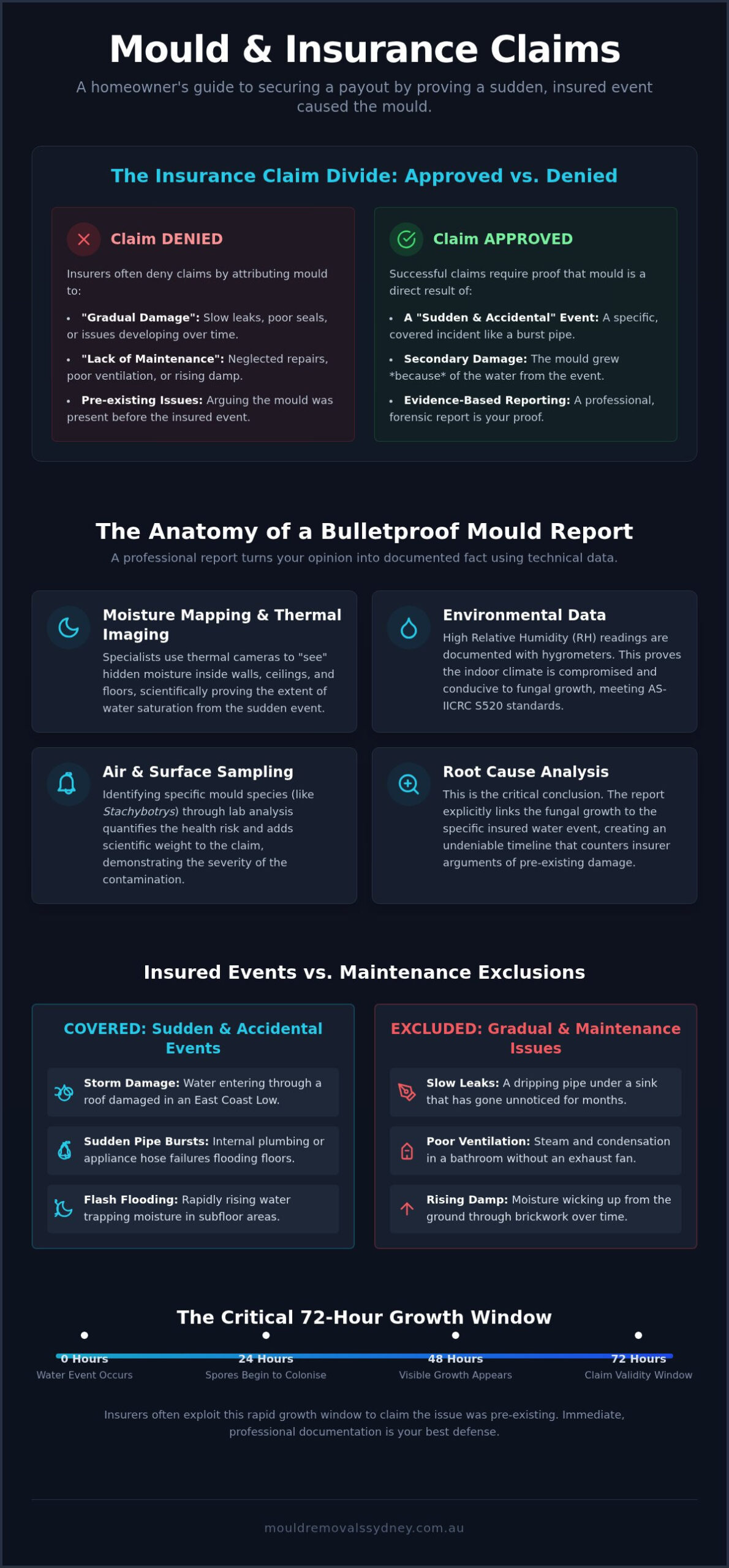
The Australian insurance industry operates under the “secondary damage” rule. This means insurers generally don’t cover mould as a standalone issue. They only pay for remediation if the mould is a direct, secondary result of a “sudden and accidental” insured event. If you cannot prove the mould grew because of a storm last Tuesday rather than a slow, neglected leak from three years ago, your claim will likely be rejected under a “gradual damage” or “maintenance” exclusion. For a comprehensive overview of indoor mould and why its presence requires this level of technical scrutiny, understanding the biology of spores is essential.
Don’t rely on DIY photos or “smell tests.” Adjusters see thousands of these every year and they are almost always dismissed as subjective. A professional report acts as your technical shield. It uses data from moisture meters, thermal imaging, and hygrometers to create an undeniable link between the water event and the fungal growth. This evidence makes it significantly harder for an insurer to argue that the damage was pre-existing or caused by poor housekeeping.
The Difference Between a Quote and a Forensic Report
A simple quote from a cleaner only tells the insurer how much money you want. It doesn’t tell them why they are legally obligated to pay it. A forensic report provides independent verification of the “insured event.” It establishes a clear timeline of damage, proving that the environment became conducive to mould only after the specific incident occurred. This technical timeline is what satisfies an insurance assessor’s requirement for proof of causation.
Common Insured Events Leading to Mould in Sydney
Sydney’s volatile weather creates perfect conditions for sudden mould outbreaks. We frequently see claims triggered by:
- Storm Damage: Roof tiles shifting during East Coast Lows, allowing water to saturate ceiling insulation.
- Sudden Pipe Bursts: Internal plumbing failures or appliance hoses (like dishwashers) that flood floorboards instantly.
- Flash Flooding: Rapid rising water that overwhelms subfloor ventilation, trapping moisture beneath the home.
These events are sudden, making them prime candidates for successful claims if documented correctly within the first 48 to 72 hours.
The Anatomy of a ‘Bulletproof’ Mould Inspection Report
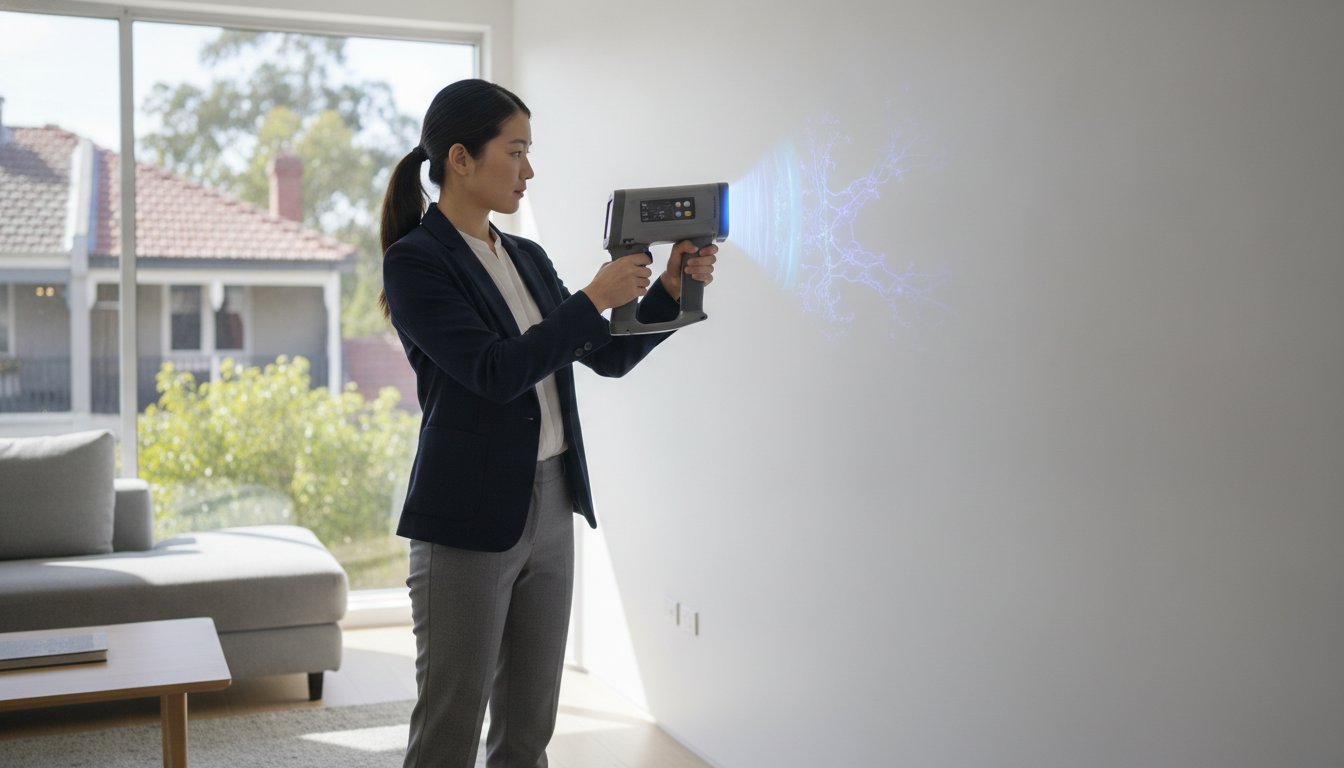
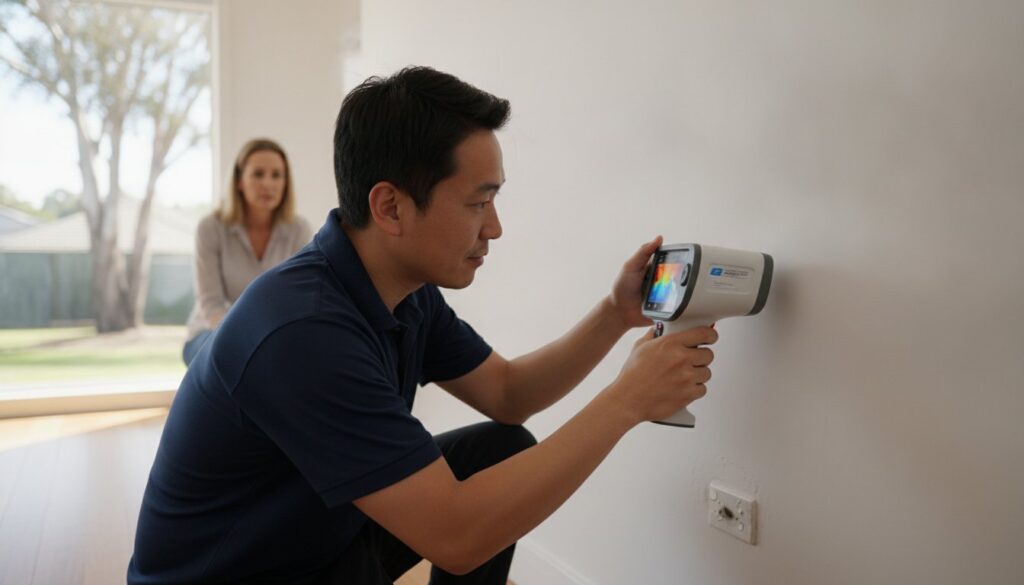
A bulletproof mould report for insurance claim must be built on empirical data rather than visual observations alone. When an assessor reviews your file, they look for technical evidence that removes all doubt regarding the source and extent of the damage. This begins with moisture mapping. By using advanced thermal imaging cameras, our specialists can “see” through walls to identify hidden pockets of moisture that the naked eye misses. This technology proves that water from a sudden event is still trapped within the building’s structure, providing the scientific link between the initial incident and the resulting mould.
Beyond finding wet spots, the report must document the environmental conditions of the property. High Relative Humidity (RH) readings are critical indicators that the indoor climate has been compromised. We compare these readings against official government guidelines to demonstrate that the property is currently unsafe for occupants. To ensure absolute accuracy, we perform both surface and air sampling. Identifying specific species like Stachybotrys chartarum (often called black mould) allows us to assess the health risk accurately. If you suspect your property is compromised, booking professional mould inspection services is the first step toward securing this vital data.
The final, most important component is the Root Cause Analysis. This section of the report explicitly links the fungal growth to the water damage event. It explains why the mould is a direct consequence of the burst pipe or storm damage rather than a long-term maintenance failure. Without this explicit connection, insurers often exploit the 24 to 72-hour growth window to claim the issue was pre-existing. A professional report shuts down these arguments by documenting the exact moisture levels present at the time of inspection.
Technical Data Adjusters Look For
Assessors require specific moisture content percentages for different building materials. We measure timber, plasterboard, and masonry, comparing these figures against a “dry standard” control area in an unaffected part of the house. This comparison proves that the affected zones are significantly wetter than they should be. A hygrometer is an instrument used to measure the amount of water vapour in the air, providing the atmospheric data needed to confirm if a room’s humidity supports active fungal growth. These precise metrics leave no room for the insurer to dispute the necessity of remediation.
Scope of Works: The Remediation Roadmap
Your report must include a detailed Scope of Works that follows the IICRC S520:2025 standards. This roadmap outlines the exact steps for removal, such as the specialised Goldmorr System, which uses biodegradable fogging to eliminate spores safely. It also specifies air purification requirements, like the use of HEPA air scrubbers, to remove airborne contaminants. Finally, we mandate Post-Remediation Verification (PRV) testing. This independent clearance test proves the building is “clean” and safe for re-occupancy, ensuring your insurer pays for a complete and permanent solution.
Insured Events vs. Maintenance: Why Claims Get Denied
The “Gradual Damage” clause is the most common weapon insurers use to avoid paying for remediation. This clause states that any damage occurring slowly over time, such as a slow-leaking tap or poor bathroom ventilation, is the owner’s responsibility. If an assessor finds evidence of long-term moisture, they will classify the mould as a maintenance issue rather than an insured event. This is why a professional mould report for insurance claim is so vital. It provides the technical data needed to prove the moisture appeared suddenly, even if the visible mould took several days to colonise surfaces.
Following the steps for identifying and controlling mould helps establish a baseline for what constitutes a safe environment. When an insured event occurs, like a storm, it creates a “point of origin” that is distinct from chronic dampness. Without this distinction, you risk your claim being grouped with “rising damp,” a condition insurers almost never cover. If you are dealing with toxic species, read our guide on What is Black Mould? to understand the specific health risks and structural impacts involved.
Identifying ‘Sudden’ Water Damage
Distinguishing between a burst pipe and slow seepage requires a forensic eye. A burst internal pipe often causes localised, high-saturation flooding with sharp water marks. In contrast, slow seepage usually presents as peeling paint, salt crusts, or a persistent musty odour that has existed for months. You must report any water incident to your insurer immediately. Any delay gives the adjuster a reason to argue that the mould grew due to your failure to mitigate the damage. Documenting the point of origin with date-stamped photos is the best way to prove the event was accidental and sudden.
The Role of Subfloor Ventilation in Denials
Blocked vents are a common “maintenance trap” in Sydney. If a storm floods your subfloor, but your vents were already obstructed by garden beds or debris, the insurer may argue the mould is your fault. They will claim the water would have dried naturally if you had maintained proper subfloor ventilation. An expert mould report for insurance claim counters this by proving that the volume of water from the insured event was so great it overwhelmed even a well-maintained system. We look for high-water marks and silt deposits to show that the flooding was an extraordinary occurrence, not a result of neglected vents.
5 Essential Steps to Take Before Your Mould Inspection
Preserving evidence is the most critical task you face between discovering a leak and the arrival of a specialist. If you accidentally destroy the proof of a “sudden event,” your mould report for insurance claim will lose its technical weight. You must act quickly but carefully to ensure your property is safe and your claim remains valid. Follow these chronological steps to prepare your home for a successful assessment.
1. Safety First: Do Not Disturb the Mould. It is tempting to scrub away visible spots, but this is a dangerous mistake. Disturbing a colony without professional containment causes spore aerosolisation. These microscopic particles can travel through your HVAC system and settle in unaffected rooms, escalating a minor issue into a whole-house contamination. Keep the area sealed and stay away.
2. Document Everything Immediately. Use your smartphone to take high-resolution, date-stamped photos and videos. Focus on the “point of origin,” such as the split washing machine hose or the collapsed ceiling section. Capture the mould in its original state. This visual trail proves the timeline of the damage, which is essential for countering any “gradual damage” arguments from the insurer.
3. Mitigate Further Loss. Australian insurance policies require you to take reasonable steps to prevent more damage. If you have a burst pipe, turn off the water mains immediately. If a window is broken, cover it with a tarp if safe to do so. For a detailed breakdown of emergency response, refer to our Water Damage Repair Guide.
4. Contact Your Insurer. Notify your insurance company before booking your independent report. Secure a claim number and ask for their specific requirements regarding third-party inspections. Having this number ready for your inspector ensures that all documentation is correctly filed from the start.
5. List Health Symptoms. Document any respiratory issues, headaches, or skin irritations residents have experienced since the water event. This information helps the inspector determine the urgency of the remediation and the types of air sampling required.
What NOT to Do with Mould
Never use bleach on porous surfaces like plasterboard or timber. Bleach is mostly water; while it kills surface colour, the water penetrates the material and feeds the mould roots, leading to more aggressive regrowth. Avoid using standard household fans to “dry out” the area. Fans simply blow spores into the air, contaminating your furniture and curtains. Most importantly, don’t clean the mould before the assessor arrives. Removing the physical evidence makes it nearly impossible for them to provide a definitive mould report for insurance claim that proves the extent of the infestation.
Preparing for the Inspector’s Visit
Ensure our team has clear, unobstructed access to the subfloor, roof cavity, and all wet areas. Move furniture or stored items away from affected walls. Have your insurance policy documents, claim number, and your timeline of events ready for review. This preparation allows us to focus entirely on the technical moisture mapping and sampling needed for your payout. If you need an urgent assessment, book a professional mould inspection today to protect your home and your health.
Expert Remediation Reports by ABC Mould Cleaning Solutions
ABC Mould Cleaning Solutions provides the technical expertise required to turn a stressful property issue into a resolved insurance payout. We specialise in creating the forensic documentation that adjusters demand. A professional mould report for insurance claim from our team doesn’t just list the damage; it uses scientific data to prove exactly how an insured event caused the infestation. By following IICRC-compliant protocols, we ensure your claim is backed by the highest industry standards in Australia. Our reports are transparent, technical, and written specifically to be understood by insurance assessors.
Our process integrates comprehensive Air Purification & Scrubbing to eliminate airborne spores and restore indoor air quality immediately. We recognise that a successful claim is only half the battle. You also need a home that is safe for your family to live in. Our specialists use advanced HEPA filtration systems to “scrub” the air, removing the microscopic contaminants that typical cleaning methods leave behind. For a complete, evidence-based solution, trust Sydney’s #1 Mould Removal Service to handle everything from the initial inspection to the final clearance testing.
Our Goldmorr Remediation Process
The Goldmorr System is our proprietary methodology for safe and effective restoration. It utilises non-invasive, biodegradable fogging that reaches hidden spores behind walls and within ceiling cavities without requiring extensive demolition. This system eliminates musty odours at the source without relying on harsh, toxic chemicals that can linger in your living spaces. Because the process is so efficient, it allows for significantly faster re-occupancy of the property compared to traditional abrasive methods. Insurers often prefer this approach because it effectively minimises secondary damage and ensures a permanent fix.
Book Your Insurance-Ready Inspection Today
Timing is everything when dealing with Sydney’s humid climate. We provide an urgent response across all Sydney suburbs to prevent secondary mould growth from taking hold. Our team manages direct, professional communication with your insurer or strata manager to streamline the approval process. We offer a price-matching guarantee for any professional remediation quote that adheres to the same IICRC technical standards. Don’t let a “maintenance” excuse stop you from getting the payout you deserve. Contact us today to secure a technical report that protects your property and your health.
Secure Your Property and Your Payout Today
A successful insurance claim relies on technical precision rather than just visible damage. You’ve learned how a comprehensive mould report for insurance claim distinguishes between a sudden, accidental water event and excluded maintenance issues. By documenting moisture levels and spore counts according to IICRC-compliant reporting standards, you remove the insurer’s ability to use “gradual damage” as an excuse for denial. Expert evidence is your strongest tool in ensuring your property is restored to a safe condition without out-of-pocket stress.
Don’t wait for the infestation to spread or for respiratory health risks to escalate. Our team provides a 24/7 emergency water damage response across Sydney to mitigate loss immediately. As Sydney’s trusted Goldmorr System specialists, we combine biodegradable remediation technology with the forensic data required to satisfy any insurance adjuster. We handle the complex technical evidence so you can focus on returning to a healthy, mould-free environment.
Secure your insurance claim with a professional mould report from Sydney’s experts today.
Take the first step toward a safe home with absolute confidence. We’re ready to help you navigate the claims process and deliver the results you deserve.
Frequently Asked Questions
Does home insurance cover mould removal in Sydney?
Insurance usually covers mould removal if the growth is a secondary consequence of a sudden, insured event like a burst pipe or storm damage. However, policies almost always exclude mould caused by gradual moisture, rising damp, or poor ventilation. A professional mould report for insurance claim is essential to prove the timeline and link the damage to a specific, covered incident.
How much does a professional mould report for an insurance claim cost?
The cost of a professional assessment varies based on the property size and the number of air or surface samples required for laboratory analysis. While basic visual checks are less expensive, a comprehensive forensic report involves moisture mapping and technical data collection to satisfy insurance adjusters. Most homeowners find that the cost of an independent report is a small investment compared to the potential risk of a denied claim.
Can I use a DIY mould test kit for an insurance claim?
No, DIY kits are almost never accepted by insurance adjusters or the Australian Financial Complaints Authority. These kits lack the scientific rigour and technical causation data required to prove an insured event. Insurers require reports that adhere to the AS-IICRC S520:2025 standards, which involve moisture mapping and professional laboratory analysis that retail kits cannot provide.
What happens if my insurance claim for mould is denied?
If your claim is denied, you should first request a copy of the insurer’s assessment report and compare it against your independent technical evidence. You can then lodge a formal complaint through the insurer’s Internal Dispute Resolution (IDR) process. If the denial stands, you can escalate the matter to the Australian Financial Complaints Authority (AFCA) for a free and independent review.
How long does it take to get a mould report back?
Most professional reports are delivered within 2 to 5 business days after the site inspection. This timeframe accounts for the laboratory processing of air and surface samples required to identify specific fungal species. Urgent assessments may be available if the property is severely flooded and requires immediate remediation to prevent further structural damage.
Is black mould always covered by insurance if it follows a flood?
Black mould is only covered if it’s a direct result of the flood event. Insurers often use moisture meters to determine if the building materials were already damp before the flood occurred. If the mould report for insurance claim shows that the contamination is new and linked to the recent ingress of water, the insurer is more likely to approve the remediation costs.
Will insurance pay for temporary accommodation during mould removal?
Many Sydney policies include “Loss of Rent” or “Temporary Accommodation” clauses if the property is uninhabitable. A professional assessment that identifies high levels of toxic spores or compromised air quality provides the evidence needed to trigger this coverage. Your insurer will usually pay for a similar standard of living while remediation work, such as air scrubbing, is performed.
What is a ‘Post-Remediation Verification’ (PRV) report?
A Post-Remediation Verification (PRV) report is a final clearance document issued after the cleaning process is complete. It involves independent air and surface testing to prove that the mould has been removed and the environment has returned to a normal, safe status. This report is often required by insurers to close the claim and ensure the property is safe for residents to return.