What if mould in a brand-new home is a reason to investigate, not proof of who’s at fault? Seeing spots, smelling mustiness or noticing damp materials can be unsettling, especially when you’re unsure whether they point to an unresolved moisture problem. For owners searching “mould inspection new build Sydney,” a professional assessment can turn those concerns into clear, organised observations.
A thorough inspection can assess visible mould, look for moisture clues and document findings that may help inform sensible next steps. It doesn’t, by itself, determine responsibility or guarantee a warranty outcome. You can gather useful evidence without jumping to conclusions about the cause.
This guide explains what a new-build mould inspection may cover, what it can and can’t establish, and how findings can support your next decisions. You’ll also learn how to organise observations and records, and where to check current NSW guidance if you’re considering raising a warranty concern. With a clearer picture of the process, you can focus on understanding the moisture issue.
Key Takeaways
- A mould inspection can assess visible growth and moisture clues, but it doesn’t automatically prove a construction defect or determine who is responsible.
- A mould inspection new build Sydney assessment can follow a clear process: discuss concerns, inspect affected areas, assess moisture clues and explain the findings.
- Visual inspection, moisture assessment, optional mould testing and legal advice serve different purposes. Knowing the distinction helps you choose an informed next step.
- Prepare by recording when and where mould appeared, arranging access and preserving evidence of the original condition.
- Inspection findings can help ABC Mould Cleaning Solutions assess mould extent and possible sources, then inform a tailored response.
Mould Inspection for a New Build in Sydney: What It Can Tell You
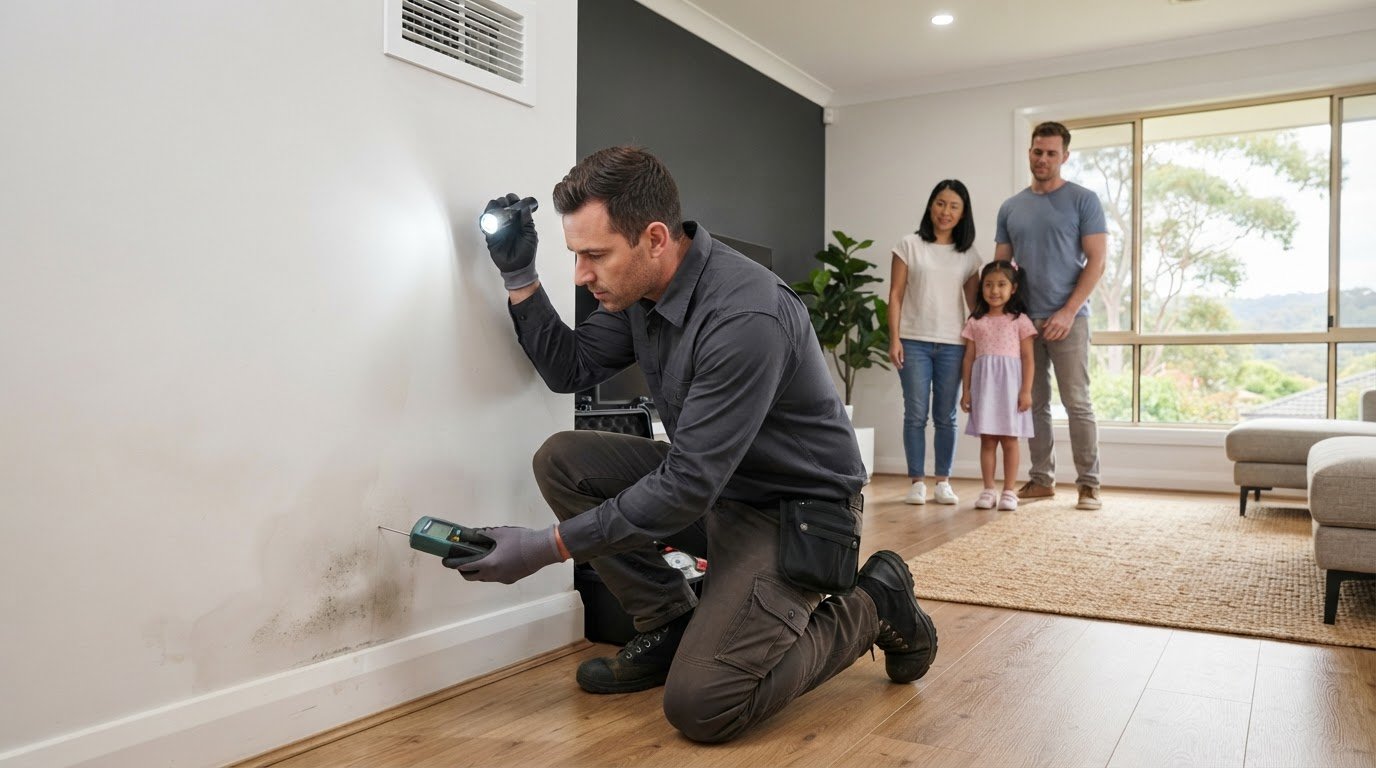
A new home can still develop mould. After handover, you might notice dark spotting near a window, a damp patch on a wall or a musty smell that lingers after the room has been aired. These signs deserve attention, but they don’t identify where moisture is coming from or who may be responsible. An inspection provides a structured assessment of visible mould, moisture clues and conditions that could be contributing to the problem.
For owners searching “mould inspection new build Sydney,” the aim is to get a clearer record of what can be observed and what may need further investigation. Depending on access and the agreed scope, an inspection may include visual observations and moisture or humidity readings. These findings can help you describe the concern clearly to relevant parties, such as a builder, without treating an observation as proof of a defect or liability.
What makes a new-build mould concern different?
Timing and context matter. A concern may appear soon after handover or only become noticeable once the home is occupied. Construction materials, ventilation, day-to-day use and water events can all be relevant when considering moisture. For example, record where a musty odour occurs and when it began, but don’t treat the odour as a diagnosis. New construction doesn’t rule out moisture issues, and mould alone doesn’t prove defective work. For general background on indoor mould and its relationship with moisture, see Indoor mold.
What a mould inspection can and cannot establish
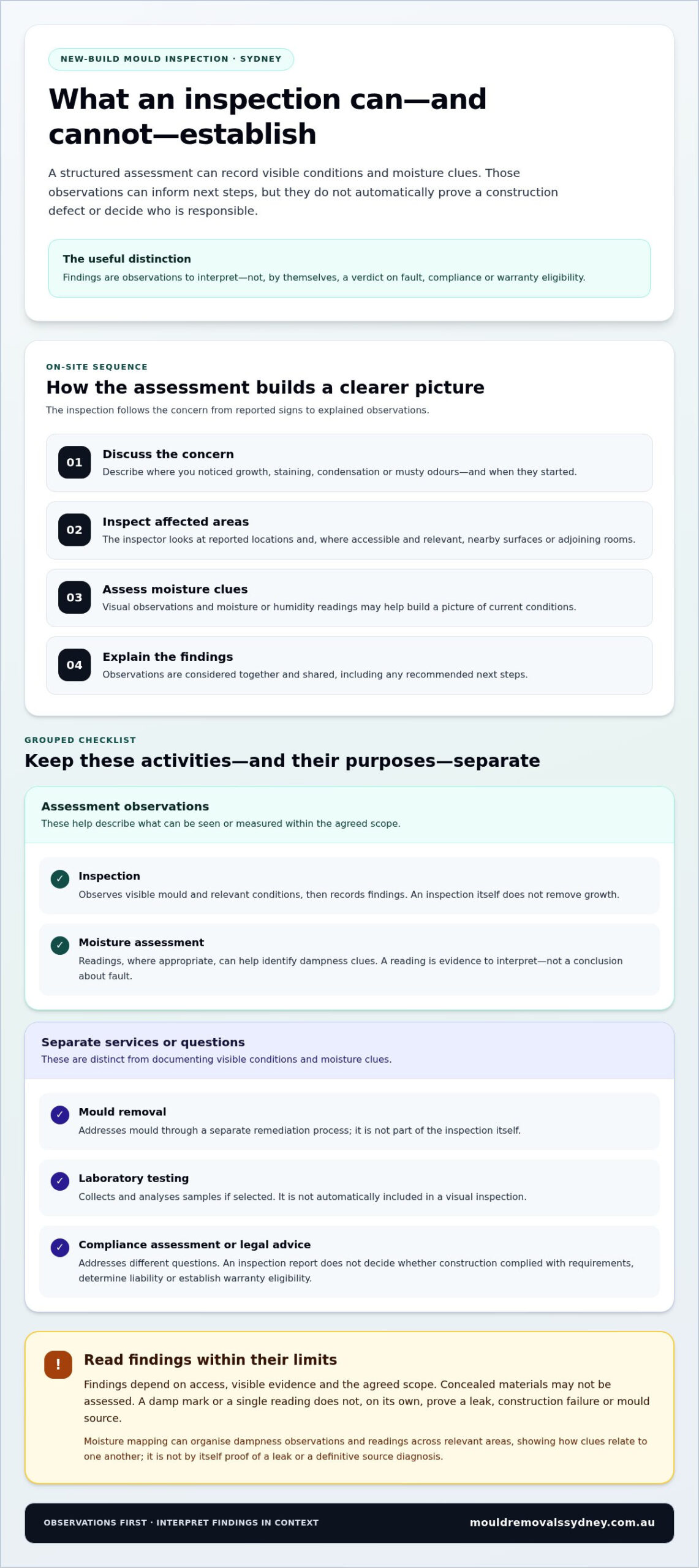
An inspector can document visible conditions and, where included in the scope, use moisture or humidity readings to help guide an assessment. The value comes from considering observations together: where growth appears, what nearby surfaces show and whether there are moisture clues worth following up. Findings are limited by access, visible evidence and the agreed scope, so concealed materials may not be assessed.
Keep these different activities separate:
- Inspection: Observes visible mould and relevant conditions, then records findings.
- Moisture assessment: Uses readings, where appropriate, to help identify dampness clues. A reading is evidence to interpret, not a conclusion about fault.
- Mould removal: Addresses mould through a separate remediation process. An inspection itself doesn’t remove growth.
- Laboratory testing: Involves collecting and analysing samples if testing is selected. It isn’t automatically part of a visual inspection.
- Building compliance assessment or legal advice: Addresses different questions. An inspection report does not decide whether construction complied with requirements, determine liability or establish warranty eligibility.
Early, organised documentation makes follow-up conversations more precise. Note the location, appearance and timing of the concern, and keep relevant photographs and records together. A professional inspection can add structured observations and recommendations to that history. Use the findings to inform your next steps, not as a substitute for a builder’s response, further investigation or legal advice where needed.
How a Sydney New-Build Mould Inspection Traces Moisture Clues
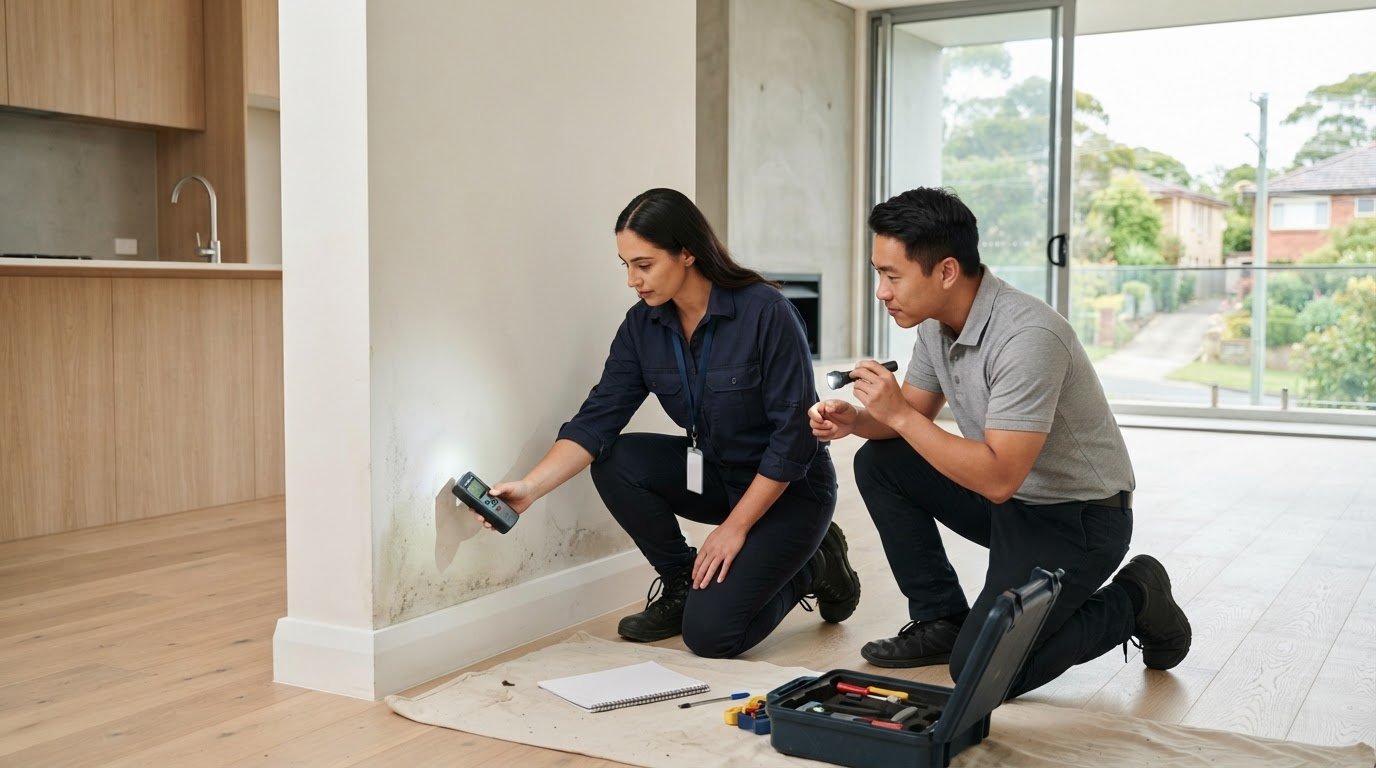
A useful inspection follows a sequence rather than focusing only on the most visible patch. It starts with your concerns, then considers affected areas, nearby surfaces and moisture clues before explaining what the observations may suggest. If you’re arranging a mould inspection for a new build in Sydney, it helps to know what happens on site. The process is straightforward, but findings depend on access and the agreed scope.
- Discuss the concern. Describe where you’ve noticed growth, staining, condensation or musty odours, and when they started.
- Inspect affected areas. The inspector looks at reported locations and, where accessible and relevant, surrounding surfaces or adjoining rooms.
- Assess moisture clues. Visual observations and moisture or humidity readings may help build a picture of current conditions.
- Explain the findings. Observations are considered together and shared with you, including any recommended next steps.
Moisture mapping is an organised record of observed dampness and readings across relevant areas, helping show where moisture clues occur in relation to one another. It isn’t, by itself, proof of a leak or a definitive source diagnosis.
Visible signs and moisture readings in a new home
Staining, surface growth, condensation on windows and damaged finishes are worth recording, but appearance alone can’t confirm the cause. A damp mark might reflect a past water event, ongoing moisture or another condition. Readings offer additional clues, interpreted alongside the material, location and surrounding conditions. One reading doesn’t prove a leak, construction failure or mould source. For general information on mould prevention and remediation, the US EPA’s EPA Mold Resources provides a useful reference.
Rooms and conditions that deserve careful attention
Start with the areas where you’ve noticed signs. Bathrooms, wardrobes and window surrounds can be useful inspection points, along with adjoining spaces if access and reported clues make them relevant. A subfloor area may also warrant attention when accessible and connected to the concern. The inspection should follow the observations, not assumptions about where a problem must be.
Context helps make the observations more useful. Before the inspection, note any recent leaks or water events, cleaning, changes to ventilation and when the home became occupied. Mention if signs appear after particular conditions, such as rain or windows being kept closed. Sydney weather and recent rainfall can help frame the history, but neither proves a moisture source. A concise timeline helps distinguish what was observed from what is suspected.
Keep your notes and photographs together and explain what has changed since the concern appeared. ABC Mould Cleaning Solutions’ Sydney mould inspection service assesses mould extent and possible sources to inform a tailored response. Clear observations give the assessment a practical starting point.
Inspection Findings, Mould Testing and Warranty Enquiries: What’s Different?
A clear report can help you describe a new-build mould concern, but different types of assessment answer different questions. When arranging a mould inspection for a new build in Sydney, it helps to know whether you need observations about visible conditions, further moisture investigation, sample testing or advice about a warranty process. These aren’t interchangeable, and one doesn’t automatically provide the answers covered by the others.
| Step or advice | What it can help with | What it doesn’t decide |
|---|---|---|
| Visual inspection | Records visible mould and surrounding conditions within the agreed scope. | It doesn’t establish legal responsibility or warranty eligibility. |
| Moisture assessment | Uses relevant readings as clues about dampness in accessible areas. | A reading alone doesn’t prove a leak or identify its source. |
| Optional mould testing | Can answer a narrower question about a sample, depending on the method and purpose. | It doesn’t automatically locate moisture or assign responsibility. |
| Legal advice | Can help interpret rights, obligations and processes for your circumstances. | It’s separate from an inspection or laboratory result. |
Inspection versus mould testing
An inspection assesses observable conditions and moisture clues; testing involves taking and analysing samples to address a specific question. Testing isn’t automatically required, and whether it’s relevant depends on the concern and inspection scope. Consider any test result in context. It doesn’t, by itself, explain why moisture is present, identify a building defect or establish who is responsible.
A report can organise observations, readings and recommendations into a useful record. Treat it as evidence of what was assessed and noted, not as a warranty ruling. If you’re raising a concern, describe what the report records, then make any request or question separately. If water damage forms part of the history, the water damage repair guide for Sydney homes may help you understand the related restoration context.
Building a clear record for a builder or warranty enquiry
Keep a simple, dated file. Add photographs that show the affected area and, where useful, wider context. Note the room, when you first noticed the concern, how it has changed and any known water events. Save the inspection findings, relevant property documents and copies of messages or letters about the issue. If cleaning or repairs have occurred, record what changed and when.
Keep your wording factual. “Damp patch appeared beside the window on this date” separates an observation from an assumption such as “the window installation is defective.” That clarity helps others understand what you’ve seen without overstating what an inspection can establish. If the report recommends follow-up, record the recommendation and any action taken.
Before making a warranty enquiry, review your building contract and check current NSW Fair Trading guidance for applicable processes. Requirements and timeframes can depend on the circumstances, so don’t rely on an inspection report to determine eligibility. Keeping correspondence and findings together makes it easier to explain the concern and identify the next step.
Before and After the Inspection: A New-Build Owner’s Action Plan
A little preparation makes an inspection more focused and the findings easier to use. Give the inspector a clear history, make agreed areas accessible and preserve an accurate record of what you’ve observed. You don’t need to diagnose the cause yourself.
What to prepare before the inspection
Before your mould inspection new build Sydney appointment, gather the details that help put each affected area in context. A short timeline is more useful than a long account built from memory. Include what you noticed, when it appeared and whether it has changed.
- List affected rooms: Note the location of visible growth, damp patches, condensation or persistent odours. Record whether the signs have spread, faded or returned.
- Collect dated photographs: Keep original images where possible, with a brief caption noting the room and date. Include a wider view to show where the affected area sits.
- Gather relevant records: Bring repair documents, correspondence and notes about known leaks, water exposure or other relevant events.
- Arrange access: Make sure the inspector can safely reach areas included in the agreed assessment. Clear stored items only where needed, and don’t move anything that could create a safety risk.
Preserve visible evidence where practical. Avoid repainting, covering marks or making non-urgent changes before the condition has been recorded, as those actions may make it harder to understand what was originally present. If urgent work is needed to address active water entry or prevent further damage, prioritise safety and keep a record of the condition and work carried out.
What to do with the findings
After the inspection, read the report carefully rather than focusing only on its summary. Check which areas were assessed, what observations and readings were recorded, any access or scope limitations, and what follow-up is recommended. If a point is unclear, ask a specific question, such as whether a recommendation relates to a particular room or an observed moisture clue.
Keep the report with your dated photographs, property documents and related correspondence. If you share findings with the builder or another relevant contact, describe the recorded observations and ask focused questions. Separate what the report documents from your own concerns about cause or responsibility. A report can help explain the issue, but it doesn’t determine warranty eligibility.
Before relying on assumed deadlines or procedures, check your contract and current NSW Fair Trading guidance for the process that applies to your circumstances. Save copies of messages and note when you sent them or received a response. A consistent record makes later follow-up clearer.
If you’re ready to document the concern with a professional assessment, arrange a Sydney mould inspection with ABC Mould Cleaning Solutions. It’s a practical step toward understanding the mould extent and possible source, then considering a suitable response.
Professional Mould Inspection in Sydney: From Findings to Next Steps
An inspection is a practical starting point, not a final verdict on why mould appeared or who is responsible. ABC Mould Cleaning Solutions assesses the extent of mould and possible sources, then uses the findings to inform recommendations suited to the property. For a new-build owner, this can help separate observed conditions from assumptions and plan a sensible technical next step. Warranty questions remain separate and should be addressed through the relevant process.
Turning inspection findings into a practical response
Documented mould and moisture observations help show what needs attention and where follow-up may be useful. Recommendations depend on the findings: mould remediation may be relevant where growth is present, while water damage restoration, air purification or subfloor ventilation may suit conditions identified at the property. ABC Mould Cleaning Solutions provides inspection, removal, air purification and recommendations to help prevent future growth. Addressing moisture conditions matters when planning remediation and prevention. The inspection informs a response; it doesn’t guarantee a particular result or determine warranty eligibility.
Use the findings to organise your next steps:
- Review what was observed: Note the affected areas, mould extent and any moisture clues described.
- Separate technical and warranty questions: Share relevant factual findings with the builder or another responsible contact, but don’t treat the inspection as a legal decision.
- Follow relevant recommendations: Consider the report’s suggested actions in light of the property and any additional assessment required.
- Keep a record: Save the report and note any changes or follow-up work so later observations can be considered in context.
If you want wider background before deciding what to do next, use a guide to mould for Australian homeowners to understand the issue in broader terms.
When to arrange a professional inspection
Consider arranging an assessment if visible mould returns after cleaning, spreads to another area or appears alongside persistent dampness. A leak or water event may also warrant prompt attention, particularly if signs of mould develop afterwards. Recording what you noticed and when it changed gives an inspection useful context. You don’t need certainty about the cause before documenting a recurring concern.
ABC Mould Cleaning Solutions provides mould inspection services across Sydney and surrounding regions. The assessment can help clarify the mould’s extent and possible sources, so you can consider a tailored response based on the findings. It won’t establish who is at fault, but it can provide a clearer technical picture to guide your next conversation or action.
For a professional assessment of mould and moisture clues in your property, request a professional mould inspection in Sydney. A clear starting point can make the next step easier to plan.
Move Forward With a Clear Next Step
You don’t need to settle questions of fault before deciding what to do next. If you’re considering a mould inspection for a new build in Sydney, focus first on what would help you make a sound decision: a clearer picture of the affected areas, the moisture clues and any follow-up worth considering. A measured assessment can reduce guesswork without forcing you to draw conclusions before the evidence is understood.
Keep your notes and records together and use them to guide focused conversations. If the concern changes or returns, add the date and what you observed. That ongoing record can help you explain the situation clearly as you decide whether further technical, building or warranty advice is appropriate.
For a professional starting point, arrange a mould inspection in Sydney with ABC Mould Cleaning Solutions. Clearer information can help you choose your next step with greater confidence.
Frequently Asked Questions
Can a mould inspection prove that a new-build defect caused the mould?
No. A mould inspection for a new build in Sydney can document technical observations, but it can’t by itself prove a construction defect or legal responsibility. For example, a report might record moisture near a window without establishing how it entered. Keep the report alongside your contract, handover documents and maintenance records. If you need to understand whether the evidence supports a warranty claim, check current NSW guidance or seek qualified legal advice.
Should I contact the builder before arranging a mould inspection?
It depends on your circumstances, contract and whether active moisture needs prompt attention. If water is still entering, don’t delay addressing the immediate issue while you consider the inspection sequence. Record what you can safely observe, then review your contract and current NSW guidance for any notification process. An inspection can provide technical context, but it doesn’t replace required contact or reporting steps that may apply to your situation.
Can an inspector check inside walls for mould?
Not necessarily. A visual assessment generally covers accessible areas, so mould hidden behind a wall lining may not be visible. Opening a wall or using another investigative method would involve a separate scope and access considerations. Before the visit, identify any wall where you suspect concealed moisture and explain why, such as a recurring mark in the same spot. Confirm the agreed scope and ensure any limits are recorded.
Is mould testing always necessary during a new-build inspection?
No. Testing is useful only when sampling can address a defined question relevant to the concern. For instance, someone may want sample analysis for a specific material, but a result won’t automatically explain how moisture reached it. Start by clarifying what decision the test is intended to support. The inspection scope and available evidence can help determine whether sampling adds useful information or another follow-up is more relevant.
What should I photograph before a mould inspection?
Capture the affected area in context: take a close view, then a wider image showing its position in the room. Include nearby surfaces if they show staining or condensation, and keep the original files so their dates remain available. A short note can identify the room and when you first saw the change. Photograph only where it’s safe, and don’t disturb material just to obtain a closer image.
Who can explain NSW warranty timeframes for a new build?
NSW Fair Trading’s current guidance can help you understand relevant processes, while a qualified legal professional can advise on how warranty rules apply to your contract and circumstances. Keep the contract, handover information and dated communications available when seeking advice. Avoid relying on a general timeframe without checking current official information. An inspection report can describe property conditions, but it can’t interpret your rights or decide whether a warranty claim is valid.