
There’s a particular kind of frustration that comes with treating the same mould spot three times in six months. You’ve cleaned it, sprayed it, painted over it, and it’s back. Not because you did anything wrong. Because the method was never designed to solve the actual problem.
Conventional mould removal treats what you can see. The problem lives in what you can’t.
Direct Answer
Conventional mould removal fails because it targets surface growth while leaving airborne spores, moisture-saturated substrates, and poor air circulation completely untreated. In apartments especially, where air doesn’t move freely and moisture has nowhere to go, surface cleaning creates a temporary result. The spore load in the air reseeds the surface within weeks. Fixing mould means fixing the environment, not just the wall.
Key Takeaways
- Surface cleaning removes visible mould but leaves the airborne spore population intact, which reseeds surfaces within weeks.
- Apartments fail faster than houses because sealed airflow, shared walls, and concrete construction trap moisture with no exit path.
- Rising damp and subfloor moisture are root causes that no spray product can address from above.
- Non-mechanical air scrubbing (fogging) is the only method that treats the air volume itself, not just the surfaces inside it.
- ABC Mould Cleaning Solutions uses the Goldmorr System to eliminate mould at the source, with quotes available by photo and same-day service across Sydney.
Why Does Mould Keep Coming Back After You’ve Cleaned It?
Mould recurrence isn’t a cleaning failure. It’s a method failure.
Here’s the mechanism. When mould grows on a wall or ceiling, the visible colony is the end product of a process that started in the air. Spores travel, land, find moisture, and establish. When you clean the surface, you remove the colony. But the spore load in the surrounding air hasn’t changed. Neither has the moisture level in the substrate. Neither has the ventilation problem that allowed humidity to build in the first place.
Within a few weeks, the same conditions that created the original growth recreate it. The surface was just the symptom. The air is the source.
This is the structural reason conventional cleaning fails, and it’s why professional mould removal that only addresses visible growth will always produce temporary results in high-moisture environments.
The surface you’re cleaning is the last place mould becomes a problem, not the first.
Why Are Apartments Worse Than Houses for Mould?
Apartments fail faster. That’s not an opinion, it’s physics.
Houses have subfloor space, roof cavities, and external walls on multiple sides. Air can move. Moisture has somewhere to go. Apartments, particularly the concrete-construction buildings that dominate Sydney Metro, the Eastern Suburbs, and inner-city Wollongong, are sealed environments. Shared walls mean you’re absorbing moisture from your neighbour’s bathroom. Concrete holds moisture rather than releasing it. Windows that face one direction give you one air path, and in humid summer conditions, opening them can make things worse by pulling in warm, wet air.
The result is a building that behaves like a slow-cooker for mould. The spore environment builds up over time, and surface cleaning doesn’t change the pressure inside the sealed system.
A common scenario: a Sydney apartment owner notices mould returning to the same bathroom ceiling every few months. They clean it each time. What they haven’t addressed is the moisture sitting in the concrete slab above, the inadequate exhaust fan that moves less air than the room produces, and the spore population that’s been cycling through the apartment’s air for years.
Cleaning the ceiling is like emptying a bucket while the tap is still running.
For apartments in coastal areas like the Eastern Suburbs, the problem compounds. Salt air, higher ambient humidity, and buildings that were designed before modern ventilation standards mean professional coastal remediation isn’t optional, it’s the baseline.
What Does Rising Damp Actually Do to a Mould Problem?
Rising damp is a building condition, not a cleaning problem. That’s the distinction most people miss.
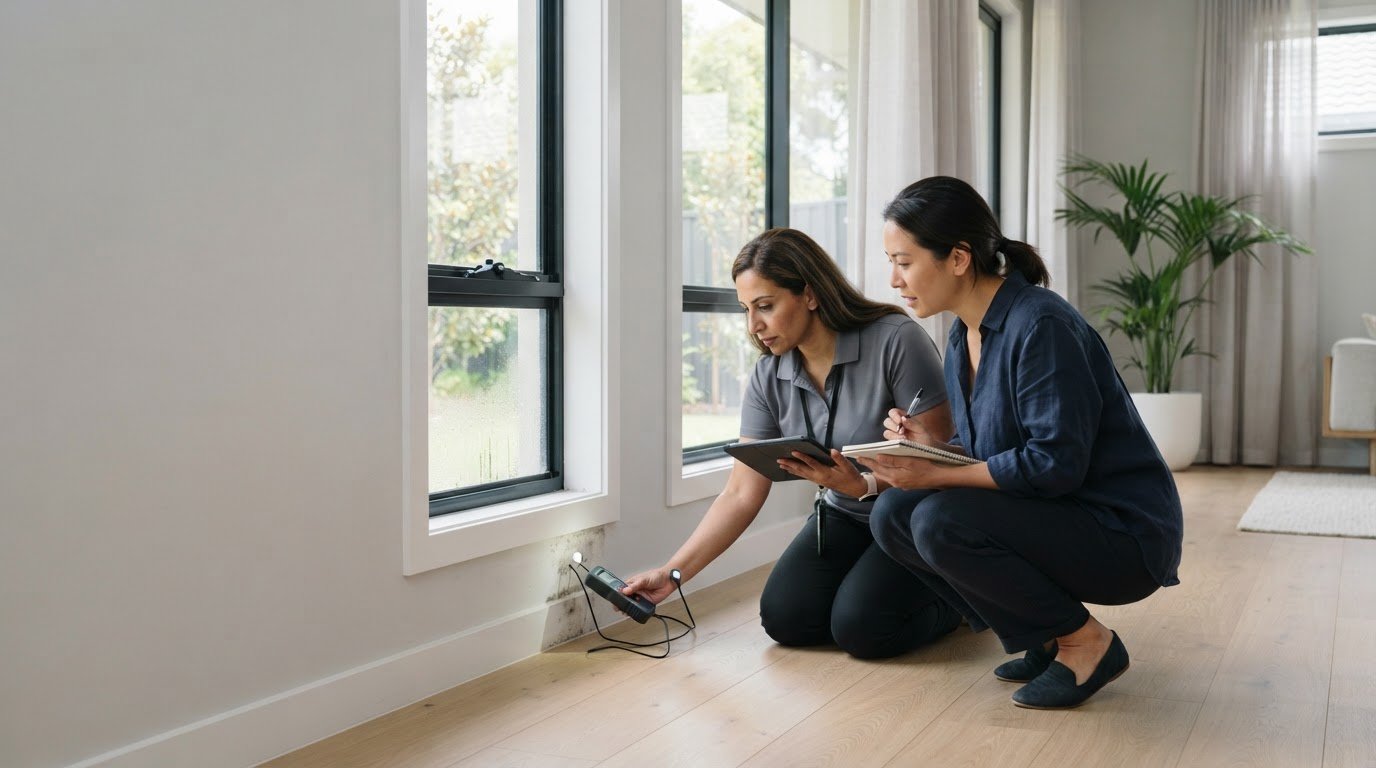
Rising damp is when groundwater travels upward through porous masonry or concrete by capillary action, carrying salts and moisture into walls from the foundation up. It creates a permanently wet substrate. You can clean the mould off the surface of a rising-damp wall as many times as you want. The wall is wet from the inside. Mould will grow back because the moisture source is structural, not environmental.
In older Sydney properties, terrace houses across the Inner West, and heritage buildings in the Blue Mountains, rising damp is one of the most common and most misdiagnosed mould causes. The chemical injection damp proof course is the structural fix. Mould treatment addresses the biological consequence. You need both.
Treating mould on a rising-damp wall without addressing the damp is like treating a fever without treating the infection.
What’s Wrong With Subfloor Ventilation and Why Does It Matter Above the Floor?
The air in your subfloor doesn’t stay in your subfloor.
Subfloor ventilation is the system (or lack of one) that manages air movement under a suspended timber floor. When subfloor air is stagnant, moisture from the ground accumulates. That moisture migrates upward through the floor structure, into the rooms above, and into the air you breathe and the walls that surround you.
In houses across Sydney’s western suburbs, the Blue Mountains, and Wollongong, inadequate subfloor airflow is one of the primary drivers of mould growth in living areas, bedrooms, and hallways. The mould appears upstairs. The cause is downstairs. Expert subfloor ventilation addresses the moisture source directly, which is the only way to stop the cycle.
If you’re seeing mould on skirting boards, lower walls, or the underside of floor coverings, subfloor moisture is a serious candidate for the cause.
Why Doesn’t Non-Mechanical Air Scrubbing Work the Way You Think It Does?
Most people assume “air scrubbing” means a machine that filters air through a HEPA unit. That’s mechanical air scrubbing, and it has a real limitation: it only treats the air that passes through the machine. In a room with dead zones, corners, inside wall cavities, and behind furniture, a mechanical unit doesn’t reach.
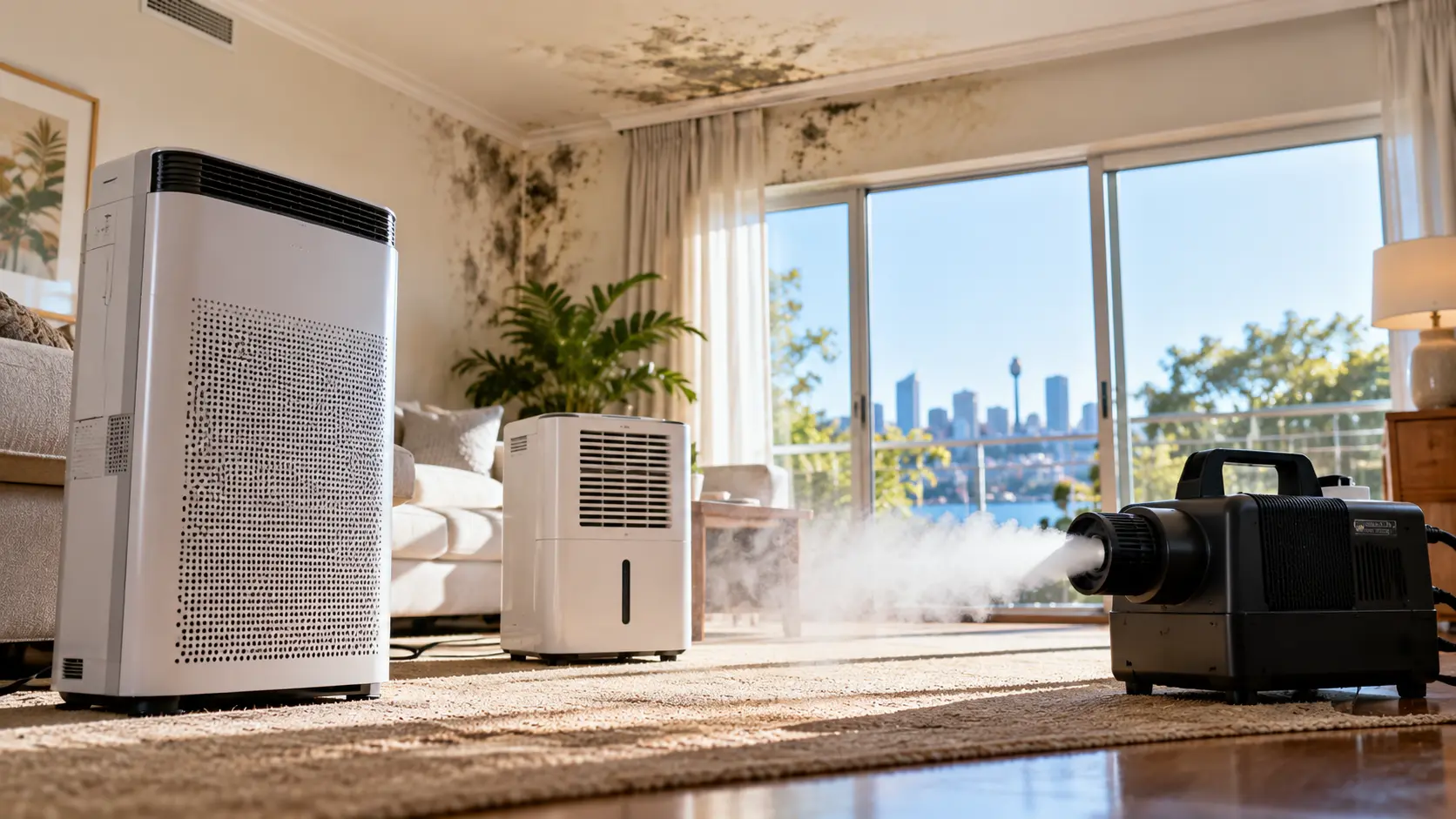
Non-mechanical air scrubbing using fogging technology works differently. The fogging agent is dispersed as a fine mist that fills the entire air volume of the space, including the areas a machine can’t reach. It treats the air, not just a sample of it.
ABC Mould Cleaning Solutions uses the Goldmorr System, a fogging-based approach developed by the Goldmorr Group and in use since 1998. As approved master technicians, ABC applies biodegradable Goldmorr products that are tested safe for people, pets, and the environment. The treatment reaches spores suspended in the air and on surfaces simultaneously, addressing both the visible growth and the airborne population that conventional cleaning leaves behind.
This is what separates a method that produces lasting results from one that produces a clean-looking wall for six weeks.
If you want to understand what’s driving recurrence in your specific space, ABC Mould Cleaning Solutions can provide a quote from photos sent via smartphone. No site visit required for most situations. If Warren does need to assess in person, the inspection fee is $275.
Send your photos to 0488 866 853 and get a same-day quote.
How Do the Methods Actually Compare?
| Approach | What It Treats | Addresses Airborne Spores | Addresses Moisture Source | Result Duration |
|---|---|---|---|---|
| DIY spray and wipe | Visible surface growth only | No | No | Weeks |
| Standard professional cleaning | Surface + some penetration | Rarely | No | Weeks to months |
| Mechanical air scrubbing | Air passing through the unit | Partially | No | Moderate |
| Goldmorr fogging (non-mechanical) | Full air volume + surfaces | Yes | Indirectly (reduces spore load) | Longer-lasting |
| Goldmorr + rising damp/subfloor fix | Full air volume + structural source | Yes | Yes | Long-term |
The table above isn’t about which option is cheapest. It’s about which option actually solves the problem. Spending less on a method that fails in six weeks costs more over two years than spending once on a method that works.
The Mould Environment Scorecard: When Do You Need More Than a Clean?
The Mould Environment Scorecard is a quick self-assessment to identify whether your situation requires environmental treatment rather than surface cleaning alone.
Score one point for each:
- Mould has returned to the same spot more than once after cleaning.
- You can smell mould but can’t locate the source.
- The affected wall is an external wall, bathroom wall, or ground-floor wall.
- You have a suspended timber floor with limited underfloor access.
- The property is a ground-floor apartment or terrace house built before 1990.
- You or someone in the household has unexplained respiratory irritation.
Use this when: you’re trying to decide whether a standard clean will hold or whether you need a full environmental assessment.
3 or more points means surface cleaning alone is unlikely to produce a lasting result. The environment needs treatment.
If you’re scoring 4 or higher, the science of mould recurrence is worth understanding before you spend money on another temporary fix.
Who Is This Approach Not Right For?
Straight answer: if you have a single small mould spot in a well-ventilated bathroom with no history of recurrence, you probably don’t need a full fogging treatment. A targeted surface treatment may be enough.
Where fogging and environmental treatment become necessary is when recurrence is the pattern, when the moisture source is structural, or when the air quality in the space has been compromised over time. That’s the majority of the mould calls ABC Mould Cleaning Solutions receives from Sydney apartments, Blue Mountains properties, and Wollongong homes with subfloor issues.
The non-toxic mould removal guide covers what to expect from a health-safe treatment approach if you’re weighing options.
It’s also worth knowing: if you have pets or young children in the space, the safety profile of whatever treatment you use matters. Goldmorr products are tested biodegradable and safe for both. That’s not a marketing claim. It’s a product specification.
FAQ
Why does mould keep coming back even after I’ve had it professionally cleaned?
If mould returns after professional cleaning, the treatment addressed the surface but not the environment that produced it. The airborne spore population, the moisture level in the substrate, and the ventilation conditions were left unchanged. The surface regrows because the conditions that created it are still present.
Is mould in my apartment actually a health risk or is it just cosmetic?
Mould produces spores and mycotoxins that circulate in the air of an enclosed space. In apartments with limited air exchange, those spores accumulate rather than dispersing. Respiratory irritation, allergic responses, and in sensitive individuals more serious reactions are all associated with sustained mould exposure. It’s not cosmetic.
How do I know if I have rising damp or just condensation?
Rising damp typically appears on lower sections of walls, often with a tide-mark line, and may have a white salt deposit (efflorescence) on the surface. Condensation tends to appear higher up, on cold surfaces, and is more seasonal. If the damp pattern starts at the floor and works upward, rising damp is the more likely cause.
Can I get a quote without someone coming to my property?
Yes. ABC Mould Cleaning Solutions can provide a quote based on photos sent via smartphone. For most apartments and standard residential situations, a photo quote is sufficient to get started. If Warren needs to assess the property in person, the site inspection fee is $275.
How long does a fogging treatment take in an apartment?
Treatment time for a typical apartment is significantly faster than for a house, which is one of the practical advantages of working in a smaller, contained space. ABC Mould Cleaning Solutions can confirm timing based on your floor plan when you send through photos.
Is the Goldmorr fogging treatment safe for my kids and pets?
Goldmorr products are tested for biodegradability and confirmed safe for people, pets, and the environment. ABC Mould Cleaning Solutions are approved master technicians for Goldmorr products, which have been in use since 1998. You don’t need to relocate pets or children for an extended period after treatment.
What’s the difference between mould removal and mould remediation?
Mould removal refers to physically eliminating visible mould growth from surfaces. Mould remediation is a broader process that includes identifying the moisture source, treating the air environment, and taking steps to prevent recurrence. Removal without remediation is why mould comes back. The professional mould cleaners guide covers the distinction in detail.
If mould has come back more than once, the problem isn’t the cleaning. It’s the approach. ABC Mould Cleaning Solutions provides same-day service across Sydney Metro, the Blue Mountains, and Wollongong, and will beat any written quote by 10%. Send photos to 0488 866 853 and get a real answer today.
About the Author
Warren Bailey is the principal technician and operator of ABC Mould Cleaning Solutions, serving Sydney Metro, the Blue Mountains, and Wollongong. Warren is an approved master technician for the Goldmorr System, working with industry-leading biodegradable mould removal products that have been in use since 1998. ABC Mould Cleaning Solutions specialises in mould removal, rising damp treatment, subfloor ventilation, and non-mechanical air scrubbing for residential and commercial properties across New South Wales.