
Mechanical air scrubbing moves contaminated air through a filter. It doesn’t treat the surfaces, wall cavities, or subfloor spaces where mould colonies actually live. If your apartment has recurring mould, a persistent damp smell, or moisture at skirting board level, the method matters far more than the effort. Here’s what the difference looks like in practice.
Key Takeaways
- Mechanical air scrubbers filter air that passes through them, but they can’t reach the cavities, surfaces, or subfloor spaces where mould originates.
- Rising damp and subfloor moisture problems need source-level treatment, not air movement.
- Non-mechanical fogging disperses treatment agents through the entire air volume simultaneously, contacting both airborne spores and surface colonies.
- Apartments typically respond faster to fogging-based remediation because their contained air volumes allow more thorough agent dispersion.
- ABC Mould Cleaning Solutions are approved master technicians for the Goldmorr System and offer same-day service across Sydney Metro, Blue Mountains, and Wollongong.
What’s the Real Difference Between Mechanical and Non-Mechanical Air Scrubbing?
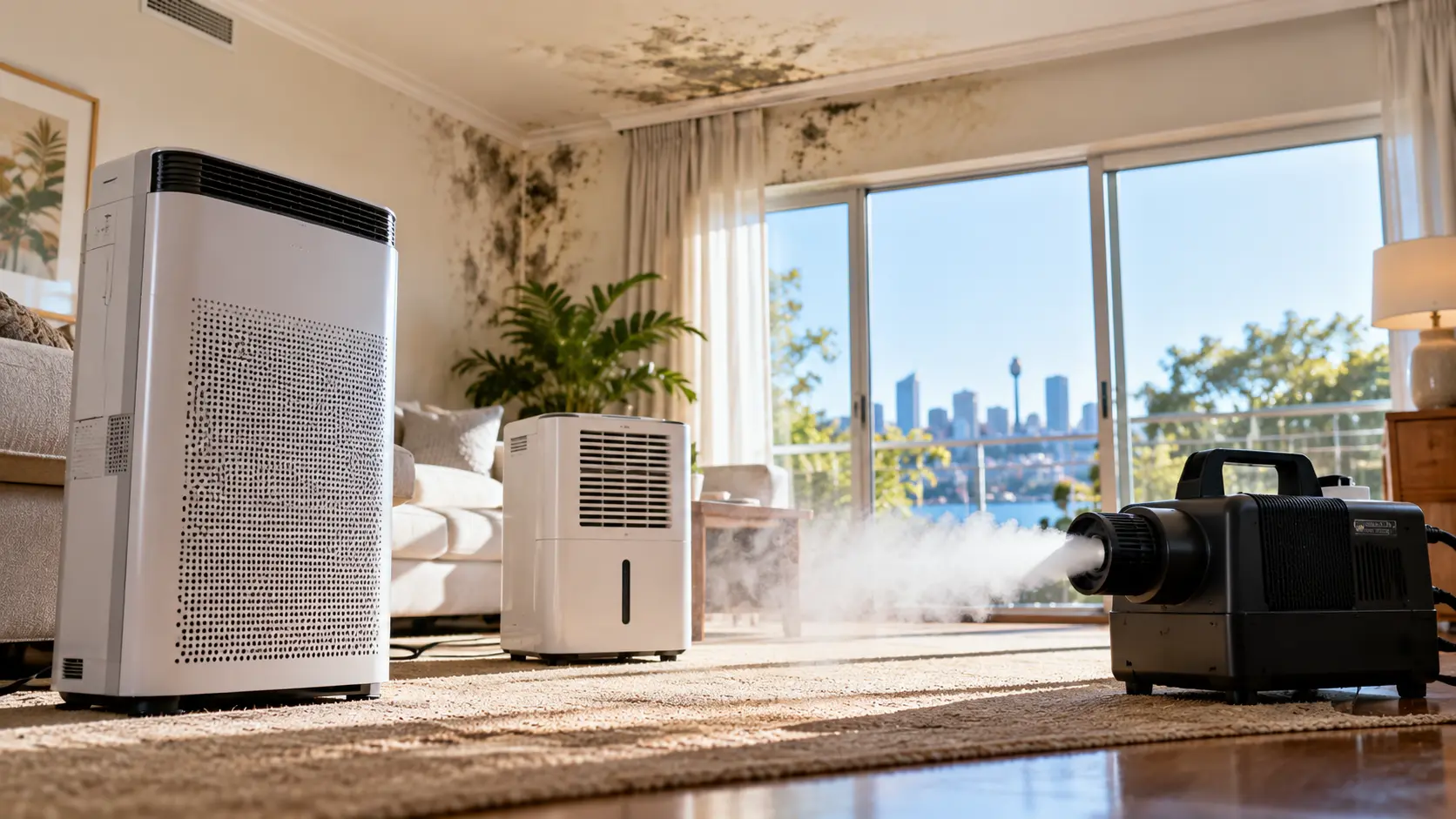
Mechanical air scrubbing uses a motor to draw air through a filtration medium, usually a HEPA filter, capturing particles that happen to pass through it. Non-mechanical fogging works the opposite way: a treatment agent is introduced into the air space and disperses through the room under its own momentum, contacting surfaces, cavities, and airborne spores without requiring air to be channelled through a machine.
The practical gap between those two methods is large. Mould spores don’t float in the centre of a room waiting to be captured by a filter. They settle on surfaces, embed in porous materials, and colonise inside wall voids and beneath flooring where no fan-driven system can reach.
The surface is the symptom. The air is the source.
A mechanical scrubber treats the air as if it were the problem. Fogging treats the environment producing the contaminated air. Those are fundamentally different interventions, and confusing one for the other is the reason most DIY and rental-machine approaches produce temporary results followed by full recurrence.
If you want to understand the specific mechanics behind why mould returns after cleaning, that’s the first thing worth getting clear on before committing to any treatment approach.
Why Does Mould Keep Returning No Matter What You Try?
Because the method addressed the visible result without changing the conditions that produced it.
Consider a typical scenario in a Sydney apartment: mould appears on a bathroom ceiling, there’s a musty smell in the bedroom, and there’s condensation forming on interior walls through summer. A rental machine runs for a few days. The visible patches get wiped down. The smell fades temporarily. A few weeks later, the mould is back in the same spots.
The reason is straightforward. The spore load inside the wall cavity behind the tiles was never reached. The moisture migrating up through the building structure is still present. The air scrubber captured some particles passing through its filter, but it didn’t alter the surface or cavity conditions that keep generating those particles.
Mould recurrence isn’t a cleaning failure. It’s a method failure.
This is also why complete mould removal from walls requires more than surface treatment. The colony lives where you can’t see it, and the filter catches what drifts past it. That’s not remediation.
How Does Rising Damp Make Air Scrubbing Completely Ineffective?
Rising damp is moisture travelling upward through masonry or concrete via capillary action. It’s not a leak. It’s not condensation from daily activity. It’s a structural moisture pathway that continuously feeds humidity into the lower walls and floor-level air of a building regardless of what you do to the air above it.
In Sydney Metro properties, particularly older apartment buildings, rising damp is frequently misread as a ventilation issue. Residents run dehumidifiers, crack windows, run fans. None of it stops the moisture source because none of it addresses the pathway.
Running a mechanical air scrubber in a space with active rising damp means pulling humid air through a filter and releasing slightly drier air back into a room being continuously re-humidified from below. It’s a loop, not a solution.
If you’re seeing persistent damp at skirting board level, salt crystallisation on lower walls, or paint bubbling near the floor, you’re most likely looking at a rising damp problem. The chemical injection damp proof course options available in Sydney address the moisture pathway directly, which is the only intervention that actually changes the underlying condition.
What About Subfloor Ventilation? Isn’t That Basically the Same Thing?
No. The confusion between the two costs people real money.
Subfloor ventilation is the management of air movement through the space beneath a suspended floor to prevent moisture accumulation and the mould growth that follows it. Air scrubbing is the treatment of contaminated air inside a living space. They address different environments at different stages of the same problem.
In a poorly ventilated subfloor, moisture accumulates, mould colonises timber bearers and the underside of flooring, and spores migrate upward into the living space through gaps, boards, and service penetrations. Running an air scrubber in the room above does nothing to the subfloor environment generating the contamination.
The subfloor ventilation approach used in Sydney’s Eastern Suburbs demonstrates what source-level treatment looks like in practice: addressing the moisture environment itself, not just the air it’s producing upstairs.
Why Do Apartments Respond Better to Fogging Than Houses?
Fogging works by dispersing a fine treatment agent through an air space. The smaller and more contained the space, the higher the agent concentration per cubic metre, and the more thoroughly it contacts surfaces, cavities, and airborne spores before it disperses.
Apartments have smaller, more contained air volumes than houses. That’s a practical advantage in remediation terms.
A typical Sydney apartment can be treated more thoroughly with non-mechanical fogging than a comparable house, because there’s less volume for the agent to travel before it works and fewer open pathways for it to dissipate early. For property managers handling multiple apartments within a building, the turnaround time difference is real and worth factoring into any remediation schedule.
ABC Mould Cleaning Solutions uses the Goldmorr System for this process. The Goldmorr Group has supplied mould removal solutions since 1998, and ABC’s technicians are approved master technicians for the system. Goldmorr products are tested for biodegradability and are safe for people, pets, and the environment during and after treatment.
Acting Now vs. Waiting It Out: What the Comparison Actually Looks Like
| Factor | Treating the problem now with ABC Mould Cleaning Solutions | Waiting, wiping it down, or using a rental machine |
|---|---|---|
| Reaches wall cavities and surface colonies | Yes, via non-mechanical fogging | No, filter only captures passing airborne particles |
| Addresses airborne spore load | Full room dispersion | Partial, only air drawn through the machine |
| Treats rising damp source | Requires damp-proofing alongside fogging | No, and delay compounds structural moisture damage |
| Recurrence risk | Lower when source is also addressed | High, method doesn’t change the producing conditions |
| Safe for pets, people, and children | Yes, Goldmorr products tested for biodegradability | Varies by product; no treatment guarantee |
| Suitable for apartments | Well-suited to contained volumes | Limited effectiveness in sealed spaces |
| Cost of inaction | Quote available via smartphone photos | Ongoing damage to surfaces, air quality, and building fabric |
The honest read on this table: fogging treats the air and surfaces far more thoroughly than mechanical scrubbing. But if rising damp or subfloor moisture is feeding the problem, you need the fogging treatment alongside the source intervention. Neither approach is complete without the other when moisture at the source is the driver.
What Does Getting a Quote and Treatment Actually Look Like?
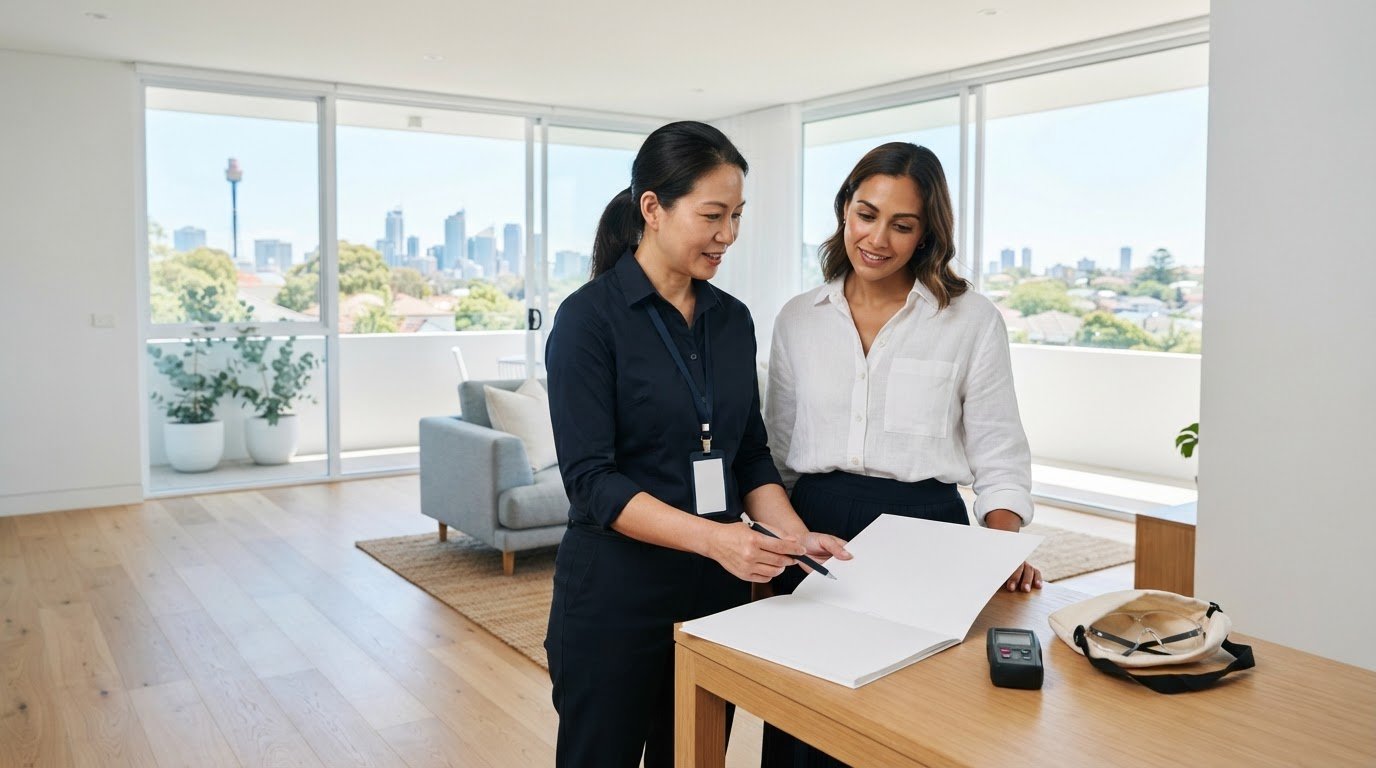
ABC Mould Cleaning Solutions keeps the process direct. You send photos via smartphone. Warren reviews the situation and provides a quote based on what he can see. No unnecessary complexity. Most situations can be quoted without a site visit at all.
If the situation is complex enough to need Warren on-site, the inspection fee is $275. That’s not a consultation where you leave with a list of concerns and no answers. It’s a direct assessment that leads to a quoted scope of work.
Same-day service is available across Sydney Metro, Blue Mountains, and Wollongong. For urgent situations, the emergency line is 0488 866 853.
ABC will beat any written quote by 10%. That’s a stated commitment.
For anyone managing a property who wants to understand what a professional remediation scope looks like before committing, the professional mould removal guide for Sydney is worth reading first.
Where mould has spread beyond walls to furniture and soft furnishings, the professional approach to mould removal from furniture covers what that scope of work involves.
When Is Professional Fogging the Right Call?
Fogging-based remediation is the right call when:
- Mould has returned after previous cleaning or wiping.
- You can smell mould but can’t find the source visually.
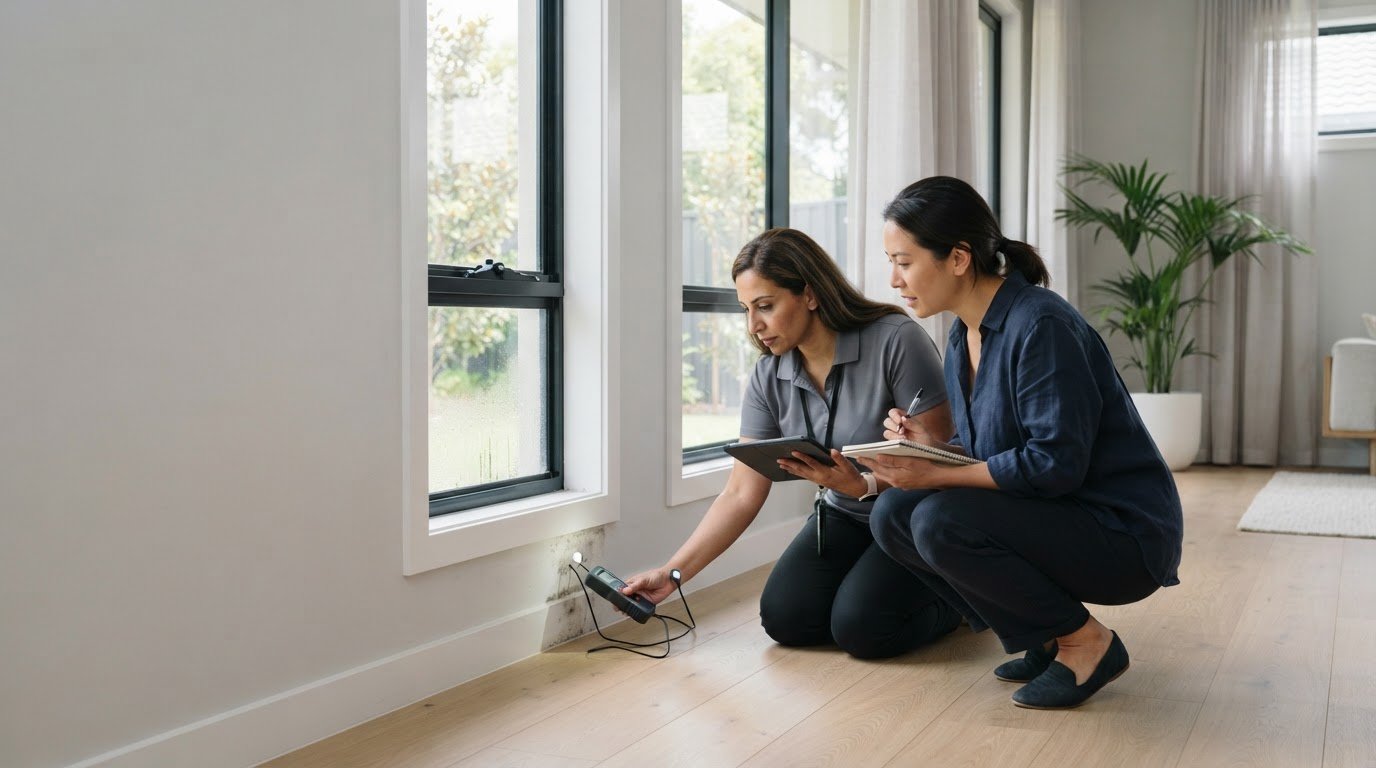
- There’s damp staining at skirting board level.
- The subfloor of your property has never been assessed.
- You’re managing a tenanted property and need documented remediation, not just a wipe-down.
For properties where black mould has been identified in Sydney, the scope of treatment needs to go beyond surface cleaning regardless of method. And if you have health sensitivities or young children at home, the non-toxic mould removal options available in Sydney are worth reviewing before any treatment begins.
Frequently Asked Questions
Can a HEPA air purifier replace professional treatment?
A HEPA purifier captures particles that pass through it, but it doesn’t treat the surfaces or cavities where mould colonies are growing. If you have active mould anywhere in your apartment, the purifier is managing symptoms while the source keeps producing spores. It’s not a substitute for remediation.
How do I tell the difference between rising damp and condensation?
Rising damp typically appears at the base of walls, often with a tide mark or salt crystallisation on the surface, and it persists regardless of the season. Condensation tends to appear on cold surfaces during temperature changes and reduces in warm weather. If the damp is at floor level and doesn’t improve through summer, rising damp is the more likely cause.
Do I need to leave my apartment during fogging treatment?
Goldmorr products are tested for biodegradability and are safe for people and pets. Your technician will advise on any ventilation period after treatment based on the size and layout of your apartment.
Will treating one apartment in a building fix the problem if neighbouring units also have mould?
Treating your apartment addresses your air environment and surfaces directly. If adjacent units have untreated mould, there’s ongoing spore pressure in shared spaces, but your treated apartment will have a significantly lower spore load. Whether neighbouring units need treatment is a building management question, not something that prevents your own treatment from working.
How quickly can ABC Mould Cleaning Solutions reach me in Sydney?
Same-day service is available across Sydney Metro, Blue Mountains, and Wollongong. For urgent situations, call 0488 866 853 directly.
What’s the fastest way to get a quote?
Send photos via smartphone. Warren can assess most situations from photos and provide a quote without a site visit. If the situation is complex enough to require a physical inspection, the fee is $275 and it leads directly to a quoted scope of work.
Is the Goldmorr System safe if I have young children at home?
Goldmorr products are tested for biodegradability and are safe for people and pets. If you have specific health concerns or very young children, mention this when you contact ABC Mould Cleaning Solutions so the technician can advise on the appropriate post-treatment ventilation period. For a broader guide on protecting young children from mould exposure, the guide to keeping babies safe from mould covers the key risks and practical precautions.
If the mould in your Sydney apartment keeps returning despite your best efforts, the method is the problem, not the effort. Contact ABC Mould Cleaning Solutions, send your photos through, and get a treatment approach that addresses the source rather than the surface. Call 0488 866 853 or reach out via the website.
About the Author
Warren Bailey is the principal technician and founder of ABC Mould Cleaning Solutions, serving Sydney Metro, Blue Mountains, and Wollongong. He is an approved master technician for the Goldmorr System and specialises in mould remediation, rising damp treatment, and subfloor ventilation for residential and commercial properties throughout New South Wales.