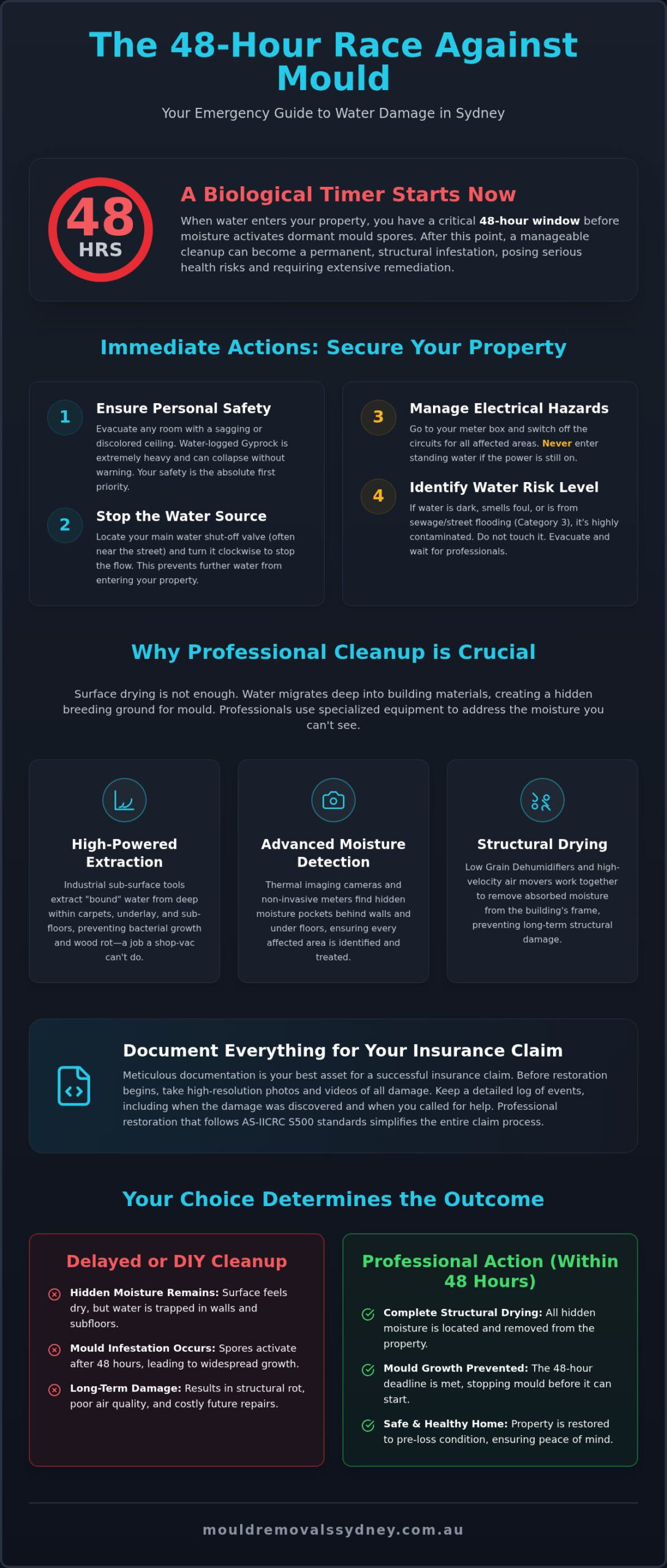
The moment water enters your property, a biological timer starts ticking. You have exactly 48 hours before manageable moisture turns into a permanent, structural mould infestation. It’s a high-stakes race against biology that requires much more than just a mop and a bucket. When you’re facing a burst pipe or sudden storm surge, the immediate priority is professional emergency water damage cleanup Sydney homeowners can trust to act before the damage becomes irreversible.
We understand the gut-wrenching stress of seeing your investment underwater and the anxiety of hidden damage lurking behind your skirting boards. You want your life back to normal, and you need to know your home is safe from toxic spores. This article provides the definitive roadmap to managing those first critical hours, ensuring you achieve full structural drying and prevent secondary mould growth through advanced air purification. We’ll preview the AS-IICRC S500 restoration protocols and the documentation you’ll need to satisfy your insurance provider, giving you total peace of mind and a clear path to recovery.
Key Takeaways
- Identify immediate safety steps like locating shut-off valves and managing electrical hazards in flooded rooms to prevent further property loss.
- Secure professional emergency water damage cleanup Sydney services to stop dormant mould spores from activating within the critical 48-hour window.
- Discover why thermal imaging and industrial moisture meters are necessary to find water trapped behind Gyprock and under floorboards.
- Learn how the Goldmorr System purifies your air while surfaces are being dried to prevent secondary mould infestations in unaffected rooms.
- Ensure your restoration team follows AS-IICRC S500 standards to simplify your insurance documentation and support a successful claim process.
Immediate Action: Sydney Water Damage Emergency
When water starts gushing through your ceiling or rising from a burst pipe, panic is your biggest enemy. You must act with clinical precision. The first step in any Water damage scenario isn’t grabbing a towel; it’s ensuring your physical safety. Structural compromises, such as heavy, water-logged Gyprock ceilings, can collapse without warning. If you see sagging or discolouration overhead, evacuate the room immediately. This is the start of a high-stakes process where every minute counts toward saving your property.
Securing the Environment for Occupants
Safety starts at the source. Locate your main water shut-off valve immediately. In most Sydney residential properties, this is found at the front of the block, often near the street boundary under a plastic or metal cover. Turn it clockwise to stop the flow. Next, head to your electrical meter box and switch off the circuits for the affected areas. Never enter a flooded room if the power is still on. Electricity and standing water are a lethal combination.
You also need to identify the risk level of the water. Category 1 is “clean” water from a burst supply line. Category 3 is “black” water, containing sewage or floodwater from the street, which carries pathogenic agents. If you suspect Category 3 contamination, do not attempt a DIY cleanup. This requires specialized emergency water damage cleanup Sydney protocols to ensure your health isn’t compromised. If the air smells foul or the water is dark, evacuate and wait for the experts.
Documenting Damage for Insurance Success
Your insurance claim depends entirely on the evidence you gather before the restoration begins. Take high-resolution photos and videos of every affected room, including close-ups of damaged skirting boards, carpets, and personal items. This “before” evidence is your strongest asset when negotiating with adjusters. For a deeper dive on these steps, see our Water damage repair: your emergency guide for Sydney homes.
Keep a detailed log of events. Record the exact time you discovered the leak, the steps you took to stop it, and the time you called for professional help. While you wait for our technicians to arrive, you can safely move light furniture or rugs to a dry area. Leave heavy items or anything in contact with contaminated water for the restorers. Fast action combined with meticulous documentation sets the stage for a successful emergency water damage cleanup Sydney and a smoother recovery process.
The Professional Cleanup Process: Beyond Extraction
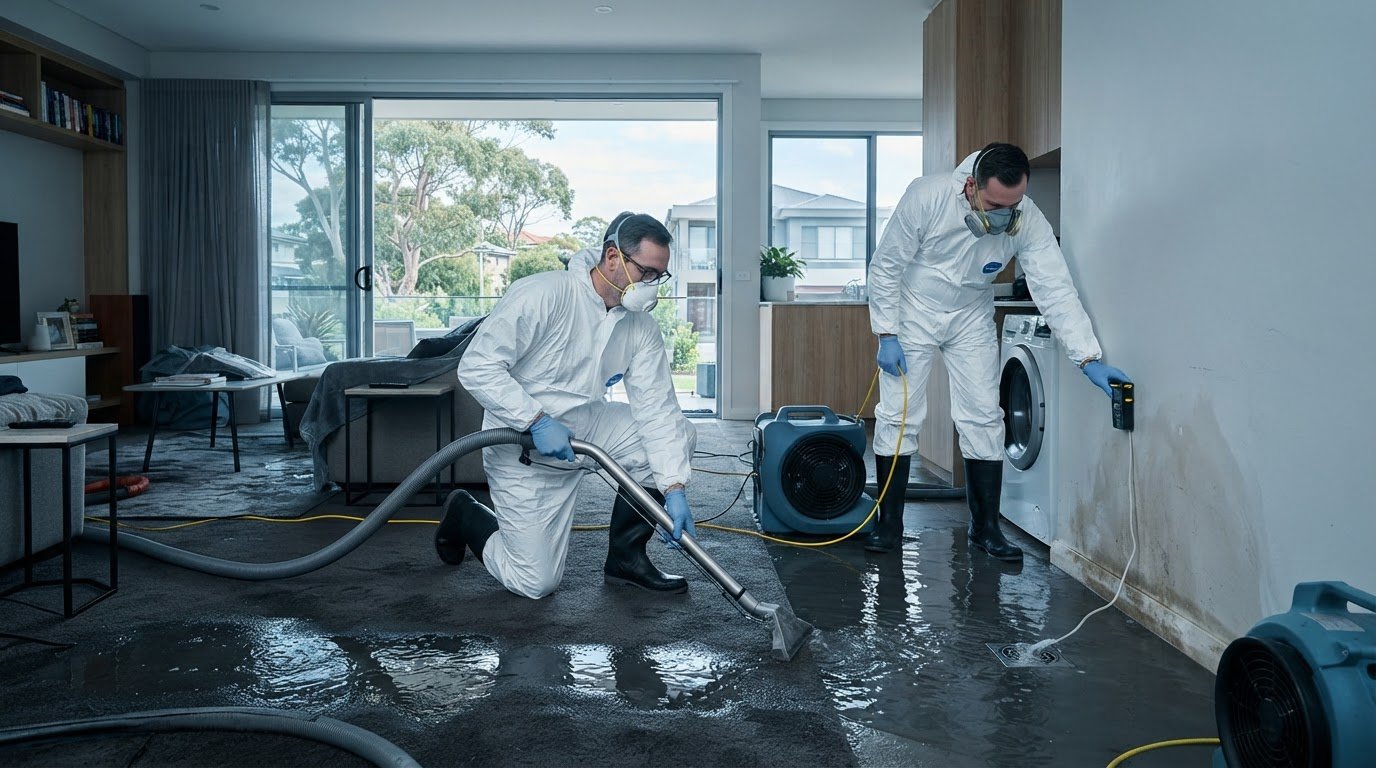
Once the water source is stopped, the real work begins. Surface water is just the tip of the iceberg, as moisture quickly migrates into porous building materials. Professional emergency water damage cleanup Sydney relies on physics and specialized equipment, not just simple suction. If you only dry the surface, you leave the structural integrity of your home at risk and create a breeding ground for pathogens.
High-Powered Water Extraction Techniques
A standard shop-vac lacks the vacuum lift required to pull moisture from deep-pile carpets and the dense underlay beneath them. We use industrial sub-surface extraction tools that apply targeted pressure to “squeeze” water out of the padding and floorboards. This is vital because stagnant water trapped in flooring layers quickly leads to bacterial blooms, especially in Sydney’s high humidity. Structural drying is the process of removing moisture from the building’s framing and sub-floors. Without addressing this “bound” moisture, your property remains at risk of wood rot and structural failure even if the carpet feels dry to the touch.
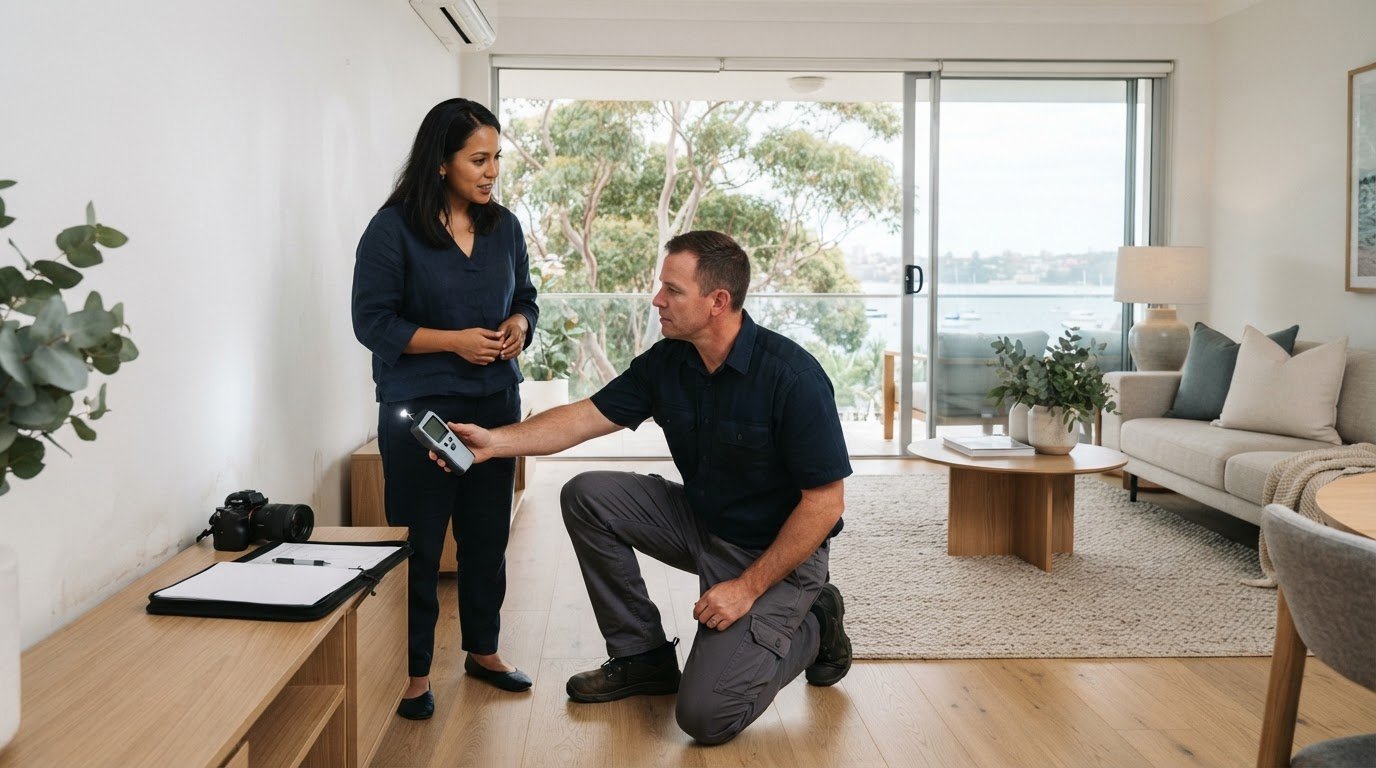
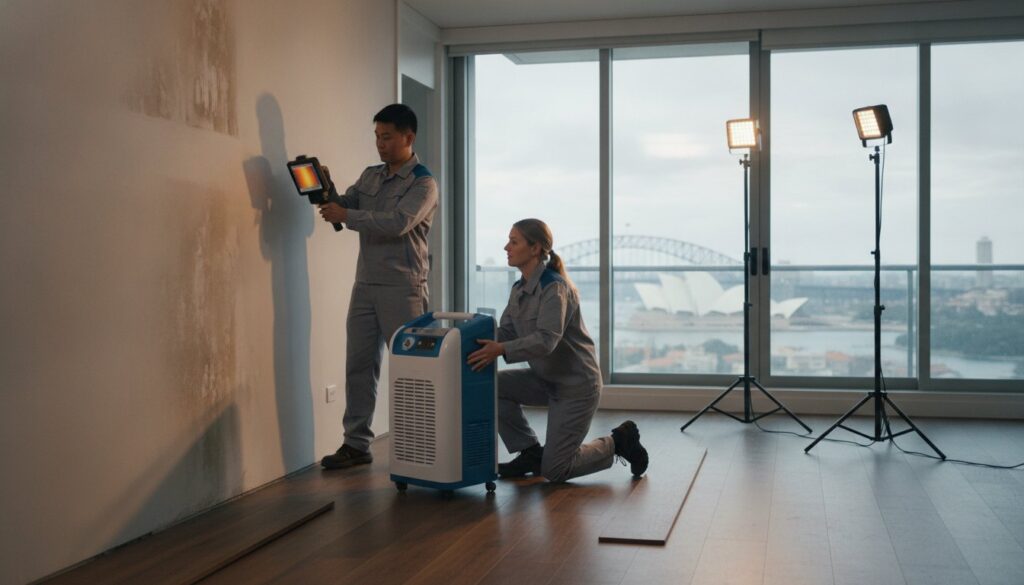
We don’t guess where the water has travelled. Our technicians use thermal imaging cameras to detect temperature differentials behind Gyprock walls and under floorboards. These tools reveal “hidden” moisture pockets that would otherwise be missed by the naked eye. Combined with non-invasive moisture meters, we map the exact boundaries of the intrusion. This precision allows us to restore your property efficiently without performing unnecessary demolition on dry sections of the home.
Dehumidification and Evaporation Control
Extraction removes liquid water, but evaporation is required to remove the moisture that has soaked into the “bones” of the building. We deploy Low Grain Refrigerant (LGR) dehumidifiers. These industrial machines are designed to pull moisture from the air even in low-humidity environments, preventing the secondary damage caused by high ambient moisture levels. To speed up this process, we place high-velocity air movers in strategic “vortex” patterns. This creates a constant, high-speed flow across wet surfaces, forcing moisture into the air where the LGR units can capture it.
You must Protect Indoor Air and Your Health by ensuring the environment is properly sanitised. Floodwaters often carry bacteria and pathogens that require professional-grade, non-toxic antimicrobials to neutralise. We monitor the entire drying process using “dry goals” based on the AS-IICRC S500 standards. We compare the moisture readings of the damaged materials against a dry “standard” taken from an unaffected part of your home. We only consider the job done when those readings match, ensuring no hidden moisture remains to fuel future mould growth.
The 48-Hour Window: Why Water Damage Becomes a Mould Crisis
Time is the most critical factor in flood recovery. While visible water is the immediate problem, the biological clock starts the moment moisture hits your floor. Mould spores are omnipresent in the Sydney environment, usually remaining dormant until they encounter a food source and moisture. Once activated, these colonies can begin to grow and reproduce within just 24 to 48 hours. This narrow window is why professional emergency water damage cleanup Sydney must address more than just the liquid on your floor. To understand the complexity of these organisms, read our guide on What is mould? A complete guide for Australian homeowners.
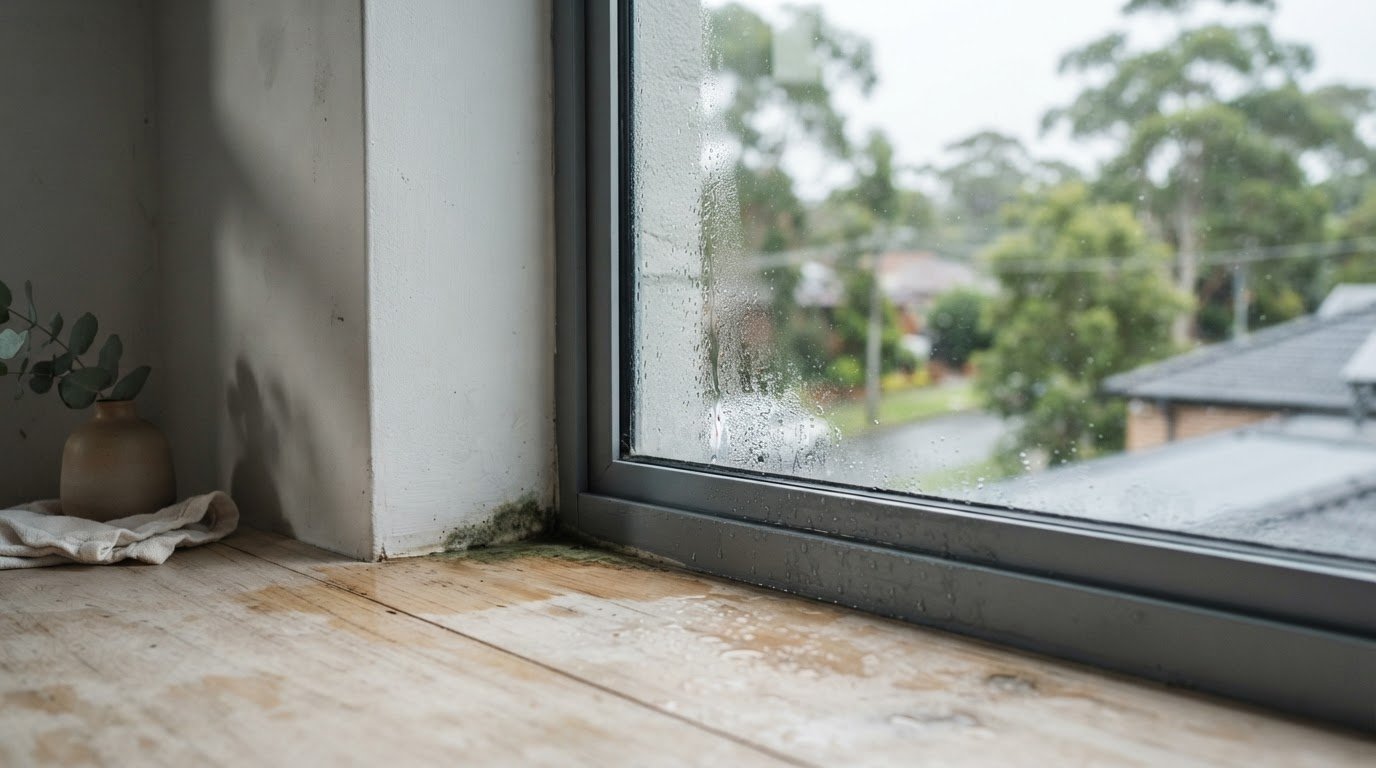
Many homeowners focus solely on the “wet” room, but high humidity levels can trigger secondary damage throughout the entire property. As water evaporates from carpets and walls, the relative humidity in the home spikes. This moisture-laden air travels to unaffected rooms, where it condenses on cool surfaces like windowsills or behind wardrobes, fueling new mould growth. DIY drying attempts often exacerbate this risk. If you use standard household fans without industrial dehumidification, you aren’t removing moisture; you’re simply blowing it around and helping spores find new places to land.
The Science of Airborne Mould Spores
Water damage physically disturbs dormant colonies and sends millions of microscopic spores into the air. These spores are easily drawn into your HVAC system, which then acts as a delivery system, blasting contaminants into every bedroom and living space. This is particularly dangerous when dealing with toxic varieties. For a detailed breakdown of the risks, see What is black mould? A complete guide for Sydney homeowners. According to the NSW Health advice on mould, exposure can lead to significant respiratory issues and allergic reactions, making rapid intervention essential to your health safety.
Air Purification and Scrubbing: The Missing Step
Effective emergency water damage cleanup Sydney requires a dual-pronged approach: drying the structure and cleaning the air. We utilize industrial-grade HEPA air scrubbers to manage the air quality throughout the restoration process. These machines cycle the air in a room multiple times per hour, stripping out 99.97% of particles as small as 0.3 microns. Air scrubbing is the mechanical filtration process that captures microscopic spores from the air before they can settle on dry surfaces and start new colonies. Without this step, you might dry your floors but leave a lingering health hazard in your breathing zone. We prioritise air purification to ensure your home is not just dry, but safe for all occupants.
Evaluating Sydney Restoration Services: What to Look For
When the clock is ticking, you don’t have time to vet every general cleaner in the phone book. You need a specialist who adheres to the AS-IICRC S500:2025 standard. This isn’t just a badge; it’s a science-based framework for professional water damage restoration adopted by the Insurance Council of Australia. Choosing the right provider for emergency water damage cleanup Sydney means looking for IICRC-trained technicians who understand the microbiology of water damage. If a company can’t provide moisture maps or drying logs, they aren’t restoring your home; they’re simply guessing.
Real 24/7 service in Greater Sydney is about more than just answering the phone. It requires a fleet ready to navigate peak-hour traffic or respond during major storm events when demand spikes. A professional restorer provides transparency through detailed reporting. You should receive a clear “Scope of Works” and daily drying logs that track the moisture content of your walls and floors. This documentation is your best tool for ensuring your insurance claim is processed without disputes.
Professional Grade Equipment vs. Consumer Tools
Don’t be fooled by a contractor showing up with a domestic dehumidifier from a local hardware store. Industrial Low Grain Refrigerant (LGR) dehumidifiers are essential because they continue to pull moisture from the air even at very low humidity levels. This level of professional-grade equipment is a standard shared by leading specialists; for example, Commercial Carpet Cleaners Stockport provides expert carpet and upholstery care using similar high-performance industrial systems. Standard units stop working once the air feels “okay,” leaving bound moisture in your structural timber. We also utilize HEPA air scrubbers to ensure that while we dry the floors, we’re also cleaning the air you breathe. Remember that “dry to the touch” is a dangerous metric. Water often remains trapped in the sub-floor or behind skirting boards, requiring professional-grade moisture meters to verify total dryness.
A professional restorer acts as your technical advocate during the insurance process. We provide the evidence your insurer requires to justify the cost of the cleanup, including thermal imaging and moisture readings. This level of detail helps avoid the “protection gap” that occurs when homeowners try to manage complex drying themselves. In the wake of recent Sydney weather patterns, ensuring your property is professionally certified as dry is the only way to prevent future liability. For reliable results that protect your health and your asset, trust Sydney’s #1 mould removal service: safe, fast & guaranteed to handle the technical details. We focus on getting you back to normal quickly with a no-nonsense, results-driven approach. Contact our specialists now to secure your property’s future.
Restoring Safety with ABC Mould Cleaning Solutions
When water damage strikes, you don’t just need a drying crew; you need a biological safety plan. ABC Mould Cleaning Solutions provides a comprehensive approach that bridges the gap between simple water extraction and total environmental restoration. Our methodology centers on the Goldmorr System, a proprietary methodology designed to eliminate airborne spores and surface mould simultaneously. This ensures that while your structure dries, your air quality is being actively restored to safe levels.
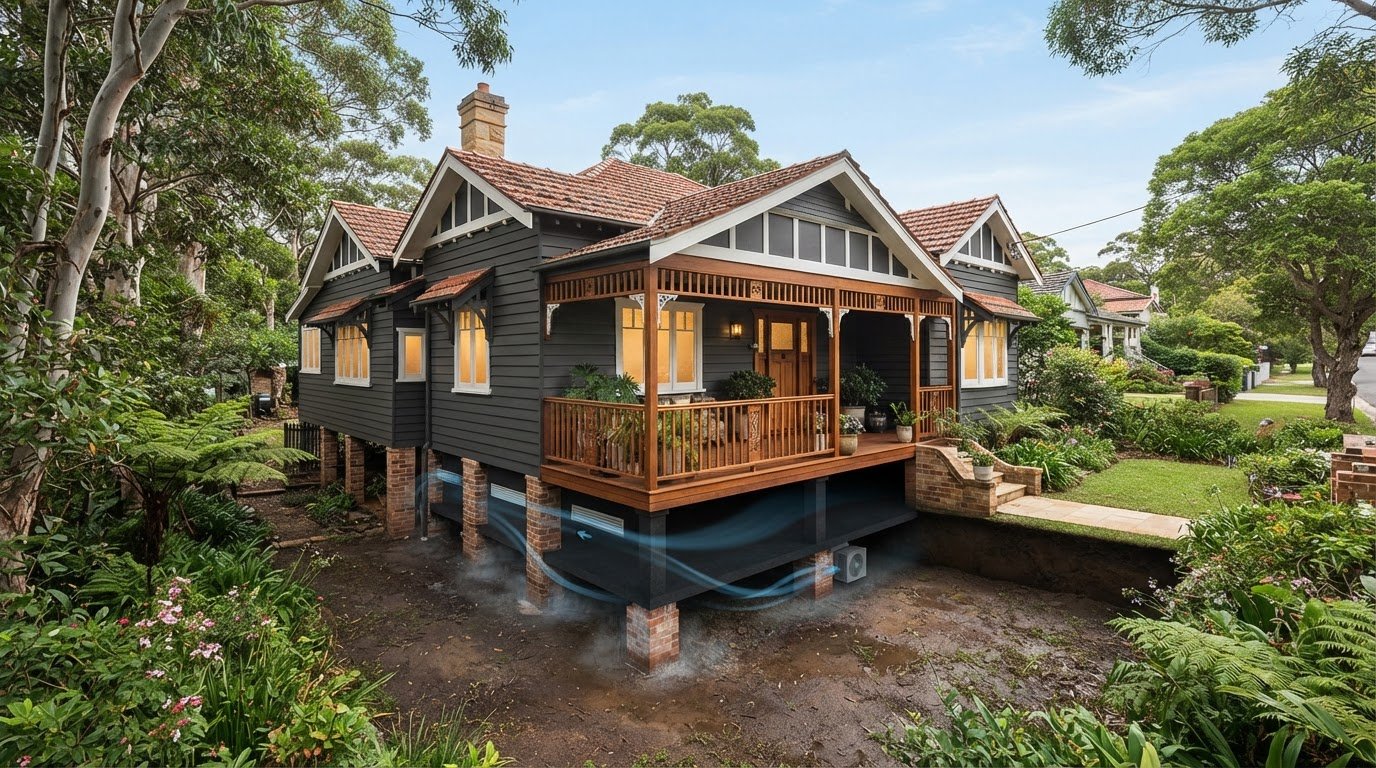
Safety is our non-negotiable priority. We use biodegradable, non-toxic treatments that are completely safe for your family and pets. Unlike harsh industrial chemicals that leave behind aggressive residues, our cleaning agents neutralise threats without introducing new environmental risks. We complement this with high-level air purification and scrubbing, using HEPA filtration to strip microscopic contaminants from your breathing zone. For long-term protection, our technicians also provide expert recommendations for subfloor ventilation and moisture management to prevent the conditions that lead to recurring growth.
Our Specialized Goldmorr Fogging Process
Traditional remediation often involves extensive and expensive “tear-out” of building materials. The Goldmorr System offers a more efficient alternative. Our specialized fogging process uses a non-mechanical delivery system to reach spores hidden in wall cavities, ceiling voids, and behind skirting boards. This mist penetrates areas where physical wiping is impossible, ensuring no dormant colonies are left behind to trigger a future bloom. This method is significantly faster than traditional demolition, allowing you to return your home to safety in a fraction of the time. It’s an evidence-based, cost-effective solution that prioritizes the preservation of your property. For instances where traditional demolition and the removal of ruined materials are unavoidable, Skip Bin Guys offers reliable skip bin hire to help manage the disposal process across Sydney.
A property crisis doesn’t follow business hours. We maintain a rapid deployment fleet ready to provide emergency water damage cleanup Sydney wide, covering the CBD, Eastern Suburbs, North Shore, and Western Sydney. Our IICRC-trained technicians arrive with the authority of experts and the empathy of specialists who understand your stress. We don’t just solve the technical problem; we provide the emotional relief of knowing your property is in the hands of global leaders in remediation. We focus on tangible results and a simplified process that moves you from concern to resolution as quickly as possible. Don’t let the 48-hour window close on your property’s future. Contact ABC Mould Cleaning Solutions for immediate emergency cleanup and let us restore your peace of mind.
Take Decisive Action to Protect Your Sydney Property
The first 48 hours after a flood or leak are the most critical for your home’s long-term health. Waiting even a single day can allow dormant spores to transform into a costly mould crisis. By prioritising immediate extraction, structural drying, and advanced air scrubbing, you don’t just remove water; you safeguard your family’s well-being. Professional emergency water damage cleanup Sydney requires the specialized precision of IICRC trained technicians and the proven effectiveness of the Goldmorr System.
Don’t let moisture compromise your investment. Our team provides a 24/7 rapid Sydney response to ensure your property returns to a safe, dry state without the need for aggressive demolition. We use biodegradable, non-toxic treatments that are safe for everyone in your household. Take the first step toward total resolution right now. Get Emergency Help Now: 24/7 Sydney Water & Mould Restoration. You’ve got this; with the right experts by your side, your home will be back to normal and safe for your family in no time.
Frequently Asked Questions
How long does it take for mould to grow after water damage?
Mould begins to grow within 24 to 48 hours of moisture exposure. While spores are always present in the environment, they remain dormant until they find water and a food source like Gyprock or timber. Rapid intervention is essential to stop these colonies from colonising your building materials. Our specialists focus on this narrow window to prevent permanent structural damage and the serious health risks associated with airborne spores.
Will my insurance cover emergency water damage cleanup in Sydney?
Most comprehensive home insurance policies cover professional restoration if the damage results from a sudden, accidental event like a burst pipe or storm. We recommend checking your specific Product Disclosure Statement for accidental damage or flood inclusions. Our IICRC-trained technicians provide the detailed moisture maps and drying logs your insurer requires. This documentation is vital for proving the necessity of emergency water damage cleanup Sydney services during the claim process.
Can I stay in my house during the water damage restoration process?
Your ability to stay depends on the category of water and the extent of the damage. Clean water leaks often allow you to remain in unaffected rooms. However, Category 3 black water from sewage or street flooding requires immediate evacuation due to pathogenic risks. We use air purification and scrubbing to maintain safe breathing zones; we will always advise you if the structural drying equipment makes the environment unsuitable for overnight stays.
What is the difference between water extraction and structural drying?
Water extraction is the mechanical removal of standing liquid from surfaces using industrial vacuums. Structural drying is the more complex process of removing bound moisture that has soaked into the building’s framing, sub-floors, and wall cavities. While extraction takes hours, structural drying often takes several days of controlled dehumidification and airflow. We use thermal imaging to ensure that both the surface and the internal structure reach a safe, dry standard.
Is the cleanup process safe for my children and pets?
Yes, our remediation process is designed with family safety as a priority. We utilize the Goldmorr System, which features biodegradable and non-toxic treatments to eliminate spores without leaving harsh chemical residues. Our air scrubbers further protect your loved ones by stripping microscopic contaminants from the air. We recommend keeping children and pets away from active drying equipment and cords to ensure their physical safety while the industrial machines are running.
How do I know if my walls are truly dry after a flood?
You cannot rely on a visual check or the touch test because moisture often remains trapped deep inside wall cavities. We use professional-grade moisture meters and thermal imaging cameras to verify dryness. Our technicians compare readings from the damaged area against a dry standard from an unaffected part of your home. We only consider the property restored when these scientific measurements confirm that the moisture levels have returned to normal.
What should I do if I smell a musty odour after the water is gone?
A musty odour is a clear indicator that mould is actively growing or that hidden moisture remains trapped. Even if surfaces look dry, the smell suggests that the 48-hour window has passed and spores are proliferating. You should request a professional mould inspection immediately. We use specialized fogging and air purification to neutralise these odours at the source rather than just masking them with retail deodorisers, perfumes, or scented sprays.
Do you provide emergency water damage services on weekends and public holidays?
Water damage doesn’t wait for business hours, so neither do we. Our team provides a 24/7 rapid response across Greater Sydney, including weekends and all public holidays. We maintain a fleet of industrial drying equipment ready for immediate deployment to the CBD, North Shore, and Western Sydney. Our goal is to arrive within the critical 48-hour window to perform emergency water damage cleanup Sydney residents can depend on during a property crisis.