Could cleaning a timber beam make the mould problem look solved while the moisture causing it stays hidden? That’s the risk of treating mould on timber beams as a surface issue alone. If the growth returns, or the wood feels soft, stained or damaged, the beam may need closer assessment before you choose a treatment.
It’s understandable to want a quick, safe way to clean the mould, especially when you’re unsure whether the timber is still sound. But wiping away visible growth won’t prevent it returning if a leak, condensation or poor ventilation keeps the beam damp. The right response depends on both the moisture source and the condition of the wood.
This guide explains how to check for likely causes and warning signs, which treatment steps may help, and when to stop DIY work and seek professional mould remediation or advice from a qualified building specialist. The key is to deal with moisture as well as visible growth.
Key Takeaways
- Visible mould needs attention, but its appearance alone can’t confirm whether a timber beam is structurally damaged.
- Effective treating mould on timber beams means identifying and addressing the moisture source, not just cleaning visible growth.
- Choose between careful small-area cleaning, professional remediation or timber replacement based on the extent of growth and the beam’s condition.
- Document the mould and limit disturbance while you assess the area. Follow current Australian guidance and product instructions before attempting treatment.
- Recurring or extensive mould, hidden dampness or suspected timber deterioration are reasons to seek professional assessment and, if needed, advice from a qualified building specialist.
Treating mould on timber beams starts with finding the moisture source
Visible mould on a timber beam needs attention, but it doesn’t prove the beam has failed or is structurally unsafe. Mould is fungal growth that can develop in damp conditions. A visible patch is a reason to investigate, not a diagnosis of the timber’s condition. Before treating mould on timber beams, look for what may be keeping the wood or nearby materials damp.
Cleaning can remove visible growth, but it won’t stop mould returning if the moisture problem remains. Mould removal clears growth; moisture control changes the conditions that allow it to return. For a foundational overview of what mould is and the conditions associated with its growth, see the linked reference.
Why mould appears on timber beams
Possible moisture sources include a roof or plumbing leak, condensation, limited airflow, or water damage that wasn’t fully dried. These are clues to investigate, not causes you can confirm from the mould’s colour or location alone. In Sydney homes, consider the property’s ventilation, exposure and moisture history, including damp roof spaces or areas affected by past water ingress. A closer inspection may be needed to identify hidden dampness.
What to check before treating a mouldy beam
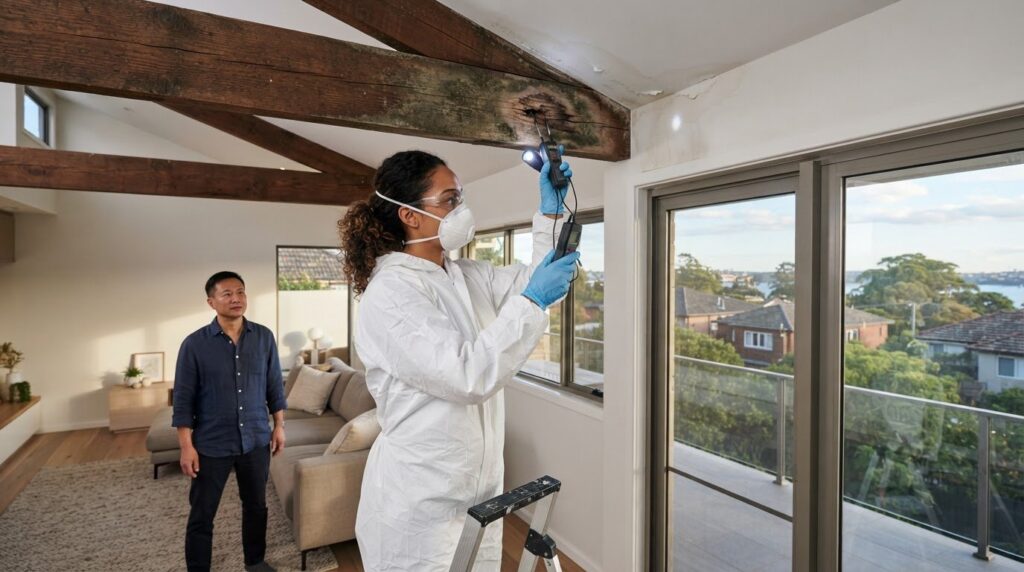
Record where the growth appears, how much of the beam is affected, whether nearby surfaces are wet or stained, and whether the mould has returned after cleaning. Look for signs of a leak or damp materials nearby, but don’t scrape or disturb suspected mould to investigate. If water damage may be involved, read this guide to water damage repair and consider whether the affected area needs professional assessment.
Keep your observations factual. A dark mark may be mould, staining or another change to the timber. Appearance alone can’t identify the cause or establish whether a beam is sound. If the wood seems soft, damaged or persistently damp, don’t treat it as a simple surface-cleaning job. A mould inspection can help clarify the extent and likely moisture source, while a qualified building specialist can assess suspected structural damage.
How to assess mould on timber beams and spot possible timber damage
Start by separating three things that can look similar: visible surface growth, staining left after growth has been removed, and possible deterioration of the timber itself. They may need different responses. A mark can remain after visible mould is gone, and removing the mark may not be possible or necessary. A clean-looking surface, on the other hand, doesn’t confirm that the beam is dry or sound.
Colour and appearance aren’t reliable ways to identify a mould species or judge structural safety. Don’t use a photograph, a dark patch or a particular colour to diagnose rot, estimate load capacity or decide a beam is safe. When treating mould on timber beams, record what you can observe without probing, scraping or cutting into the wood.
Mould, staining or signs of deterioration?
Look at the pattern and note any changes over time. Record whether you see fuzzy or spot-like growth, flat discolouration that remains after cleaning, or a patch that appears to be spreading. Staining can remain after visible growth has been addressed, so it doesn’t by itself prove that mould is still active. Appearance alone also can’t establish whether the timber has deteriorated.
Stop DIY work and seek qualified assessment if the beam seems soft, crumbles, has cracks, or appears bowed or otherwise deformed. Suspected softness, cracking or deformation warrants assessment by a qualified building specialist, not a guess based on appearance. Avoid pressing, scraping or drilling the beam to test it. The condition and structural role of timber need appropriate assessment.
When an inspection should go beyond the visible beam
Mould on a beam may be one visible sign of a moisture issue affecting nearby materials. Depending on access and location, the area to investigate may include a roof space, an adjoining cavity, insulation or surfaces around the beam. Don’t dismantle building materials just to look for hidden growth. If mould is extensive, keeps returning or has no clear moisture source, a professional mould inspection can help clarify the extent and likely cause.
For more background on mould in Australian homes, read what mould is and how it affects Australian homes. The U.S. Environmental Protection Agency’s professional mould remediation guidelines also explain remediation principles for schools and commercial buildings. Use them as supplementary guidance, not as a substitute for current Australian advice or a site-specific assessment.
If you’re in Sydney or surrounding regions and the extent of mould is difficult to judge, consider arranging a professional mould inspection before choosing a treatment. A building specialist should separately assess any suspected timber or structural damage.
Compare timber mould treatment options without overlooking their limits
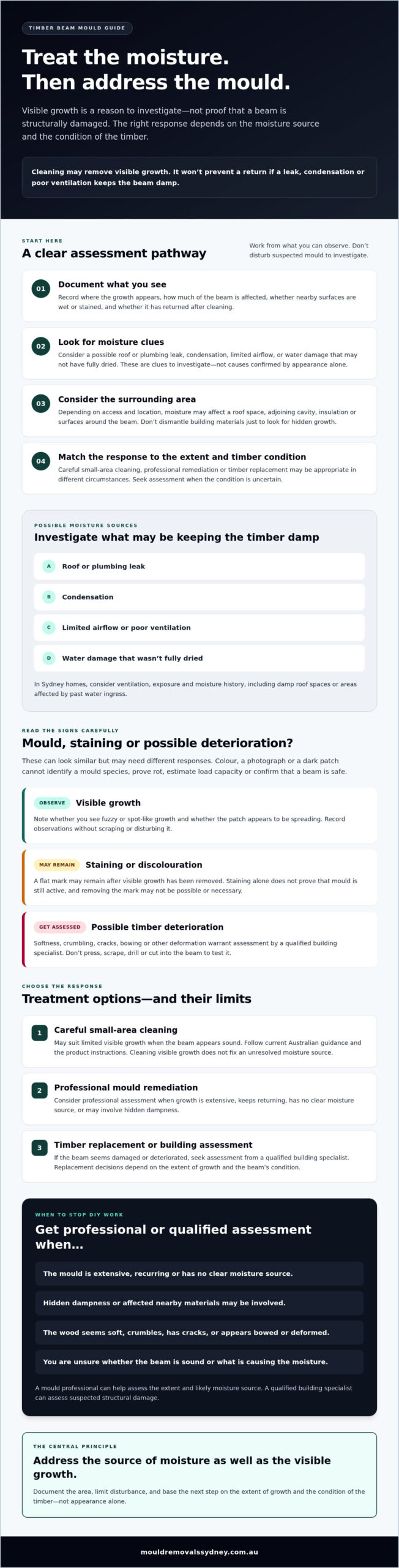
The right response depends on how much of the beam is affected, whether the growth is accessible and what an assessment reveals about the timber. A small surface patch is different from recurring mould across a roof space, and neither situation can be judged by appearance alone. Removing visible growth doesn’t automatically fix the moisture source. If dampness continues, mould may return.
| Option | May suit | Limits and moisture needs | When specialist input is prudent |
|---|---|---|---|
| Careful small-area cleaning | A small, accessible area when the timber appears sound and current Australian safety advice supports a DIY approach. | Cleaning addresses visible growth only. It won’t correct a leak, condensation or another ongoing moisture problem. Follow product instructions and avoid unverified chemicals or methods. | If the growth spreads, returns, is difficult to reach, or the beam’s condition is uncertain. |
| Professional mould remediation | Extensive or recurring growth, inaccessible areas, or cases where the extent or moisture source is unclear. | Remediation can address mould within its assessed scope, but the moisture conditions still need attention. It does not, by itself, establish the beam’s structural safety. | When the affected area is difficult to assess or disturbance could spread contamination. |
| Timber repair or replacement | Only when assessment indicates the timber is damaged and repair or replacement is appropriate. | Replacing timber without resolving the source of dampness may leave the same conditions in place. | A qualified building professional should assess suspected deterioration and advise on structural work. |
When limited surface cleaning may be considered
DIY cleaning may be reasonable only for a small, accessible area, and only when you can follow current Australian safety guidance and the chosen product’s label. Don’t dry-brush, sand or otherwise disturb suspected mould without suitable expert guidance. These actions may disperse material, and an unsuitable product or technique could affect the timber or its finish. Cleaning is not a substitute for finding and correcting ongoing dampness.
When professional remediation or timber assessment is appropriate
Seek specialist advice if mould is extensive, keeps returning, is inaccessible or has no clear moisture source. ABC Mould Cleaning Solutions offers mould inspection, remediation and air purification. An inspection can help establish the extent and likely source before a treatment is selected. Its remediation uses the Goldmorr System, but suitability for a particular timber beam should be confirmed for the circumstances. Mould remediation and structural assessment are separate. Ask a qualified building professional to assess suspected timber damage.
A safer step-by-step plan for treating mould on timber beams
A measured process helps you avoid disturbing growth before you understand its extent or the moisture behind it. Treat the beam as part of a wider area that may need attention, not as an isolated surface to clean and forget.
- Document what you see. Take photographs from a safe distance and note the affected area, visible dampness, nearby staining and whether mould has returned. Record any known leaks, condensation or previous remediation. These details can help inform an inspection.
- Limit disturbance. Don’t scrape, dry-brush, sand, cut or remove the beam to investigate. Where practical, keep occupants away from active disturbance. If someone in the household may be more vulnerable to mould exposure, check current Australian health advice or seek professional guidance rather than assuming a particular precaution is enough.
- Investigate possible moisture. Consider whether a leak, condensation, poor airflow or earlier water damage may be involved. Arrange for the appropriate trade to address any leak or building issue. Don’t assume mould treatment alone will resolve the cause.
- Assess the extent and condition. Consider whether growth is confined to an accessible surface or appears extensive, recurring or hidden in adjoining areas. If the beam seems soft, cracked or deformed, stop and seek assessment from a qualified building professional. Don’t cut or remove structural timber without suitable advice.
- Select a suitable treatment. Only consider DIY cleaning if the area is small and accessible, the timber appears sound, and the approach is consistent with current Australian guidance and product instructions. For extensive, recurring or hard-to-assess growth, seek professional mould inspection and remediation advice.
Before any cleaning begins
Check product labels for the intended surface, application directions and precautions. Don’t improvise with chemicals, combine products or assume a method is suitable for every timber type or setting. Safety advice can depend on the product, the extent of contamination and who may be exposed. Follow current Australian guidance or ask a qualified professional if you’re uncertain.
After treatment: check moisture and recurrence
Before deciding whether treatment has worked, confirm that the suspected moisture source has been repaired or managed by the appropriate trade. Cleaning may remove visible growth, but it can’t keep mould from returning if damp conditions persist.
Keep a record of the area after treatment. Watch for renewed visible growth, fresh dampness or changes in the beam’s condition. If mould returns, don’t repeatedly clean the same surface without reassessing the moisture source and extent. An inspection can help clarify what needs attention. Ask ABC Mould Cleaning Solutions about an inspection if you need help assessing mould in your Sydney-area property.
When Sydney property owners should call a mould professional
Consider professional help if mould covers an extensive area, returns after cleaning, appears to extend into hidden spaces or has no clear moisture source. Suspected timber deterioration, such as softness, crumbling or deformation, also needs attention. A mould professional can assess the visible growth and likely moisture conditions, but suspected structural damage should be referred to a qualified building professional.
What to expect from a professional mould assessment
An assessment can consider where mould is visible, how far the affected area appears to extend and what moisture sources may be contributing. The findings help inform an appropriate treatment plan. A mould inspection is not the same as a structural assessment, so ask a qualified building specialist to evaluate concerns about the beam’s condition or safety.
ABC Mould Cleaning Solutions serves Sydney and surrounding regions, offering mould inspection, mould removal, air purification and recommendations to help reduce the chance of recurrence. Its remediation uses the Goldmorr System, which the business describes as a biodegradable fogging process. This should not be taken as a guarantee or confirmation that a specific treatment is suitable for every timber beam. The moisture conditions still need attention.
Preventing mould from returning to timber
Prioritise resolving the conditions that keep the area damp. A leak may need attention from the appropriate trade, while condensation or poor airflow may call for a different response. Check nearby materials and spaces where dampness or limited ventilation persists, rather than repeatedly cleaning only the visible patch. Monitor the beam and surrounding area for renewed growth, moisture or changes in the timber.
For broader information about professional mould removal in Sydney, review the service details and confirm what is included for your situation. If the growth is extensive, recurring or difficult to assess, arranging an inspection can help clarify the next step.
Contact ABC Mould Cleaning Solutions for Sydney service to discuss a mould inspection for your property.
Take the next step towards a dry, sound timber beam
Successful treating mould on timber beams starts with understanding why the timber became damp. Cleaning visible growth without addressing that moisture can leave conditions for mould to return. Assess the extent carefully, avoid disturbing suspected growth, and treat signs of softness, cracking or deformation as reasons to seek qualified building advice.
If mould is extensive, recurring or difficult to assess, a professional inspection can help clarify the likely source and appropriate next steps. ABC Mould Cleaning Solutions offers inspection, mould removal, air purification and prevention recommendations for residential and commercial properties across Sydney and surrounding regions.
Arrange an inspection to discuss the mould affecting your property. Contact ABC Mould Cleaning Solutions for help assessing the situation and planning what to do next.
Frequently Asked Questions
Can I treat mould on a timber beam myself?
Yes, a small, accessible patch may be suitable for careful DIY cleaning if current Australian safety guidance supports it and you can address the moisture source. Follow product instructions and avoid disturbing extensive or hidden growth. When treating mould on timber beams, seek professional advice if mould returns, safe handling is uncertain, someone in the home is vulnerable, or the beam may be damaged. Don’t cut, sand or scrape suspected growth to investigate.
Does vinegar or bleach remove mould from timber beams?
Neither vinegar nor bleach should be treated as a universal solution for mould on timber. Suitability depends on the timber, its finish, the extent of growth and the moisture conditions. Surface cleaning also can’t fix an ongoing leak or dampness. Don’t rely on an improvised chemical recipe. Follow verified Australian guidance and product directions, or consult a qualified mould professional if the affected area is extensive or the right approach is unclear.
How can I tell if mould has damaged a timber beam?
You can’t establish a beam’s structural condition from mould colour or surface appearance alone. Softness, crumbling, cracking or visible deformation are warning signs. Stop disturbing the area and seek assessment from a qualified building professional. A mould inspection can help assess visible growth and likely moisture sources, but it is not the same as a structural assessment. Don’t rely on a photo or description to determine whether a beam is safe or load-bearing.
Will mould on timber beams come back after cleaning?
Yes, mould can return if the damp conditions that support growth remain. A leak, condensation or poor airflow may continue to affect the beam even after visible growth has been cleaned. Cleaning alone doesn’t confirm that the moisture source has been corrected. Address the underlying dampness, monitor the beam and nearby area, and arrange an inspection if growth reappears or you can’t identify the cause. No single cleaning method guarantees permanent prevention.
When should I call a mould removal professional for timber beams?
Seek professional advice if mould is widespread, recurring, hard to reach, linked to ongoing water damage or accompanied by possible timber deterioration. An inspection can help clarify the visible extent and likely moisture source, then inform a suitable treatment plan. If the beam is soft, cracked, crumbling or deformed, contact a qualified building professional as well. Mould remediation can address mould, but it doesn’t replace an assessment of structural condition.
Can mould remediation treat airborne mould as well as visible growth on beams?
Some mould remediation services address visible mould and airborne spores, but the scope and method depend on the assessment. ABC Mould Cleaning Solutions says its Goldmorr System uses a biodegradable fogging process to address surface mould and airborne spores. Whether it’s suitable for a particular timber beam depends on the circumstances. Fogging alone doesn’t repair a moisture source, reverse timber damage or guarantee that mould won’t return.