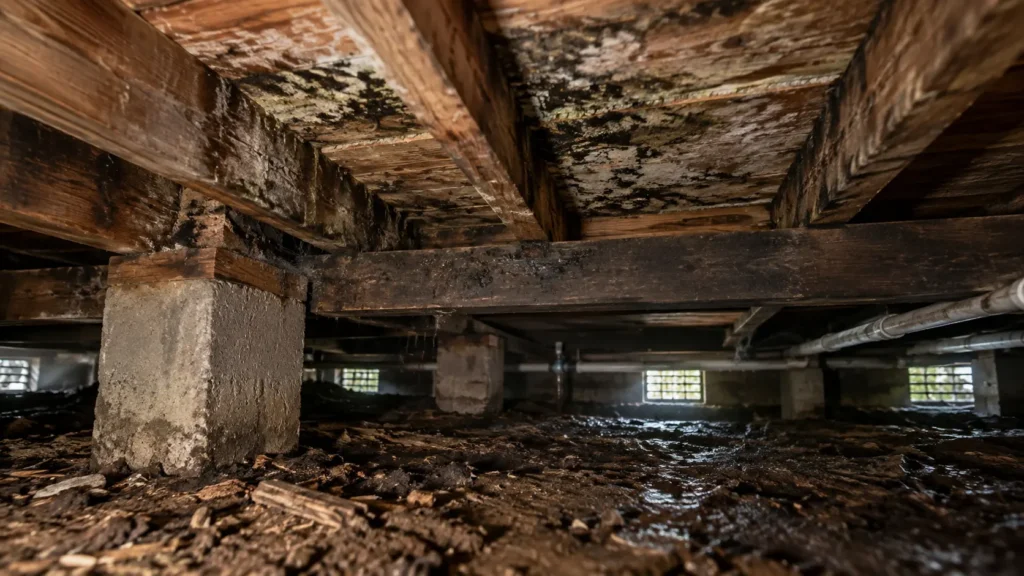
The smell hits you before you see anything. That damp, earthy odour rising through floorboards isn’t something to dismiss as part of an older property. It can be a sign of moisture and mould activity happening in a space most people rarely inspect.
Subfloor cleaning is the process of addressing mould, moisture-driven contamination, and organic debris in the enclosed cavity beneath a building’s ground floor. Across Sydney, both houses and apartment buildings can have subfloor spaces where restricted airflow and excess moisture create conditions for mould growth.
When the source is underneath the property, cleaning visible mould inside the living space alone may not address the underlying problem.
Key Takeaways
- Subfloor mould can affect both houses and apartment buildings, particularly where moisture and poor ventilation are present.
- Mould spores and damp conditions in a subfloor can affect the areas above through gaps, penetrations, and airflow pathways.
- Surface mould treatment inside a property does not necessarily resolve an underlying subfloor moisture or mould problem.
- Rising damp and inadequate subfloor ventilation can contribute to moisture problems and should be assessed according to the individual property.
- ABC Mould Cleaning Solutions uses non-mechanical fogging technology designed to treat difficult-to-access areas and contaminated air volume.
- You can send photos for an initial quote or assessment. An on-site inspection with Warren Bailey is available for $275.
Why Does Mould Keep Coming Back Even After You’ve Cleaned It?
You’ve wiped the walls. Bought the spray. Maybe you’ve had the affected area professionally treated. Then, after some time, the mould appears again.
The problem may not be the cleaning itself. The underlying moisture source may never have been addressed.
Recurring mould often means the source needs further investigation, not simply another round of surface cleaning.
A contaminated subfloor can continue contributing moisture and mould spores to the environment above. Treating visible mould without identifying what is happening underneath the property may therefore result in recurring problems.
This is why professional mould removal that targets the source can produce a different outcome from repeatedly cleaning visible growth.
Subfloor cavities can be enclosed and poorly ventilated. Moisture may enter or accumulate for several reasons, including ground moisture, drainage issues, inadequate ventilation, leaks, or rising damp. Timber and other building materials within the cavity can then provide surfaces where mould establishes itself.
The exact cause varies from property to property, which is why identifying the source matters.
What Does a Subfloor Mould Problem Actually Look Like?
Most property owners don’t regularly inspect beneath their floors, so a subfloor issue can develop without being immediately obvious.
For example, a house or ground-floor apartment in Sydney may develop recurring mould or a persistent damp smell. The visible mould is treated, but the problem returns. In situations like these, the subfloor is one of the areas that may need to be investigated.
Possible signs of a subfloor moisture or mould problem include:
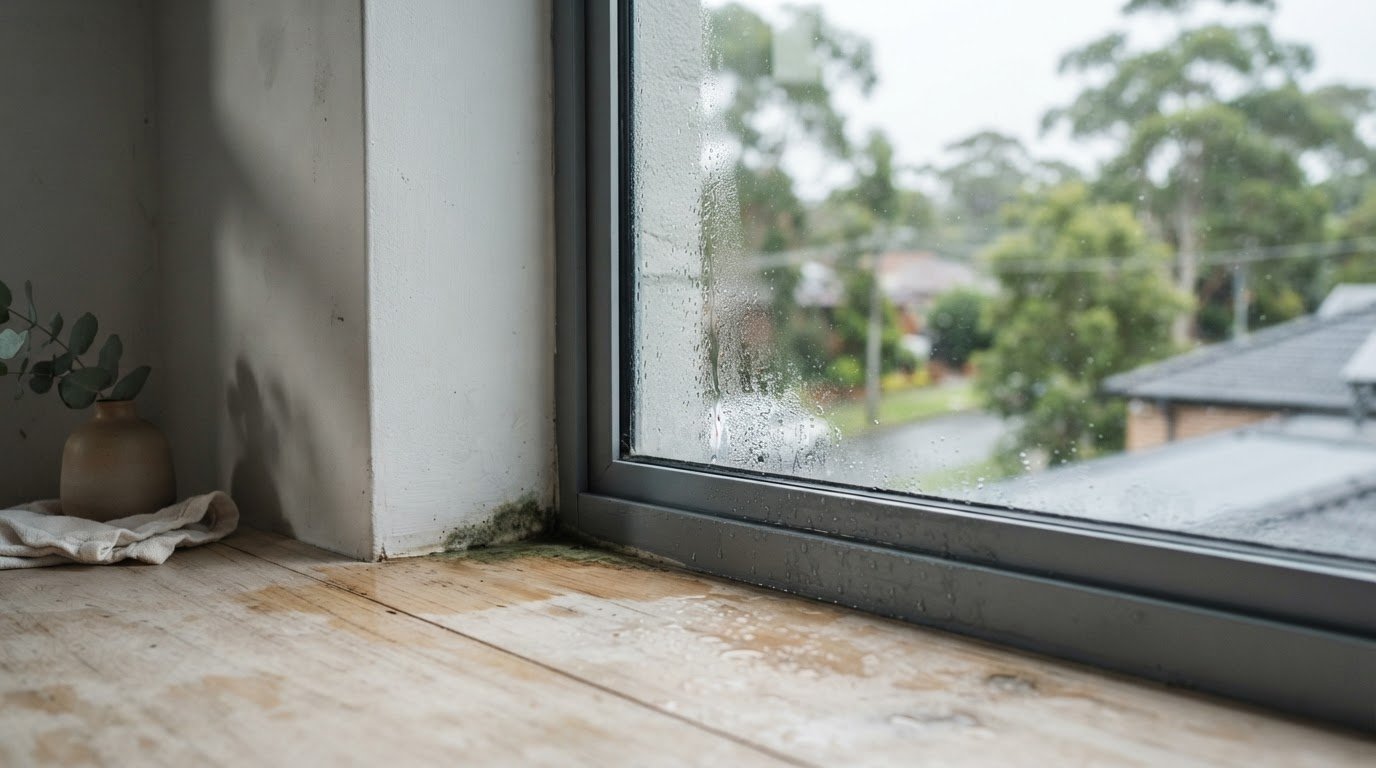
- Mould repeatedly returning in lower sections of walls or near skirting boards
- A persistent damp or musty smell after visible mould has been treated
- Dampness or moisture around the lower areas of the property
- Signs of inadequate airflow beneath the building
- Recurring mould without an obvious internal leak or condensation source
These signs don’t automatically prove that the subfloor is responsible. They indicate that the underlying source should be investigated rather than assuming the visible mould is the entire problem.
Getting a second opinion on your mould remediation approach can help determine whether further investigation is needed.
How Is Subfloor Cleaning Actually Done?
Subfloor mould cleaning and subfloor ventilation are related, but they’re not the same service.
Subfloor cleaning addresses existing contamination in the area beneath the property.
Subfloor ventilation focuses on improving airflow and helping control the moisture conditions that can contribute to future mould growth.
Depending on the property, both may need to be considered.
ABC Mould Cleaning Solutions uses a non-mechanical fogging technique based on the Goldmorr System. Fogging allows treatment to disperse throughout difficult-to-access spaces rather than relying exclusively on manually reaching and wiping every surface.
This approach can be used where physical access to parts of a subfloor is limited.
The appropriate treatment depends on the building, access, moisture source, extent of contamination, and other property-specific conditions. Houses and apartment buildings can both experience subfloor problems, so the type of property alone doesn’t determine whether treatment is required.
For properties dealing with subfloor moisture and ventilation concerns, expert subfloor ventilation solutions for Sydney’s Eastern Suburbs explains the ventilation side of the process.
Subfloor Cleaning vs. The Alternatives
| Approach | What It Addresses | What It May Miss | When Further Action May Be Needed |
|---|---|---|---|
| DIY surface cleaning | Visible mould on accessible surfaces | Inaccessible contamination and underlying moisture sources | When mould continues returning |
| Ventilation improvements only | Airflow and moisture management | Existing mould contamination | When mould is already established |
| Indoor surface mould treatment | Visible mould on walls and ceilings | A separate subfloor or structural moisture source | When the underlying source remains active |
| Professional subfloor treatment | Contamination within the subfloor environment | Structural moisture problems requiring separate remediation | When damp, drainage, ventilation, or other moisture issues are contributing |
The important point is that there isn’t one solution for every property.
If moisture is continuing to enter the building or subfloor, mould treatment alone won’t correct the building condition causing it. The moisture source also needs to be identified and addressed.
For properties where rising damp is involved, this guide to chemical damp proofing and its costs in Sydney explains one of the treatment options that may be considered after assessment.
What About Rising Damp?
Rising damp is a moisture problem that can affect a property’s walls and building materials when ground moisture moves upward through porous masonry.
It isn’t limited exclusively to one type of residential property. Houses and other buildings can experience rising damp where the construction and moisture conditions allow it to occur.
Subfloor mould is different. It refers to mould contamination developing beneath the floor, often in an environment affected by excess moisture, poor ventilation, leaks, drainage problems, or other building conditions.
The two issues can sometimes occur together, but one should not automatically be assumed to cause the other.
This is why assessment is important.
If you’re seeing mould on your walls that keeps returning, identifying where the moisture is coming from should come before deciding on the treatment.
If you’re unsure what’s causing the problem, you can send photos of the affected areas to ABC Mould Cleaning Solutions for an initial assessment and quote.
Call 0488 866 853 or email abcmouldcleaningsolutions@gmail.com with photos of the affected areas.
What About Bathroom Mould?
Bathroom mould should be assessed separately from subfloor mould because bathrooms have their own moisture and ventilation conditions.
ABC Mould Cleaning Solutions concentrates its bathroom mould treatment on ceilings and walls rather than bathroom tiles.
Mould on bathroom ceilings and walls can develop where humidity, condensation, and inadequate ventilation allow moisture to remain on surfaces.
If bathroom mould repeatedly returns after treatment, the next step is to investigate why the ceiling or walls remain damp rather than continually cleaning the visible growth.
The same principle applies throughout a property: effective mould treatment starts by understanding where the moisture is coming from.
Why Both Sydney Houses and Apartments Can Develop Subfloor Problems
Subfloor mould isn’t exclusively an apartment problem or a house problem.
Sydney’s housing stock includes older freestanding houses, terraces, duplexes, units, and apartment buildings with different construction methods and varying levels of ventilation beneath ground floors.
In a house, the homeowner may have direct responsibility for and access to the subfloor.
In an apartment or strata property, responsibility and access can be more complicated if the affected area forms part of common property.
What matters from a mould perspective is the condition of the space itself: moisture levels, ventilation, drainage, building materials, existing contamination, and access.
Properties across Sydney Metro, the Blue Mountains, Parramatta, Wollongong, and surrounding areas can experience these problems.
For strata properties, the NSW strata mould cleaning guidelines provide more information about mould treatment and property responsibilities.
The Subfloor Source Framework: When to Investigate Further
A useful way to approach recurring mould is to focus on the source rather than simply the size of the visible patch.
A subfloor assessment may be appropriate when:
- Mould keeps returning after previous treatment
- The property has an accessible or enclosed subfloor cavity
- A persistent damp or musty smell remains after visible mould has been treated
- There are signs of excess moisture beneath or around the property
- There is no obvious internal explanation for recurring mould
A subfloor treatment may not be the appropriate starting point when:
- The mould is isolated to a bathroom ceiling or wall and there is a clear bathroom ventilation or condensation issue
- The affected area has no connection to a subfloor cavity
- The mould followed a known one-time water event that has been repaired and completely dried
- Inspection identifies another clear moisture source
The important distinction is the source.
A small amount of visible mould can return repeatedly if the moisture source remains unresolved. A larger mould problem caused by a one-time water event may be successfully treated once the water source has been repaired and the area properly dried.
Where the source isn’t clear, a professional mould inspection certificate can provide documented information about the property’s condition.
When Should You Get the Subfloor Checked?
Visible mould is only one part of the picture.
If you’re a homeowner dealing with recurring mould, a property manager responding to repeated tenant complaints, or a real estate professional preparing a property with an unexplained damp smell, the subfloor may be one of the areas worth investigating.
ABC Mould Cleaning Solutions provides services across Sydney Metro, the Blue Mountains, Parramatta, and Wollongong.
The first step can be as simple as sending photos of the affected areas for review.
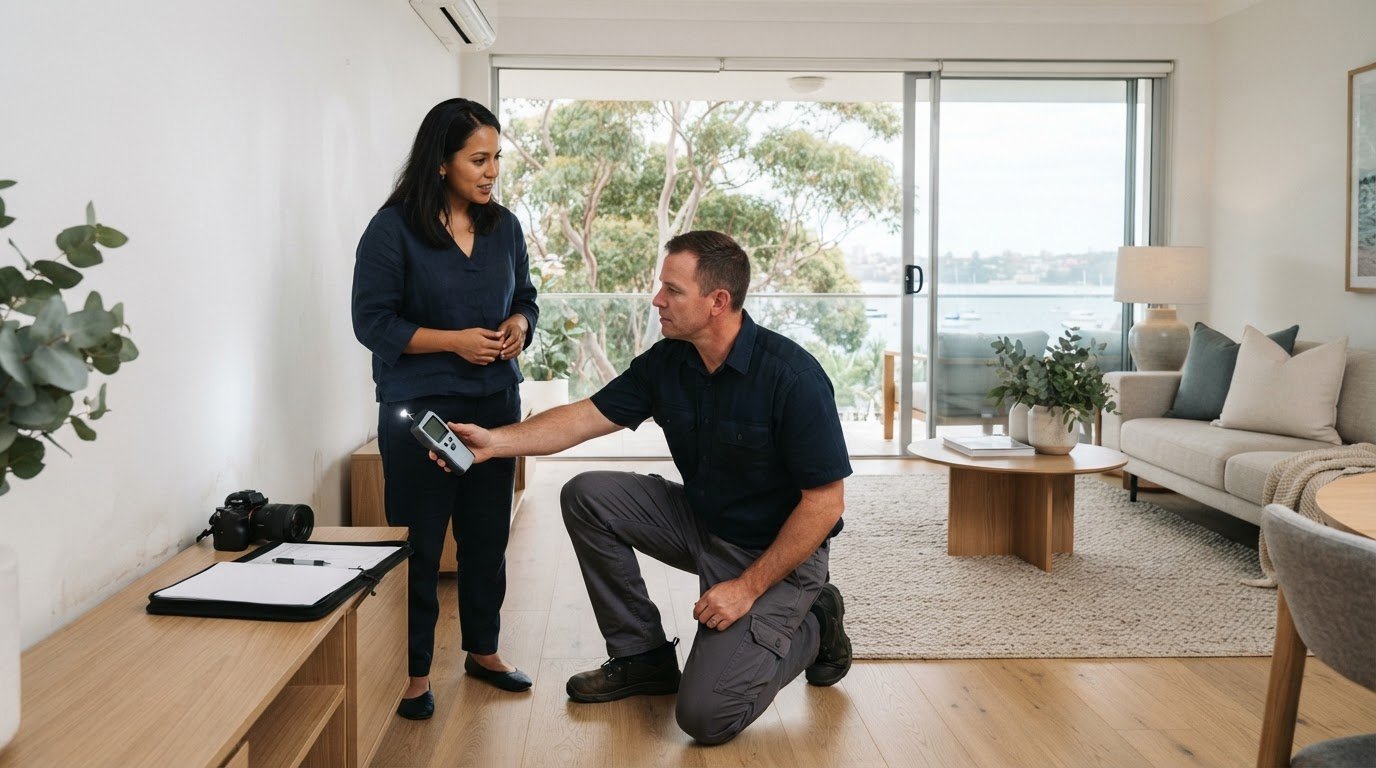
For an on-site assessment, Warren Bailey can inspect the property for $275 and provide a professional evaluation of the mould and moisture conditions present.
Call 0488 866 853 or email abcmouldcleaningsolutions@gmail.com to get started.
FAQ
How do I know if my mould problem is coming from the subfloor?
Recurring mould, persistent damp odours, visible moisture problems, and mould concentrated around lower areas of a property can indicate that the subfloor should be investigated. These signs don’t confirm the source on their own, so an assessment is the best way to determine what’s actually happening.
Can houses have subfloor mould, or is it mainly an apartment problem?
Both houses and apartment buildings can experience subfloor mould. The risk depends on factors such as building construction, moisture, drainage, ventilation, access, and the condition of the subfloor rather than simply whether the property is a house or apartment.
Does ABC Mould Cleaning Solutions treat bathroom tiles?
For bathroom mould, ABC Mould Cleaning Solutions concentrates on ceilings and walls rather than tiles. If mould continues returning on those surfaces, the underlying humidity, condensation, ventilation, or moisture issue should also be investigated.
Does fogging require me to leave my home?
Requirements can vary depending on the treatment area, property configuration, and scope of the job. Warren can explain the appropriate process and any re-entry requirements when assessing or quoting the property.
I’m in a strata building. Who’s responsible for the subfloor?
Responsibility depends on whether the affected area forms part of the individual lot or common property. For subfloor areas in strata buildings, it’s important to establish the property boundary and owners corporation responsibilities before remediation work begins.
How much does a subfloor inspection cost with ABC Mould Cleaning Solutions?
An on-site inspection with Warren Bailey is $275. You can also send photos first for an initial assessment and quote where appropriate.
Will fixing subfloor mould also fix rising damp?
Not necessarily. They are separate issues that can occur together. Subfloor mould treatment addresses mould contamination, while rising damp requires the underlying moisture movement through the building materials to be assessed and treated appropriately.
Can rising damp occur in apartments as well as houses?
Rising damp isn’t defined by whether a property is a house or apartment. Whether it can occur depends on the building’s construction, its contact with the ground, moisture conditions, and the effectiveness of its damp-proofing system.
What’s the easiest way to get a quote?
Send clear photos of the affected areas to abcmouldcleaningsolutions@gmail.com or call 0488 866 853. ABC Mould Cleaning Solutions can review the information and advise on the appropriate next step.
About the Author
Warren Bailey is the principal technician and operator at ABC Mould Cleaning Solutions, serving Sydney Metro, the Blue Mountains, Parramatta, and Wollongong. He is an approved master technician for the Goldmorr System. ABC Mould Cleaning Solutions provides mould removal, rising damp treatment, subfloor cleaning, and non-mechanical air treatment services for residential and commercial properties across New South Wales.